

The BMI (Body Mass Index) Calculator works out your body mass index from your weight and height, tells you which weight category it falls in (WHO and NICE cut-offs for adults, CDC percentiles for ages 2 to 19) and shows the weight range that would put you in the healthy band for your height. BMI is a screening number, not a body fat measurement.
Example: 165 lb man, 5 ft 9 in, age 40
24.4kg/m²
A BMI of 24.4 is in the healthy weight range for adults, 18.5 to 24.9.
BMI compares weight with height. It does not measure body fat: muscular people can score high, and the same BMI can mean more or less fat with age, sex and ethnic background. Enter your own details above to replace this example.
Healthy weight for your height
125 to 168.9 lb
BMI 18.5 to 24.9 at 5 ft 9 in
Your weight and the range
In the range
Inside the healthy range for this height.
BMI Prime
0.98
Your BMI divided by 25, where overweight starts on the standard cut-offs.
Green: healthy weight, BMI 18.5 to 24.9. Red bands: underweight below it, then overweight and obesity classes 1 to 3, darker as BMI rises.
| BMI category for adults | BMI |
|---|---|
| Underweight | under 18.5 |
| Healthy weight (you) | 18.5 to 24.9 |
| Overweight | 25 to 29.9 |
| Obesity class 1 | 30 to 34.9 |
| Obesity class 2 | 35 to 39.9 |
| Obesity class 3 | 40 or more |
| Check what BMI cannot see |
|---|
| Waist-to-height ratio calculatorShows fat around the middle, which BMI misses. NICE advises measuring it alongside BMI when BMI is under 35. |
| Body fat calculatorEstimates how much of your weight is fat, which BMI cannot tell apart from muscle. |
BMI = 74.84 kg / (1.753 m)^2 = 24.4; BMI Prime = 24.4 / 25 = 0.98. Sources: WHO 2000 (Technical Report Series 894), NICE guideline NG246, CDC adult BMI categories; BMI Prime: Gadzik 2006.
What is Body Mass Index (BMI)?
Body mass index is weight in kilograms divided by the square of height in meters. It’s one way to determine whether or not someone is at a healthy weight.
BMI is not an accurate measure of body fat percentage. It is a screening measure, and it cannot tell fat from muscle.
BMI categories
- Underweight = under 18.5
- Healthy weight = 18.5 to 24.9
- Overweight = 25 to 29.9
- Obesity class 1 = 30 to 34.9
- Obesity class 2 = 35 to 39.9
- Obesity class 3 = 40 or more
These are the adult categories the calculator uses. For adults with a South Asian, Chinese, other Asian, Middle Eastern, Black African or African-Caribbean family background, NICE uses lower cut-offs: overweight from 23 and obesity from 27.5 (6).
So, for example, according to the basic BMI calculation, someone who is 5’2″ and weighs 160 lbs is considered to be overweight. They have a high BMI score between 25 and 29.9.
On the other end, someone who stands at 6’2″ and weighs 140 lbs would be considered underweight, with a BMI of 18.0.
LBM Calculator – Find Your Lean Body Mass Calculator
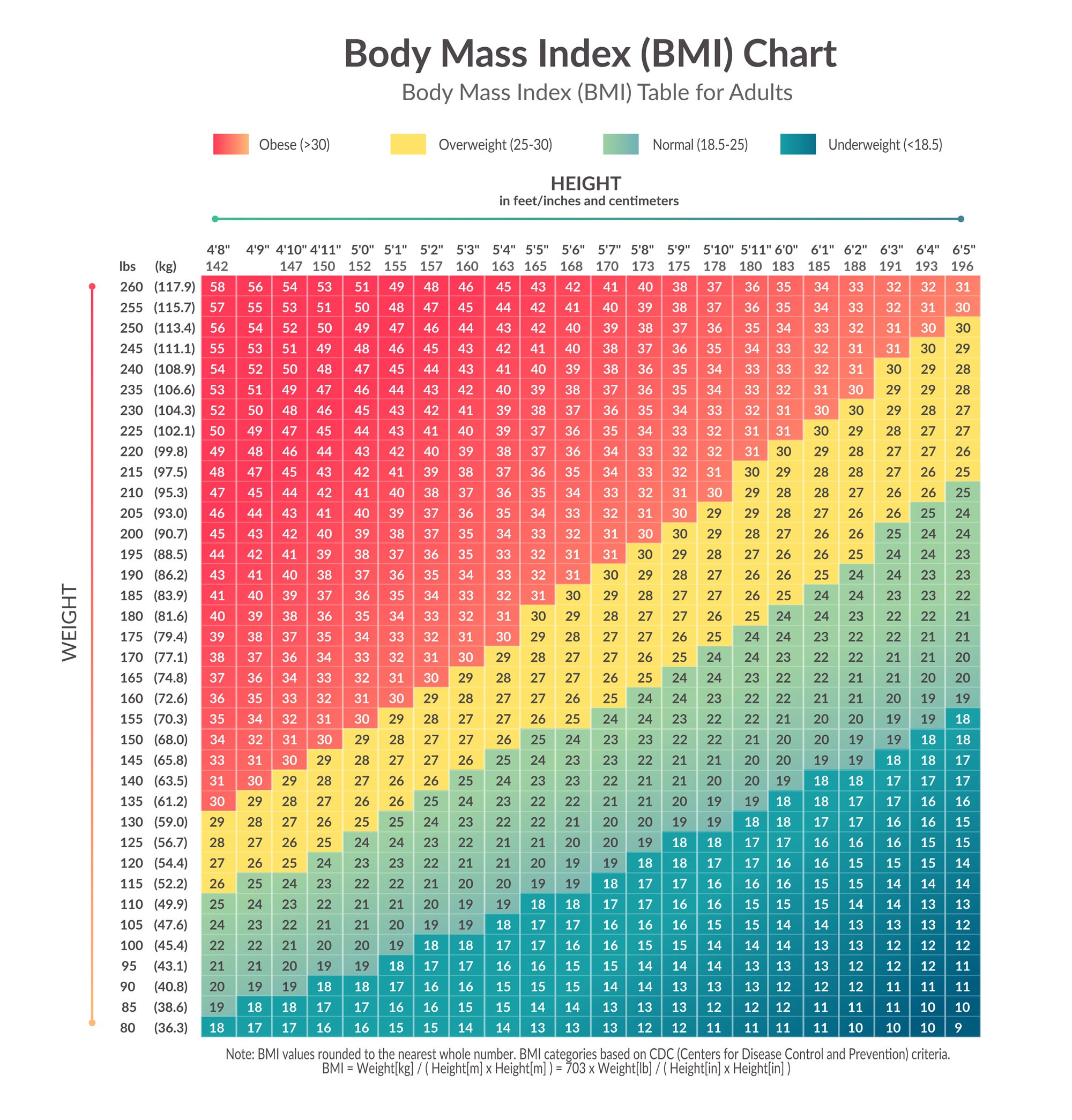
BMI Chart for Adults
Following is an example of a BMI chart.
How To Use The BMI Calculator
The Body Mass Index calculator is incredibly easy and simple to use.
- Type your weight and pick lb or kg.
- Type your height in feet and inches, or in centimeters if you picked kg.
- Enter your age in years. Under 20, add the months too, because the CDC charts for children and teens change month by month.
- Choose Male or Female. The CDC has separate charts for boys and girls aged 2 to 19.
- Pick your family background if it is listed. For adults from those backgrounds, NICE uses the lower cut-offs above.
- Press Work out my BMI.
Related: Use our reverse BMI calculator to estimate the weight you need to be at to achieve a specific BMI score.
How Accurate Is The BMI Calculation?
Using BMI as a measure of whether or not someone is at a healthy weight may be a good option for many people.
However, it does not take into account variables such as body composition, body type (e.g, smaller or larger frame and bone mass), ethnicity, genetics, or how much muscle mass someone has.
For example, let’s say two people are considered overweight based on the basic BMI formula. But one has more muscle, bigger bones, and a healthy body fat percentage, while the other has a very high body fat percentage.
Do you see how BMI is not necessarily always a good indicator of healthy body weight?
For adults, BMI uses only weight and height. Family background changes only the category cut-offs. There are many different body types and variables that determine a healthy or unhealthy weight.
However, BMI calculators that recommend a weight range can be a useful tool for most people.
Try these body composition exercises to build some muscle, lose fat, and achieve a healthier weight.
Our BMI Calculator
While the BMI calculator, in its most basic form, does not provide you with a recommended or ideal body weight, but rather a BMI score, our BMI calculator does. In fact, it recommends a healthy weight range.
So, for example, if you are 40 years old, 5’9″ tall, and weigh 165 lbs, your recommended healthy weight range would be 125 to 168.9 lbs.
Your BMI would be 24.4 and your healthy BMI range would be 18.5 to 24.9. This is the example the calculator shows before you enter your own details.
Children and Teens
The BMI calculator also works out body mass index for children and teens from age 2, as well as for adults.
During childhood and early adolescence, a lot of physical growth takes place and there are more factors to consider when estimating BMI.
For example, puberty often causes kids to gain weight rather quickly as they grow and develop.
Because of this, the BMI calculator uses BMI-for-age percentile based on the CDC (Centers for Disease Control and Prevention) growth charts for children and teens aged 2 to 19. From age 20, it uses the adult categories.
BMI-for-age percentile compares children’s or teens’ weight to others of the same age and sex.
To give you an example, a 14-year old female who is 5’5″ tall and weighs 117 pounds would be considered a healthy weight. With a BMI of 19.5 she’d sit at the 51.5th percentile, inside the healthy range of the 5th to under the 85th percentile.
Underweight for her age and sex would be less than the fifth percentile whereas overweight is considered 85th to less than the 95th percentile and obese is equal to or greater than the 95th percentile (1).
Related: TDEE (total daily energy expenditure) Calculator
BMI and the Ponderal Index

BMI divides weight by height squared. The ponderal index divides it by height cubed, which some researchers prefer for very tall or very short adults. This calculator does not work it out. Use our ponderal index calculator for that score.
How To Achieve a Healthy Body Weight
While resistance training and exercise are incredibly beneficial for both physical and mental health, just being more active should be a priority for everyone.
That means making time to go for a brisk walk, doing something that gets your heart rate up, and not being too sedentary.
Use our heart rate calculator to find your target heart rate zone during physical activity.
According to the CDC, obesity prevalence increased by more than 10% from 1999-2000 through 2017 and 2018. During the same period, the prevalence of severe obesity more than doubled from 4.7% to 9.2%. That is significant and very alarming (2).
The side effects of obesity and severe obesity include heart disease, stroke, and various cancers which are all causes of premature death.
Due to our technology-heavy, junk food-obsessed lifestyles, it’s easier than ever to gain fat weight on a weekly basis.

Change your habits
If you find yourself sitting around too much and giving in to your cravings a little too often, that’s a sign that something needs to change. While it may not necessarily affect you in the immediate short term, bad habits are detrimental in the long term.
Use this weight loss calculator to find your ideal calorie intake to shed pounds and reach a healthier body weight.
Start slow and do a little each day until you build up to several hours of activity per week and include some weight-bearing or resistance training exercises. This is important to keep your bones and muscles strong and prevent injuries especially as you age.
The best way to get up and doing things is to do something that you enjoy but that always requires total-body movement. Whether that’s walking in a nice park, martial arts, shooting hoops, swimming, or playing an activity-based game with your family, these are all good choices.
Try these fun workout games.
Get your eating right
Having a healthy daily nutrition regime is just as important (yes, we know, easier said than done) for weight management and health.
For those who need to watch their weight, that means keeping an eye on your calorie intake and watching the scale to ensure you’re staying within a healthy weight range and not gaining weight, especially on a monthly basis.
It’s best to choose healthy foods that are not insanely calorically dense like the options you’ll grab at a drive-thru window or order at your favorite restaurant.
Also read: The Greatest Healthy Grocery List For Improving Your Health
On the other end, underweight individuals should eat more of those healthy foods throughout the day. It really helps to eat more frequently as this stimulates your hunger hormones and it’s a good habit to make time to fuel your body with the nutrients it needs to function healthily and optimally.
Set a clock to go off every 2.5 to 3 hours if you have to, to remind yourself that it’s time to put something in your belly.
Another very effective habit to make a part of your weekly routine is to prepare your meals so that you’re not tempted to skip out on eating. Having healthy snacks at the ready is also a good strategy.
Use this weight gain calculator to determine how many calories you should be eating to gain weight at a healthy pace.
Sometimes our busy lifestyles cause us to ignore meal times and while consuming fewer calories, going long hours without eating/ fasting has its benefits, people who are underweight should focus on getting to a healthy weight.
We also recommend resistance training for underweight folks as your body will use those calories to build muscle mass, a healthier and better option than gaining lots of body fat. This will also improve your body composition in the process.
Take our Body Type Quiz to determine if you’re an ectomorph, mesomorph, endomorph, or a combination.
Ectomorph Workout: The Skinny Guy’s Training Guide
It’s very important to understand that it will take some effort, being in control, and making good decisions to ensure you achieve and maintain a healthy body weight.
Find Your BMI
The BMI calculator isn’t always the most accurate method of determining healthy body weight as things like age, body composition, bone mass, and how much muscle you have are factors that vary between people.
But it is a quick screening measure, and muscular people can score high without carrying much fat. Check your waist-to-height ratio or body fat as well.
Use this tool as a general guideline for maintaining a healthy weight range.
Calculation Reference Links:
1. CDC (2021-06-07). “BMI Calculator for Child and Teen”. Centers for Disease Control and Prevention.
2. “BMI Calculator Child and Teen | Healthy Weight | CDC”. www.cdc.gov.
3. “Body Mass Index (BMI) (for Parents) – Nemours Kidshealth”. kidshealth.org.
4. 2 to 20 years: Boys Body mass index-for-age percentiles. www.cdc.gov.
5. 2 to 20 years: Girls Body mass index-for-age percentiles. www.cdc.gov.
6. NICE (2025). “Overweight and obesity management” (NG246), recommendations 1.9.10 and 1.9.11. www.nice.org.uk.