


Your fitness age is the age at which a healthy person has the same aerobic fitness, or VO2max, as you. The Fitness Age Calculator estimates your VO2max from your waist, resting heart rate, age and exercise habits. A fitness age below your real age means you are fitter than average for your age.
Example: Male, 40 years, waist 36 in, resting heart rate 62 bpm
48years: your fitness age
A healthy man of about 48 in Norway's HUNT study has the VO2max the model estimates for you, 45.9 ml/kg/min.
Your fitness age is the age at which a healthy person in the HUNT study has the VO2max the model estimates for you. VO2max is your body's top rate of oxygen use. In the HUNT study, each 3.5 ml/kg/min more of estimated VO2max went with 21% fewer deaths from heart disease over 24 years in adults under 60 (Nes et al. 2014). Enter your own numbers above to replace this example.
Estimated VO2max
45.9 ml/kg/min
From your waist, resting heart rate, age and exercise.
Average for your age
48.2 ml/kg/min
Healthy men your age in the HUNT study. The table shows averages by decade.
Likely range
30 to 62
Two in three people with these entries have a true fitness age in this span.
Ages run from 75 on the left to 25 on the right. Each tick is the average VO2max of healthy men at that age; your marker sits at your fitness age.
| Age group | Average VO2max, healthy men |
|---|---|
| 20 to 29 | 54.4 ml/kg/min |
| 30 to 39 | 49.1 ml/kg/min |
| 40 to 49 | 47.2 ml/kg/min |
| 50 to 59 | 42.6 ml/kg/min |
| 60 to 69 | 39.2 ml/kg/min |
| 70 and over | 35.3 ml/kg/min |
- Next stepVO2 max calculatorMeasure your VO2max with a running or step test for a firmer number.
- Next stepTarget heart rate calculatorHeart rate zones to train the fitness this age measures.
- Next stepMetabolic age calculatorA different question: your resting metabolism against your age.
Formula: VO2max = 100.27 - 0.296 x age - 0.369 x waist cm - 0.155 x resting HR + 0.226 x activity index (Nes 2011, men); fitness age = the HUNT3 age with that average VO2max. The HUNT model explains 61% of the differences in VO2max between men and 56% between women, so treat the age as an estimate. The reference averages come from healthy Norwegian adults aged 20 to 90 (HUNT3).
Sources: Nes et al. 2011 (Med Sci Sports Exerc); Nauman et al. 2012 (PLoS One); Loe et al. 2013 (PLoS One); Nes et al. 2014 (Med Sci Sports Exerc)
Understanding the Fitness Age Calculator
This calculator estimates your VO2max, the most oxygen your body can use, from your waist, resting heart rate, age and how much you exercise. It then finds the age at which a healthy person in Norway’s HUNT study has that VO2max. That age is your fitness age.
What is Fitness Age?
Fitness age compares your fitness with the typical fitness of healthy people at each age. A fitness age below your real age means your estimated VO2max is higher than average for your age; above it means lower.
Research indicates that a significantly older Fitness Age may correlate with increased early mortality risk. For example, a study of Senior Olympians found their average chronological age was 68, while their Fitness Age averaged 43 – demonstrating how an active lifestyle can yield a 25-year biological advantage.
A lower Fitness Age correlates with improved cardiovascular health and longevity.
How the Calculator Works
The VO2max estimate comes from scientists at the Norwegian University of Science and Technology, who built it from treadmill tests of more than 4,000 healthy adults in the HUNT study. It uses your waist, resting heart rate, age, and how often, how hard and how long you exercise. Height, weight, smoking and diet are not part of it.
Key Metrics Used by the Calculator
Sex, Age, Waist, Resting Heart Rate, Exercise
Each metric contributes uniquely to fitness age calculation:
- Sex: Men and women have separate equations
- Age: VO2max falls with age, so age is part of the estimate and the yardstick
- Waist: Measured at your navel; a larger waist lowers the estimate
- Resting Heart Rate (RHR): A lower resting heart rate usually goes with higher fitness
- Exercise: How often, how hard and how long, combined into the HUNT activity index
VO2 Max Estimation
VO2 Max estimation is crucial for Fitness Age calculation. It measures maximum oxygen utilization during intense exercise, reflecting cardiovascular health and aerobic endurance. Higher VO2 Max correlates with improved cardiorespiratory fitness and reduced chronic disease risk, including heart disease and dementia.
Aerobic fitness predicts longevity more accurately than other health markers.
Physical Activity Level
Physical activity significantly influences fitness age. Regular exercise enhances cardiovascular and respiratory function, increasing VO2 Max and overall fitness. Activities like running, swimming, and cycling improve oxygen utilization and mitigate health risks associated with sedentary lifestyles.
Waistline Measurements
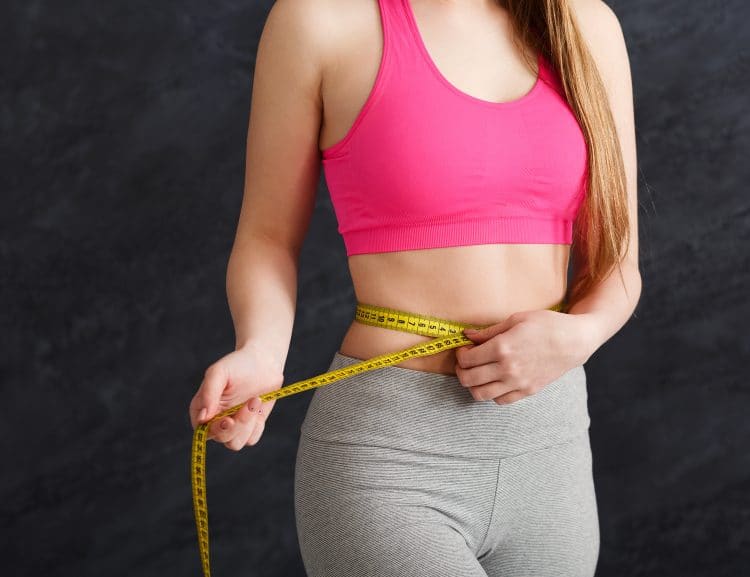
Waistline measurements provide critical health risk insights. Measure at navel level for accuracy. Larger waist circumference may indicate increased risk for conditions like non-alcoholic fatty liver disease and cardiovascular issues, negatively impacting fitness age.
Scientific Formulas Used in the Calculator
The calculator uses the HUNT non-exercise equations (Nes et al. 2011), with waist in centimeters:
- Men: VO2max = 100.27 – (0.296 x age) – (0.369 x waist) – (0.155 x resting heart rate) + (0.226 x activity index)
- Women: VO2max = 74.74 – (0.247 x age) – (0.259 x waist) – (0.114 x resting heart rate) + (0.198 x activity index)
The activity index multiplies three answers: how often you exercise (once a week 1, 2 or 3 times 2.5, almost every day 5, less than weekly 0), how hard (easy 1, out of breath and sweating 2, near exhaustion 3) and how long (under 15 minutes 0.1, 15 to 29 minutes 0.38, 30 to 60 minutes 0.75, over an hour 1).
Average VO2max of Healthy Adults by Age
Measured on a treadmill in 3,816 healthy Norwegians (HUNT3, Loe et al. 2013), in ml/kg/min. The calculator compares your estimate with these averages:
| Age Group | Men (VO2max) | Women (VO2max) |
|---|---|---|
| 20 to 29 | 54.4 | 43.0 |
| 30 to 39 | 49.1 | 40.0 |
| 40 to 49 | 47.2 | 38.4 |
| 50 to 59 | 42.6 | 34.4 |
| 60 to 69 | 39.2 | 31.1 |
| 70 and over | 35.3 | 28.3 |
Fitness Age Formula
Your fitness age is the age at which the average healthy person of your sex in the table above has your estimated VO2max. Between the table’s ages the calculator reads along a straight line. Above the 20 to 29 average it shows 25 or younger, and below the 70 and over average, 75 or older.
The estimate is rough. The equations explain about 60% of the differences in VO2max between people, so the calculator also shows a likely range, often more than a decade wide.
Benefits of Knowing Your Fitness Age
Understanding your fitness age provides valuable insights into bodily function and potential health risks. It identifies areas for improvement, motivates healthier habits, and enables progress monitoring, thereby reducing chronic disease risk.
Health Risk Assessment
Knowing your fitness age facilitates early health risk detection. High fitness levels can reduce premature death and heart disease risk by 40-50%, lower sudden cardiac event likelihood, and decrease cancer incidence. Fit individuals have up to 15% lower prostate cancer risk and reduced dementia-related mortality.
Personal Fitness Tracking
The calculator gives you a baseline to track. A lower resting heart rate, a smaller waist or more exercise all lower your fitness age, so retake it after a few months of training. Each result is rough, and the calculator shows its likely range, so watch the change over time more than any single number.
Conclusion
The Fitness Age Calculator serves as an effective tool for comprehensive fitness assessment. From your waist, resting heart rate, age and exercise, it estimates your VO2max and turns it into a fitness age. Treat it as an estimate: a lab or field test measures VO2max more closely. Regular utilization of this tool facilitates progress tracking and motivates sustained healthy lifestyle choices.
References
Fitness Volt is committed to providing our readers with science-based information. We use only credible and peer-reviewed sources to support the information we share in our articles.
- Karvonen, M., Kentala, E., & Mustala, O. (1957). The effects of training on heart rate; a longitudinal study. Annals of Medicine and Experimental Biology.
- Astrand, P.O., & Rhyming, I. (1954). A nomogram for calculation of aerobic capacity (physical fitness) from pulse rate during sub-maximal work. Journal of Applied Physiology.
- Cooper, K. H. (1968). A means of assessing maximal oxygen intake: Correlation between field and treadmill testing. Journal of the American Medical Association.
- American College of Sports Medicine. (2018). ACSM’s guidelines for exercise testing and prescription (10th ed.). Wolters Kluwer.
- Nes, B. M., Janszky, I., Vatten, L. J., Nilsen, T. I. L., Aspenes, S. T., & Wisløff, U. (2011). Estimating V̇O2peak from a nonexercise prediction model: The HUNT Study, Norway. Medicine and Science in Sports and Exercise, 43(11), 2024-2030.
- Loe, H., Rognmo, Ø., Saltin, B., & Wisløff, U. (2013). Aerobic capacity reference data in 3816 healthy men and women 20-90 years. PLoS One, 8(5), e64319.
- Nauman, J., Aspenes, S. T., Nilsen, T. I. L., Vatten, L. J., & Wisløff, U. (2012). A prospective population study of resting heart rate and peak oxygen uptake (the HUNT Study, Norway). PLoS One, 7(9), e45021.
- Nes, B. M., Vatten, L. J., Nauman, J., Janszky, I., & Wisloff, U. (2014). A simple nonexercise model of cardiorespiratory fitness predicts long-term mortality. Medicine and Science in Sports and Exercise.
- Aspenes, S. T., Nilsen, T. I. L., Skaug, E. A., Bertheussen, G. F., Ellingsen, Ø., & Vatten, L. J. (2011). Peak oxygen uptake and cardiovascular risk factors in 4631 healthy women and men. Medicine and Science in Sports and Exercise.
- Blair, S. N., Kohl, H. W., Paffenbarger, R. S., Clark, D. G., Cooper, K. H., & Gibbons, L. W. (1989). Physical fitness and all-cause mortality: A prospective study of healthy men and women. JAMA.
- Biddle, S. J., & Asare, M. (2011). Physical activity and mental health in children and adolescents: A review of reviews. British Journal of Sports Medicine.
- U.S. Department of Health and Human Services. (2018). Physical Activity Guidelines for Americans (2nd ed.).






Hey Andy,
Great site here. Very informative. Thanks for sharing