
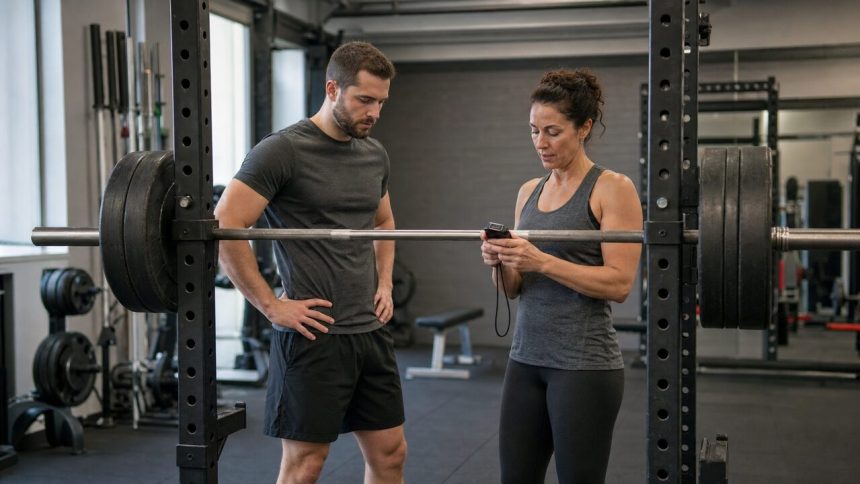
Neither slow nor fast reps are automatically better for muscle growth. Most controlled research finds similar hypertrophy across a broad range of repetition durations, roughly 0.5 to 8 seconds per rep, when the rest of the program is comparable. Intentionally taking longer than 10 seconds for every rep may be less effective because the load and number of productive reps usually fall.
Your goal should decide the tempo. For hypertrophy, lower the weight under control and lift it with strong intent. For maximal strength, heavy loads and an intent to move the concentric phase quickly matter more than counting a perfect cadence. For power, acceleration is the point, so slow grinding reps are a poor match. Beginners can use a deliberate tempo to learn positions, but tempo should support sound technique rather than replace progressive overload.
This guide explains what tempo notation means, what the research actually compares, and how to choose a cadence for muscle, strength, power, and technique.
What Rep Tempo Means
A repetition has more than one phase. The eccentric phase is when the working muscles lengthen under load, such as lowering a squat or bringing a dumbbell down during a curl. The concentric phase is when those muscles shorten to produce force. Exercises may also include a pause at either end.
Coaches often write tempo as four numbers. In the common eccentric-pause-concentric-pause format, 3-1-1-0 means:
- Lower for 3 seconds.
- Pause for 1 second in the stretched or bottom position.
- Lift in about 1 second.
- Begin the next rep without a pause at the top.
Notation is not perfectly standardized. Some coaches list the concentric phase first for exercises that begin by lifting the weight, such as a deadlift. Always state the order instead of assuming every four-digit prescription means the same thing.
Rep Duration, Bar Speed, and Intent Are Not the Same
These terms are often blended together, which creates bad advice.
- Rep duration is the total time needed to complete all phases.
- Movement velocity describes how fast the weight travels over a distance.
- Intent describes how hard you are trying to accelerate the load.
A heavy bar may move slowly even when the lifter pushes as hard and fast as possible. That is different from deliberately slowing a light load. For strength and power, the intent to accelerate can be important even when the visible speed is low.
| Training goal | Useful tempo emphasis | Main priority |
|---|---|---|
| Muscle growth | Controlled eccentric, purposeful concentric | Progressive hard sets through a useful range of motion |
| Maximal strength | Stable descent, maximal concentric intent | Heavy practice with the target movement |
| Power | Fast, technically sound reps | Acceleration and stopping before speed collapses |
| Technique | Slower phases or pauses at problem positions | Consistent positions and feedback |
| Rehabilitation | Clinician-selected cadence | Diagnosis, tissue tolerance, and gradual loading |
Do Slow Reps Build More Muscle?
Not by default. A 2015 systematic review and meta-analysis found similar muscle growth across a wide range of repetition durations from about 0.5 to 8 seconds. The authors noted that deliberately very slow reps lasting longer than 10 seconds appeared less favorable, although the available trials were limited.
A newer 2025 meta-analysis reached a similar overall conclusion: fast and slower repetition conditions produced little difference in hypertrophy across the included studies. The research base is still small, the interventions are short, and the definitions of “fast” and “slow” vary. Those limits make a universal one-second or four-second rule hard to defend.
Why does very slow training sometimes disappoint? Slowing both phases forces you to use less weight or perform fewer reps. A set may feel brutal because the muscles burn, yet the total mechanical stimulus can be no better. Discomfort is not a direct measurement of growth.
The useful middle ground is a rep you can control without turning the set into slow motion. For many conventional exercises, that means lowering in roughly 1 to 3 seconds and lifting with purposeful intent. This is a practical default, not a special hypertrophy formula.

Time Under Tension Is Useful, but Easy to Misuse
Time under tension describes how long a muscle is loaded during a set. It can help explain why two sets with the same number of reps feel different. It does not tell you the load, range of motion, effort, exercise, or whether the target muscle produced most of the force.
Consider two sets of 10 curls. One uses a challenging dumbbell with controlled two-second reps. The other uses half the weight and takes eight seconds per rep. The second set has more time under tension, but it does not automatically provide more high-quality tension. Counting seconds while ignoring load progression and proximity to failure turns a descriptive measure into a false target.
For hypertrophy, track the variables that make progress visible: exercise, load, reps, sets, range of motion, and effort. Add tempo when it solves a real problem, such as bouncing out of the bottom or losing control during the lowering phase. Our rep range calculator can help connect your current strength to practical loading zones.
Controlled Eccentrics Are Not the Same as Slow Reps
A controlled eccentric prevents gravity from taking over. It gives you time to maintain position and keep the intended muscles loaded. That does not mean every eccentric must take four or five seconds.
Research comparing different eccentric durations is mixed. Some individual muscles or exercises may respond differently, but the evidence does not support one slow eccentric prescription for every lift. A one- to three-second lowering phase works well for most general training because it is long enough to stay organized and short enough to preserve load and session efficiency.
Longer eccentrics and pauses are useful tools when you need them. They can expose a weak position, reduce momentum, make a light load challenging, or provide clear technique feedback. Use them for a block of training and evaluate the result instead of assuming more seconds always means more growth.
Fast Reps for Strength
Strength is specific to force production and the skill of the lift. A 2017 meta-analysis found that faster or explosive movement training generally produced greater gains in dynamic strength than slower training under the included conditions. The size and direction of the effect varied with load, exercise, and training status, so this does not make fast reps universally superior.
“Explosive” does not mean reckless. Lower the weight into a repeatable position, then try to drive the concentric phase hard while keeping the exercise technically sound. A near-maximal squat may still rise slowly because the load is heavy. The intent is fast even when the bar is not.
If you do not know your current max, use the one-rep max calculator to estimate it from a recent submaximal set. That is usually more useful than testing a true maximum simply to choose training loads.
Fast Reps for Power
Power training aims to produce force quickly. That requires lighter or moderate loads, strong acceleration, sufficient rest, and sets that end before speed falls sharply. Slow concentric reps conflict with the goal.
The 2026 American College of Sports Medicine position stand emphasizes training specificity and progressive resistance rather than a universal tempo. Power-oriented work uses fast concentric actions with loads and exercises selected for the athlete. Olympic-lift derivatives, medicine-ball throws, and jumps require technical competence and enough space to perform safely.
Do not turn a normal bodybuilding set into “power” by jerking the weight. If an exercise is not suited to ballistic intent, use a controlled setup and accelerate only as far as technique allows.
When Slow Tempo Is the Better Tool
Learning a new movement
A deliberate descent gives a beginner more time to feel balance, joint position, and range of motion. The load must remain light enough that the lifter can actually make corrections. Once the pattern is stable, tempo can become more natural.
Removing momentum
Slowing a curl, lateral raise, or row can reveal when the hips and torso are doing work that the target muscles should handle. This is a technique constraint, not proof that slow reps are inherently anabolic.
Building control at a sticking point
Pauses and slower eccentrics can make a difficult position harder without adding weight. A tempo bench press, for example, can teach a stable descent and remove the bounce from the bottom. That exercise-specific page covers its setup and variations.
Training with limited equipment
When heavier weights are unavailable, slowing the eccentric or adding a pause can make a light load more demanding. This can keep a home workout productive, although progression may eventually require more resistance, reps, or range of motion.
Practical Tempo Prescriptions
Use these as starting points, not laws. The notation below follows eccentric-pause-concentric-pause order.
| Exercise | General hypertrophy | Technique emphasis | Strength emphasis |
|---|---|---|---|
| Squat | 2-0-X-0 | 3-1-1-0 | Controlled descent, X up |
| Bench press | 2-0-X-0 | 3-1-1-0 | Controlled descent, brief competition-style pause if relevant, X up |
| Row | 2-1-1-0 | 3-1-1-1 | Controlled return, strong pull |
| Curl | 2-0-1-0 | 3-0-1-1 | Usually not a maximal-strength priority |
| Deadlift | Controlled reset each rep | Light 3-second eccentric when appropriate | X up, controlled return or reset |
The letter X means “lift with maximal safe intent,” not that the bar must visibly fly. Stop a set when the planned tempo or range of motion breaks down. If a program specifies an RPE or reps in reserve, those effort targets still matter. Tempo does not override them.
A Simple Four-Week Tempo Experiment
If you want to know whether tempo improves your training, change one variable at a time:
- Choose one exercise that you rush or bounce.
- Keep the exercise, weekly sets, and target rep range unchanged.
- Use a two- to three-second eccentric for four weeks.
- Record load, reps, effort, and whether the prescribed cadence stayed intact.
- Keep the tempo only if control or target-muscle loading improves without stalling progression.
This turns tempo into a testable programming tool. It also keeps you from changing every lift at once and mistaking novelty for progress.
Common Rep-Tempo Mistakes
- Chasing the burn: a longer, more painful set is not automatically more productive.
- Making every phase slow: slow eccentrics and slow concentrics have different effects.
- Letting fast mean sloppy: acceleration should not erase range of motion or position.
- Counting seconds but not progressing: load, reps, sets, and effort still drive the program.
- Using one cadence for every goal: hypertrophy, strength, power, and rehabilitation are different jobs.
The Bottom Line
For muscle growth, a wide range of repetition durations can work. Use controlled reps that let you train hard through a useful range of motion, and avoid making extremely slow repetitions your default. For strength, combine stable technique with the intent to accelerate the concentric phase. For power, move quickly and end the set before speed and skill deteriorate.
Tempo is most valuable when it fixes a specific problem. If your reps are already controlled, repeatable, and progressing, you do not need a stopwatch for every set.
Sources
- Schoenfeld BJ, Ogborn D, Krieger JW. Effect of repetition duration during resistance training on muscle hypertrophy. Sports Medicine. 2015. doi:10.1007/s40279-015-0304-0.
- Enes A, et al. How slow should you go? A systematic review with meta-analysis of resistance training repetition tempo and muscle hypertrophy. Journal of Strength and Conditioning Research. 2025. doi:10.1519/JSC.0000000000005302.
- Wilk M, et al. The influence of movement tempo during resistance training on muscular strength and hypertrophy responses. Sports Medicine. 2021. doi:10.1007/s40279-021-01465-2.
- Davies TB, et al. Effect of movement velocity during resistance training on dynamic muscular strength. Sports Medicine. 2017. doi:10.1007/s40279-017-0676-4.
- Hermes MJ, Fry AC. Effects of repetition velocity on the development of muscular strength. Journal of Strength and Conditioning Research. 2023. doi:10.1519/JSC.0000000000004490.
- Currier BS, et al. Resistance training prescription for muscle function, hypertrophy, and physical performance in healthy adults. Medicine & Science in Sports & Exercise. 2026. doi:10.1249/MSS.0000000000003897.
- Pearson J, et al. Does varying repetition tempo in a single-joint lower-body exercise augment muscle size and strength? Journal of Strength and Conditioning Research. 2022. doi:10.1519/JSC.0000000000003953.