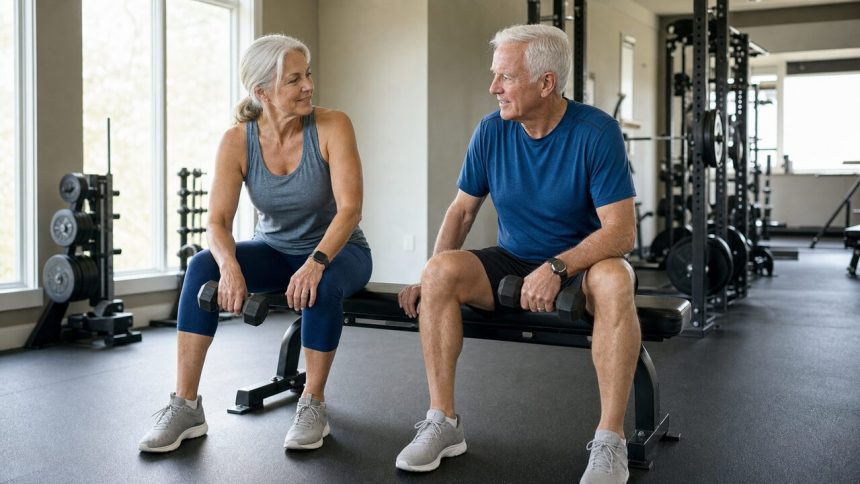
Strength training may help you live longer, but the honest answer is more precise than the old promise that lifting weights will “extend your lifespan.” Large observational studies consistently link regular muscle-strengthening activity with a lower risk of early death. They cannot prove that lifting caused the difference. What resistance training can do with much stronger certainty is preserve strength, improve physical function, and make everyday tasks easier as you age.
The practical target is not an extreme bodybuilding routine. U.S. guidance recommends muscle-strengthening activity for all major muscle groups on at least two days per week, alongside aerobic and balance work. Two well-planned full-body sessions are enough to build a useful base. This guide separates the mortality statistics from the better-supported strength and function benefits, then gives you a simple starting plan you can adapt to your age, experience, and health.
What the Longevity Research Actually Shows
The strongest recent evidence comes from long-running cohort studies. Researchers observe people’s habits for years, adjust for other health factors, and compare outcomes. This approach can find durable associations, but it cannot fully remove differences in income, diet, medical care, smoking, or general health behavior.
A 2026 British Journal of Sports Medicine analysis followed 147,374 adults for as long as 30 years. Compared with no resistance training, an average of 90 to 119 minutes per week was associated with a 13 percent lower rate of death from any cause. The same group had a 19 percent lower rate of cardiovascular death and a 27 percent lower rate of death from neurological disease. More than 120 minutes did not show an additional reduction in that study.
Those figures are useful context, not a prescription to chase exactly 90 minutes. The participants reported their own training, and the study was observational. Earlier research also points toward benefit at lower amounts. A 2022 meta-analysis of 16 prospective cohort studies found that muscle-strengthening activity was associated with roughly 10 to 17 percent lower risks across several major outcomes, with the clearest risk reductions around 30 to 60 minutes per week. The available studies used different questions and activity categories, so their apparent “best dose” should not be treated as a hard threshold.
| Finding | What it means | What it does not prove |
|---|---|---|
| 90 to 119 minutes per week was linked with 13 percent lower all-cause mortality in a 2026 cohort. | Regular resistance training belongs in a longevity-focused routine. | That exact dose guarantees a longer life. |
| A 2022 cohort meta-analysis found lower risks with muscle-strengthening activity. | The association appears across several populations and outcomes. | Lifting alone caused every observed difference. |
| Combined aerobic and strength activity produced some of the lowest observed risks. | A balanced program is more defensible than lifting alone. | One type of exercise can replace every other health behavior. |
The most useful conclusion is simple: strength training is one part of a longer-life pattern. Walking, cycling, swimming, or other aerobic work still matters. Sleep, nutrition, smoking status, medical care, and social conditions matter too.
Lifespan and Healthspan Are Different Questions
Lifespan is the number of years you live. Healthspan is the portion of those years spent with enough physical and cognitive function to live as you choose. Mortality research cannot tell an individual how many extra years a barbell will provide. Trials of progressive resistance training can tell us much more about strength and function.
A Cochrane review covering 121 trials and about 6,700 older adults found that progressive resistance training produced clear improvements in muscle strength and smaller but meaningful gains in walking speed, chair-rise performance, and overall physical ability. Serious adverse events were rare in the included trials, although adverse-event reporting was incomplete.
That distinction matters. Getting out of a chair without help, carrying groceries, climbing stairs, and recovering balance are not abstract fitness goals. They are the physical reserve that supports independent living.

Five Ways Strength Training Supports Healthy Aging
1. It preserves muscle and usable strength
Aging is commonly accompanied by losses in muscle mass, strength, and power. The rate varies widely, and inactivity can accelerate it. Resistance training supplies the progressive loading muscles need to adapt. You do not need to train like a competitive lifter to benefit. Machines, dumbbells, bands, bodyweight movements, and weighted household tasks can all provide resistance.
If your goal is a more muscular program after midlife, our guide to building muscle after 50 covers training volume, recovery, and nutrition in more depth. This page stays focused on longevity and function.
2. It helps maintain physical function
Strength matters when you stand from a low chair, lift a suitcase, steady yourself on stairs, or get up from the floor. Programs that train the legs, hips, back, chest, shoulders, arms, and trunk improve the movements that daily life demands. Greater capacity also gives you room to handle illness or a temporary period of inactivity without falling below the threshold needed for independence.
3. It can improve cardiometabolic risk factors
Resistance training can improve blood pressure, glucose control, insulin sensitivity, and body composition in many populations. The size of the change depends on starting health, program design, medication, diet, and total activity. These are risk-factor improvements, not proof that lifting prevents every case of heart disease or diabetes.
The balanced approach remains strongest: meet your muscle-strengthening target, accumulate regular aerobic activity, and work with your clinician on blood pressure, cholesterol, or blood-glucose treatment when needed.
4. It contributes to bone and fall-risk management
Loading from resistance exercise can support bone health, particularly when the program is progressive and the exercises load the hips and spine appropriately. The response is site-specific and usually modest. No responsible program can promise a fixed percentage increase in bone density, and training is not a substitute for osteoporosis evaluation or medication when those are indicated.
Falls are also a balance and coordination problem. Strength work can improve the force needed to recover from a stumble, but older adults should combine it with balance practice. Large reviews of exercise programs show fewer fallers overall, yet those programs often mix strength, balance, gait, and functional training. The combined package is the useful lesson.
5. It may support mood
A 2018 meta-analysis of 33 randomized trials found that resistance exercise reduced depressive symptoms compared with inactive control conditions. The studies varied considerably, and exercise is not a replacement for professional mental-health treatment. Still, regular training can be a valuable part of care for many people, especially when it also creates routine, confidence, and social contact.
How Much Strength Training Do You Need?
The Centers for Disease Control and Prevention recommends that adults perform muscle-strengthening activities for all major muscle groups on at least two days each week. Adults 65 and older should also include balance activity. The aerobic target is at least 150 minutes of moderate activity or 75 minutes of vigorous activity per week, or an equivalent combination.
For a new lifter, “two days” can mean two 30- to 45-minute full-body sessions. You do not need to reach the 90 to 119 minutes seen in one cohort before training becomes worthwhile. Build a routine you can recover from and repeat.
| Goal | Practical weekly target | Simple example |
|---|---|---|
| Strength | At least 2 nonconsecutive days | Two full-body sessions |
| Aerobic fitness | 150 minutes moderate or 75 minutes vigorous | Five 30-minute brisk walks |
| Balance for older adults | Practice several days per week | Heel-to-toe walking and supported single-leg stands |
| Recovery | Enough time to repeat good sessions | A rest day between full-body workouts |
A Two-Day Strength Plan for Healthy Aging
This template trains the major movement patterns without requiring maximal loads. Choose versions that match your mobility and experience. A stable machine is a valid choice. So is a resistance band. Our full-body resistance band guide offers a home-based alternative.
| Day A | Sets and reps | Day B | Sets and reps |
|---|---|---|---|
| Box squat or leg press | 1 to 3 x 8 to 12 | Supported split squat or step-up | 1 to 3 x 8 to 12 per side |
| Chest press or incline push-up | 1 to 3 x 8 to 12 | Dumbbell or machine press | 1 to 3 x 8 to 12 |
| Seated cable or band row | 1 to 3 x 8 to 12 | Lat pulldown or band pulldown | 1 to 3 x 8 to 12 |
| Hip hinge or light Romanian deadlift | 1 to 3 x 8 to 12 | Glute bridge or machine hamstring curl | 1 to 3 x 8 to 12 |
| Farmer carry or suitcase hold | 2 x 20 to 40 seconds | Calf raise and balance hold | 2 x 8 to 15 |
Start with one set if you are returning after a long break. Use a load that lets you complete every rep with steady control and several good reps still available. Add a second or third set over time. When you can exceed the top of the rep range without form changing, increase the resistance by the smallest practical amount.
The dumbbell squat guide is one accessible way to learn a loaded squat pattern. If you already train and want an objective benchmark, FitnessVolt’s strength standards can help you track progress without turning every workout into a maximum attempt.
When to Get Medical or Coaching Guidance
Most adults can begin with light, tolerable resistance and gradual progression. Get individual medical guidance before starting or returning if you have unstable cardiovascular symptoms, uncontrolled blood pressure, recent surgery, unexplained fainting, severe shortness of breath, an acute injury, or a condition that changes how you should load bone or joints.
Stop the session and seek care for chest pressure, fainting, sudden neurological symptoms, or severe and unusual shortness of breath. Joint pain that worsens during each rep is also a reason to change the exercise or end the set. Normal muscular effort and next-day soreness are different from sharp, radiating, or escalating pain.
A qualified trainer or physical therapist can help adapt exercise selection, range of motion, and starting loads. Good coaching is especially useful if balance problems, osteoporosis, arthritis, or a previous injury makes generic instructions a poor fit.
Common Mistakes That Reduce the Benefit
- Starting too hard: a demanding first week creates soreness and fear without building a sustainable habit.
- Only training mirror muscles: include legs, hips, pulling, pushing, and trunk work.
- Replacing aerobic activity: lifting and cardio support different parts of health and work best together.
- Never progressing: add a rep, a set, a little load, or a harder variation when the current work becomes easy.
- Testing max strength too often: use submaximal sets for most training. The one-rep max calculator can estimate strength from a recent set.
The Bottom Line
Strength training is associated with a lower risk of early death, but no study can promise that a particular lifting routine will add a set number of years to your life. The more certain payoff is improved strength and physical function, which can make those years more capable and independent.
Begin with two full-body sessions, keep the loads manageable, and combine lifting with aerobic and balance work. The program that supports healthy aging is the one you can progress, recover from, and continue.
Sources
- Zhang Y, et al. Long-term resistance training with all-cause and cause-specific mortality. British Journal of Sports Medicine. 2026. doi:10.1136/bjsports-2025-110503.
- Momma H, et al. Muscle-strengthening activities are associated with lower risk and mortality in major non-communicable diseases. British Journal of Sports Medicine. 2022. doi:10.1136/bjsports-2021-105061.
- Kraschnewski JL, et al. Is strength training associated with mortality benefits? A 15-year cohort study of US older adults. Preventive Medicine. 2016. doi:10.1016/j.ypmed.2016.02.038.
- Liu C, Latham NK. Progressive resistance strength training for improving physical function in older adults. Cochrane Database of Systematic Reviews. Updated 2022. doi:10.1002/14651858.CD002759.pub2.
- Centers for Disease Control and Prevention. Older Adult Activity: An Overview. Updated December 4, 2025.
- Dautzenberg L, et al. Interventions for preventing falls and fall-related fractures in community-dwelling older adults. Journal of the American Geriatrics Society. 2021. doi:10.1111/jgs.17375.
- Gordon BR, et al. Association of efficacy of resistance exercise training with depressive symptoms. JAMA Psychiatry. 2018. doi:10.1001/jamapsychiatry.2018.0572.