

10 Best Hip Flexion With Band Alternatives for Rehab & Strength
The Hip Flexion With Band is done standing with a band. Ranked closest by our scoring: Barbell Step Ups, the Dumbbell Step-up Lunge and the Dumbbell Single Leg Split Squat. A harder version, the Band Step-up, is listed below as a progression rather than a swap.
Updated Ranked by our 12-factor similarity model How it works
Original Exercise: Hip Flexion With Band
- Primary muscle
- Quads
- Equipment
- Band
- Difficulty
- Beginner
- Type
- Isolation
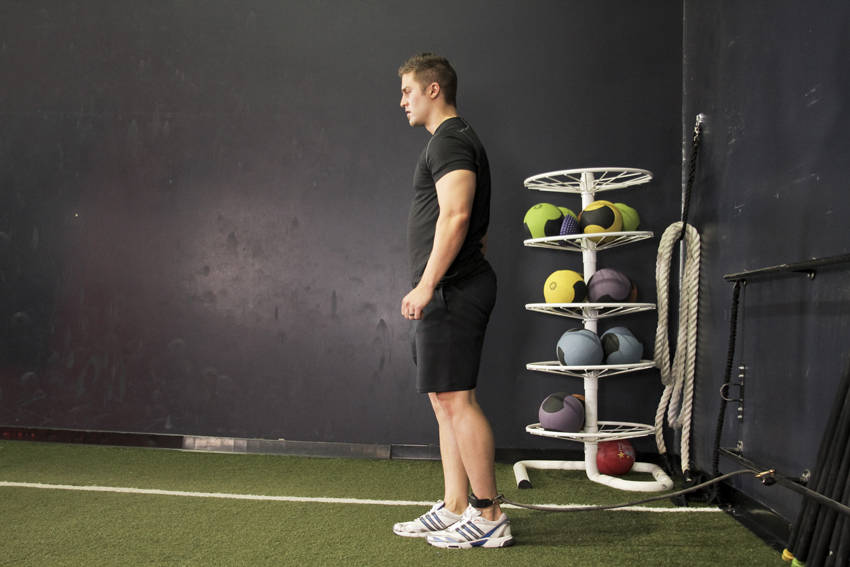
How to perform Hip Flexion With Band
- Secure one end of the band to the lower portion of a post and attach the other to one ankle.
- Face away from the attachment point of the band.
- Keeping your head and your chest up, raise your knee up to 90 degrees and pause.
- Return the leg to the starting position.
Ranked Hip Flexion With Band Alternatives
10 substitutes, ranked by how closely each one matches the Hip Flexion With Band on movement pattern, muscles worked, equipment and body position. The higher the score, the less you change. Open "How to perform this exercise" on a card for the steps; every card title links to that exercise's own alternatives page. Harder versions are tagged as progressions and kept out of the top spot even when they score higher.
Best match 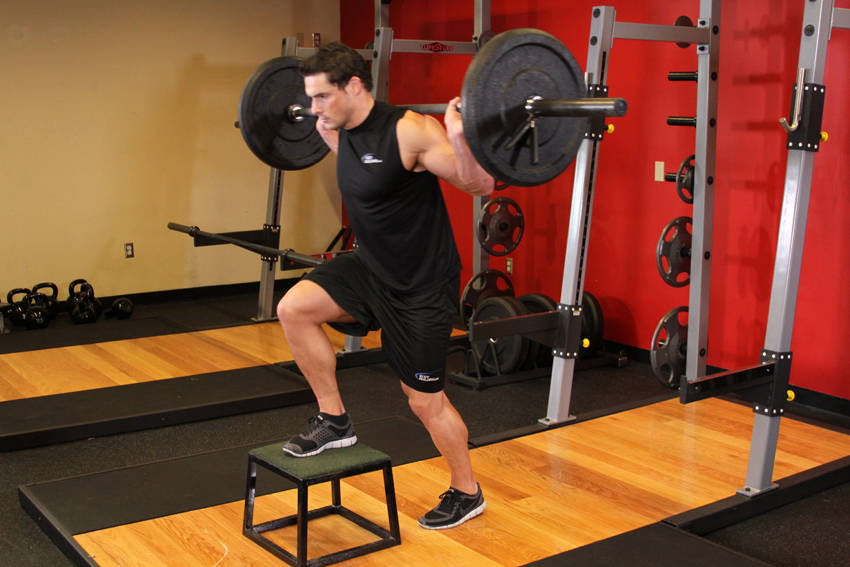
1. Barbell Step Ups
76% match- Quads
- Barbell
- Intermediate
- Compound
A good swap when you have a barbell to work with, and it still works the quads.
How to perform this exercise
- Stand up straight while holding a barbell placed on the back of your shoulders (slightly below the neck) and stand upright behind an elevated platform (such as the one used for spotting behind a flat bench). This is your starting position.
- Place the right foot on the elevated platform. Step on the platform by extending the hip and the knee of your right leg. Use the heel mainly to lift the rest of your body up and place the foot of the left leg on the platform as well. Breathe out as you execute the force required to come up.
- Step down with the left leg by flexing the hip and knee of the right leg as you inhale. Return to the original standing position by placing the right foot of to next to the left foot on the initial position.
- Repeat with the right leg for the recommended amount of repetitions and then perform with the left leg.
Sets and reps: 3 or 4 sets of 6 to 10 reps on each side.
Why this matches
- Primary muscle: quads, the same as the Hip Flexion With Band
- Equipment: free weights, not a band
- Body position: standing, the same as the Hip Flexion With Band
Progression
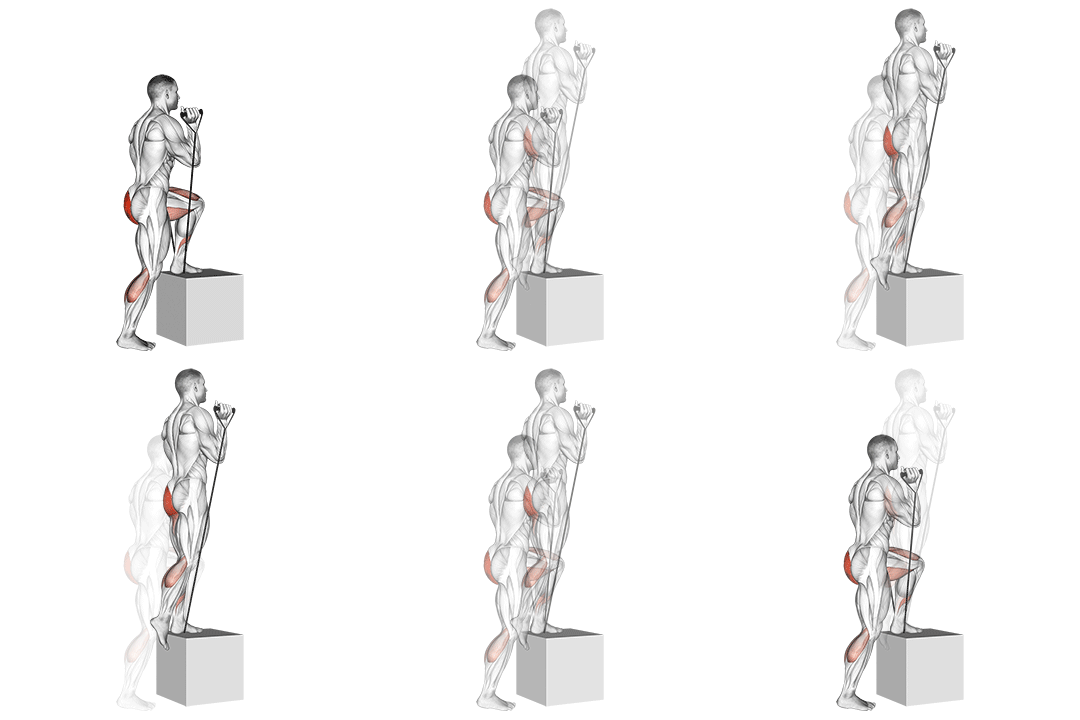
2. Band Step-up
75% match- Glutes
- Band
- Intermediate
- Compound
A looser match: it uses the same equipment, but it works the glutes rather than the quads.
How to perform this exercise
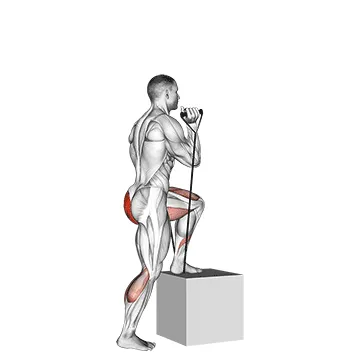
- Place a band around your thighs, just above your knees.
- Stand facing a step or platform with your feet hip-width apart.
- Step up onto the platform with your right foot, pushing through your heel.
- Extend your left leg behind you, keeping it straight.
- Lower your left foot back down to the ground.
- Repeat with your left foot stepping up onto the platform.
- Continue alternating legs for the desired number of repetitions.
Sets and reps: 3 or 4 sets of 6 to 10 reps on each side.
Why this matches
- Primary muscle: glutes, not quads
- Equipment: a band, the same as the Hip Flexion With Band
- Body position: standing, the same as the Hip Flexion With Band
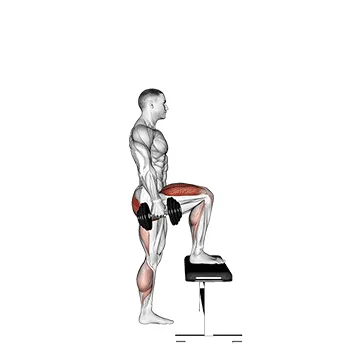
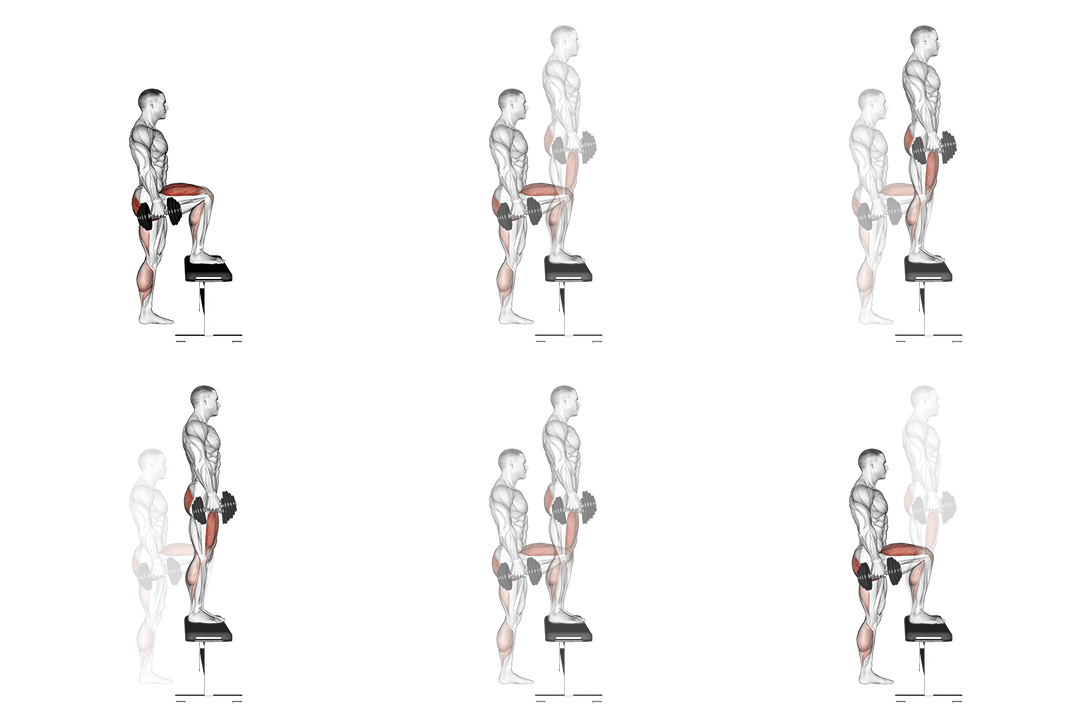
3. Dumbbell Step-up Lunge
75% match- Quads
- Dumbbell
- Intermediate
- Compound
A good swap when you have dumbbells to work with, and it still works the quads.
How to perform this exercise
- Stand in front of a step or platform with a dumbbell in each hand, palms facing your sides.
- Place your right foot on the step, ensuring your entire foot is on the surface.
- Push through your right heel and lift your body up onto the step, bringing your left foot up as well.
- Once both feet are on the step, lower your left foot back down to the starting position, keeping your right foot on the step.
- Repeat the movement, alternating which foot you step up with each time.
- Continue for the desired number of repetitions.
Sets and reps: 3 or 4 sets of 6 to 10 reps on each side.
Why this matches
- Primary muscle: quads, the same as the Hip Flexion With Band
- Equipment: free weights, not a band
- Body position: standing, the same as the Hip Flexion With Band
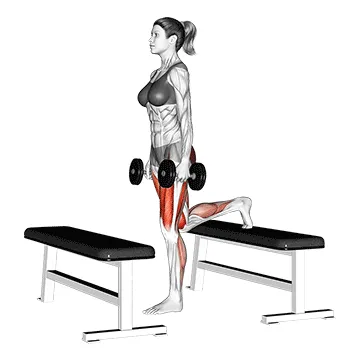
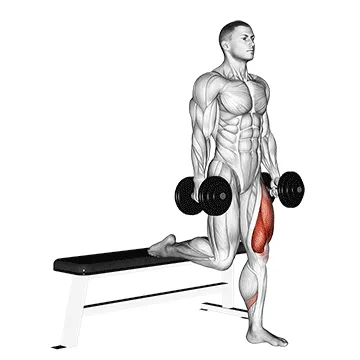
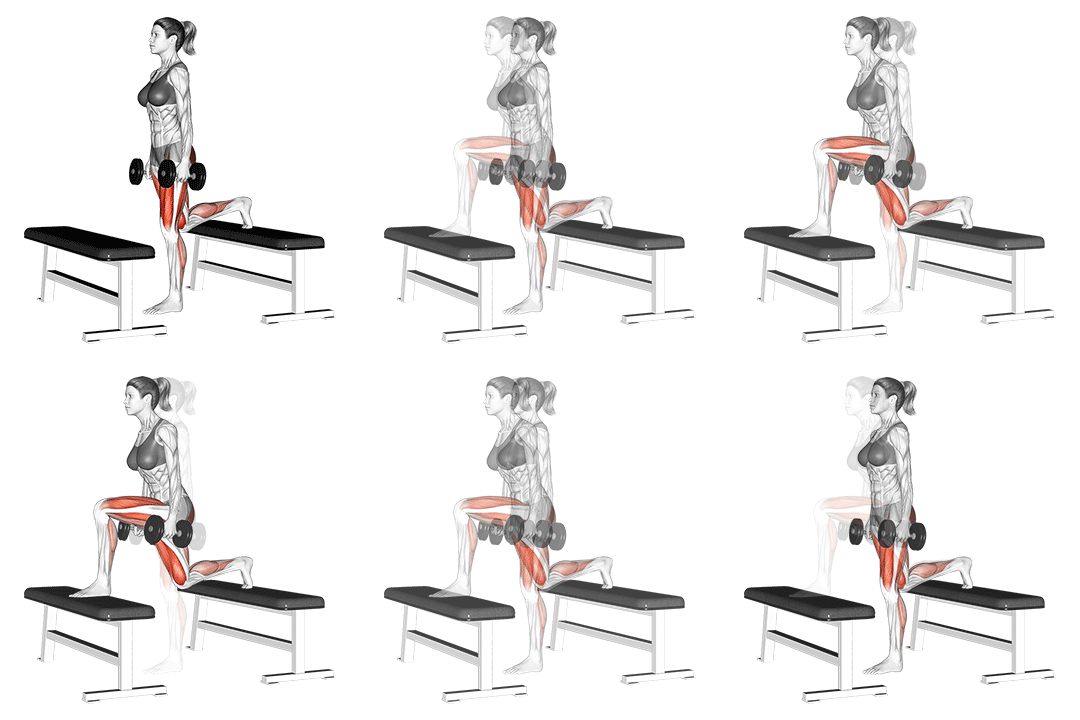
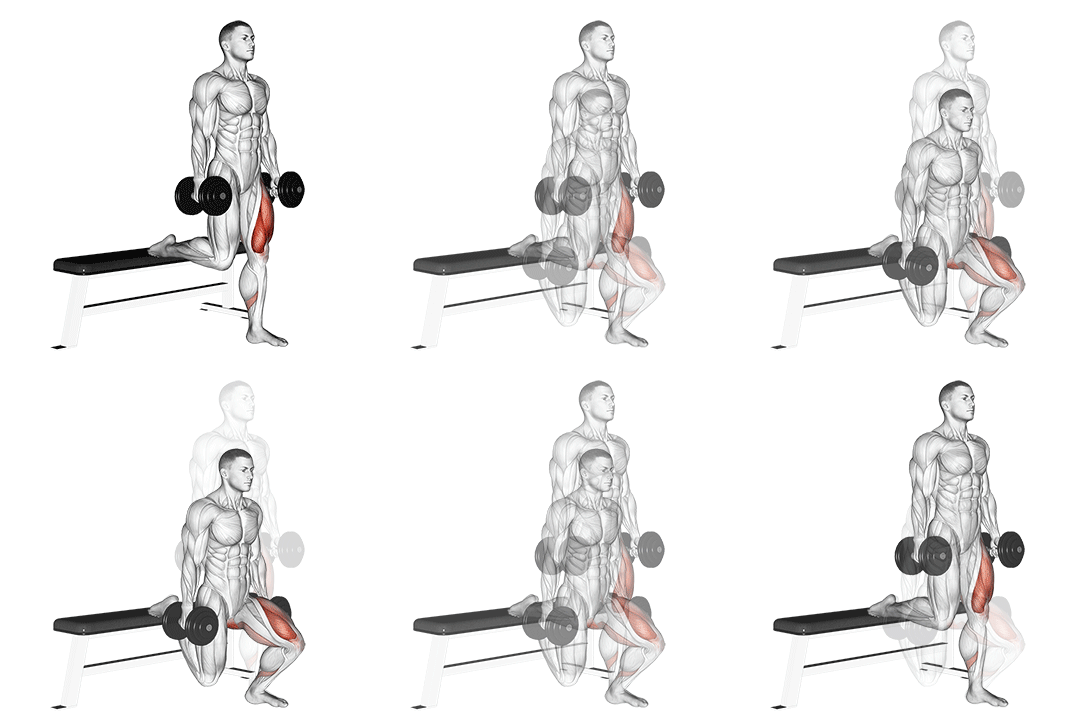
4. Dumbbell Single Leg Split Squat
69% match- Quads
- Dumbbell
- Intermediate
- Compound
How to perform this exercise
- Stand with your feet shoulder-width apart, holding a dumbbell in each hand.
- Take a step forward with one foot and position your feet so that your front foot is flat on the ground and your back foot is elevated on a bench or step.
- Lower your body by bending your front knee and hip, keeping your back knee slightly bent and your back heel off the ground.
- Continue lowering until your front thigh is parallel to the ground, then push through your front heel to return to the starting position.
- Repeat for the desired number of repetitions, then switch legs and repeat.
Sets and reps: 3 to 5 sets of 5 to 8 reps on each side.
Why this matches
- Primary muscle: quads, the same as the Hip Flexion With Band
- Equipment: free weights, not a band
- Body position: standing, the same as the Hip Flexion With Band
5. Backward Drag
68% match- Quads
- Other
- Intermediate
- Compound
Pick this when you want a harder version that still works the quads.
How to perform this exercise
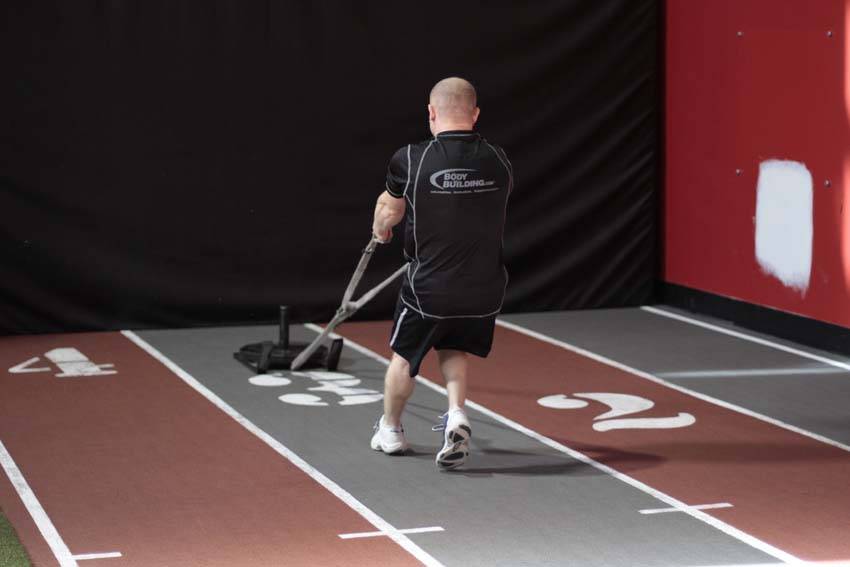
- Load a sled with the desired weight, attaching a rope or straps to the sled that you can hold onto.
- Begin the exercise by moving backwards for a given distance. Leaning back, extend through the legs for short steps to move as quickly as possible.
Sets and reps: 3 or 4 sets of 6 to 10 reps on each side.
Why this matches
- Primary muscle: quads, the same as the Hip Flexion With Band
- Body position: standing, the same as the Hip Flexion With Band
6. Scissors Jump
66% match- Quads
- Bodyweight
- Advanced
- Compound
Use this when you have nothing to train with, because it works the quads with bodyweight alone.
How to perform this exercise
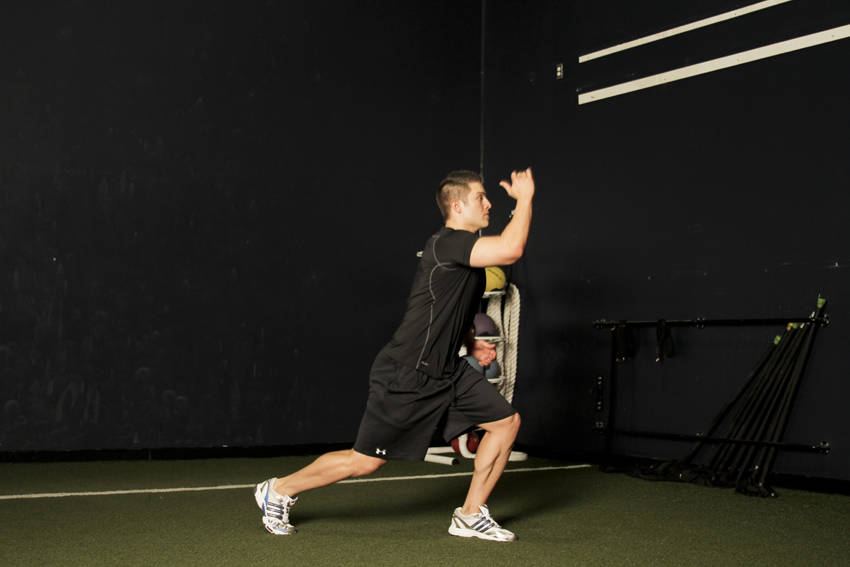
- Assume a lunge stance position with one foot forward with the knee bent, and the rear knee nearly touching the ground.
- Ensure that the front knee is over the midline of the foot. Extending through both legs, jump as high as possible, swinging your arms to gain lift.
- As you jump as high as you can, switch the position of your legs, moving your front leg to the back and the rear leg to the front.
- As you land, absorb the impact through the legs by adopting the lunge position, and repeat.
Sets and reps: 3 or 4 sets of 6 to 10 reps on each side.
Why this matches
- Primary muscle: quads, the same as the Hip Flexion With Band
- Equipment: bodyweight only, not a band
- Body position: standing, the same as the Hip Flexion With Band
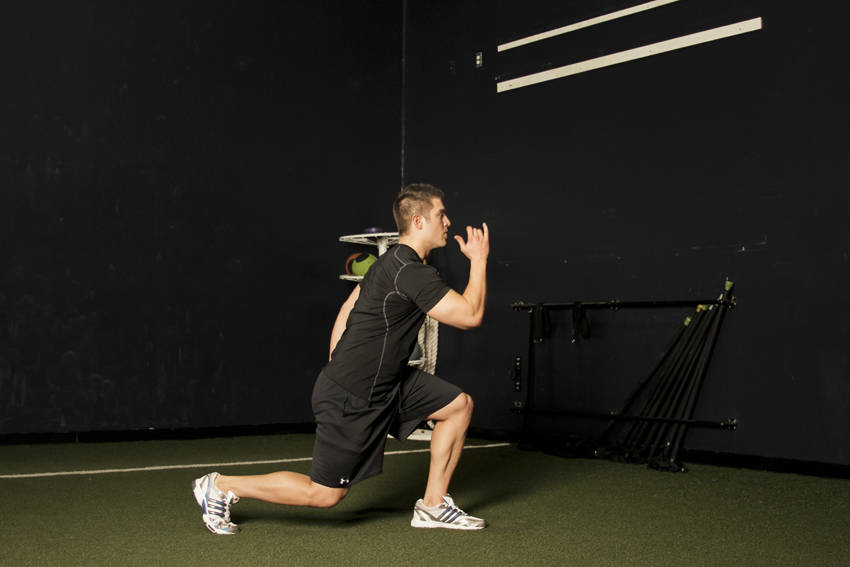
7. Split Jump
66% match- Quads
- Bodyweight
- Intermediate
- Compound
How to perform this exercise
- Assume a lunge stance position with one foot forward with the knee bent, and the rear knee nearly touching the ground.
- Ensure that the front knee is over the midline of the foot.
- Extending through both legs, jump as high as possible, swinging your arms to gain lift.
- As you jump, bring your feet together, and move them back to their initial positions as you land.
- Absorb the impact by reverting back to the starting position.
Sets and reps: 3 or 4 sets of 6 to 10 reps on each side.
Why this matches
- Primary muscle: quads, the same as the Hip Flexion With Band
- Equipment: bodyweight only, not a band
- Body position: standing, the same as the Hip Flexion With Band
8. Band Hip Adductions
66% match- Adductors
- Band
- Beginner
- Isolation
How to perform this exercise
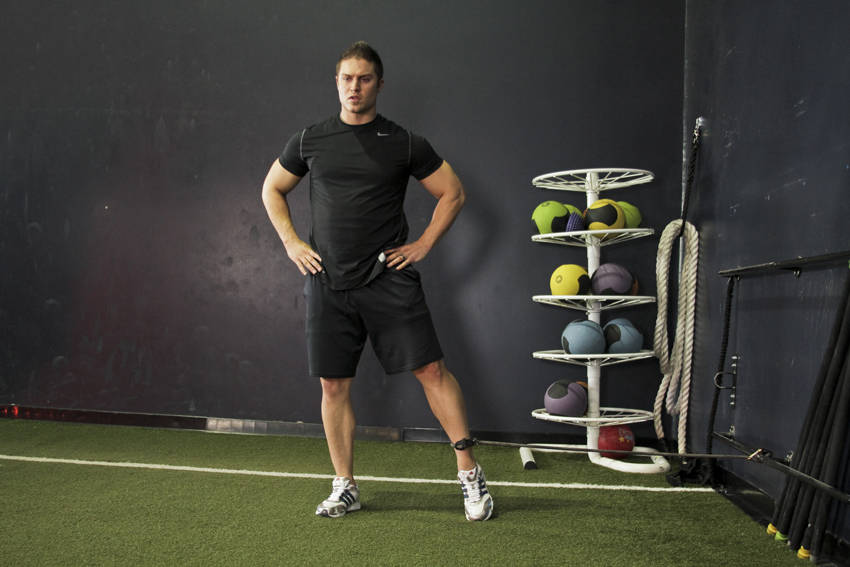
- Anchor a band around a solid post or other object.
- Stand with your left side to the post, and put your right foot through the band, getting it around the ankle.
- Stand up straight and hold onto the post if needed. This will be your starting position.
- Keeping the knee straight, raise your right legs out to the side as far as you can.
- Return to the starting position and repeat for the desired rep count.
- Switch sides.
Sets and reps: 3 sets of 10 to 15 reps on each side.
Why this matches
- Primary muscle: adductors, not quads
- Equipment: a band, the same as the Hip Flexion With Band
- Body position: standing, the same as the Hip Flexion With Band
9. Dumbbell Step-up
65% match- Glutes
- Dumbbell
- Intermediate
- Compound
How to perform this exercise
- Stand in front of a bench or step with a dumbbell in each hand, palms facing your body.
- Place your right foot on the bench or step, ensuring your entire foot is in contact with the surface.
- Push through your right heel and lift your body up onto the bench or step, straightening your right leg.
- Bring your left foot up onto the bench or step, standing fully upright.
- Step back down with your left foot, followed by your right foot, returning to the starting position.
- Repeat for the desired number of repetitions, then switch legs.
Sets and reps: 3 or 4 sets of 6 to 10 reps on each side.
Why this matches
- Primary muscle: glutes, not quads
- Equipment: free weights, not a band
- Body position: standing, the same as the Hip Flexion With Band
10. Dumbbell Step Ups
65% match- Quadriceps
- Dumbbell
- Intermediate
- Compound
How to perform this exercise
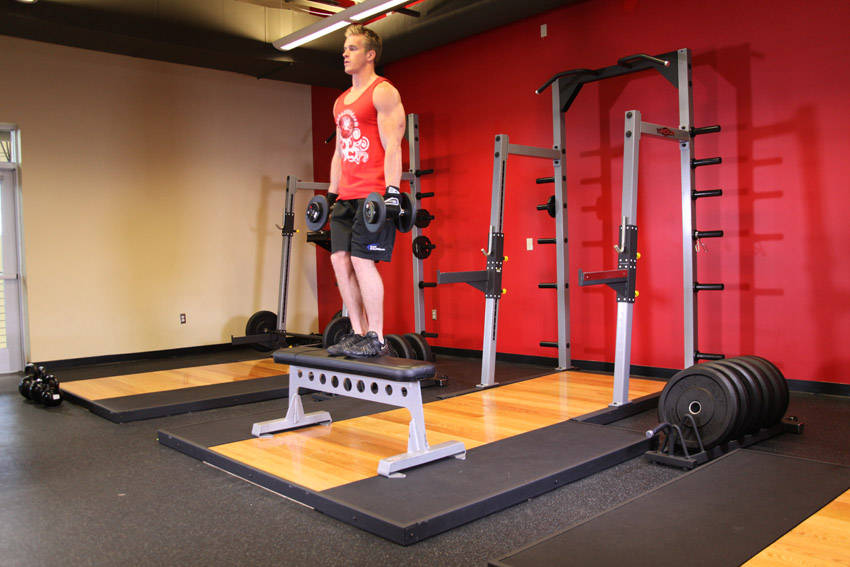
- Stand up straight while holding a dumbbell on each hand (palms facing the side of your legs).
- Place the right foot on the elevated platform. Step on the platform by extending the hip and the knee of your right leg. Use the heel mainly to lift the rest of your body up and place the foot of the left leg on the platform as well. Breathe out as you execute the force required to come up.
- Step down with the left leg by flexing the hip and knee of the right leg as you inhale. Return to the original standing position by placing the right foot of to next to the left foot on the initial position.
- Repeat with the right leg for the recommended amount of repetitions and then perform with the left leg.
Sets and reps: 3 or 4 sets of 6 to 10 reps on each side.
Why this matches
- Primary muscle: quadriceps, not quads
- Equipment: free weights, not a band
- Body position: standing, the same as the Hip Flexion With Band
Why You Might Need a Hip Flexion With Band Alternative
You might swap Hip Flexion With Band because of equipment limits, anterior hip pain, or the need for more progressive overload. Some lifters avoid bands when they cant produce consistent tension or when the clip angle causes groin discomfort. Clinically, pain at the rectus femoris tendon or tight iliopsoas can make band tension irritating. Technique-wise, substitutes let you change load, range of motion and joint angle to emphasize rectus femoris vs iliopsoas. Cue for rehab: perform slow 3-second concentric hip flexion with a 2-second hold at peak to assess pain and target fascicle tension without aggressive end-range stretch.
How to Choose the Right Hip Flexion With Band Substitute
Select a substitute by matching your goal: isolation, progressive overload, or functional transfer. For strict quad isolation choose seated straight-leg raises or cable hip flexion so you can increase load incrementally; cue: keep the hip flexed slightly and dorsiflex the foot to accentuate rectus femoris. For functional power pick step-ups or resisted knee drives that combine hip flexion with knee extension. If pain limits range, choose low-load, slow-tempo reps and monitor where you feel activation, front of the thigh indicates quad engagement, deep groin suggests iliopsoas compensation.
Hip Flexion With Band FAQ
What muscles does Hip Flexion With Band work?
Hip Flexion With Band primarily targets the hip flexors, especially the iliopsoas and rectus femoris (part of the quads), with secondary involvement from sartorius. You should feel contraction across the front of the hip and upper thigh; cue: lead the movement by driving the knee up rather than pulling with the lower leg.
What is the best bodyweight alternative to Hip Flexion With Band?
A standing high-knee march is the best bodyweight option to approximate hip flexion loading while keeping it simple; cue: brace your core, raise the knee to hip height and hold for 1–2 seconds, dorsiflexing the foot to increase rectus femoris tension. Progress by adding tempo, holds, or single-leg repetitions to increase demand.
Find Alternatives for Any Exercise
Search the exercise database and filter the ranked substitutes by the equipment you own.
Similarity scores compare exercise metadata such as movement pattern, muscles, equipment and body position. They are not a safety rating or a check that you own the equipment. Learn about our methodology