

5 Best One Leg Barbell Squat Alternatives
The One Leg Barbell Squat is done standing with a barbell.
Original Exercise: One Leg Barbell Squat
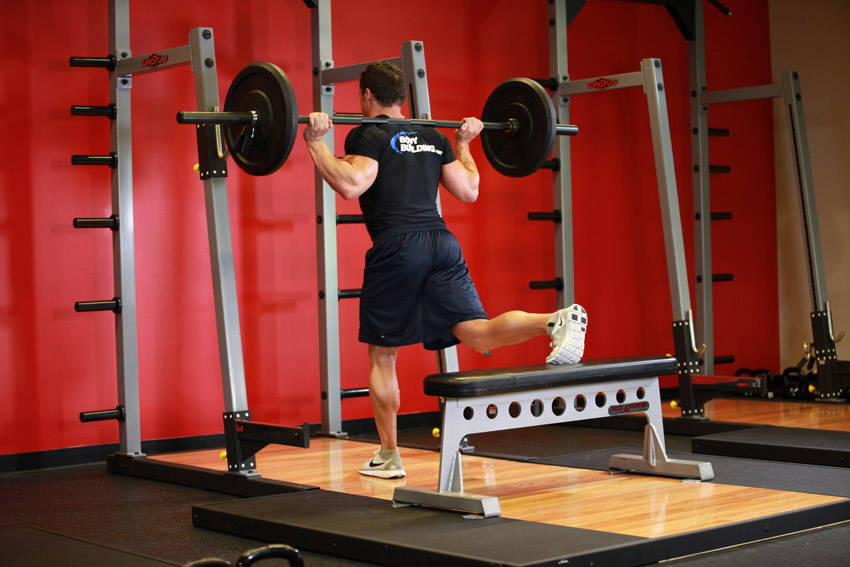
- Primary muscle
- Quads
- Equipment
- Barbell
- Difficulty
- Advanced
- Type
- Compound
Secondary muscles: Calves, Glutes, Hamstrings
How to perform One Leg Barbell Squat
- Start by standing about 2 to 3 feet in front of a flat bench with your back facing the bench. Have a barbell in front of you on the floor. Tip: Your feet should be shoulder width apart from each other.
- Bend the knees and use a pronated grip with your hands being wider than shoulder width apart from each other to lift the barbell up until you can rest it on your chest.
- Then lift the barbell over your head and rest it on the base of your neck. Move one foot back so that your toe is resting on the flat bench. Your other foot should be stationary in front of you. Keep your head up at all times as looking down will get you off balance and also maintain a straight back. Tip: Make sure your back is straight and chest is out while performing this exercise.
- As you inhale, slowly lower your leg until your thigh is parallel to the floor. At this point, your knee should be over your toes. Your chest should be directly above the middle of your thigh.
- Leading with the chest and hips and contracting the quadriceps, elevate your leg back to the starting position as you exhale.
- Repeat for the recommended amount of repetitions.
- Switch legs and repeat the movement.
One Leg Barbell Squat FAQ
What muscles does One Leg Barbell Squat work?
The One Leg Barbell Squat primarily targets the quadriceps (vastus lateralis, medialis, and intermedius) with secondary activation of the gluteus maximus and hamstrings for hip stability. It also recruits core and spinal erectors to stabilize the axial load; emphasize knee extension by driving through the midfoot and keeping the torso upright to maximize quad recruitment.
What is the best bodyweight alternative to One Leg Barbell Squat?
The Bulgarian split squat is the best bodyweight alternative for most lifters because it preserves a steep knee angle and unilateral load distribution that target the quads. Cue a tall chest and drive through the front heel; if you lack balance, regress to a rear-supported split or controlled step-up to maintain quad emphasis.
Find Alternatives for Any Exercise
Search the exercise database and filter the ranked substitutes by the equipment you own.