

Archer Push Up vs Chest Tap Push-up (male): Complete Comparison Guide
Archer Push Up vs Chest Tap Push-up (male) — two advanced, bodyweight chest builders that test strength, stability, and power. If you want clear direction on which to include in your program, this guide breaks down muscle activation, technique cues, equipment needs, progression paths, and injury risk. You’ll get specific rep ranges, biomechanics-based tips (angles, force vectors, length-tension), and practical recommendations so you can choose the move that best matches your goal—hypertrophy, strength, power, or simple home conditioning.
Exercise Comparison
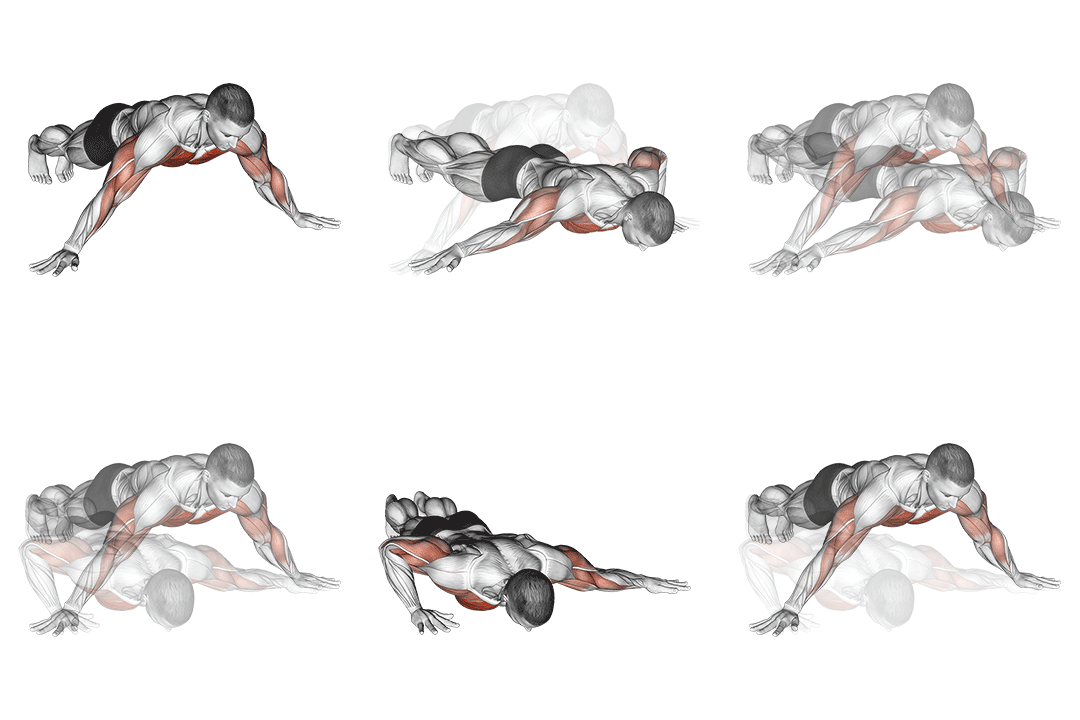
Archer Push Up
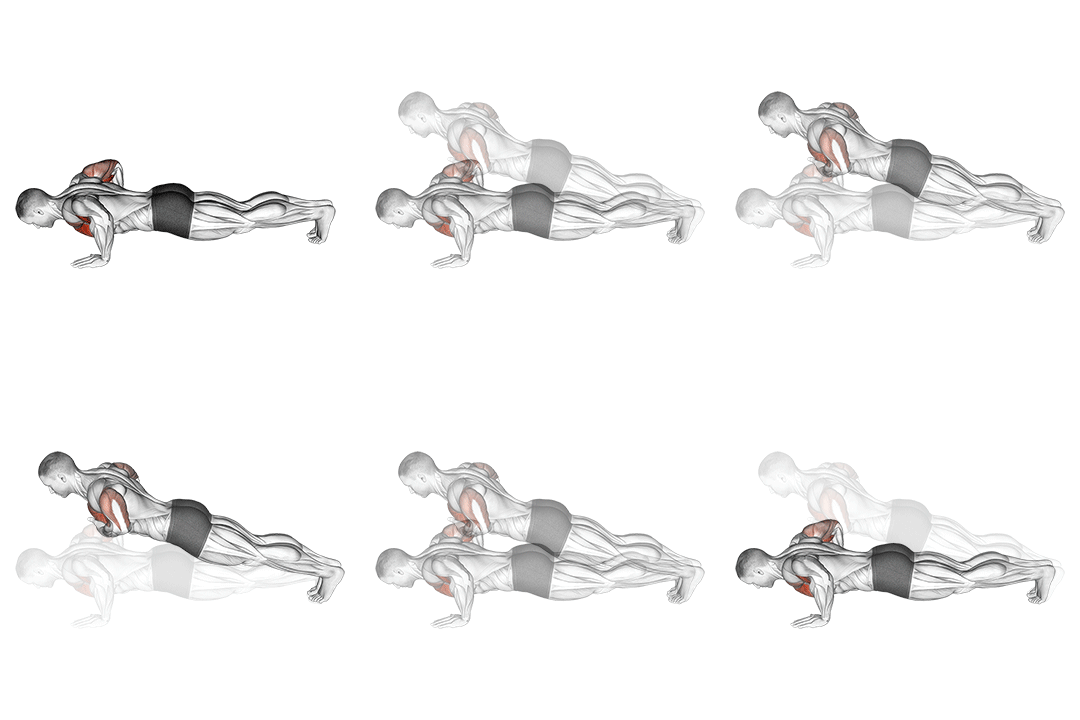
Chest Tap Push-up (male)
Head-to-Head Comparison
| Attribute | Archer Push Up | Chest Tap Push-up (male) |
|---|---|---|
| Target Muscle |
Pectorals
|
Pectorals
|
| Body Part |
Chest
|
Chest
|
| Equipment |
Body-weight
|
Body-weight
|
| Difficulty |
Advanced
|
Advanced
|
| Movement Type |
Compound
|
Compound
|
| Secondary Muscles |
3
|
2
|
Secondary Muscles Activated
Archer Push Up
Chest Tap Push-up (male)
Visual Comparison
Overview
Archer Push Up vs Chest Tap Push-up (male) — two advanced, bodyweight chest builders that test strength, stability, and power. If you want clear direction on which to include in your program, this guide breaks down muscle activation, technique cues, equipment needs, progression paths, and injury risk. You’ll get specific rep ranges, biomechanics-based tips (angles, force vectors, length-tension), and practical recommendations so you can choose the move that best matches your goal—hypertrophy, strength, power, or simple home conditioning.
Key Differences
- Both exercises target the Pectorals using Body-weight. The main differences are in their movement patterns and muscle activation angles.
Pros & Cons
Archer Push Up
+ Pros
- High unilateral loading for targeted pectoral overload and anti-rotation core demand
- Easily manipulates leverage to increase mechanical tension (lateral hand offset)
- Develops single-arm stability and imbalanced strength useful for bridging to one-arm push progressions
- Longer time under tension on the working side enhances muscle growth when done with slow eccentrics (3–5 s)
− Cons
- Greater shoulder and wrist stress if scapular control or thoracic mobility is poor
- Steep learning curve — requires baseline push-up strength of 15–20 strict reps or similar unilateral strength
- Less explosive/power development compared with plyometric push variants
Chest Tap Push-up (male)
+ Pros
- Develops explosive concentric power and fast-twitch recruitment useful for athletic performance
- Symmetrical base reduces unilateral collapse and is easier to regress or scale
- Lower continuous core torque than archer, making it approachable for more lifters
- Can be programmed as plyometric work (3–6 rep clusters) or hypertrophy sets (8–15 reps)
− Cons
- Lower sustained unilateral tension limits targeted pectoral overload compared with archer
- Requires precise landing control; poor technique can increase acute joint stress
- Less effective for developing single-arm strength and anti-rotation capacity
When Each Exercise Wins
Archer places more continuous mechanical tension on the loaded pec via a longer ROM and unilateral overload; use 3–5 sets of 6–12 controlled reps with 3–5 s eccentrics to maximize time under tension and stimulate growth.
The asymmetric lever increases peak force demand on one side, allowing you to train higher relative loads and build unilateral pushing strength—progress leverage and eccentric control across 4–8 weeks.
It retains bilateral mechanics and can be regressed to incline or tempo versions; beginners can build stability and power safely before attempting unilateral archer patterns.
Both need no equipment, but chest taps scale more cleanly for mixed goals at home—use incline or tempo variations for conditioning, or low-rep plyometrics for power in limited space.
Frequently Asked Questions
Can I do both Archer Push Up and Chest Tap Push-up (male) in the same workout?
Yes. Pair them strategically: start with Chest Tap clusters (3–5 sets of 3–6 explosive reps) to train power, then follow with Archer Push Ups for 3–5 sets of 6–12 slower reps focused on tension. Watch total volume to avoid shoulder fatigue.
Which exercise is better for beginners?
Chest Tap Push-up (male) is better for most beginners because it preserves symmetrical mechanics and is easier to regress (incline, tempo). Build baseline push strength (15–20 strict reps or equivalent) before attempting Archer variations.
How do the muscle activation patterns differ?
Archer produces asymmetrical activation with ~60–80% of force on the loaded pec and higher core anti-rotation demand; Chest Tap produces brief, high-amplitude activation spikes across both pecs and triceps during the explosive concentric, but less continuous unilateral loading.
Can Chest Tap Push-up (male) replace Archer Push Up?
Not completely. Chest taps train explosive power and bilateral stability but lack sustained unilateral mechanical tension. If your priority is unilateral strength or maximal pectoral overload, keep archer work in your program.
Expert Verdict
If your goal is targeted pectoral overload and unilateral strength, prioritize the Archer Push Up—its lateral load shift and increased time under tension make it the superior choice for muscle growth and one-arm progressions. If you want to build explosive upper-body power, improve bilateral stability, or need an option that scales cleanly for beginners and home routines, choose the Chest Tap Push-up (male). Program both: use archer-focused sets (6–12 reps, slow eccentrics) 1–2 times weekly for hypertrophy/strength, and include chest taps (3–6 rep plyo clusters or 8–15 hypertrophy reps) for power and conditioning.
Also Compare
More comparisons with Archer Push Up
More comparisons with Chest Tap Push-up (male)
Compare More Exercises
Use our free comparison tool to analyze any two exercises head-to-head.
Compare Exercises