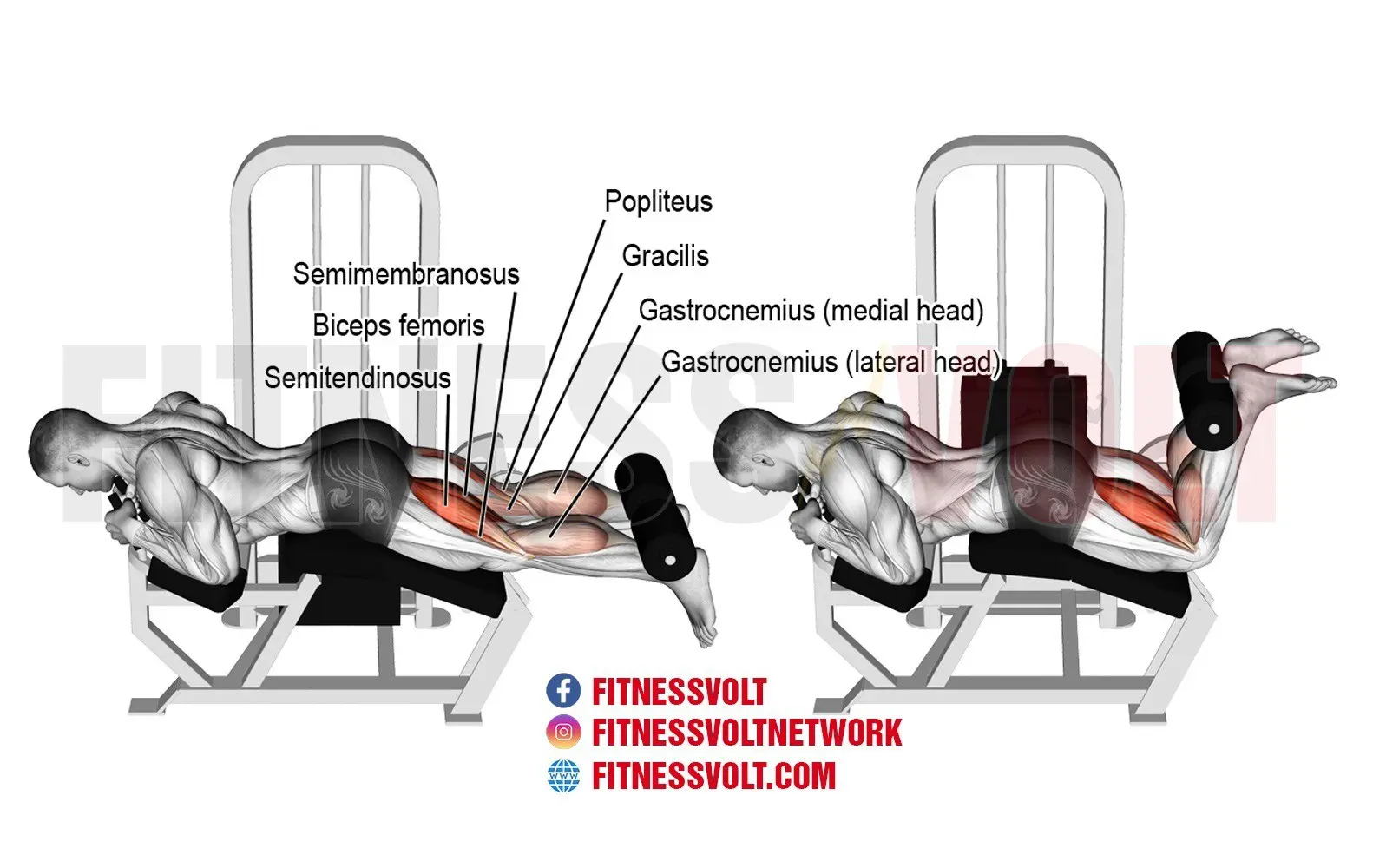
The lying leg curl is a machine exercise that trains knee flexion, the action of bringing your heel toward your glutes. The hamstrings do most of the work, while the gastrocnemius assists because it also crosses the knee.
For a clean rep, align your knee with the machine pivot, place the roller just above the heel, keep your pelvis against the pad, and lower the weight under control. The curl should come from the knee, not from lifting your hips or arching your lower back.
In This Exercise
- Primary muscles: Biceps femoris, semitendinosus, semimembranosus
- Assisting muscle: Gastrocnemius
- Movement: Knee flexion
- Equipment: Lying leg curl machine
- Level: Beginner to advanced
Lying Leg Curl Muscles Worked
| Muscle | Role in the exercise |
|---|---|
| Hamstrings | Produce knee flexion and control knee extension as the weight returns. |
| Biceps femoris | The long and short heads contribute to bending the knee; the long head also crosses the hip. |
| Semitendinosus and semimembranosus | Flex the knee and help control rotation of the lower leg when the knee is bent. |
| Gastrocnemius | Assists knee flexion. It is not the main target, but it is active because it crosses the knee. |
| Trunk and hip muscles | Brace isometrically to keep the pelvis and torso still. They do not turn the curl into a compound lift. |
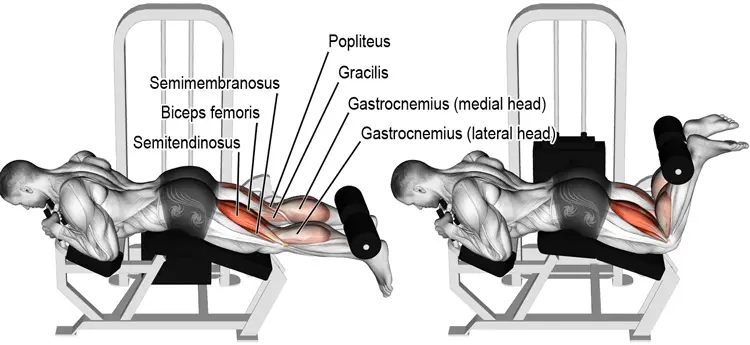
The hamstrings include the biceps femoris, semitendinosus, and semimembranosus. All contribute to knee flexion. Most also extend the hip, but the lying leg curl trains their knee-flexion function directly. That makes it a useful complement to hip-hinge exercises such as Romanian deadlifts.
For a broader exercise selection, see our guide to the best hamstring exercises.
How to Do the Lying Leg Curl
1. Set the machine to your body
Lie face down and place your knees close to the edge of the bench. Adjust your position so the machine’s rotational axis lines up with your knee joint. Set the roller against the lower calf, just above the heel rather than directly on the Achilles tendon.
2. Brace before you curl
Hold the handles, gently tighten your abs, and keep the front of your hips in contact with the pad. Start with your knees nearly straight, but do not force them into a painful locked position.
3. Curl through your available range
Bend your knees and bring the roller toward your glutes. Stop when you reach the end of your controlled range or before your hips begin to lift. A 90-degree knee angle is not a universal finish point because machine geometry and individual mobility differ.
4. Lower with control
Return the weight under control. A two-to-three-second lowering is an optional coaching target, not a tempo tested by the cited study. Keep the stack from slamming down and maintain the same hip position throughout the rep.
Watch: How to Do the Lying Leg Curl
Setup Details That Change the Exercise
Pad placement
A pad set too high on the calf shortens the lever and may let you use more weight without creating the same knee-flexion demand. A pad pressing into the heel or Achilles tendon can be uncomfortable. Use the lowest comfortable position on the calf that still lets you control the machine.
Hip and pelvis position
If the load pulls your pelvis off the bench, reduce the weight or stop the curl slightly earlier. Lifting the hips changes the position of the hamstrings and often introduces lower-back movement that does not help the target action.
Ankle position
Keep the ankle position comfortable and consistent. The gastrocnemius can contribute more when it is in a favorable position, but changing your foot angle is not a reliable way to isolate one hamstring muscle. Do not turn a simple knee curl into an ankle-cue contest.
Common Lying Leg Curl Mistakes
- Loading more than you can control: If the first rep requires a hip pop, the weight is too heavy for the intended movement.
- Letting the pelvis lift: Keep the front of the hips against the pad and use only the range you can own.
- Dropping the eccentric: The lowering phase is part of the rep. Resist the machine instead of letting the stack pull your legs down.
- Misaligning the knee and machine pivot: Poor alignment can make the movement feel awkward and changes the machine’s leverage.
- Forcing the roller to touch the glutes: Finish where knee flexion ends without compensation. The exact endpoint differs by machine and person.
- Turning the toes aggressively in or out: Small changes are acceptable for comfort, but twisting under load is not a dependable isolation technique.
Lying vs. Seated Leg Curl
| Variation | Hip position | Practical tradeoff |
|---|---|---|
| Lying leg curl | Hip is closer to extended | Stable prone setup and direct knee-flexion work; some lifters prefer the machine fit and pelvic support. |
| Seated leg curl | Hip is flexed | Places the biarticular hamstrings at a longer length and may offer a hypertrophy advantage under some conditions. |
| Standing leg curl | One leg works at a time | Useful for unilateral loading, but balance and machine design vary. |
| Cable or band curl | Depends on setup | Useful when a dedicated machine is unavailable; resistance changes through the range. |
| Slider or ball curl | Hip extension plus knee flexion | Requires more trunk and hip control and is not a like-for-like machine substitute. |
In a 12-week within-person study of 20 healthy adults, each participant trained one leg with seated curls and the other with prone curls. Whole-hamstring muscle volume increased in both conditions, with a larger average increase for the seated condition. The result applies to that study’s participants and protocol, and it does not mean lying curls are ineffective. Read the study abstract on PubMed.
Sets, Reps, and Progression
The ranges below are practical coaching starting points, not prescriptions tested by the cited lying-versus-seated curl study. Adjust load and volume to your training age, recovery, and the rest of the session.
| Goal | Starting prescription | How to progress |
|---|---|---|
| Technique | 2 sets of 10 to 15 reps | Use a light load and repeat the same setup on every set. |
| Muscle gain | 3 to 4 sets of 8 to 15 reps | Add a small amount of weight after reaching the top of the range with controlled reps. |
| Higher-rep accessory work | 2 to 3 sets of 15 to 20 reps | Keep one to three good reps in reserve and avoid shortening the range as fatigue builds. |
Most lifters can place curls after squats, hinges, or other demanding leg exercises. They can also be paired with a quadriceps exercise in a leg workout. Frequency depends on total hamstring volume and recovery, not on a special rule for the machine.
Benefits and Limits
- Direct knee-flexion training: Hip hinges train the hamstrings differently, so curls can fill a real programming gap.
- Stable setup: The machine reduces balance demands and makes load progression easy to track.
- Scalable resistance: Beginners can learn the action with a light stack, while experienced lifters can progress it over time.
- Not a complete posterior-chain program: Lying curls do not replace hip-extension work, calf training, or compound leg exercises.
- Not an injury guarantee: Stronger hamstrings may be useful in many programs, but one exercise cannot prevent injury by itself.
When to Modify or Stop
Muscular effort in the back of the thigh is expected. Sharp pain behind the knee, cramping that does not settle after changing the load, or back and hip discomfort caused by the machine setup are reasons to stop and reassess. Try a lighter load, a different pad position, or another curl variation. Persistent pain or symptoms following an injury warrant guidance from a qualified clinician.
Use Lying Leg Curls to Complement Hip Hinges
The lying leg curl is a straightforward way to train the hamstrings as knee flexors. Match the machine to your joints, keep the pelvis down, curl only through a controlled range, and give the lowering phase the same attention as the lift. Use it alongside hip hinges and other lower-body work rather than expecting one machine exercise to cover the entire posterior chain.
Interested in measuring your progress? Check out our strength standards for Lying Leg Curl, Floor Hip Extension, Zercher Squat, and more exercises.