
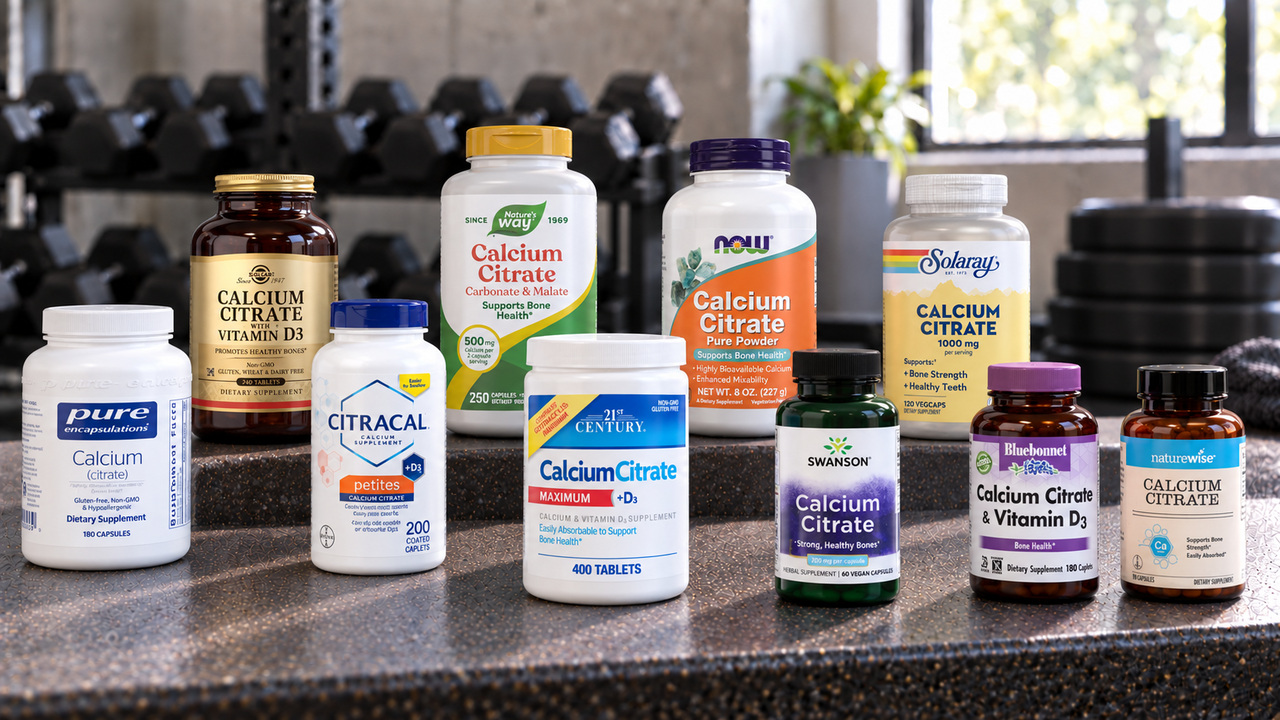
The best calcium citrate supplement is the one that fills the gap in your diet without adding more pills or vitamin D than you need. Some picks below contain citrate alone; others add D3 or blend citrate with carbonate or malate. Citrate is useful when taking calcium with a meal is inconvenient: the NIH notes that it depends less on stomach acid for absorption, while carbonate is generally best taken with food.
Pure Encapsulations Calcium (Citrate) is our best overall pick. Each capsule supplies 150 milligrams of elemental calcium, so its two-capsule serving reaches 300 milligrams without forcing a large single dose. The 180-capsule bottle contains 90 servings, and the short ingredient list makes it easy to compare with the rest of a supplement routine. Citracal Petites is our smaller-caplet pick with added D3, while 21st Century offers the longest tablet supply in this group.
Short on time? Start with Pure Encapsulations Calcium (Citrate) for flexible 150-milligram capsules and a 90-serving bottle. It is a citrate-only formula without added vitamin D. Check the current Amazon listing.
Quick Comparison
| Rank | Product | Label distinction | Rating |
|---|---|---|---|
| 1 | Pure Encapsulations Calcium (Citrate) | 300 mg in two capsules; 90 servings | 4.8/5 |
| 2 | Citracal Petites | 400 mg calcium plus 500 IU D3; 100 servings | 4.7/5 |
| 3 | 21st Century Calcium Citrate +D3 Maximum | 630 mg plus 500 IU D3; 200 servings | 4.6/5 |
| 4 | NatureWise Calcium Citrate | 500 mg in three capsules; 30 servings | 4.5/5 |
| 5 | NOW Calcium Citrate Pure Powder | 600 mg per 1.5 teaspoons; about 76 servings | 4.4/5 |
| 6 | Swanson Calcium Citrate | 200 mg per capsule; 60 servings | 4.3/5 |
| 7 | Solgar Calcium Citrate with Vitamin D3 | 1,000 mg plus 600 IU D3 in four tablets | 4.2/5 |
| 8 | Bluebonnet Calcium Citrate with D3 | 1,000 mg plus 800 IU D3 in four caplets | 4.1/5 |
| 9 | Nature’s Way Calcium Citrate, Carbonate & Malate | 500 mg blended calcium in two capsules | 3.9/5 |
| 10 | Solaray Calcium Citrate | 1,000 mg from 85% citrate plus carbonate | 3.7/5 |
What Matters Before the Rankings
Our ratings weigh elemental-calcium clarity, dose flexibility, serving count, pill burden, added vitamin D, formula purity, and the quality of the public label information. The number beside “calcium” on the Supplement Facts panel is the elemental amount to compare. A separate quantity for calcium citrate describes the compound, not the amount of calcium your daily total should use.
Calcium absorption falls as the amount in a single dose rises. The NIH notes that absorption is highest with doses of 500 milligrams or less.1 That is why a 1,000-milligram four-tablet serving is more useful when divided than when swallowed all at once. Calcium citrate contains about 21% elemental calcium by weight, compared with about 40% for carbonate, so citrate products often need more capsules, tablets, or powder to deliver the same elemental amount.
The 10 Best Calcium Citrate Supplements
1. Pure Encapsulations Calcium (Citrate) – Best Overall

Pure Encapsulations Calcium (Citrate) 180 Capsules
Best OverallA flexible citrate-only capsule with straightforward elemental-calcium math and a short ingredient list.
Pros
- 150 mg elemental calcium per capsule
- Two-capsule serving is easy to divide
- 180 capsules provide 90 servings
Cons
- No vitamin D included
- Higher intakes require several capsules
Pure Encapsulations wins for smaller adjustments. Each capsule supplies 150 mg of elemental calcium as citrate, compared with Swanson’s 200 mg capsule and the much larger full servings from Solgar and Bluebonnet. Two capsules make the labeled 300 mg serving; the 180-count bottle gives you 90 servings. That is a useful format when food already covers much of your daily calcium.
The formula does not include vitamin D, so it will not quietly duplicate the D3 in a multivitamin or a separate vitamin D3 and K2 supplement. That is an advantage for shoppers who already have vitamin D covered, but not for someone specifically seeking a combined formula. The maker suggests two capsules one to three times daily; use your actual dietary need and clinician’s advice rather than assuming the largest label range is necessary.
2. Citracal Petites – Best Smaller Caplet

Citracal Petites Calcium Citrate with Vitamin D3 200 Caplets
Best Smaller CapletA smaller coated caplet with a moderate citrate dose and added vitamin D3.
Pros
- 400 mg elemental calcium per two caplets
- 500 IU vitamin D3 per serving
- 200 caplets provide 100 servings
Cons
- Label direction uses four caplets daily
- Contains gelatin
Citracal Petites provides 400 milligrams of calcium as calcium citrate and 12.5 micrograms, or 500 IU, of vitamin D3 in two caplets. The 200-count bottle contains 100 two-caplet servings. Its elemental amount stays within the dose range the NIH associates with the best absorption, and the coated caplets are smaller than Citracal Maximum Plus.
The adult label direction is two caplets twice daily, which turns the bottle into a 50-day supply and brings the daily label total to 800 milligrams. Count calcium from food first and D3 from every supplement before following that maximum routine. “Petites” is a comparison with another Citracal product, not a promise that everyone will find the caplets small. The formula also contains gelatin, so it is not a vegan option.
3. 21st Century Calcium Citrate +D3 Maximum – Best Value Tablet Supply

21st Century Calcium Citrate +D3 Maximum 400 Tablets
Best Value Tablet SupplyA long tablet supply with added D3, best approached as divided doses rather than one large serving.
Pros
- 400-tablet bottle
- 630 mg elemental calcium plus 500 IU D3 per serving
- 200 two-tablet servings
Cons
- 630 mg serving is better split
- Four tablets daily at full label direction
This 400-tablet bottle has the most labeled servings in our comparison. Two tablets provide 630 milligrams of calcium as calcium citrate plus 12.5 micrograms, or 500 IU, of vitamin D3. That makes 200 two-tablet servings, although the label direction of two tablets twice daily reduces the bottle to 100 days at full use.
The tradeoff is dose size. A 630-milligram serving is above the amount the NIH links to the best absorption in one sitting, so two separate one-tablet doses make more sense when they fit the amount your diet leaves uncovered. Do not treat the 1,260-milligram full label day as a universal target. This is the value pick for shoppers comfortable with tablets and added D3; Pure Encapsulations is easier for smaller adjustments.
4. NatureWise Calcium Citrate – Best 500 mg Capsule Serving

NatureWise Calcium Citrate 500 mg 90 Capsules
Best 500 mg Capsule ServingA citrate-only, vegan capsule formula at the 500-milligram amount associated with the best absorption.
Pros
- 500 mg elemental calcium per serving
- Citrate-only calcium source
- Vegan capsules
Cons
- Three capsules per serving
- Only 30 servings per bottle
NatureWise supplies 500 milligrams of elemental calcium from calcium citrate in three capsules. That is the upper end of the dose range the NIH associates with the best absorption, and the 90-capsule bottle contains 30 servings. The capsule shell is plant based, making this one of the clearer choices for readers avoiding gelatin.
The main limitation is value per bottle: three capsules daily empty it in one month. A 500-milligram serving can also be more than someone needs when food already supplies most of the day’s calcium. Choose NatureWise when a vegan, citrate-only formula at a round 500 milligrams fits the plan. Choose Pure Encapsulations or Swanson when smaller per-capsule increments would be more useful.
5. NOW Calcium Citrate Pure Powder – Best Powder

NOW Calcium Citrate Pure Powder 8 oz
Best PowderA capsule-free pure citrate powder for readers willing to measure and mix each serving.
Pros
- 600 mg calcium from pure calcium citrate per serving
- No capsule or tablet excipients
- About 76 servings in an 8 oz bottle
Cons
- Needs careful measuring and mixing
- Full serving is above the best-absorption range
NOW’s powder lists 600 milligrams of calcium from 3,000 milligrams of calcium citrate in a 1.5-teaspoon serving. The 8-ounce bottle contains about 76 servings and lists no other ingredients. It is the most direct option here for someone who dislikes pills or wants to mix calcium citrate into water or another drink.
Powder shifts the burden from swallowing to measuring. The full 600-milligram serving is also slightly above the amount the NIH associates with the best absorption. A smaller amount can be used, but teaspoons are not precision laboratory tools, and the powder should not be guessed by sight. This is a good format choice when measuring is comfortable; premeasured capsules are easier for travel and consistent routine.
6. Swanson Calcium Citrate – Best Low-Dose Capsule

Swanson Calcium Citrate 200 mg 60 Vegan Capsules
Best Low-Dose CapsuleA straightforward 200-milligram vegan capsule for filling a smaller calcium gap.
Pros
- 200 mg elemental calcium per capsule
- Vegan capsule shell
- Simple citrate-only formula
Cons
- 60-count bottle lasts 30 days at label direction
- No vitamin D included
Swanson puts 200 milligrams of calcium as calcium citrate in one vegan capsule. That is the smallest complete serving in this roundup and a useful amount when the goal is to supplement a diet rather than replace it. The bottle contains 60 one-capsule servings, while the label direction of one capsule twice daily makes it a 30-day supply.
No vitamin D is included, which keeps the formula simple and avoids overlap with other products. The smaller bottle is the drawback: Pure Encapsulations has 180 capsules and a slightly smaller 150-milligram increment. Swanson is the better fit when 200 milligrams per capsule matches the intended gap and a low pill count matters more than a long bottle life.
7. Solgar Calcium Citrate with Vitamin D3 – Best 60-Serving High-Dose Formula

Solgar Calcium Citrate with Vitamin D3 240 Tablets
High-Dose FormulaA high-dose calcium and D3 formula that makes sense only as divided tablets matched to a real dietary need.
Pros
- 1,000 mg elemental calcium plus 600 IU D3
- 240 tablets provide 60 servings
- Four-tablet serving can be divided
Cons
- Four tablets per full serving
- Full serving is better divided
Solgar lists 1,000 milligrams of calcium as calcium citrate and 15 micrograms, or 600 IU, of vitamin D3 in four tablets. The 240-tablet bottle contains 60 full servings. Because the dose is spread across four tablets, it is possible to divide it into smaller portions rather than taking the entire serving at once.
That flexibility is also a warning against reading “four tablets” as a requirement for everyone. A full serving is twice the amount used in the NIH’s best-absorption guidance and may duplicate calcium or D3 from other products. This is a reasonable high-dose option when a clinician has identified a large gap and provided a divided schedule. It ranks below the smaller-dose products because most shoppers benefit from more conservative dose control.
8. Bluebonnet Calcium Citrate with D3 – Best 800 IU D3 Combination

Bluebonnet Calcium Citrate with Vitamin D3 180 Caplets
800 IU D3 CombinationA high-dose calcium citrate formula with more vitamin D3 per serving than the other combined picks.
Pros
- 1,000 mg elemental calcium plus 800 IU D3
- Four-caplet serving can be divided
- Gluten-free label
Cons
- Only 45 full servings
- Four caplets per serving and D3 is from lanolin
Bluebonnet’s four-caplet serving provides 1,000 milligrams of calcium as calcium citrate and 20 micrograms, or 800 IU, of vitamin D3. The 180-count bottle supplies 45 full servings. Like Solgar, the four-caplet format allows a large serving to be split across the day.
Bluebonnet uses D3 from lanolin, so the formula is not vegan even though the calcium source is citrate. The short 45-serving bottle and four-caplet burden also limit its everyday appeal. Choose it only when the added 800 IU of D3 fits the rest of the routine. If you already use a vitamin D supplement, a citrate-only pick is easier to total accurately.
9. Nature’s Way Calcium Citrate, Carbonate & Malate – Best Blended Capsule

Nature's Way Calcium Citrate, Carbonate and Malate 250 Capsules
Blended CapsuleA long-supply vegan blend of citrate, carbonate, and malate rather than a pure calcium citrate formula.
Pros
- 500 mg elemental calcium in two capsules
- 250 capsules provide 125 servings
- Vegan capsule shell
Cons
- Not a citrate-only product
- Label does not disclose each calcium form's proportion
Nature’s Way provides 500 milligrams of calcium from citrate, carbonate, and malate in two capsules. The 250-count bottle contains 125 servings, or about 62 days at the label direction of two capsules twice daily. The capsule shell is plant based, and the two-capsule serving lands at the upper end of the dose range the NIH associates with the best absorption.
This product is included as a clearly labeled blended alternative, not as a pure citrate pick. The Supplement Facts panel does not tell shoppers how much calcium comes from each form, so its absorption and food-timing comparison is less precise. It may suit someone who specifically wants a mixed formula and long supply. For citrate alone, every product ranked above it is easier to evaluate.
10. Solaray Calcium Citrate – Best 85% Citrate Blend Comparison

Solaray Calcium Citrate 1000 mg 120 VegCaps
85% Citrate BlendA predominantly citrate formula that still contains carbonate, with a large four-capsule serving.
Pros
- 1,000 mg elemental calcium per four capsules
- Official label identifies 85% calcium citrate
- Vegetarian capsules
Cons
- Also contains calcium carbonate
- Only 30 full servings and no vitamin D
Solaray’s four-capsule serving supplies 1,000 milligrams of calcium from calcium citrate and calcium carbonate. The official label identifies the formula as 85% calcium citrate, an important detail that the large front-label number does not explain. The 120-capsule bottle contains 30 full servings and does not add vitamin D.
This is a predominantly citrate product, but it is not citrate only. That keeps it below Nature’s Way and the pure-citrate formulas for shoppers specifically searching by form. The 1,000-milligram serving should also be divided, and four capsules are a substantial daily burden. Solaray is worth considering only when the buyer accepts the disclosed carbonate component and prefers its vegetarian capsule format.
How to Choose a Calcium Citrate Supplement
Start with food, then fill the gap
Adults generally need 1,000 to 1,200 milligrams of calcium per day depending on age and sex, but that target includes food and beverages.1 Dairy, fortified plant milks, canned fish with bones, tofu made with calcium, and some greens can cover a meaningful share. Estimate that intake before choosing a 200-, 500-, or 1,000-milligram supplement. More is not automatically better.
Favor 500 mg or less per dose for absorption
Absorption is highest at 500 milligrams or less, so larger servings are more useful when split. Solgar and Bluebonnet put 1,000 milligrams across four units, while 21st Century supplies 630 milligrams in two tablets. Dividing those tablets or caplets is more consistent with the NIH guidance than taking the full amount together. Pure Encapsulations, Swanson, and Citracal make smaller increments easier.
Count added vitamin D and identify blends
Citracal, 21st Century, Solgar, and Bluebonnet include D3. That can simplify a routine, but it can also duplicate a multivitamin or separate D product. Nature’s Way blends citrate, carbonate, and malate; Solaray uses 85% citrate plus carbonate. A blended label is not inherently poor, but it should not be presented as pure calcium citrate.
Review kidney history and medication timing
Calcium can interfere with the absorption of levothyroxine, dolutegravir, and some quinolone antibiotics. In a small pharmacokinetic study, calcium citrate reduced levothyroxine absorption by roughly 20% to 25% when taken together, similar to carbonate and acetate.2 Ask a pharmacist how far apart to schedule calcium and prescription medication. People with kidney disease, a history of kidney stones, high blood calcium, or parathyroid disorders should get individualized medical guidance before supplementing.
Watch the total upper limit
The adult upper limit from food, drinks, and supplements combined is 2,500 milligrams daily for ages 19 to 50 and 2,000 milligrams for adults 51 and older.1 Exceeding the limit is not a shortcut to stronger bones. Calcium supplements can also cause gas, bloating, or constipation. A lower dose that matches the dietary gap is the more useful comparison.
Frequently Asked Questions
Is calcium citrate better absorbed than calcium carbonate?
Calcium citrate depends less on stomach acid and can be taken with or without food. Calcium carbonate is absorbed best with food and provides more elemental calcium by weight. The best form depends on tolerance, meal timing, dose, medications, and the amount you actually need. It is too broad to say citrate is superior for every adult.
What does “500 mg calcium” mean on a citrate label?
On the Supplement Facts panel, it should mean 500 milligrams of elemental calcium, usually followed by the source in parentheses. That is different from 500 milligrams of calcium citrate compound. Compare the elemental calcium line across products and use it when totaling daily intake.
Should calcium citrate be taken with vitamin D?
Vitamin D supports calcium absorption, but a combined product is not automatically necessary. Citracal, 21st Century, Solgar, and Bluebonnet include D3; the other picks let you manage vitamin D separately. Add the D from every supplement before choosing between those approaches.
Can calcium citrate cause kidney stones?
Kidney-stone risk depends on the type of stone, diet, fluid intake, medical history, and how calcium is used. Dietary calcium and supplemental calcium are not interchangeable in stone-risk guidance. Anyone with a history of stones or kidney disease should discuss the dose and timing with a clinician rather than self-prescribing a high-dose product.
Can I take calcium citrate with magnesium?
They can appear in the same routine, but both totals still matter. A combined product may not provide the amount or form you want. Our magnesium supplement guide compares that mineral separately so you can avoid choosing a formula only because it bundles more ingredients.
Bottom Line
Pure Encapsulations Calcium (Citrate) is the best starting point for most readers because each capsule supplies a manageable 150 milligrams of elemental calcium and the 180-count bottle provides 90 two-capsule servings. Citracal Petites is the stronger smaller-caplet choice with D3, 21st Century offers the longest tablet supply, and NOW is the best pill-free powder. Whichever format you choose, match the dose to the calcium your diet does not provide and split amounts above 500 milligrams to support absorption.
Sources
- National Institutes of Health, Office of Dietary Supplements. Calcium: Fact Sheet for Health Professionals.
- Zamfirescu I, Carlson HE. Absorption of Levothyroxine When Coadministered with Various Calcium Formulations. Thyroid. 2011.