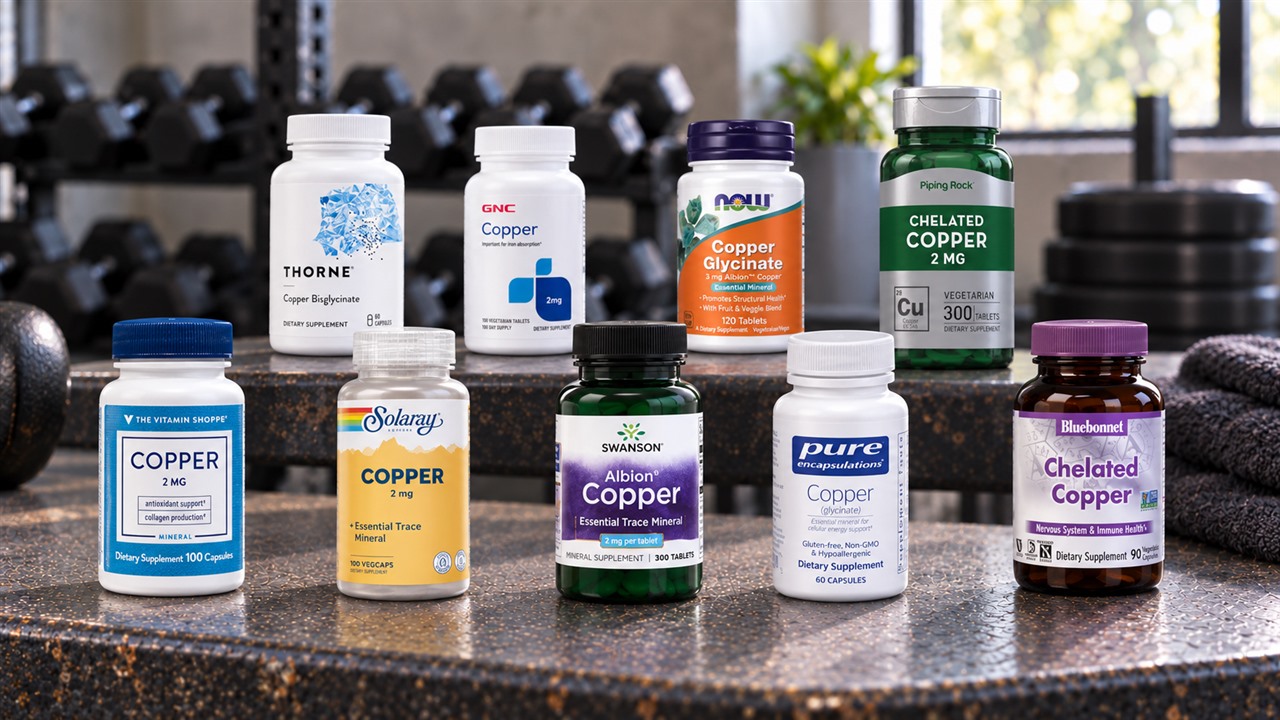
A 3 mg copper tablet supplies more than three times an adult’s daily requirement before you count food. That makes dose selection more important than a long list of wellness claims. If your clinician has identified a reason to supplement, our picks compare straightforward 2 mg, 2.5 mg, and 3 mg formulas without bundling copper into a crowded mineral stack.
Written by Tom Miller, CSCS. Reviewed by the FitnessVolt Editorial Team. Last updated: October 6, 2026.
Short on time? Pure Encapsulations Copper (Glycinate) is our first choice for a simple 2 mg capsule. Swanson makes more sense for a longer tablet supply. Neither is an automatic addition to an adequate diet.
How We Chose
We favor clearly stated elemental copper doses, recognizable mineral forms, and a manageable serving size. A one-capsule 2 mg formula ranks ahead of a higher-dose product when both meet the buyer’s needs. We also compare bottle supply, dietary restrictions, and extra ingredients. A large bottle can lower the purchase cost per serving, but it does not justify months of unnecessary supplementation. Our editorial scores reflect dose clarity, formulation simplicity, buyer fit, and value; they do not represent a change in blood copper levels. We kept multivitamins, zinc-and-copper stacks, and products with unclear copper quantities outside this standalone list. Those purchases solve different problems. The amount your clinician recommends should determine which dose category you consider.
Our Verdict
Pure Encapsulations Copper (Glycinate)
A clearly stated 2 mg copper dose in one capsule, without a bundled mineral stack.
Best for: Adults whose clinician has recommended a straightforward 2 mg copper supplement
Check Price on AmazonOur Top Picks
1. Pure Encapsulations Copper (Glycinate) – Best Overall

Pure Encapsulations Copper (Glycinate) 60 Capsules
Best OverallA simple one-capsule 2 mg glycinate formula for a clinician-directed plan, with fewer servings to commit to than a bulk tablet bottle.
Pros
- 2 mg copper per capsule
- 60 one-capsule servings
- Glycinate form without a mineral blend
Cons
- More than the adult daily requirement
- Smaller bottle than Swanson
Pure keeps this purchase uncomplicated: 2 mg of copper in a glycinate form and 60 capsules. At one capsule per serving, the bottle contains 60 servings. You do not have to account for added zinc, iron, or a second supplement’s worth of minerals.
Choose it when a 2 mg capsule matches your plan and you prefer a modest bottle. Skip this if you want to match the 900 mcg adult requirement with a supplement alone; this dose exceeds it. Swanson also supplies 2 mg, but its 300-tablet bottle commits you to five times as many servings.
2. Thorne Copper Bisglycinate – Best Alternative 2 mg Capsule

Thorne Copper Bisglycinate 60 Capsules
Alternative 2 mg CapsuleThorne pairs a 2 mg dose with a named bisglycinate chelate; compare its checkout price with Pure before paying for brand preference.
Pros
- 2 mg copper in one capsule
- TRAACS bisglycinate chelate
- 60 capsules with a short ingredient list
Cons
- No dose advantage over Pure
- Premium price needs justification
Thorne lists 2 mg of elemental copper as TRAACS copper bisglycinate chelate per capsule. Its label also names microcrystalline cellulose, a cellulose-derived capsule, and leucine. The important number is the 2 mg copper dose, not the weight of the chelate.
This is a sensible alternative to Pure if you already prefer Thorne’s capsule formulation. Both bottles contain 60 capsules, so the price comparison needs little adjustment. Skip this if you expect a premium brand to supply a lower dose or a proven performance advantage over another clearly labeled 2 mg formula.
3. Solgar Chelated Copper – Best 2.5 mg Tablet

Solgar Chelated Copper 100 Tablets
2.5 mg TabletSolgar supplies a distinct 2.5 mg glycinate tablet dose, making it a fit for that specific plan rather than a default higher-dose upgrade.
Pros
- 2.5 mg copper per tablet
- 100 single-tablet servings
- Vegan tablet formula
Cons
- 25 percent more copper than a 2 mg option
- Tablet rather than capsule
Solgar’s label states 2.5 mg of copper as copper glycinate amino acid chelate in one tablet. That is 25 percent more copper than Pure or Thorne, with 100 servings in the bottle. It sits between the common 2 mg and 3 mg options.
Buy it for the dose, not because the extra half milligram sounds beneficial. Its vegan tablet formulation may also suit buyers who avoid capsule shells. Skip this if your recommendation specifies 2 mg or you prefer capsules; Solaray and Pure supply the lower amount in that format.
4. Swanson Albion Copper – Best Long-Supply 2 mg Tablet

Swanson Albion Copper 2 mg 300 Tablets
Long-Supply TabletSwanson's 300-tablet bottle suits an established 2 mg plan, but a smaller supply makes more sense when your clinician expects to reassess soon.
Pros
- 2 mg per tablet
- Albion copper bisglycinate
- 300 single-tablet servings
Cons
- Long supply can outlast a short treatment plan
- No need to finish an unnecessary supplement
Swanson combines a 2 mg dose with an Albion bisglycinate form and a 300-tablet bottle. The supply difference is substantial: five bottles of Pure contain the same number of individual servings. Compare prices per tablet when both formats suit you.
This is a value option for an established plan with follow-up, not a reason to extend supplementation. Skip this if you are buying copper for the first time or expect an early reassessment. A lower initial spend on a 60-count bottle can be the more sensible purchase even when its unit cost is higher.
5. NOW Copper Glycinate – Best 3 mg Tablet

NOW Copper Glycinate 3 mg 120 Tablets
3 mg TabletNOW's 3 mg Albion tablet fits a specific higher-dose recommendation; its extra copper and botanical blend make it less minimal than the leading capsules.
Pros
- 3 mg Albion copper per tablet
- 120 tablets
- Named bisglycinate mineral form
Cons
- 50 percent more copper than the 2 mg picks
- Contains a fruit and vegetable blend
NOW’s 3 mg tablet contains 50 percent more copper than the 2 mg options. The 120-count bottle is smaller than Swanson’s, but each tablet supplies a different dose. The label also includes a fruit and vegetable blend, so this is not the shortest ingredient list here.
Choose NOW when 3 mg matches the recommendation you received and tablets suit you. Skip this if you were advised to use 2 mg or want a capsule without extra botanicals. Bluebonnet supplies the same 3 mg amount in a vegetable capsule, while Pure keeps the copper dose lower.
6. Piping Rock Chelated Copper – Best Alternative Bulk Tablet

Piping Rock Chelated Copper 2 mg 300 Tablets
Alternative Bulk TabletA second 300-tablet 2 mg option for price comparison with Swanson, without treating the chelated label as evidence of better health outcomes.
Pros
- 2 mg per tablet
- 300-tablet bottle
- Vegetarian formula
Cons
- Large commitment for a new user
- Chelated does not prove superior results
Piping Rock matches Swanson’s headline purchase: 2 mg per tablet and 300 tablets. That makes them useful checkout comparisons. Do not compare either bottle with a 60-count capsule product using bottle price alone.
The vegetarian formula suits buyers who want tablets and have a continuing need. Skip this if you want a small trial supply or need a specific named chelate in your plan. Swanson states Albion bisglycinate, while this product’s main purchase distinction is its bulk 2 mg tablet format.
7. The Vitamin Shoppe Copper – Best Gluconate Capsule

The Vitamin Shoppe Copper 2 mg 100 Capsules
Gluconate CapsuleA 100-serving copper gluconate capsule for buyers who do not need a vegan shell or a glycinate formulation, with the same 2 mg copper dose.
Pros
- 2 mg copper gluconate per capsule
- 100 servings
- No artificial colors or flavors
Cons
- Gelatin capsule is not vegan
- Different form from glycinate picks
The Vitamin Shoppe lists 2 mg of copper as copper gluconate in each capsule. Its 100-count bottle gives you more servings than Pure, but the ingredient list includes gelatin. The mineral form and capsule shell make it a different purchase.
It suits a buyer who wants a straightforward 2 mg capsule and does not avoid animal-derived ingredients. Skip this if you need a vegan capsule or your clinician specified glycinate. Solaray and Bluebonnet use vegetable capsules; compare dose as well as shell before switching.
8. GNC Copper – Best 100-Count Vegetarian Tablet

GNC Copper 2 mg 100 Vegetarian Tablets
100-Count TabletGNC supplies the familiar 2 mg dose in a manageable 100-tablet bottle, a middle ground between the smaller capsules and 300-tablet bulk options.
Pros
- 2 mg copper per serving
- 100 vegetarian tablets
- Gluten-free formula
Cons
- No dose advantage over bulk tablets
- Tablet format may not suit capsule users
GNC’s 100 vegetarian tablets sit between the 60-count capsule bottles and the 300-count value tablets. The stated 2 mg dose matches the leading picks. Its main appeal is buying a moderate tablet supply rather than chasing a higher mineral amount.
Consider it when you want vegetarian tablets and a 100-count bottle. Skip this if you prefer capsules or can justify the larger Swanson supply at a lower cost per serving. GNC’s label does not turn copper into an iron treatment; unexplained fatigue or suspected anemia needs assessment.
9. Solaray Copper – Best 100-Count Vegan Capsule

Solaray Copper 2 mg 100 Vegan Capsules
100-Count Vegan CapsuleSolaray combines a 2 mg dose and vegan capsule with a 100-count supply, giving you a longer bottle than Pure without stepping up to 3 mg.
Pros
- 2 mg copper per capsule
- 100 vegan capsules
- Amino acid chelate mineral form
Cons
- Includes rice concentrate
- Chelate blend is not identical to Pure's glycinate
Solaray lists 2 mg of copper from an amino acid chelate complex in one vegan capsule. You get 100 servings, and the label includes whole rice concentrate. A vegetable shell does not mean the capsule contains only the copper compound.
This is a practical longer-supply capsule alternative to Pure at the same copper dose. Skip this if you avoid rice ingredients or require a specifically named bisglycinate chelate. Thorne is clearer on that particular form; compare the complete ingredient lists rather than assuming all chelates are identical.
10. Bluebonnet Albion Chelated Copper – Best 3 mg Vegetable Capsule

Bluebonnet Albion Chelated Copper 3 mg 90 Vegetable Capsules
3 mg Vegetable CapsuleBluebonnet is the capsule alternative to NOW's 3 mg tablet, with a named Albion chelate and 90 servings for a specific higher-dose plan.
Pros
- 3 mg Albion copper per capsule
- 90 single-capsule servings
- Vegan capsule formulation
Cons
- Higher dose than most readers need
- Fewer units than NOW's 3 mg bottle
Bluebonnet lists 3 mg of copper as an Albion bisglycinate chelate, with 90 vegetable capsules and 90 servings. Compared with NOW’s 120 tablets, you get fewer individual servings but a different delivery format at the same copper amount.
Choose it for the capsule and dose combination, not as an upgrade from 2 mg. Skip this if your diet already covers copper or your plan calls for a lower amount. Pure and Solaray supply 2 mg; Solgar’s 2.5 mg tablet is another distinct dose rather than a substitute to make without advice.
Alternatives Worth Considering
If a balanced diet or your existing multivitamin already covers copper, the best purchase may be no standalone bottle. A zinc-and-copper combination can be useful in a specific plan, but it also adds zinc you may not need. Avoid choosing a copper liquid by concentration in parts per million unless the label translates that into a clear elemental dose per serving.
Copper Supplement Comparison
| Product | Key Spec | Best For | Price |
|---|---|---|---|
| Pure Encapsulations Copper (Glycinate) 60 Capsules | 2 mg glycinate; 60 capsules | Best Overall | Check Price |
| Thorne Copper Bisglycinate 60 Capsules | 2 mg bisglycinate; 60 capsules | Alternative 2 mg Capsule | Check Price |
| Solgar Chelated Copper 100 Tablets | 2.5 mg glycinate; 100 tablets | 2.5 mg Tablet | Check Price |
| Swanson Albion Copper 2 mg 300 Tablets | 2 mg bisglycinate; 300 tablets | Long-Supply Tablet | Check Price |
| NOW Copper Glycinate 3 mg 120 Tablets | 3 mg bisglycinate; 120 tablets | 3 mg Tablet | Check Price |
| Piping Rock Chelated Copper 2 mg 300 Tablets | 2 mg chelated copper; 300 tablets | Alternative Bulk Tablet | Check Price |
| The Vitamin Shoppe Copper 2 mg 100 Capsules | 2 mg gluconate; 100 capsules | Gluconate Capsule | Check Price |
| GNC Copper 2 mg 100 Vegetarian Tablets | 2 mg copper; 100 tablets | 100-Count Tablet | Check Price |
| Solaray Copper 2 mg 100 Vegan Capsules | 2 mg amino acid chelate; 100 capsules | 100-Count Vegan Capsule | Check Price |
| Bluebonnet Albion Chelated Copper 3 mg 90 Vegetable Capsules | 3 mg bisglycinate; 90 capsules | 3 mg Vegetable Capsule | Check Price |
How to Choose a Copper Supplement
Start with the reason, then the dose
The NIH lists 900 mcg per day as the adult copper requirement. That is 0.9 mg from total intake, not a recommendation to add a 2 mg capsule to food. Pure, Thorne, and Solaray each supply more than twice that amount in a serving. Solgar supplies 2.5 mg, and NOW and Bluebonnet supply 3 mg. Pick among those amounts only after establishing why a supplement belongs in your routine.
Read elemental copper, not chelate weight
Use the copper line in Supplement Facts when you compare formulas. Thorne’s 2 mg refers to copper, even though the mineral arrives in a larger bisglycinate compound. Chelation identifies a mineral form; it does not establish that one brand will improve your energy or training. Pure and Thorne are the closest capsule comparisons here. Swanson and Piping Rock are the closest long-supply tablet comparisons.
Check the zinc you already take
The NIH warns that excessive zinc can impair copper absorption. Bring the labels of your zinc supplement, multivitamin, and pre-workout to a clinician rather than trying to balance them with an online ratio. A product in our zinc supplement guide may already overlap with another bottle you own. Adding copper without reviewing the source of excess zinc can leave the underlying problem unresolved.
Compare supply without committing to unnecessary use
Divide the checkout price by the number of labeled servings. Pure and Thorne each contain 60 single-capsule servings; Swanson and Piping Rock contain 300 single-tablet servings. At identical bottle prices, a 300-count product costs one fifth as much per serving. Actual prices vary, and the lower unit price matters only if the formulation and ongoing need match. Do not increase frequency or extend a plan to use up a bottle.
Account for shell ingredients and medical history
The Vitamin Shoppe capsule contains gelatin, while Solaray and Bluebonnet use vegetable capsules. Solgar and GNC are tablet options. Those details matter more than broad clean-label claims. Avoid copper supplements with Wilson disease or another copper-handling disorder unless your specialist directs them. The adult upper limit is 10 mg from all sources, not a target dose. Seek medical advice for suspected deficiency, liver disease, pregnancy, or unexplained neurological symptoms rather than using copper as a diagnostic experiment.
Frequently Asked Questions
Who needs a copper supplement?
A documented shortfall, an absorption problem, or a clinician-directed plan can justify supplementation. Adequate dietary intake does not create a reason to add more copper for fitness. Copper contributes to normal physiological functions, but that fact alone does not establish a benefit from additional capsules. Discuss suspected deficiency before selecting a dose from this list.
Is 2 mg of copper a low dose?
It is lower than the 2.5 mg and 3 mg products here, but it still exceeds the 0.9 mg adult daily requirement before food. Lower within a product category does not mean universally appropriate. Pure, Thorne, Swanson, Piping Rock, GNC, Solaray, and The Vitamin Shoppe all state 2 mg per serving.
Should I take copper whenever I take zinc?
No fixed rule fits every dose and duration. Excessive zinc can reduce copper absorption, but adding copper automatically can create another unnecessary supplement. Check total zinc from your existing products and discuss longer-term high-dose use with a clinician. Our ZMA guide covers another common source of overlapping minerals.
Is copper glycinate better than gluconate?
Both names identify copper forms used in supplements. They do not, by themselves, establish a meaningful difference in outcomes for you. Pure lists glycinate, Thorne names bisglycinate, and The Vitamin Shoppe lists gluconate. Choose the advised elemental dose and compatible ingredients first. A form preference should not prompt you to increase the copper amount.
Can copper supplements improve workout energy?
Copper participates in energy metabolism, but participation in a biological pathway does not mean additional copper acts as a stimulant. Correcting a diagnosed deficiency differs from supplementing an adequate diet. Do not treat fatigue as proof of low copper or use a capsule to replace assessment of sleep, food intake, iron status, or other possible causes.
Bottom Line
Pure Encapsulations is our first pick for a clinician-directed 2 mg capsule because its dose and single-capsule serving are straightforward. Swanson suits an established plan where a 300-tablet supply makes sense. Keep the 3 mg NOW and Bluebonnet options for a recommendation that calls for that amount. Check your existing multivitamin before adding standalone copper; an adequate diet and appropriate mineral balance matter more than owning another bottle.
Sources
- NIH Office of Dietary Supplements: Copper, consumer fact sheet.
- NIH Office of Dietary Supplements: Copper, health professional fact sheet.