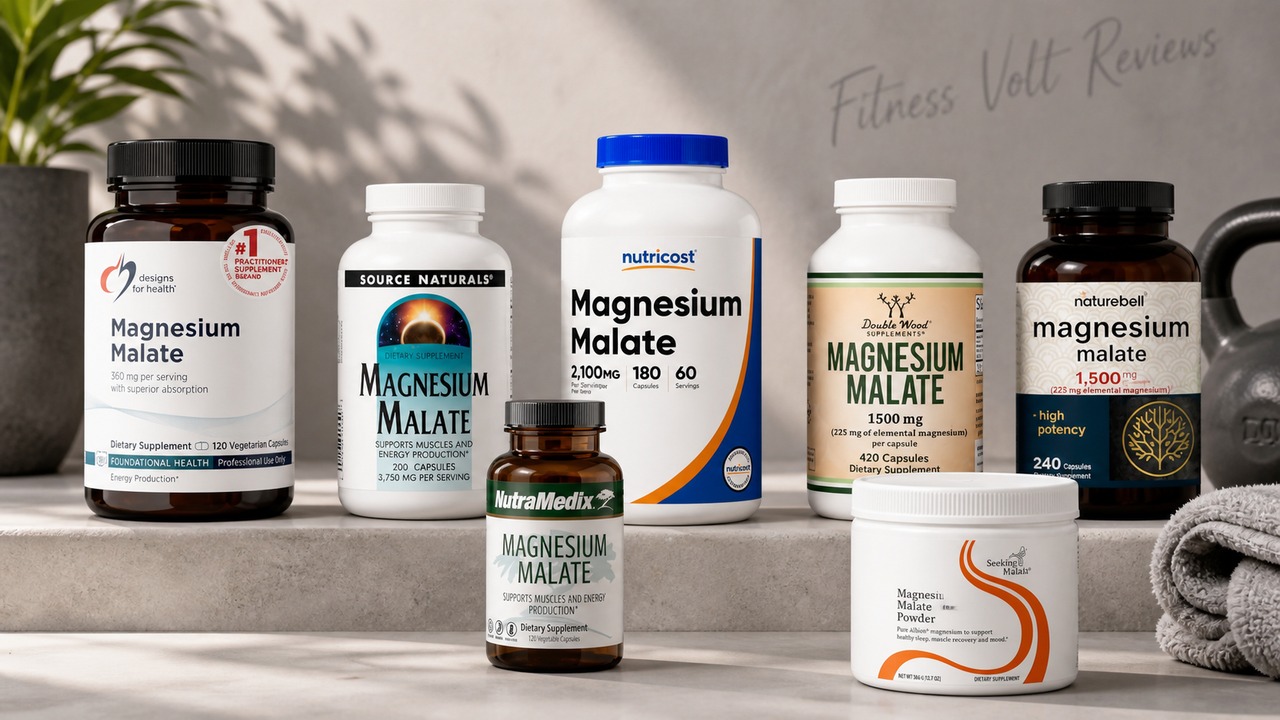
An evidence-aware guide to eight magnesium malate listings, focused on the one number that decides whether a comparison is honest: elemental magnesium per serving, not the biggest compound-weight claim on the front.
Magnesium malate shopping gets confusing when a bottle leads with 1,500 mg, 2,100 mg, or 3,750 mg and the buyer assumes that number is elemental magnesium. It may be the total weight of a magnesium-malate compound instead. The Supplement Facts panel, not the largest number in a product title, is where a reader learns the elemental-magnesium amount, serving size, and how many capsules it takes to reach that serving. A label that does not make those details visible should be ranked for its uncertainty, not rewarded for sounding potent.
Magnesium is essential, and food remains a meaningful source. A supplement can help fill a gap for some people, but it is not an automatic energy, muscle-recovery, or sleep solution. Magnesium malate is a magnesium-and-malic-acid form; the word malate does not make every product equivalent, nor does it establish a special performance benefit. The National Institutes of Health recommends assessing total intake, possible gastrointestinal effects, and medication timing rather than casually stacking several magnesium products. For the broader picture, see FitnessVolt’s magnesium guide for muscle, sleep, and recovery.
This list rewards records that make the form, elemental amount, serving burden, and format easier to audit. The Nutricost powder is the only selected title that directly states 420 mg of magnesium per serving, so it earns the cleanest dose-clarity role. Several capsule titles name only 1,500 mg, 2,100 mg, or 3,750 mg of magnesium malate. Those figures may still be useful product facts, but they cannot be treated as elemental magnesium without checking the delivered panel. Read that panel, any buffered or blended-form wording, inactive ingredients, and the directions before buying. FitnessVolt’s best magnesium supplements guide is the better starting point for readers who have not yet decided that malate is the desired form.
Our Verdict
Nutricost Magnesium Malate Powder
The selected title states 420 mg of magnesium per serving and a 300 g powder format, which gives buyers a concrete elemental-magnesium comparison instead of only a large compound-weight number. That disclosure wins the label comparison, not a special recovery promise.
Best for: Adults who prefer an unflavored powder and want a selected listing that states elemental magnesium per serving before they inspect the complete label
Check Price on AmazonHow These Magnesium Malate Listings Were Ranked
The first criterion is elemental-magnesium clarity. Magnesium is the mineral the buyer is trying to quantify; magnesium malate is the compound form. Nutricost Powder explicitly says 420 mg of magnesium per serving. Seeking Health says 500 mg and 100 servings in the selected title but does not specify whether that 500 mg is elemental magnesium or compound weight, so it belongs below the product whose mineral amount is stated. The same restraint applies to 1,500 mg, 2,100 mg, and 3,750 mg capsule listings.
The second criterion is serving burden. A 420-capsule bottle can be appealing, yet no one can call it a 420-day supply without knowing capsules per serving. Powders remove capsule burden but add measuring, mixing, taste, and travel friction. The best format is the one a buyer can take consistently and safely after the label is read, not the format with the most dramatic number. Prices are recorded marketplace snapshots before tax and shipping, not permanent value claims.
The third criterion is formula clarity. A true magnesium-malate label should identify the form and the actual elemental-magnesium amount. If the facts panel lists more than one magnesium form, including oxide or a blend, the product may still be usable but should not be presented as a pure-malate comparison. The word buffered can also signal a blend rather than a simple one-form product. The selected listings do not show the complete facts panel for every bottle, so these rankings call out questions instead of inventing answers.
Magnesium Malate Supplements at a Glance
| Product | Listing facts to compare | Recorded price | Best fit | |
|---|---|---|---|---|
| Nutricost Powder | 300 g powder; 420 mg magnesium per serving | $21.95 | Clearest elemental-magnesium title | Check price |
| Source Naturals | 3,750 mg per serving; 200 capsules | $16.45 | Large compound-weight listing to inspect | Check price |
| Nutricost Capsules | 2,100 mg; 180 vegetarian capsules | $15.95 | Budget capsule comparison | Check price |
| Double Wood | 1,500 mg; 420 capsules | $21.95 | High-count capsule comparison | Check price |
| NatureBell | 1,500 mg; 240 capsules | $17.99 | Middle-count capsule comparison | Check price |
| Seeking Health Powder | 500 mg; 100 servings | $23.00 | Powder with facts-panel question | Check price |
| Designs for Health | 120 capsules; amount absent from selected title | $31.99 | Capsule product requiring label review | Check price |
| NutraMedix | 120 vegetarian capsules; amount absent from selected title | $16.46 | Lowest-cost unclear-dose listing | Check price |
Prices, availability, quantities, and images reflect the selected shopping records. Confirm elemental magnesium, form, serving size, every ingredient, and checkout total on the physical product and current listing. No stated amount is personal dosing advice.
Our Eight Picks
1. Best Elemental-Magnesium Clarity: Nutricost Magnesium Malate Powder

Nutricost Magnesium Malate Powder, 300 g, 420 mg Magnesium per Serving
Best Elemental-Magnesium ClarityA 300 g magnesium malate powder with 420 mg magnesium per serving stated in the selected title, making it the cleanest starting point for dose comparison.
Pros
- Selected title states 420 mg of magnesium per serving
- Powder avoids a multi-capsule burden
- 300 g format is stated
Cons
- Powder requires measuring and mixing
- Elemental amount still needs a physical-label and total-intake check
Nutricost Powder wins because it gives the buyer the essential fact directly: 420 mg of magnesium per serving. That is elemental-magnesium language, not merely a 1,500 mg or 2,100 mg compound-weight headline. The 300 g powder format is also distinct from the capsule products. At the recorded $21.95, it costs the same as Double Wood’s 420-capsule listing, but it makes the dose comparison more transparent from the selected title.
Skip this if: measuring powder, mixing an unflavored drink, or taking magnesium away from certain medicines is impractical. Powder is not inherently superior. A capsule with a clear facts panel can be easier to use. Check the scoop size, number of servings, complete form statement, and total supplemental magnesium across multivitamins, electrolytes, ZMA, and sleep products before using this as a daily source.
2. Best Large Compound-Weight Listing to Audit: Source Naturals

Source Naturals Magnesium Malate, 3,750 mg per Serving, 200 Capsules
Best Large-Label AuditA 3,750 mg-per-serving, 200-capsule magnesium malate listing for readers who will check the elemental-magnesium line before treating the large front number as a dose.
Pros
- 3,750 mg per serving and 200 capsules are stated
- Recorded price is low for the capsule count
- Makes compound-versus-elemental math visible
Cons
- 3,750 mg should not be read as elemental magnesium without the facts panel
- Capsules per serving determine the true supply
Source Naturals is a useful second-place product precisely because it forces the correct label question. The title says 3,750 mg per serving and 200 capsules at $16.45. That looks like enormous magnesium value until the buyer asks what the 3,750 mg represents. Magnesium malate is a compound, so the actual elemental magnesium must be found in the Supplement Facts panel. The title alone does not prove it.
Skip this if: the facts panel is not available before purchase or the buyer wants a one-glance elemental amount. Nutricost Powder makes that information clearer from the start. Source Naturals can still be a good capsule comparison after the label is checked, but it should never be selected by dividing $16.45 by 3,750 mg and calling the result a cost per milligram of magnesium.
3. Best Budget Capsule Listing: Nutricost Magnesium Malate Capsules

Nutricost Magnesium Malate 2,100 mg, 180 Vegetarian Capsules
Best Budget CapsulesA low-upfront-cost, 180-capsule magnesium malate listing for buyers who prefer capsules and will verify elemental magnesium before comparing value.
Pros
- 180 vegetarian capsules are stated
- Lowest recorded price among selected 180-plus-capsule listings
- Malate form is named
Cons
- 2,100 mg may be compound weight rather than elemental magnesium
- Serving size and complete form details need checking
Nutricost Capsules is the straightforward budget capsule entry. Its selected title lists 2,100 mg, 180 capsules, vegetarian status, and a $15.95 recorded price. That combination gives it a practical role for buyers who do not want powder. The same hard rule applies, though: a 2,100 mg product-title figure does not by itself reveal the elemental-magnesium dose. There is no honest shortcut around the Supplement Facts line.
Skip this if: a fully visible elemental number is required before checkout, or if a multi-capsule serving will be a nuisance. Nutricost Powder is clearer on elemental magnesium. A reader who prefers capsules can still choose this product after confirming facts-panel math, but should compare price per actual serving, not price per capsule or price per compound-weight claim.
4. Best High-Count Capsule Comparison: Double Wood

Double Wood Magnesium Malate 1,500 mg, 420 Capsules
Best High-Count CapsulesA 420-capsule magnesium malate listing for buyers comparing bottle count, provided they first identify the elemental magnesium and capsules per serving.
Pros
- 420-capsule count is stated
- 1,500 mg malate figure is stated
- Recorded price matches the clearer Nutricost powder
Cons
- Large capsule count is not a day count
- Title does not state elemental magnesium
Double Wood owns the high-count role with 420 capsules for $21.95. It can look like an obvious long-term bargain, yet 420 is a packaging count, not the number of servings. The chosen title also names 1,500 mg but not elemental magnesium. That combination is why it ranks as a specific comparison tool, not as the automatic best value or highest dose in the list.
Skip this if: capsule burden is unknown or the product will be stacked with other magnesium sources. A powder may be easier for someone who dislikes capsules, while a shorter bottle with a fully stated elemental amount may be easier to budget and audit. Check whether the facts panel identifies a pure malate form or additional magnesium forms before assuming the label reflects a simple one-ingredient product.
5. Best Middle-Count Capsule Comparison: NatureBell

NatureBell Magnesium Malate 1,500 mg, 240 Capsules
Best Middle-Count CapsulesA 1,500 mg, 240-capsule magnesium malate listing for readers who want a middle-size bottle but will inspect the mineral amount and serving burden.
Pros
- 1,500 mg and 240 capsules are stated
- Non-GMO and gluten-free wording is stated
- Lower recorded price than Double Wood
Cons
- Chelated wording does not substitute for elemental-magnesium disclosure
- Capsules per serving are not stated in the selected title
NatureBell gives the buyer a middle path between Nutricost’s 180 capsules and Double Wood’s 420: 240 capsules for $17.99. Its title uses chelated and high-absorption language, but the valuable comparison information is still the elemental-magnesium line and the exact serving size. Chelated is a formulation description, not a guarantee of a particular absorption result, tolerance outcome, or recovery benefit for the individual buyer.
Skip this if: the word chelated is the main reason for purchase. It is better to verify form, elemental magnesium, and other ingredients first. Double Wood offers more capsules at a higher recorded price, while Nutricost Powder is clearer about 420 mg of magnesium per serving. Choose NatureBell for its bottle size only after the facts-panel numbers make sense for the whole routine.
6. Best Powder Supply to Verify: Seeking Health

Seeking Health Magnesium Malate Powder, 500 mg, 100 Servings
Best 100-Serving PowderA 100-serving magnesium malate powder for buyers who prefer a drink format but will verify whether the stated 500 mg refers to magnesium or the compound.
Pros
- 100 servings are stated
- Powder avoids capsule burden
- Dimagnesium malate wording appears in the title
Cons
- Selected title does not make clear whether 500 mg is elemental magnesium
- Powder format adds measuring and travel friction
Seeking Health is a useful powder alternative with a stated 100 servings and a $23.00 recorded price. It also names dimagnesium malate. The caution is the title’s 500 mg figure: without a clear elemental-magnesium label in the selected record, it cannot be compared directly with Nutricost Powder’s stated 420 mg magnesium per serving. The difference may be easy to resolve on the physical label, but it should not be guessed.
Skip this if: elemental-dose clarity is the primary reason to choose powder. Nutricost Powder wins that contest from the title alone. Seeking Health may fit a buyer who has already checked its full label and wants 100 listed servings, but a seller’s broad bone, muscle, or absorption language should not become a personalized claim.
7. Best Capsule Listing Requiring a Dose Check: Designs for Health

Designs for Health Magnesium Malate, 120 Capsules
Verify Elemental DoseA 120-capsule magnesium malate listing that requires a Supplement Facts check before its high recorded price can be compared with any other product here.
Pros
- Magnesium malate form and 120-capsule count are stated
- Capsule format is simple to transport
- Product title is concise
Cons
- Selected title omits elemental magnesium and total compound weight
- Highest recorded price in the list
Designs for Health may be a product a buyer recognizes, but the selected title only gives magnesium malate and 120 capsules. It does not state a mineral amount, total compound weight, capsules per serving, or why $31.99 should be preferred over the clearer Nutricost Powder. The product can become a reasonable option after a facts-panel review, yet the information on hand does not support a stronger ranking.
Skip this if: a product must be easy to compare before checkout. The 120-capsule count is not enough. Request or locate the actual Supplement Facts panel, then check elemental magnesium, serving size, inactive ingredients, and the full form statement. Until then, the price is a number without a useful denominator.
8. Best Low-Cost Listing to Pause On: NutraMedix

NutraMedix Magnesium Malate, 120 Vegetarian Capsules
Pause for Label DetailsA $16.46, 120-vegetarian-capsule magnesium malate listing that must clear a full-label check before it can be compared responsibly with the better-documented options.
Pros
- 120 vegetarian capsules are stated
- Recorded price is low
- Non-GMO and gluten-free wording is stated
Cons
- Selected title does not state elemental magnesium or serving size
- Benefit language is not a substitute for dose clarity
NutraMedix has a tempting $16.46 recorded price and 120 vegetarian capsules, but it illustrates why a generic benefit claim should not outweigh dose clarity. The selected title describes several intended benefits but gives no elemental-magnesium number or serving size. That makes it impossible to calculate a meaningful cost per serving or to judge whether it would duplicate magnesium already coming from an electrolyte mix, multivitamin, or sleep product.
Skip this if: the listing does not provide a complete Supplement Facts panel before purchase. Nutricost Powder and other clear labels reduce the need to guess. A low checkout price does not make a bottle a value when the amount, form composition, and capsule burden are not fully visible.
Products We Would Not Choose First
Designs for Health and NutraMedix are the two products to pause on first. Both selected titles identify magnesium malate and a capsule count, but neither supplies the elemental-magnesium amount needed for an honest comparison. Designs for Health is also the most expensive product in this group at $31.99. NutraMedix is inexpensive, but its lower price cannot be called value without the serving and mineral math.
This is not a verdict that either product is unsafe or ineffective. It is an editorial rule against buying a magnesium product because the front label says energy, muscle, sleep, or joint support. The right first purchase is one whose actual magnesium amount, serving burden, form, and stack risk can be read before the credit card comes out.
Magnesium Malate Buying Guide: The Numbers That Matter
Elemental magnesium comes first
The word magnesium on the Supplement Facts panel should be followed by an elemental amount and a percent Daily Value. That is the mineral amount to use when comparing products and total intake. A title saying 1,500 mg magnesium malate can describe the entire magnesium-and-malic-acid compound, not 1,500 mg elemental magnesium. Nutricost Powder provides a useful model because its selected title specifically says 420 mg of magnesium per serving. Do not apply its clarity to another brand whose title only names a much larger compound weight.
Then read the form statement and any buffered wording
Magnesium malate can be listed as dimagnesium malate or another malate form. The full panel may also reveal a blend of magnesium forms. That is important because a blended product should not be sold as a pure-malate product by implication. Buffered wording can deserve additional scrutiny: it may describe an ingredient blend, which changes both the form comparison and the amount of each form. Ask for the exact form, the elemental amount, and the ingredients list before choosing a product for a supposedly special malate benefit.
Capsules, tablets, and powders solve different problems
Nutricost Powder and Seeking Health avoid swallowing several capsules but require a scoop, a drink, and tolerance for unflavored powder. Double Wood’s 420 capsules and NatureBell’s 240 capsules can be simpler to carry, but bottle size has no meaning until the serving size is known. A capsule form also does not remove possible digestive effects. Choose the format that makes the intended serving easy to follow and easy to keep separate from medication timing, not the format with the most impressive bottle count.
Watch the supplemental-magnesium ceiling and medication timing
The NIH Office of Dietary Supplements lists a tolerable upper intake level for supplemental magnesium for adults of 350 mg per day, separate from magnesium naturally present in food and beverages. That limit is not an invitation to self-prescribe a target, and individual clinical guidance can differ. High supplemental amounts can cause diarrhea, nausea, and abdominal cramping. Magnesium can also interact with some antibiotics and bisphosphonates, and people with impaired kidney function need professional guidance. Do not stack a malate product with several magnesium-containing supplements casually.
Do not buy malate for a promise it cannot keep
Malate is often marketed for energy, exercise recovery, muscle comfort, or daytime use. Those phrases do not establish a specific outcome for the finished supplement or the person taking it. Adequate food, carbohydrates around hard training when appropriate, protein, sleep, hydration, and a manageable program decide far more about recovery. For a form comparison centered on sleep-oriented routines, FitnessVolt’s magnesium glycinate guide explains why a different form should be chosen for a clear reason rather than a trend.
Frequently Asked Questions
Is 1,500 mg magnesium malate equal to 1,500 mg magnesium?
Usually, no. A magnesium-malate number can refer to the total compound weight, which includes malic acid as well as magnesium. The elemental-magnesium line in Supplement Facts is the number to compare. Do not read Source Naturals’ 3,750 mg, Nutricost Capsules’ 2,100 mg, or NatureBell’s 1,500 mg title figures as elemental magnesium unless the product’s actual label says so.
Is magnesium malate better for energy or workouts?
Not as a universal rule. Magnesium is involved in normal energy metabolism, and malate is a form component, but a form name does not prove an acute energy or workout effect from a finished supplement. Correct a real nutrition gap, keep expectations modest, and do not use a supplement to mask sleep loss, under-fueling, unusually severe fatigue, or a health concern that needs evaluation.
How much magnesium malate should I take?
There is no universal product dose for every adult. Read the elemental-magnesium amount, serving directions, diet, medications, kidney status, and every other magnesium source. The NIH supplemental upper limit is a population guidance point, not personal prescribing. A pharmacist, registered dietitian, or clinician can help when medication timing, health conditions, pregnancy, breastfeeding, or a high total intake is involved.
Can I take magnesium malate with other magnesium supplements?
Only after adding up the elemental magnesium from every product. Multivitamins, electrolytes, ZMA, sleep formulas, antacids, laxatives, and other mineral products can overlap. Stacking makes it easier to overshoot a planned amount and harder to identify the source of digestive effects. One clear product is easier to assess than several products added because each one sounded useful.
What should I verify before buying a magnesium malate powder?
Check elemental magnesium per serving, scoop size, total servings, exact magnesium form, whether other forms such as oxide are included, all inactive ingredients, mixing instructions, storage, and timing relative to medicines. The Nutricost Powder title states 420 mg magnesium per serving, but the full label still matters. Seeking Health’s 500 mg title needs an even closer check to see whether that number is elemental magnesium or compound weight.
Bottom Line
Nutricost Magnesium Malate Powder is the best starting point because the selected title states 420 mg of magnesium per serving. That allows a real elemental-magnesium comparison before the buyer reaches for a calculator. Source Naturals, Nutricost Capsules, Double Wood, and NatureBell can all be reasonable products to investigate, but their bigger 1,500 mg to 3,750 mg labels need a facts-panel check before they are treated as doses.
The rule worth keeping is simple: buy elemental-magnesium clarity, not compound-weight theater. Read the form, serving size, and full ingredient list; count overlap across every supplement; and choose powder or capsules based on the routine that can be followed safely. FitnessVolt’s sleep supplements for recovery guide can help keep magnesium in perspective when the real issue is an overstuffed evening stack.
Sources
- National Institutes of Health Office of Dietary Supplements. Magnesium: Fact Sheet for Health Professionals.
- National Institutes of Health Office of Dietary Supplements. Magnesium: Fact Sheet for Consumers.
- National Center for Complementary and Integrative Health. Using Dietary Supplements Wisely.
- U.S. Food and Drug Administration. Questions and Answers on Dietary Supplements.
- Pardo, M. R., et al. Bioavailability of magnesium food supplements: A systematic review. Nutrition.