

Astride Jumps (male) vs Burpee: Complete Comparison Guide
Astride Jumps (male) vs Burpee — two bodyweight, compound cardio moves that push your heart rate and challenge your lower body. If you want clear direction on which to use for specific goals, this guide has your back. You’ll get a breakdown of primary and secondary muscle activation, step-by-step technique cues (including landing angles and rep ranges), equipment needs, relative injury risk, and practical progressions. Read on to see which exercise fits sprint-style intervals, steady-state circuits, or mixed metabolic conditioning, and how to program reps, sets, and rest for measurable progress.
Exercise Comparison
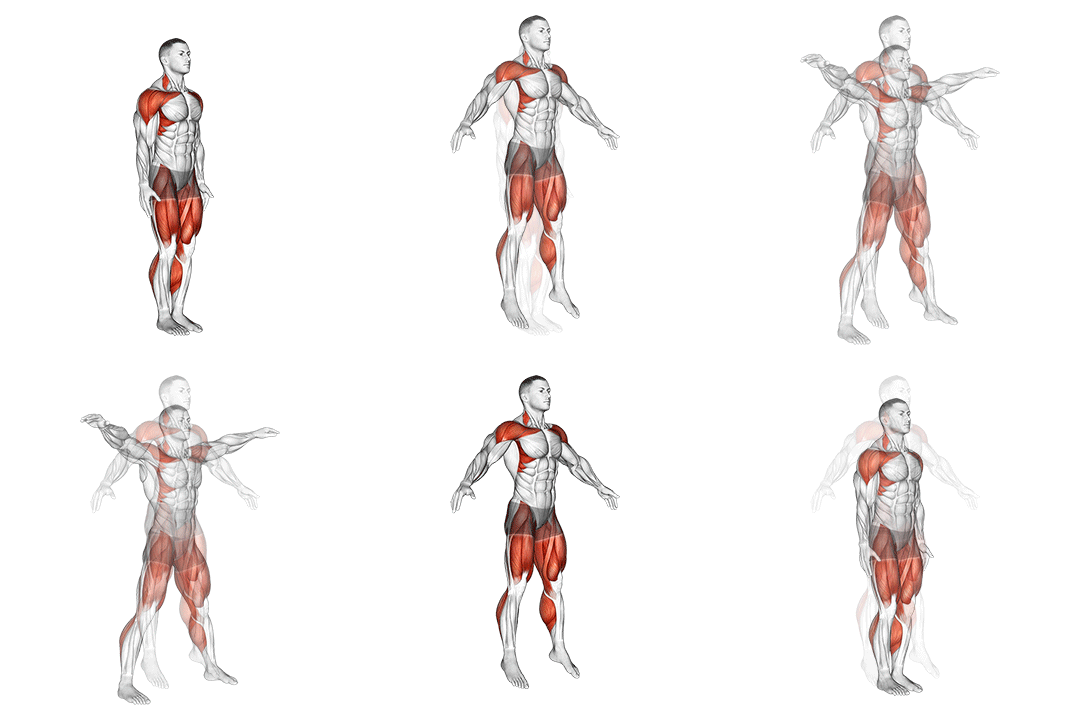
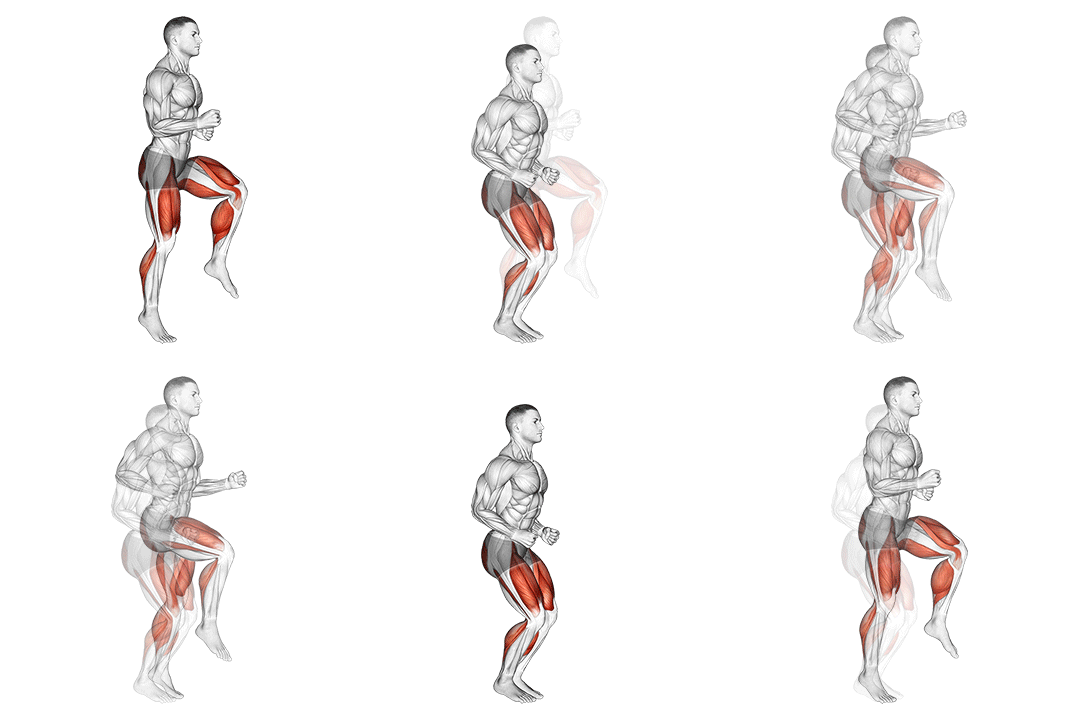
Astride Jumps (male)
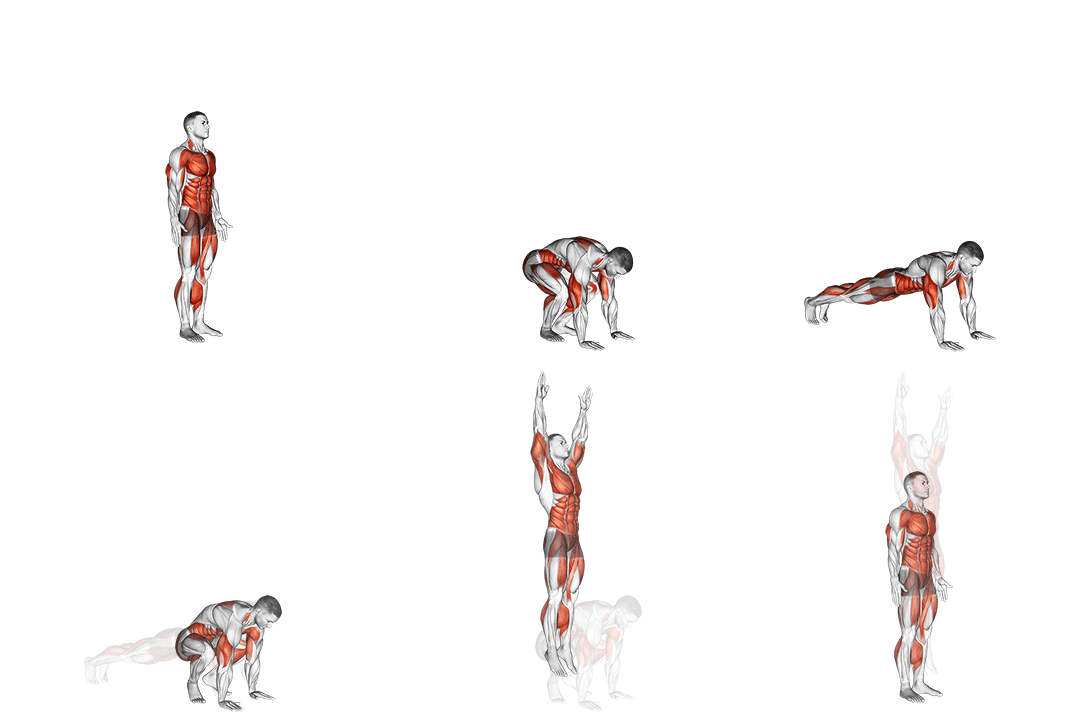
Burpee
Head-to-Head Comparison
| Attribute | Astride Jumps (male) | Burpee |
|---|---|---|
| Target Muscle |
Cardiovascular-system
|
Cardiovascular-system
|
| Body Part |
Cardio
|
Cardio
|
| Equipment |
Body-weight
|
Body-weight
|
| Difficulty |
Intermediate
|
Intermediate
|
| Movement Type |
Compound
|
Compound
|
| Secondary Muscles |
3
|
5
|
Secondary Muscles Activated
Astride Jumps (male)
Burpee
Visual Comparison
Overview
Astride Jumps (male) vs Burpee — two bodyweight, compound cardio moves that push your heart rate and challenge your lower body. If you want clear direction on which to use for specific goals, this guide has your back. You’ll get a breakdown of primary and secondary muscle activation, step-by-step technique cues (including landing angles and rep ranges), equipment needs, relative injury risk, and practical progressions. Read on to see which exercise fits sprint-style intervals, steady-state circuits, or mixed metabolic conditioning, and how to program reps, sets, and rest for measurable progress.
Key Differences
- Both exercises target the Cardiovascular-system using Body-weight. The main differences are in their movement patterns and muscle activation angles.
Pros & Cons
Astride Jumps (male)
+ Pros
- Simple to teach and quick to ramp intensity with cadence or jump height
- Lower upper-body strain — good if you have wrist or shoulder limitations
- Excellent for improving plyometric efficiency and reactive power (short ground contact times)
- Requires no equipment and minimal space
− Cons
- Limited upper-body and core loading for strength development
- High repetitive landing forces can irritate knees and Achilles without technique cues
- Less variety for long-term progression compared to push-up inclusive moves
Burpee
+ Pros
- Full-body compound pattern that combines vertical power and upper-body pressing
- High metabolic demand — efficient for conditioning and work-capacity
- Multiple progression and regression paths (push-up depth, plyometric jump, weighted vests)
- Builds core stiffness through plank-to-push-up transitions
− Cons
- Higher technical demand — transitions increase coordination errors under fatigue
- Greater wrist and shoulder stress, especially with many reps
- Harder to scale purely for plyometric power without adding complexity
When Each Exercise Wins
Burpees recruit additional upper-body musculature (chest, shoulders, triceps) and allow greater time-under-tension through push-up variations. If you program 8–15 reps across 3–5 sets and include slow eccentrics on the push phase, you get more direct muscular stimulus for hypertrophy than Astride Jumps.
Burpees combine compound pushing with lower-body triple-extension, offering more avenues to increase load (weighted vests, deficits, clapping push-ups). That vertical and horizontal force production helps transfer to general strength when progressed appropriately.
Astride Jumps have fewer transitions and simpler mechanics — teach hinge, soft landing (approx. 80–100° knee flexion), and explosive drive first. They let beginners build conditioning and landing control before introducing plank and push-up complexity.
Both are suitable for home use, but Astride Jumps are marginally better if space is tight or you have weak wrists. They require minimal flooring tolerance and scale easily by adjusting rep density or interval length (20–40s work, 20–40s rest).
Frequently Asked Questions
Can I do both Astride Jumps (male) and Burpee in the same workout?
Yes — pairing them creates a potent conditioning circuit. Use Astride Jumps for short plyometric blocks (6–10 reps or 20–30s) and Burpees for metabolic work (10–15 reps or 30–45s), alternating 1:1 work:rest to manage fatigue and technical breakdown.
Which exercise is better for beginners?
Astride Jumps are generally better for beginners because they have fewer transitions and lower upper-body demands. Start with 3 sets of 20–30 seconds focusing on soft landings and neutral spine before adding Burpee progressions.
How do the muscle activation patterns differ?
Astride Jumps emphasize cyclic concentric hip and knee extension with rapid eccentric absorption — the force vector stays mostly vertical. Burpees switch vectors: the jump phase is vertical but the push-up phase creates horizontal force and increased anterior chain (pectorals, delts) and core bracing demands.
Can Burpee replace Astride Jumps (male)?
Burpees can substitute when you want additional upper-body stimulus and similar cardiovascular stress, but they don’t replicate the exact plyometric loading pattern. If your goal is pure reactive power or reducing wrist load, keep Astride Jumps in the program.
Expert Verdict
Choose Astride Jumps (male) when your priority is simple, repeatable plyometric work that spikes heart rate while minimizing upper-body strain; they’re ideal for interval training, reactive power drills, and beginners building landing mechanics. Choose Burpees when you need a time-efficient, full-body conditioning tool that also provides upper-body strength stimulus — program sets of 6–12 reps or 20–40s intervals and progress with tempo push-ups or a weighted vest. For joint-sensitive athletes, favor Astride Jumps with controlled landings. For balanced conditioning and modest muscle growth, favor Burpees and emphasize strict plank and push-up technique.
Also Compare
More comparisons with Astride Jumps (male)
Compare More Exercises
Use our free comparison tool to analyze any two exercises head-to-head.
Compare Exercises