Barbell Curl vs Barbell Prone Incline Curl

Compare target muscles, equipment, difficulty, movement type, and secondary muscles for Barbell Curl and Barbell Prone Incline Curl.

Change comparison Share

Get comparison link

Select the link and use your device's Copy command.

Comparison overview

AI-generated
Barbell Curl vs Barbell Prone Incline Curl — you’re choosing between two isolation moves that target the biceps but load them differently. In this guide you’ll get clear comparisons of muscle activation, equipment needs, learning curve, injury risk, and when to program each exercise. You’ll learn specific technique cues (elbow position, bench angle, rep ranges) and the biomechanics behind why one variation stretches the long head more while the other lets you produce higher peak force. Read on so you can pick the right curl for your goals and structure smart progressions.

Exercise Comparison

Exercise A
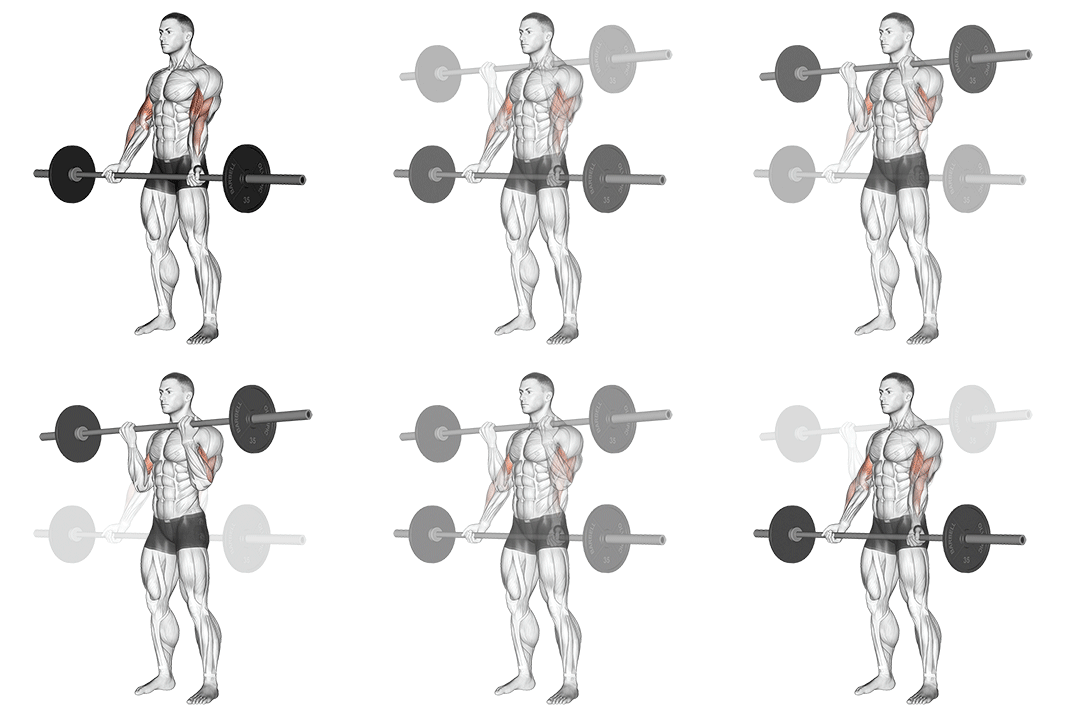
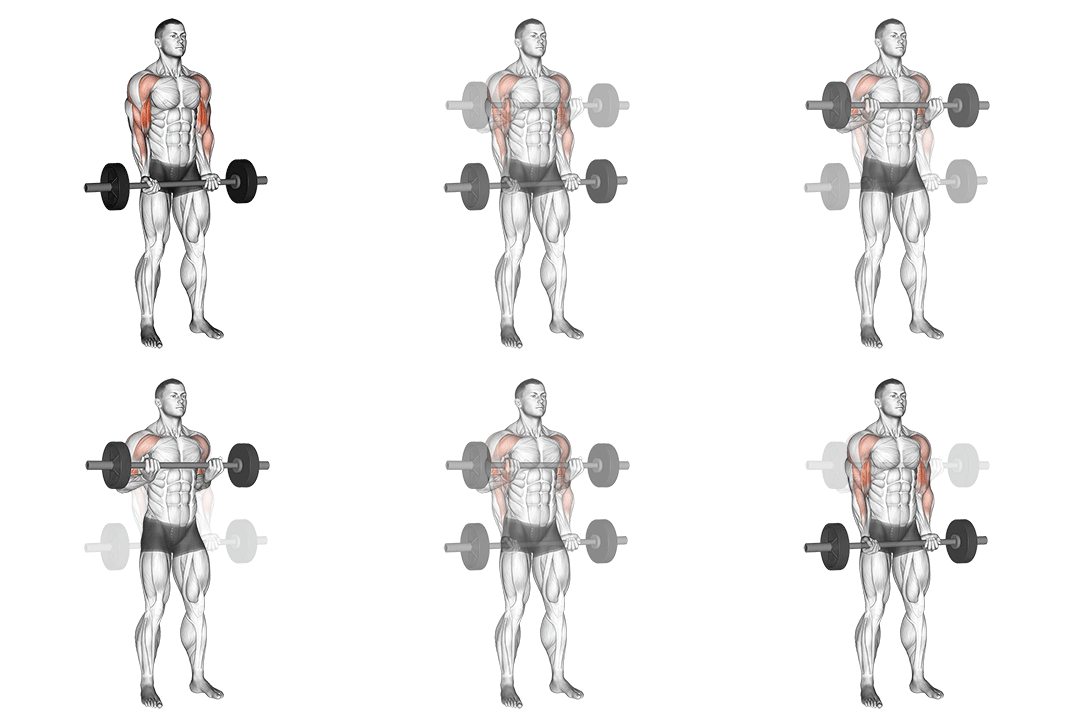
Barbell Curl demonstration

Barbell Curl

Target Biceps
Equipment Barbell
Body Part Upper-arms
Difficulty Beginner
Movement Isolation
Secondary Muscles
Forearms
VS
Exercise B
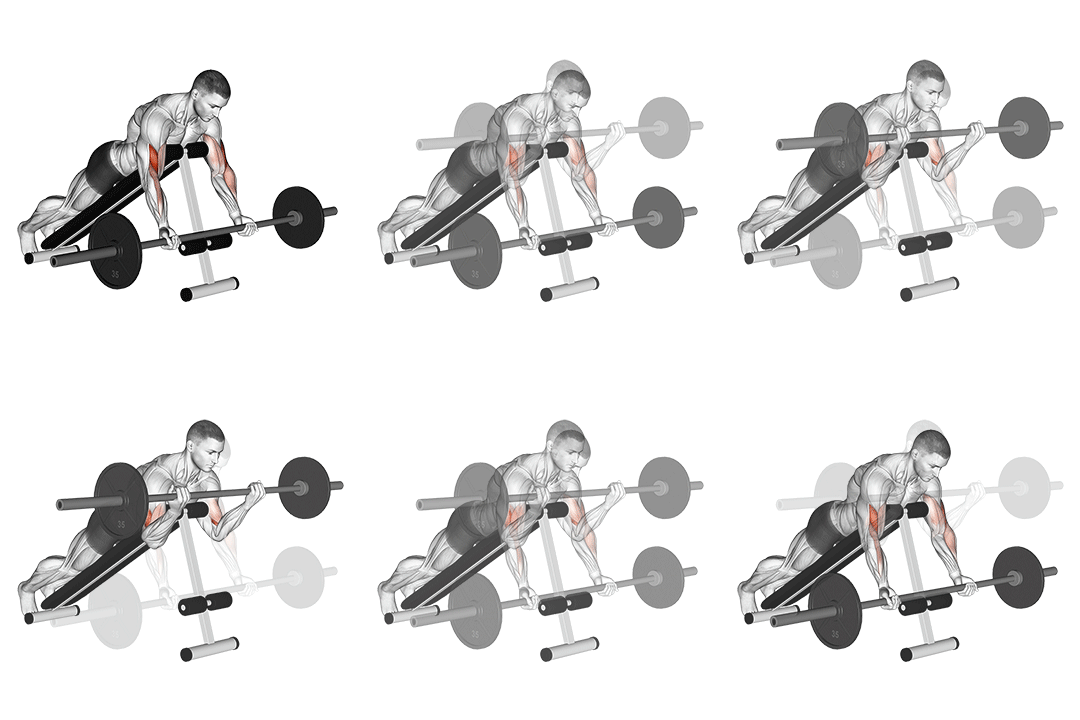
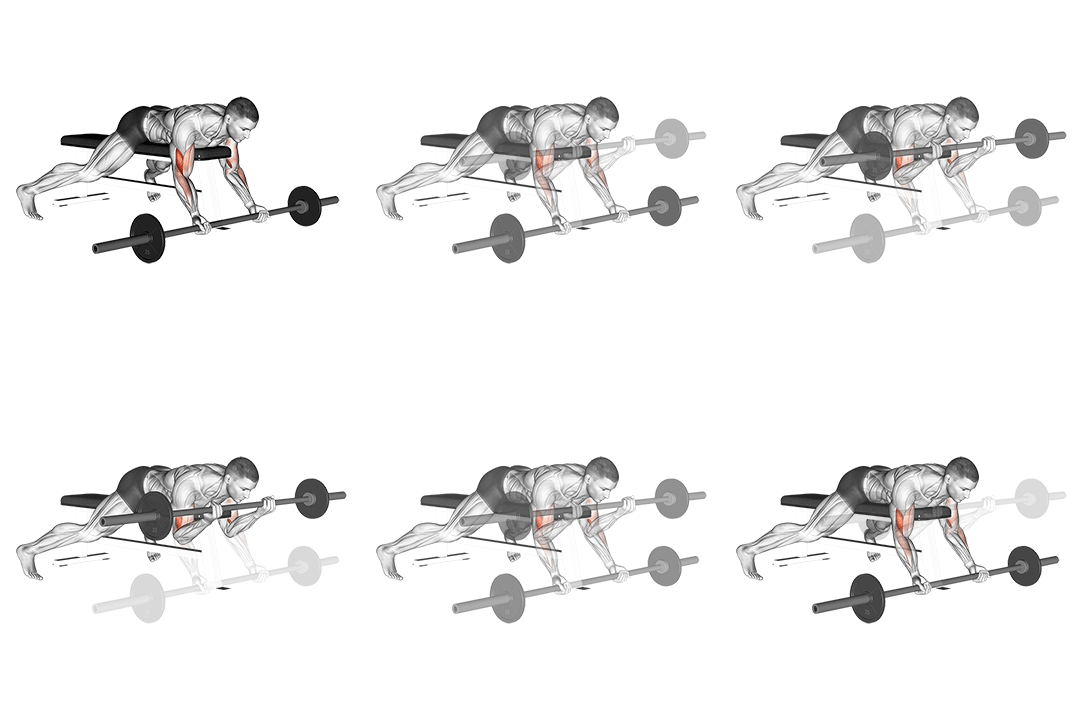
Barbell Prone Incline Curl demonstration

Barbell Prone Incline Curl

Target Biceps
Equipment Barbell
Body Part Upper-arms
Difficulty Beginner
Movement Isolation
Secondary Muscles
Forearms

Head-to-Head Comparison

Different values are marked. These are catalogue attributes, not performance scores.

Muscles used

Listed target and secondary muscles, shown on the body. Locations, not activation or strength scores.

  • Target
  • Secondary
  • Not highlighted

Barbell Curl

Front
Barbell Curl: front muscle locationsSolid: listed target. Striped: listed secondary. Grey: not highlighted. Locations, not activation or strength scores. See the muscle names below.
Back
Barbell Curl: back muscle locationsSolid: listed target. Striped: listed secondary. Grey: not highlighted. Locations, not activation or strength scores. See the muscle names below.
Target
Biceps
Secondary
Forearms

Barbell Prone Incline Curl

Front
Barbell Prone Incline Curl: front muscle locationsSolid: listed target. Striped: listed secondary. Grey: not highlighted. Locations, not activation or strength scores. See the muscle names below.
Back
Barbell Prone Incline Curl: back muscle locationsSolid: listed target. Striped: listed secondary. Grey: not highlighted. Locations, not activation or strength scores. See the muscle names below.
Target
Biceps
Secondary
Forearms

Grey does not mean a muscle is unused. The diagrams show only the mapped catalogue labels.

Attribute Barbell Curl Barbell Prone Incline Curl
Target Muscle
Biceps
Biceps
Body Part
Upper-arms
Upper-arms
Equipment
Barbell
Barbell
Difficulty
Beginner
Beginner
Movement Type
Isolation
Isolation
Secondary Muscles
Forearms
Forearms

Visual Comparison

An illustrative 1–10 profile derived from catalog difficulty, equipment, and listed-muscle fields—not measured performance or muscle activation.

Key Differences

  • Both exercises target the Biceps using Barbell. The catalogue does not establish which exercise is better for an individual goal.

Muscle comparison

Shared target muscles

Both exercises primarily load the biceps brachii through elbow flexion and forearm supination. They produce similar peak elbow-flexor torque when performed in the mid-range (about 45–90 degrees of elbow flexion), so both drive concentric and eccentric stimulus for muscle growth in the biceps.

Secondary muscle differences

Barbell Curl tends to recruit more brachioradialis and pronator/supinator stabilizers because of the upright posture and potential wrist motion. The Barbell Prone Incline Curl places the shoulders into greater extension (bench at roughly 30–45°), increasing long-head strain and reducing shoulder assist, which slightly reduces cheating and emphasizes the biceps long head over the brachialis.

Muscle involvement analysis

On a standard standing barbell curl you start with the biceps at a shorter length and produce high peak force in the mid-range; shoulder movement can shift the force vector. On the prone incline variation the shoulder is extended, placing the long head on stretch at the bottom and increasing length-tension across the eccentric phase, which increases time-under-tension at longer muscle lengths and emphasizes the long head during the early concentric.

Equipment and setup

Barbell Curl: setup

Barbell Curl requires a barbell (straight or EZ), collars, and enough space to stand with good posture. No bench is required.

Barbell Prone Incline Curl: setup

Barbell Prone Incline Curl requires a barbell and an incline bench set between 30° and 45° so your chest rests on the pad and your arms hang straight down at the start.

Access and practicality

Barbell Curl is more accessible because it needs only a barbell and open space. The incline variation needs an adjustable bench, which limits access in some home setups.

Learning and progression

Learning the movements

Barbell Curl has a shallow learning curve; beginners can grasp upright curling mechanics quickly with cues like keeping elbows fixed and driving through the forearms. The prone incline curl is also beginner friendly but requires bench setup and tighter control to maintain vertical forearms.

Progression considerations

Barbell Curl offers more straightforward load progression (add 2.5–10 lb increments) and variations (EZ bar, wide/narrow grip). Prone incline offers unique progression in time-under-tension by adjusting bench angle and tempo, but absolute loading is often slightly lower due to reduced momentum.

Limitations and precautions

Both are low-risk when performed with controlled loads. Standing barbell curls carry a higher tendency for elbow flare or shoulder swing if you chase heavy loads, raising risk to the low back and elbows. Prone incline reduces shoulder cheat and thus lowers compensatory risk, but an extreme bench angle or poor wrist alignment can place undue stress on the distal biceps tendon.

Pros & Cons

Barbell Curl

+ Pros

  • Easy to load and progress with standard barbells
  • Strong mid-range torque for heavy sets (6–12 reps)
  • Versatile grips (narrow, wide, EZ) to shift emphasis
  • Good for building absolute elbow-flexor strength

Cons

  • Prone to body English and elbow drift on heavier sets
  • Less long-head stretch compared with incline variations
  • Can overload wrists and low back if form breaks

Barbell Prone Incline Curl

+ Pros

  • Greater long-head stretch due to shoulder extension
  • Reduces cheating; elbows held more fixed against bench
  • Excellent for strict time-under-tension work (8–15 reps)
  • Better isolation of the biceps long head with less brachioradialis involvement

Cons

  • Requires an adjustable incline bench
  • Typically lower absolute loads than standing curls
  • Setup is less convenient for quick drop sets or supersets

When Each Exercise Wins

1
For muscle hypertrophy: Barbell Prone Incline Curl

The incline position stretches the long head at the bottom and increases time-under-tension at longer muscle lengths, which supports hypertrophy. Use 8–15 rep sets with a 30–45° bench to target that long-head stimulus.

2
For strength gains: Barbell Curl

Standing barbell curls allow higher absolute loads and more straightforward progressive overload, producing greater maximal elbow-flexor torque for low-rep strength work (4–8 reps). Maintain strict elbows and a controlled tempo to avoid momentum.

3
For beginners: Barbell Curl

The learning curve is simpler and equipment needs are minimal, so beginners can quickly learn elbow flexion mechanics and progressive loading. Start with light weight, 8–12 reps, and focus on fixed elbows and full range of motion.

4
For home workouts: Barbell Curl

Most home gyms have a barbell and plates but not an adjustable incline bench, making the standing barbell curl the more practical choice for consistent training and easy load progression.

Frequently Asked Questions

Can I do both Barbell Curl and Barbell Prone Incline Curl in the same workout?

Yes. Pair them smartly: start with the heavier standing barbell curls for 4–8 heavy sets to build strength, then follow with 2–3 sets of prone incline curls at a lighter weight for 8–15 reps to increase long-head time-under-tension and metabolic stress.

Which exercise is better for beginners?

Barbell Curl is better for most beginners because it’s easier to learn and requires only a barbell. Teach fixed elbows, neutral spine, and full ROM before adding incline variations to refine long-head targeting.

How do the muscle activation patterns differ?

Standing barbell curls produce peak activation in the mid-range as torque rises; they involve more brachioradialis and forearm stabilizers. Prone incline curls put the long head on stretch at the bottom, increasing activation during the early concentric and eccentric phases due to length-tension mechanics.

Can Barbell Prone Incline Curl replace Barbell Curl?

Yes for hypertrophy-focused blocks where long-head development is prioritized, but not if your goal is maximal elbow-flexor strength or heavy progressive overload. Use the incline as a complement rather than a full replacement if you need absolute loading capacity.

Comparison Summary

Choose the Barbell Curl when you want to build raw elbow-flexor strength, simplify progressions, or train at home—its upright position produces high mid-range torque and accommodates heavier loading (4–8 or 6–12 rep blocks). Pick the Barbell Prone Incline Curl when your goal is targeted long-head hypertrophy and strict isolation: set the bench to 30–45°, keep your chest on the pad, let the arms hang fully at the bottom, and use controlled 8–15 rep sets. For balanced development, rotate both across training cycles: prioritize incline-focused work during hypertrophy blocks and standing curls in strength phases.

Exercise instructions

Steps from the exercise catalogue. Read the full sequence before starting.

Barbell Curl

  1. Stand up straight with your feet shoulder-width apart and hold a barbell with an underhand grip, palms facing forward.
  2. Keep your elbows close to your torso and exhale as you curl the weights while contracting your biceps.
  3. Continue to raise the bar until your biceps are fully contracted and the bar is at shoulder level.
Read remaining steps for Barbell Curl
  1. Hold the contracted position for a brief pause as you squeeze your biceps.
  2. Inhale as you slowly begin to lower the bar back to the starting position.
  3. Repeat for the desired number of repetitions.

Barbell Prone Incline Curl

  1. Set up an incline bench at a 45-degree angle.
  2. Lie face down on the bench with your chest and stomach resting against it.
  3. Hold a barbell with an underhand grip, shoulder-width apart.
Read remaining steps for Barbell Prone Incline Curl
  1. Extend your arms fully, allowing the barbell to hang down towards the floor.
  2. Keeping your upper arms stationary, exhale and curl the weights while contracting your biceps.
  3. Continue to raise the barbell until your biceps are fully contracted and the bar is at shoulder level.
  4. Hold the contracted position for a brief pause as you squeeze your biceps.
  5. Inhale and slowly begin to lower the barbell back to the starting position.
  6. Repeat for the desired number of repetitions.

Also Compare

Compare another pair

Choose two exercises to see their differences side by side.

Compare Exercises