
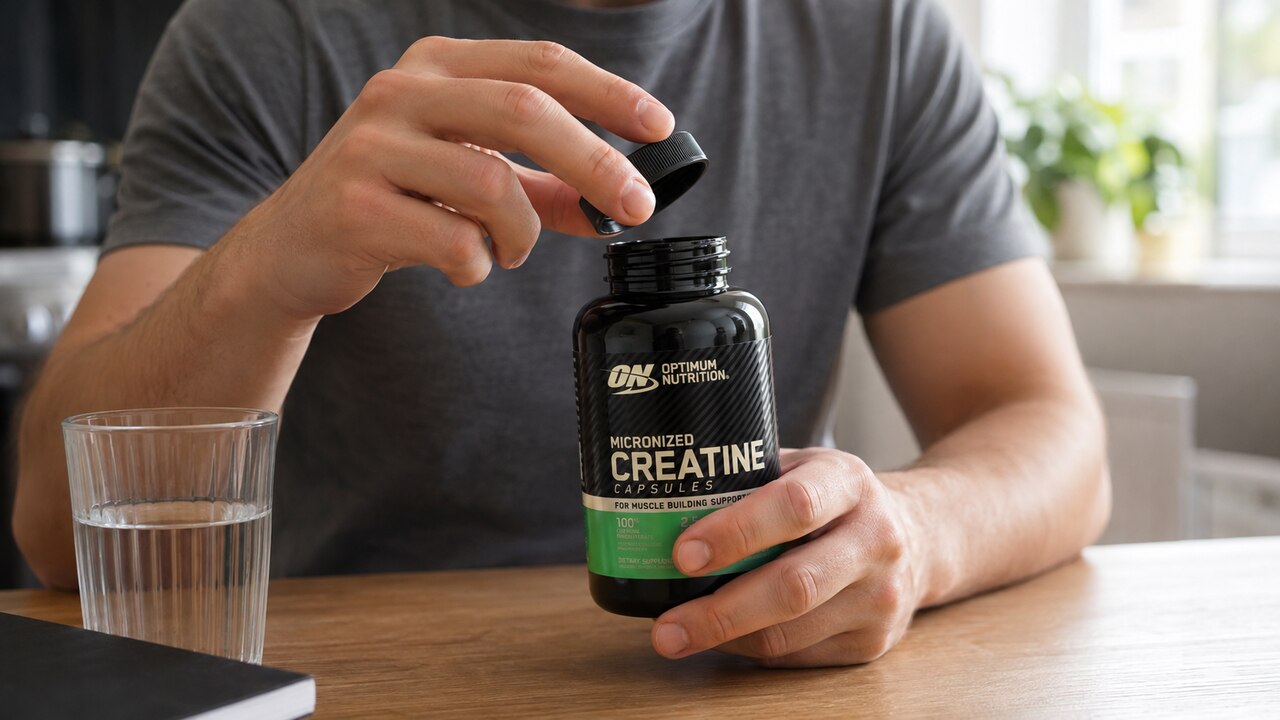
Optimum Nutrition’s 100-count creatine bottle contains 50 servings, but the directions on its current label use two servings a day. That makes it a 25-day bottle. You get the convenience of capsules, with a refill schedule that deserves more attention than the large number on the front.
I would consider these capsules for a healthy adult who wants creatine without mixing powder and can manage four capsules across two meals. Powder makes more sense if you already prepare a daily shake, need flexible measurements, or want to minimize cost per gram. The active ingredient is creatine monohydrate; the capsule format does not establish a muscle-building advantage over an equivalent amount of powder.
FitnessVolt may earn a commission from purchases through our links. Tom Miller used the US 100-count product, ASIN B00DLWONF2, across meals and checked capsule size, swallowability, bottle handling, and travel convenience. He also confirmed the current label, product data, and relevant human research.
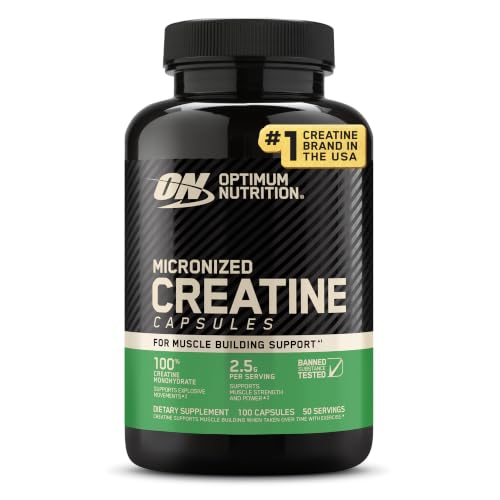
Optimum Nutrition Micronized Creatine Capsules, 100 Count
For a No-Mix Creatine RoutineA 100-capsule bottle with 1.25 g creatine monohydrate per capsule. The published label directs two capsules with a meal twice daily, giving 25 days per bottle.
Pros
- No powder mixing or flavoring required
- 1.25 g per capsule makes the quantity easy to count
- Smallest of the brand's listed capsule-bottle sizes
Cons
- Four capsules per day at the published label directions
- Gelatin makes this formula unsuitable for vegan buyers
- The 100-count bottle lasts 25 days at that use
The Serving Size and Directions Are Different Numbers
The official product page lists 2.5 g of creatine monohydrate per two-capsule serving. Its 100-count label image gives the complete directions: two capsules with a meal, twice daily. That totals four capsules and 5 g per day.
The page’s shorter suggested-use text omits the twice-daily detail. For this review’s calculations, we used the photographed 100-count label, not the abbreviated web sentence. Read your delivered bottle before taking it. A different regional pack or revised label could carry different directions.
| Quantity | Creatine monohydrate | What it means |
|---|---|---|
| One capsule | 1.25 g | Half of one labeled serving |
| Two capsules | 2.5 g | One labeled serving |
| Four capsules | 5 g | The daily total in the published label directions |
| All 100 capsules | 125 g | 50 labeled servings or 25 days at four capsules per day |
A 30-day routine at four capsules per day needs 120 capsules. One bottle leaves a five-day gap. For a seven-day trip, the same routine needs 28 capsules; for 14 days, it needs 56. These are packing calculations, not a reason to change your dose. Keep the product identity and directions available when traveling, and check the rules for your destination.
What the 100-Count Bottle Costs to Use
Amazon product data showed $19.99 for this exact 100-count ASIN on September 7, 2026. The calculations below exclude tax, shipping, subscription discounts, and later price changes. Confirm the checkout price before buying.
| Comparison | Calculation | Result |
|---|---|---|
| Cost per capsule | $19.99 / 100 | About $0.20 |
| Cost per labeled serving | $19.99 / 50 | About $0.40 for 2.5 g |
| Cost per day at label directions | $19.99 / 25 | About $0.80 for 5 g |
| Cost per gram | $19.99 / 125 g | About $0.16 |
| 30-day consumption cost | 120 x $0.1999 | About $23.99 |
The monthly consumption cost differs from the money you spend at checkout. Starting with no capsules, you would need two 100-count bottles to cover 30 days. At the recorded price, that purchase costs $39.98 and leaves 80 capsules for later use. A smaller bottle limits the size of your first purchase, but it does not cover a full month at the pictured directions.
Use the same math when comparing larger packs. A 200-count bottle with the same 1.25 g per capsule beats the recorded 100-count price per gram below $39.98. A matching 300-count bottle beats it below $59.97. Those are break-even prices, not claims about today’s larger-pack offers. Confirm the formula, count, seller, and final delivered price before comparing.
Powder requires a different comparison: divide its price by the total grams of creatine, not the number of scoops printed on the tub. A powder with 5 g servings can look more expensive per serving while costing less per gram than capsules with 2.5 g servings. Our creatine capsule comparison covers other no-mix options when you prefer pills but want to compare bottle sizes.
The Ingredients Suit Some Buyers Better Than Others
The official panel lists creatine monohydrate plus gelatin and magnesium stearate. Gelatin rules this version out for vegan buyers. Magnesium stearate appears among the other ingredients; this is not a magnesium supplement with a declared nutritional magnesium dose.
Micronized describes smaller creatine particles. That can matter when preparing a powder drink, but here you swallow a capsule. We found no head-to-head trial showing that this exact capsule improves strength or muscle gain more than a matched dose of standard creatine monohydrate. Paying for the no-mix format can make sense without assuming superior absorption or fewer digestive symptoms.
The label also carries a banned-substance-testing statement. We did not verify a current, lot-matched certification record for the bottle offered by this seller. Drug-tested competitors should check their required certification program and the exact product and batch before purchase. A familiar brand or a testing statement on an image does not replace that check.
How the Dose Fits the Research
Researchers have studied creatine monohydrate across strength and repeated high-intensity exercise. The International Society of Sports Nutrition’s position stand supports its use for increasing muscle creatine stores and improving high-intensity exercise capacity. That evidence concerns the ingredient and a sustained routine. It does not establish that this brand, bottle size, or capsule shell produces a better result.
Loading is optional. In Hultman and colleagues’ human study, 3 g daily for 28 days increased muscle total creatine by about 20%, with a slower rise than the higher-dose loading protocol. The study supports a gradual approach, not a promise that every user will gain a certain amount of muscle.
The quantities in that paper also show why capsules can be awkward for individualized plans. With 1.25 g units, two capsules provide 2.5 g and three provide 3.75 g; neither equals 3 g. Follow your bottle’s directions and any clinician’s advice rather than rounding a prescribed amount on your own. A powder measured by weight offers more flexibility. Our creatine intake calculator provides planning context, but its estimate should not override those instructions.
Timing deserves less certainty than many supplement ads give it. A 2013 randomized study compared 5 g before versus after training in 19 male recreational bodybuilders over four weeks. Both groups trained and took creatine. The researchers found no significant group-by-time interactions in their conventional analysis; their suggestion that post-workout use might be better came from magnitude-based inference. The small sample, short duration, and lack of a non-creatine control limit what you can conclude.
You do not need to build your day around that uncertain timing difference. Start with a training schedule you can sustain, such as the structure in our beginner bodybuilding program, then fit label-directed supplementation around meals. Capsules solve the mixing step. You still have to remember to take them.
Reasons to Choose Another Format
Swallowing several capsules is difficult. Four per day is enough of a burden to make this a poor first choice if pills already bother you. Powder avoids swallowing intact capsules; our creatine gummies and chews guide covers chewable formats, with their own dose and ingredient checks.
You already make a shake. Capsules remove preparation only when you would otherwise mix creatine on its own. Adding measured powder to a drink you already prepare may cost less and involve fewer items to remember.
You need a vegan formula or a verified sport-certified batch. The gelatin conflicts with the first requirement. Our review did not establish the second. Resolve those points before comparing price.
For health considerations, the scientific review of common creatine questions found no evidence of kidney damage from recommended doses in healthy individuals, while explaining that creatine can affect blood creatinine interpretation. Tell the clinician ordering kidney tests that you use it. Existing kidney impairment, pregnancy, breastfeeding, or medication-related concerns call for individual advice, not reassurance borrowed from healthy-adult studies. The product label specifies healthy adults.
Bottom Line
Optimum Nutrition Creatine Capsules make sense when you prefer a no-mix routine, accept gelatin, and can take four capsules across two meals as the published label directs. For the 100-count version, budget for 25 days per bottle and about $0.80 a day at the September 7 price. I would choose powder for flexible amounts or a routine that already includes a shake. Choose these capsules for convenience, with no expectation that the format will outperform equivalent creatine monohydrate powder.
Sources
- Kreider RB, et al. (2017). International Society of Sports Nutrition position stand: safety and efficacy of creatine supplementation in exercise, sport, and medicine. Journal of the International Society of Sports Nutrition.
- Hultman E, et al. (1996). Muscle creatine loading in men. Journal of Applied Physiology.
- Antonio J, Ciccone V. (2013). The effects of pre versus post workout supplementation of creatine monohydrate on body composition and strength. Journal of the International Society of Sports Nutrition.
- Antonio J, et al. (2021). Common questions and misconceptions about creatine supplementation: what does the scientific evidence really show? Journal of the International Society of Sports Nutrition.