

Your First Strongman Competition
The complete prep guide for first-time competitors. From registering eight weeks out to your warm-up on competition morning, every step is covered.
Your first strongman competition will be one of the most memorable training experiences of your life. It will also be one of the most overwhelming if you walk in unprepared. This guide covers everything you need to know - not just the training, but the logistics, the gear, the mental game, and the unwritten rules of competition day that nobody tells you about until you are standing on the platform wondering what to do.

8-Week Countdown Timeline
Follow this week-by-week timeline to arrive at your competition prepared, rested, and confident. Each phase builds on the last.
Register & Assess
- Register for the competition. Novice divisions fill up. Do not wait.
- Read the event list carefully. Note the weights, distances, and time limits for your weight class.
- Honestly assess your current strength against the event requirements. Use our Readiness Calculator for an objective score.
- Identify your two weakest events. These get priority in your remaining training.
- If you have never touched some of the implements, find a strongman gym and book a session now.
Train the Specific Events
- Train each competition event at least once per week. Technique matters more than weight at this stage.
- Practice transitions between events. In competition, you do not get unlimited rest.
- If the competition uses a log press, train with a log. If it uses an axle, train with an axle. Specificity matters.
- Start timing your event practice. Run the clock for 60-second rep events. Walk measured distances.
- Order any gear you still need (tacky, belt, wraps). Do not wait until the last week.
Mock Competition Day
- Run a full mock competition. All events, competition weights (or close to them), with 15-20 minute rest between events.
- Time everything. Write down your results. This becomes your baseline for competition-day goals.
- Finalize your equipment list. Try on your competition outfit with your belt to make sure everything fits.
- Start a food journal. Figure out what you eat well during hard training sessions. Competition day is not the time to try new foods.
- Book travel and accommodation if the competition is not local.
Deload & Taper
- Reduce training volume by 50%. Keep intensity moderate (75-80%). No max attempts.
- Touch each competition event one more time at 60-70% of competition weight. Technique only.
- Do not try anything new. No new exercises, no new gear, no new foods.
- Write your game plan: opening attempts, pacing strategy for timed events, rest between events.
- Prioritize sleep. 8+ hours every night for these two weeks.
Rest & Prepare
- No heavy training. Light mobility work, walking, and stretching only.
- Pack your competition bag (see equipment checklist below).
- Confirm travel plans, check-in times, and weigh-in schedule.
- If cutting weight: plan your water and food intake. If not cutting, eat normally and stay hydrated.
- Read the competition rules one more time. Know the commands, the zeroing criteria, and what gear is allowed.
Weigh-In & Rest
- Attend weigh-in if it is the day before. Bring your ID and your federation membership card.
- After weigh-in, rehydrate and eat a normal meal. Nothing unusual or heavy.
- Prep all your food and drinks for competition day. Pack the cooler.
- Lay out your clothes, gear, and bag. Double-check everything against the checklist.
- Go to bed early. You will not sleep perfectly because of nerves, and that is normal. Getting into bed early gives you the best chance at enough rest.
Execute Your Game Plan
- Arrive early. Give yourself at least 60-90 minutes before the first event for warm-ups and logistics.
- Warm up for each event 10-15 minutes before your flight. Do not over-warm-up.
- Eat small, easy-to-digest meals between events. Sip electrolytes throughout.
- Watch the athletes before you. Learn from their technique and pacing.
- Treat every event as a fresh start. A bad event does not ruin the whole day.
- Celebrate every completed lift. You are doing something most people will never attempt.
Recover & Reflect
- Take 3-5 full rest days. Your body took a beating you are not used to.
- Write down your results while they are fresh. What went well? What needs work?
- Thank the organizers and volunteers. These competitions run on volunteer labor.
- Connect with the competitors you met. The strongman community is small and welcoming.
- Register for your next competition. Most people are already planning the next one before the soreness fades.
Competition Day Equipment Checklist
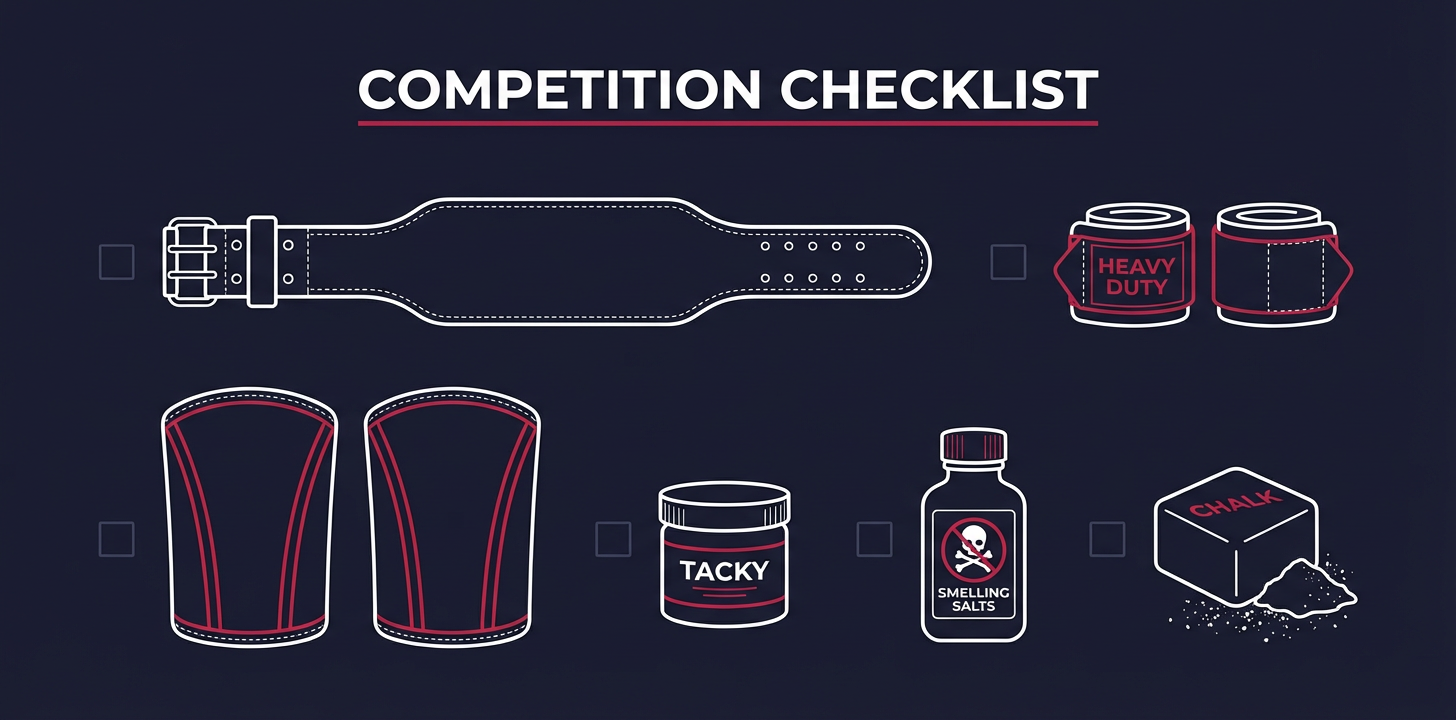
Pack your bag the night before. Check everything off this list. Forgetting your belt or tacky on competition day is more common than you think.
Essential Gear
- Weight belt - 4-inch leather or lever belt. Broken in, not brand new.
- Wrist wraps - For pressing events. Stiff wraps for max attempts.
- Chalk - Block chalk and liquid chalk. Some venues restrict loose chalk.
- Tacky (spider tack) - For atlas stone events. Check competition rules on tacky allowance.
- Flat shoes - Wrestling shoes, Converse, or deadlift slippers. No running shoes.
- Knee-high socks or shin guards - Required for deadlift events at most competitions.
- Knee sleeves - 5mm or 7mm neoprene. Check federation rules on thickness.
- Competition outfit - Singlet, shorts + t-shirt, or whatever the federation requires. Check rules.
Nice to Have
- Ammonia inhalants - For max effort attempts. Use sparingly.
- Baby powder - For deadlift (reduces friction on thighs). Apply away from the platform.
- Extra tacky + WD-40 - WD-40 is the best tacky remover. Bring paper towels too.
- Elbow sleeves - For pressing events if allowed by the federation.
- Camping chair - You will be at the venue for 4-8 hours. Standing the whole time is tiring.
- Canopy/shade tent - Many competitions are outdoors. Shade matters.
Food & Hydration
- Cooler with ice - Keep everything cold and fresh all day.
- Water (1-2 gallons) - You will drink more than you think.
- Electrolyte mix - Pedialyte, LMNT, or similar. Cramping kills performance.
- Easy carbs - Rice cakes, gummy bears, bananas, PB&J sandwiches.
- Protein source - Deli meat wraps, protein shake, or jerky. Nothing heavy.
- Caffeine - Your usual pre-workout or coffee. Do not try a new one today.
Common Events at Novice Competitions
Most novice competitions feature 4-5 events from the list below. Here is what to expect and how each one works.
Max Deadlift
Format: 3 attempts at increasing weight, or max reps at a fixed weight in 60 seconds
The deadlift is the most common opening event. For max attempt events, you pick your starting weight and get three tries. For reps, a fixed weight is loaded and you pull as many reps as possible in 60 seconds. Lock out each rep fully. Wait for the "down" command before dropping.
Log Press for Reps
Format: Max reps in 60-75 seconds, clean each rep or clean once
The log is cleaned from the floor to the chest, then pressed overhead. Some competitions require you to clean every rep (clean and press away). Others allow a single clean and then press for reps from the rack position. Read the rules carefully. Use a push press, not a strict press.
Farmer's Walk
Format: Carry loaded handles 50-100 feet for time
Pick up the handles, walk the distance as fast as possible, and set them down in the finish zone. Dropping the handles is a zero (you have to pick them back up). Most courses are 50 feet down or 50 feet down and back with a turn.
Atlas Stones
Format: Load stones to platforms of increasing height, or max stone over a bar
Atlas stones are usually the final event. Stones are loaded from lightest to heaviest onto platforms at progressively higher heights. You lap the stone (pull it to your thighs), stand up with it, and load it onto the platform. Apply tacky to your forearms and chest before your attempt.
Medley / Tire Flip
Format: Complete a series of implements for time, or flip a tire for distance/reps
Medleys combine multiple implements (e.g., yoke carry 50ft, farmer's walk 50ft, sandbag load). Tire flips are judged by distance or reps within a time limit. Both test conditioning and transitions. The winner is usually the fastest person who does not drop anything.
Mental Preparation
Managing Nerves
Every single competitor at your first competition was nervous before their first competition. The nerves do not go away with experience - they just become familiar. Pre-event jitters are adrenaline, and adrenaline makes you stronger. Channel it. Pace around, listen to music, visualize your lifts. Do not sit still and ruminate.
Setting Realistic Goals
Your goal for your first competition should not be to win. Your goals should be: (1) complete every event without zeroing, (2) learn something you can not learn in the gym, and (3) have fun. If you hit all three, the competition was a success regardless of your placement. PRs on competition day are a bonus, not an expectation.
The Community is Friendly
Strongman has the most welcoming community in strength sports. Experienced competitors will lend you gear, give you technique tips between events, and cheer for you. Do not be afraid to ask questions. Nobody will judge you for being new. Everyone in the room competed for the first time at some point.
Dealing with a Bad Event
You will likely have one event that goes badly. Maybe you zero an event. Maybe you finish last on the deadlift. It does not matter. Strongman is scored across all events. A bad result on one event can be recovered on the next. The worst thing you can do is let a bad event ruin your mental state for the rest of the day.
Day-of Strategy
Your performance on competition day depends as much on logistics and timing as it does on strength. Here is how to manage the day.
Warm-Up Timing
Start warming up 15-20 minutes before your flight. Do not warm up too early and cool down. Do not warm up too little and go in cold. General warm-up: 5 minutes of light movement (jumping jacks, band pull-aparts, bodyweight squats). Specific warm-up: 2-3 progressive sets working up to about 70% of the event weight.
When and What to Eat
Eat a full meal 2-3 hours before the first event. Between events, snack on easy carbs every 30-45 minutes. A rice cake with honey, a banana, or a handful of gummy bears. Avoid anything heavy, fatty, or fibrous. Sip electrolytes constantly. Do not chug a full bottle of water right before an event.
Watch the Athletes Before You
Pay attention to the competitors in the flights before yours. Watch how the event flows, where the judge positions, what the start and finish commands are, how much time they get between reps. This intel is free and valuable. Note where other athletes struggle so you can avoid those mistakes.
Between Events
After each event, immediately: (1) sit down and drink, (2) eat something small, (3) remove gear you do not need for the next event, (4) check the schedule for when you are up next. Do not stand in the sun dissecting your performance. Recover first, analyze later. Stay warm but not overheated.
Celebrate Every Lift
You are doing something remarkable. Most people will never attempt what you are about to do. Celebrate your completed lifts. High-five your competitors. Yell if you want to. This is supposed to be fun. The scoreboard matters, but the experience matters more - especially the first time.
About Your First Strongman Competition Guide
This guide covers every aspect of preparing for your first strongman competition, from the moment you register to the days after the event. It is designed for first-time competitors who have some training experience but have never stepped on a competition platform.
What to Expect at a Novice Competition
Novice strongman competitions typically feature 4-5 events spread across a single day. Events commonly include a max deadlift or deadlift for reps, log or axle press for reps, a carrying event like farmer's walk or yoke, and atlas stones. Competitions last 4-8 hours depending on the number of competitors and events. Weight classes ensure you compete against athletes of similar size.
How Scoring Works
Most strongman competitions use a points-based system. Each event awards points based on placement (first place in an event gets the most points, last place gets the fewest). The athlete with the most total points across all events wins. This means consistency across all events is more valuable than dominating one event and zeroing another.
Finding Competitions
Strongman Corporation and United States Strongman are the two largest amateur strongman organizations in the United States. Both maintain competition calendars on their websites. International athletes should check their national strongman federation. Social media groups for local strongman communities also post upcoming competitions regularly.
Frequently Asked Questions
Compete at your natural bodyweight. Do not cut weight for your first competition. Water cutting adds stress to an already stressful day and reduces your performance. If you are between weight classes, compete in the heavier class. You can optimize weight management for future competitions once you have experience.
If you cannot complete an event, you receive a zero for that event. This happens at every competition to multiple athletes. It is not the end of the world. You still compete in the remaining events and earn points. Many first-time competitors zero one event and still place well overall because strongman rewards consistency across all events.
Most competitions allow tacky (a sticky substance applied to your forearms and chest) for atlas stone events. It significantly improves your ability to grip and load the stone. Check your specific competition rules, as some novice competitions prohibit tacky. If allowed, bring spider tack or similar tacky, apply it right before your attempt, and bring WD-40 and paper towels to clean up afterward.
A typical novice competition lasts 4-8 hours from the first event to the awards ceremony. Plan for a full day. The time between events varies from 15 minutes to over an hour depending on the number of competitors and flights. Bring a chair, food, water, and entertainment for the downtime between your events.
The two largest amateur organizations are Strongman Corporation and United States Strongman (USS). Both require a membership to compete in sanctioned events. Membership is typically $40-60 per year. Check which federation hosts competitions near you and join that one. Some athletes hold memberships in both.