
Last updated: June 2026. FitnessVolt rebuilt this article with controlled sleep-diet research, a practical sleep audit, updated internal links, and new editorial visuals.
Sleep does not burn fat by itself, but it can decide whether a fat-loss plan is easy enough to repeat. When sleep gets cut short, hunger rises, cravings get louder, training quality drops, and the same calorie deficit can feel much harder. When sleep improves, many people eat less without forcing it and recover better from training.
The old version of this article focused on one small University of Chicago study. That study still matters, but it is only the start. Since then, stronger real-world research has shown that extending sleep in adults with overweight can reduce daily energy intake. The practical lesson is simple: if you are dieting hard but sleeping poorly, you are making the plan harder than it has to be.
Key Facts
- Sleep target: Most healthy adults should aim for at least 7 hours per night.
- Main fat-loss link: Sleep affects appetite, food reward, impulse control, training recovery, and daily movement.
- Best evidence: Controlled trials show sleep restriction can shift weight loss away from fat mass, while sleep extension can reduce energy intake in some adults.
- Practical move: Audit caffeine timing, bedtime consistency, evening screens, alcohol, hunger, and bedroom environment before cutting calories lower.
How Sleep Affects Fat Loss
Fat loss still comes down to sustained energy balance. Sleep matters because it changes how hard that balance is to maintain. A tired person is more likely to crave calorie-dense food, skip steps, train with lower output, drink more caffeine, and make less patient decisions at night.
Sleep also affects the signals around hunger and fullness. Short sleep has been linked with changes in ghrelin and leptin, two hormones involved in appetite regulation. That does not mean hormones override calories. It means poor sleep can make the calorie target feel louder, more irritating, and harder to repeat.
There is also a recovery angle. If you lift while dieting, your goal is not only to lose scale weight. It is to lose fat while keeping muscle and performance. Sleep supports training recovery, mood, coordination, and the consistency needed to keep lifting while calories are lower.
What The Controlled Research Shows
In the University of Chicago trial that made this topic famous, 10 adults with overweight completed two 14-day calorie-restricted lab phases. During the longer sleep phase, they had 8.5 hours in bed and slept about 7 hours and 25 minutes. During the short sleep phase, they had 5.5 hours in bed and slept about 5 hours and 14 minutes. Weight loss was similar, but the composition differed: adequate sleep produced more fat loss, while short sleep produced more loss from fat-free mass.
That study was small and tightly controlled, so it should not be stretched beyond its design. Its strength is that food intake was controlled, which allowed researchers to see how sleep changed the body-composition response during a deficit. Its weakness is that real-life dieters are not locked in a lab with controlled meals.
A later randomized clinical trial by Tasali and colleagues tested a more practical question: what happens when adults with overweight who usually sleep less extend sleep in real life? The sleep-extension group reduced objectively assessed energy intake compared with controls. That matters because many people do not need a more aggressive diet. They need the same diet to feel less like a fight.
| Research Finding | What It Means | What It Does Not Mean |
|---|---|---|
| Short sleep increased hunger signals in controlled settings | Dieting may feel harder when sleep is restricted | Hormones do not cancel the need for calorie control |
| Sleep restriction shifted weight loss away from fat mass in a small lab study | Sleep may help protect the quality of weight loss | One small trial does not define every person’s result |
| Sleep extension reduced energy intake in a real-life randomized trial | Sleeping more may make lower intake happen with less force | Sleep is not a stand-alone obesity treatment |
| Adults are advised to sleep 7 or more hours | Seven hours is a sensible minimum target for most adults | More time in bed is not always better if sleep quality is poor |
The Sleep And Hunger Loop
Poor sleep makes hunger more expensive. You may still hit your calorie goal for a day or two, but the plan drains more willpower. Evening snacks become harder to resist, portions creep up, and high-reward foods look more useful because the brain is tired and wants fast energy.
This is why many fat-loss stalls are not only calorie problems. They are adherence problems. The person knows what to eat but cannot repeat it under fatigue. Before cutting another 200 calories, ask whether sleep is making the current target unnecessarily difficult.
Use our fat-loss troubleshooting guide if your scale trend has stalled. Sleep should be part of that audit, along with calorie tracking accuracy, sodium swings, stress, training fatigue, steps, and weekend intake.
How Much Sleep Do You Need For Fat Loss?
Most healthy adults should aim for at least 7 hours per night. Some lifters feel better with 8 to 9 hours, especially during hard training blocks or aggressive deficits. The exact target depends on age, training load, stress, schedule, sleep quality, and how you feel during the day.
The minimum practical test is this: can you train well, control hunger, think clearly, and avoid late-night overeating on your current sleep? If not, the issue is not only the number of hours. It may be timing, consistency, caffeine, alcohol, bedroom temperature, light exposure, or meals too close to bed.
If you consistently sleep under 6 hours, do not make the deficit more aggressive. Fix sleep first. A harsher diet layered on short sleep often produces the pattern people hate most: poor training, high hunger, low mood, and scale swings that feel unfair.
A Two-Week Sleep Audit For Dieters
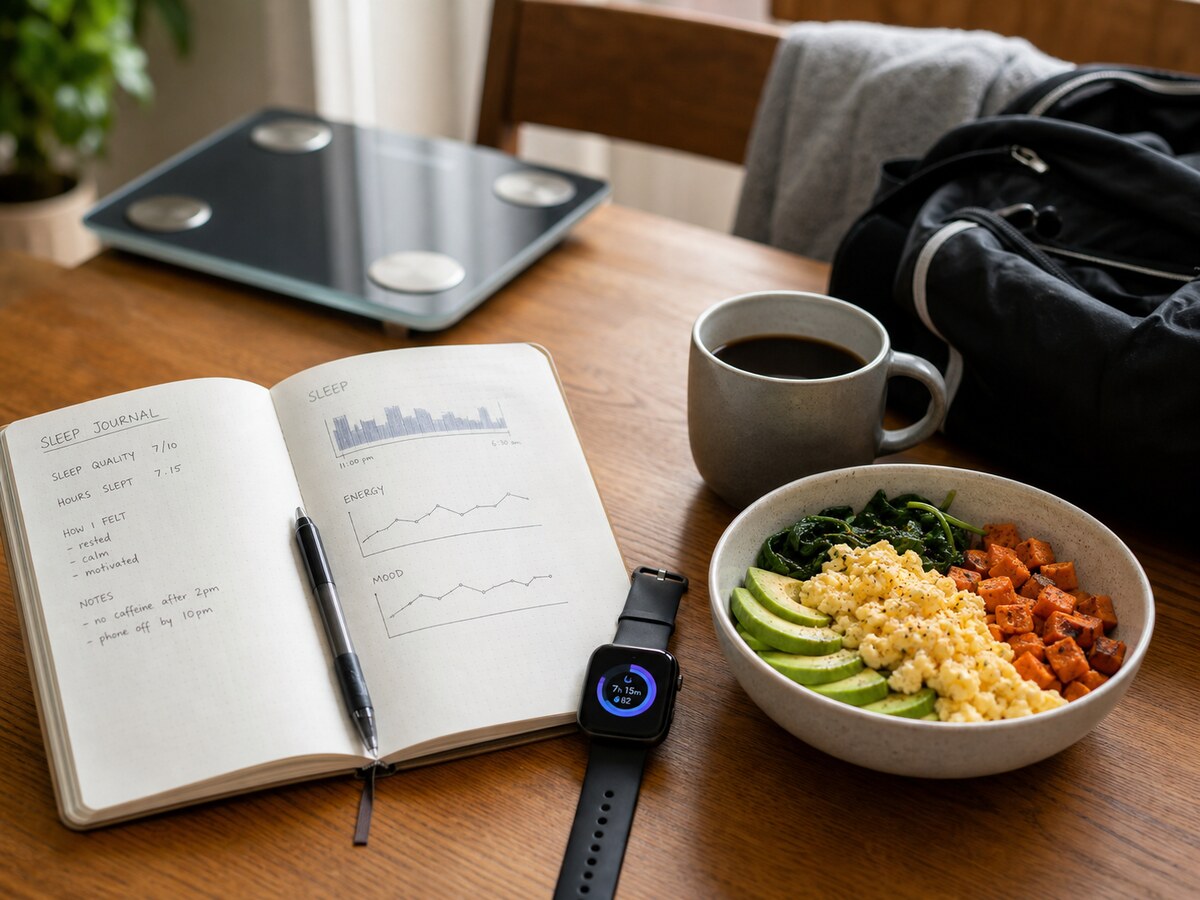
Track sleep like you track calories. Not forever, just long enough to see the pattern. For two weeks, write down bedtime, wake time, estimated sleep duration, caffeine cutoff, alcohol, late meals, morning hunger, evening cravings, training performance, steps, and body weight.
The point is not to create another obsession. The point is to see whether your worst eating days follow your worst sleep nights. Many people discover that they do not have a discipline problem on Thursday night. They have a Wednesday sleep problem, a late caffeine problem, or a stress spillover problem.
| What To Track | Why It Matters | Action If It Looks Bad |
|---|---|---|
| Sleep duration | Shows whether you are consistently below the 7-hour target | Add 20 to 30 minutes in bed for one week before changing calories |
| Caffeine cutoff | Late caffeine can reduce sleep quality even if you fall asleep | Move the final dose earlier by 2 hours |
| Evening cravings | Often tracks with fatigue and under-eating earlier in the day | Add protein and fiber at dinner before cutting calories lower |
| Training performance | Poor sleep can make loads feel heavier and effort feel higher | Reduce volume for a week if performance drops and soreness climbs |
| Morning hunger | Helps separate true deficit pressure from random appetite swings | Adjust meal timing before adding supplements |
What To Fix First
Fix the largest sleep leak first. For many lifters, that is caffeine timing. A fat burner or pre-workout at 4 p.m. can make a diet harder by stealing sleep, even if it helps the workout. If you use stimulants, keep them earlier and track whether sleep improves.
Next, fix bedtime consistency. Going to bed and waking up at wildly different times makes hunger and energy harder to predict. You do not need a perfect schedule. You need a repeatable enough schedule that your body knows when to wind down.
Then look at the evening environment. Dim bright lights, reduce phone use close to bed, keep the room cool, and avoid turning the final hour into work, arguments, or scrolling. None of this is exciting. It works because it reduces friction.
How Sleep Fits With Calories, Protein, And Training
Sleep does not replace the fat-loss fundamentals. It protects them. Set a calorie target, eat enough protein, lift consistently, keep steps stable, and use sleep to make those behaviors repeatable. If you are not sure how much energy you burn, start with the FitnessVolt TDEE calculator and adjust based on your actual weight trend.
Protein matters because it supports satiety and lean mass retention. Sleep matters because a tired body is worse at executing the plan that protein and calories are supposed to support. That is why your best diet may fail when paired with late nights and poor recovery.
For food setup, use our fat-loss foods guide. For training recovery and sleep habits aimed at lifters, see our sleep rules for lifters. If magnesium is relevant to your routine, our magnesium and recovery guide explains where it may and may not help.
Signs Sleep Is Limiting Your Fat Loss
- You are hungrier on low-sleep days even when calories are the same.
- You need more caffeine each week to train normally.
- Evening snacking is predictable after late nights.
- Your lifts feel heavier, but the program has not changed.
- Your step count drops after poor sleep.
- You crave highly palatable foods more often during the deficit.
- Your mood is worse and patience is lower near meals.
If three or more are true, do not assume the answer is a stronger diet. The answer may be a more recoverable diet plus a better sleep setup.
Simple Sleep Plan For A Fat-Loss Phase
Use the smallest effective change. Start with a caffeine cutoff, a consistent wake time, and a 30-minute wind-down. Keep calories the same for seven days so you can judge the effect. If hunger and cravings improve, you have found a lever that does not require more restriction.
- Set a caffeine deadline. Put the final caffeine dose at least 8 hours before bed, then adjust earlier if sleep is still poor.
- Keep wake time stable. A steady wake time helps anchor the day even if bedtime is not perfect yet.
- Build a shutdown routine. Use the same 20 to 30 minutes before bed: dim lights, hygiene, next-day prep, no work email.
- Eat enough dinner. Protein, vegetables, and a planned carb source can reduce late-night grazing.
- Review weekly averages. Judge sleep, body weight, hunger, and training together, not from one bad night.
Sleep Myths That Hurt Dieters
| Myth | Reality | Better Action |
|---|---|---|
| “I can sleep less and just use more caffeine.” | Caffeine may hide fatigue while worsening the next night’s sleep. | Use caffeine strategically and protect bedtime. |
| “Sleep burns fat, so calories matter less.” | Calories still determine the direction of weight change. | Use sleep to improve adherence to the deficit. |
| “One bad night ruins fat loss.” | One night rarely matters. Patterns matter. | Return to your normal plan the next day. |
| “More sleep always means more fat loss.” | More time in bed helps only if it improves real sleep and daily behavior. | Track energy, hunger, training, and intake. |
Bottom Line
Sleep is not a fat-loss shortcut. It is a force multiplier for the habits that create fat loss. A calorie deficit still drives the result, but adequate sleep can make that deficit easier to follow and may improve the quality of the weight you lose.
If fat loss has stalled, do not immediately slash calories. Check two weeks of sleep, caffeine timing, hunger, training, steps, and weekend intake. If sleep is the weak link, fixing it may give you a better result than pushing the diet harder.
Sources
- Nedeltcheva et al. Insufficient sleep undermines dietary efforts to reduce adiposity.
- Tasali et al. Sleep extension and objectively assessed energy intake in adults with overweight.
- Full text: Sleep extension randomized clinical trial.
- Watson et al. Recommended amount of sleep for a healthy adult consensus statement.
- Full text: Recommended amount of sleep for a healthy adult.
- Spiegel et al. Sleep curtailment, leptin, ghrelin, hunger, and appetite.
- Markwald et al. Insufficient sleep, food intake, energy expenditure, and weight gain.
- St-Onge et al. Short sleep duration and energy intake.
- Sleep Foundation: Weight loss and sleep.