


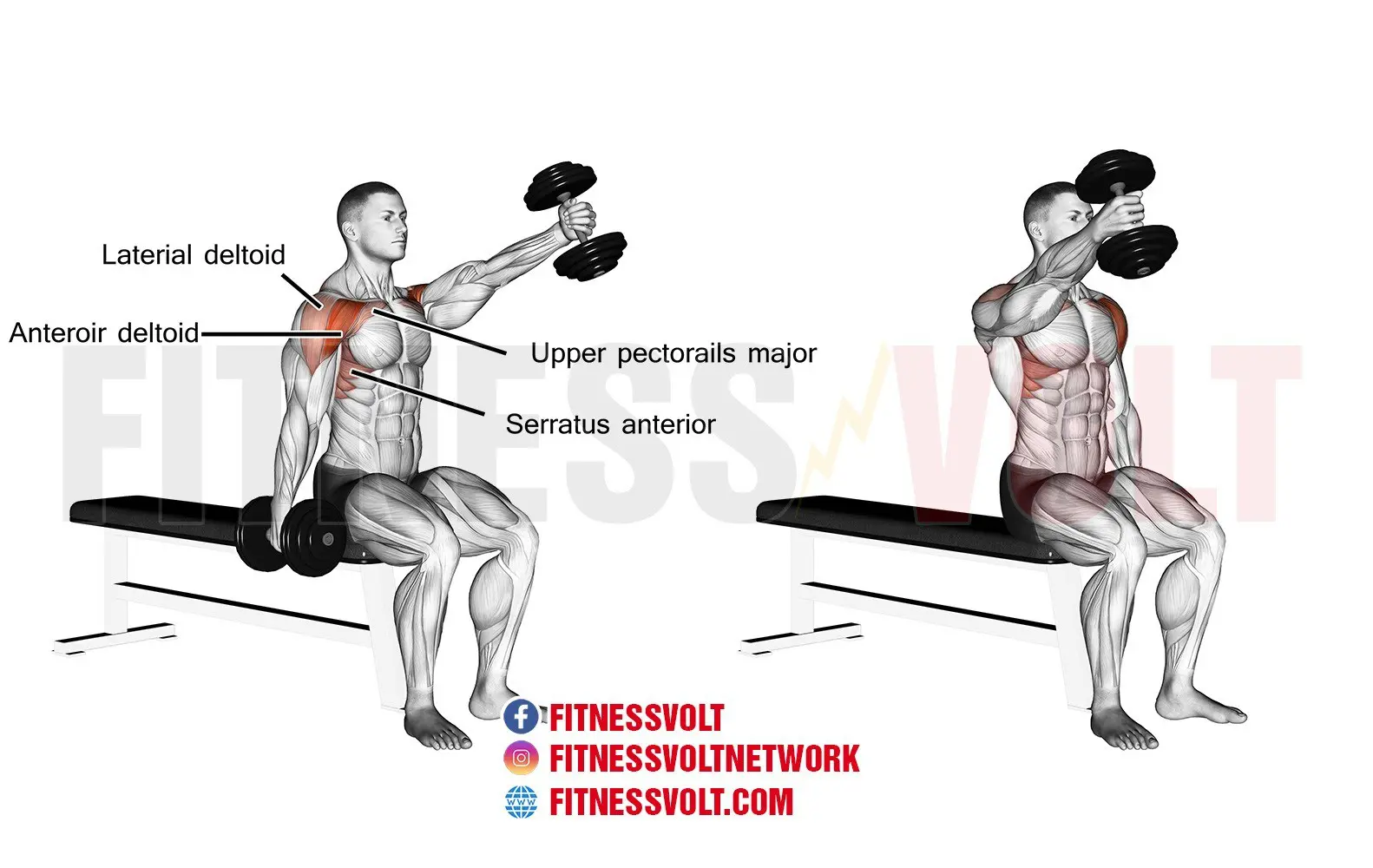
The seated alternating dumbbell front raise is an isolation exercise for the anterior (Front) deltoids. Now, although the anterior deltoids get stimulated during all pressing exercises, direct isolation work is always great for additional stimulus. Plus, you can avoid compound exercises and you can still get an effective workout.
The seated dumbbell raise should be performed with a lighter to moderate weight because the shoulders are a sensitive area. So, it’s not an exercise intended for maximum resistance unless you’re an advanced lifter. But you can still get great size gains doing this exercise if you do it safely.
In this Exercise
- Target Muscle Group: Anterior Deltoid
- Type: Strength
- Mechanics: Isolation
- Equipment: Dumbbell
- Difficulty: Beginner
Exercise Instructions
- Sit on a bench and hold a dumbbell in each hand with back straight.
- Bend your elbows slightly and raise one arm up until your hand is level with your head.
- Hold this position for a couple of seconds.
- Slowly reverse the motion back to the starting position.
- Repeat with opposite arm.
Variations & Tips
- You can use a hammer (Neutral) grip instead of a pronated grip which can be safer on the shoulder joint.
- You can also do both arms at the same time.
- This exercise helps to build the anterior and lateral portions of your deltoids.
- Use lighter to moderate weights if you’re a beginner or intermediate lifter because safety is a concern with any movements where the shoulder joint rotates.
Watch: How to do the seated alternating dumbbell front raise
Interested in measuring your progress? Check out our strength standards for Reverse Grip Bench Press, Barbell Front Raise, Machine Lateral Raise, and more exercises.






Shoulder front raises with a resistance band are a muscle-building as well as a weight training exercise.
And it targets your shoulders muscles, including anterior deltoid, lateral deltoid, and trapezius.
Since the shoulder front raise with resistance band helps to have more muscle mass, which can lead to an increase in your strength and power.
It means that the increased strength provides you with enough energy in the bench press, dips, and other pressing movements.