

If there is one type of exercise that most people do too little of, it’s probably stretching. This is understandable given that stretching is arguably the least exciting part of any workout.
I mean, lifting weights, doing sprints, jumping, throwing stuff—they’re all challenging, exciting, and instantly gratifying. But sitting on the floor while touching your toes? Where’s the fun in that?
Consequently, a lot of exercisers do very little, if any, stretching.
The good news is that, provided you work out using a full range of motion, not stretching won’t necessarily lead to inflexibility. Studies even show that strength training can enhance mobility and flexibility (1).
However, your body only adapts to the type of exercises you do, and that means that even if you squat and lunge frequently, you may still have tight hips.
That’s because your hips—a ball-and-socket type joint—are capable of many different movements. While squats, lunges, leg presses, etc. are great for improving flexion and extension, they do very little for medial (inward) or lateral (outward) rotation.
These critical movements—and your inability to perform them—can affect everything from your knees to your lower back, and are a leading cause of pain, dysfunction, and poor exercise and sports performance (2).
The good news is that unlocking your hips doesn’t have to be time-consuming. All you need is a few minutes a day and a willingness to do just one straightforward exercise.
In this article, I explain how to do the 90-90 hip drill, the only exercise you need for mobile, healthy hips.
Why Hip Mobility Matters (and Why Yours Needs Work)
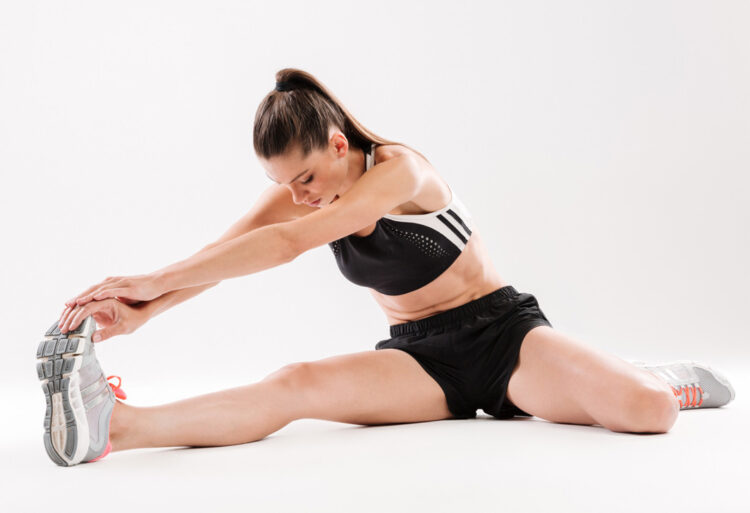
A joint is where two or more bones come together to form a union. The hips, like the shoulders, are a type of ball-and-socket joint capable of numerous movements, including:
- Flexion
- Extension
- Abduction
- Adduction
- Medial rotation
- Lateral rotation
While the range of motion available at the hips is quite large, most people only use a fraction of that range during their workouts and daily life. For example, when was the last time you moved your hips in any direction other than forward (flexion) or backward (extension)?
In addition, prolonged sitting puts your hips in a flexed position and keeps them there for hours at a time. Add in exercises that mainly move in one plane, such as squats, deadlifts, and lunges, and it’s no wonder your hips start to feel tight, stuck, or painful.
This lack of mobility doesn’t just affect your hips. It often leads to compensation elsewhere. Your knees, lower back, and even your ankles may take on stress that should be handled by your hips.
For example, runner’s knee pain is often caused by a lack of hip mobility, and some lower back problems are caused by immobile hips.
Related: Poor Hip Internal Rotation: Causes, Side Effects, and 8 Best Exercises
Stretching can help, but it often fails to address the underlying cause—poor movement quality and joint control. What you need is mobility, best described as the ability to actively move through a full range of motion with control and stability.
And that’s where the 90-90 hip mobility drill comes in.
90-90 Hip Drill: How to Do It Right
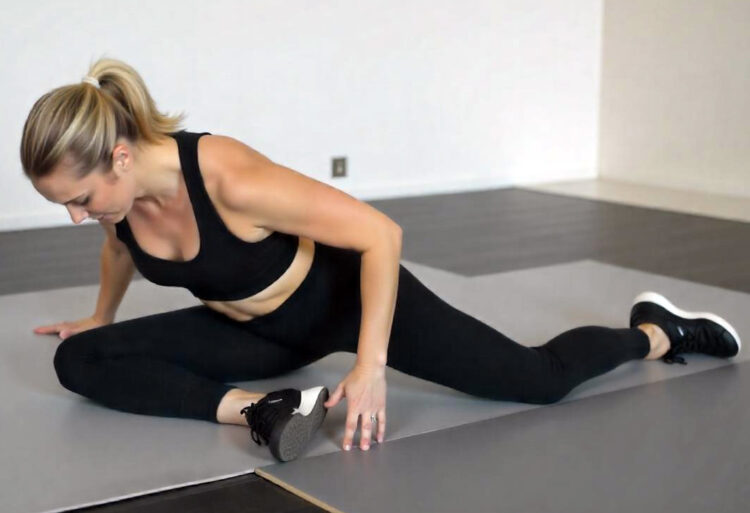
The 90-90 hip drill is designed to improve medial and lateral hip rotation. It breaks you out of the all-too-common sagittal plane and gets your hips moving in a way that tends not to happen during squats, lunges, etc. As such, it’s the key to unsticking your hips and restoring lost mobility.
But, before you attempt this exercise, I suggest that you spend a few minutes warming up your hips and lower back. This will make the 90-90 hip drill much more comfortable and effective.
You don’t need a full warm-up as this is not a particularly intense exercise, but some easy high-knee marching, lunges, and air squats will lubricate your joints and improve tissue elasticity.
90-90 Hip Drill Instructions
- Sit in good posture on the floor with your feet flat and knees and hips flexed to around 90 degrees.
- Keeping your butt firmly grounded, rotate both legs to one side, trying to get them as close to the floor as possible without forcing them down. Your hips and knees should stay at 90 degrees while your torso remains upright.
- Smoothly roll your legs to the other side.
- Continue alternating sides, gradually increasing your range of motion as your hips start to loosen.
Trainer Tips: Make the Most of the 90-90 Drill
- Stay tall: Avoid slouching or collapsing your chest. Good posture improves joint alignment and movement quality.
- Breathe deeply: Don’t hold your breath. Slow, steady breathing helps relax tight muscles and enhances control.
- Don’t rush it: Move slowly and with intent. The goal is quality of movement, not speed or reps.
- Keep your butt down: Your glutes should stay in contact with the floor. If one side lifts, reduce your range of motion slightly.
- Focus on control: Use your hip muscles rather than momentum to guide your legs from side to side.
- Expect asymmetry: One side will likely feel tighter or more restricted. That’s normal. Ease into your weaker side without forcing it.
- Be consistent: A few minutes a day will lead to significant improvements over time. However, doing the exercise less frequently could mean slow or no progress.
Pair It With These Exercises
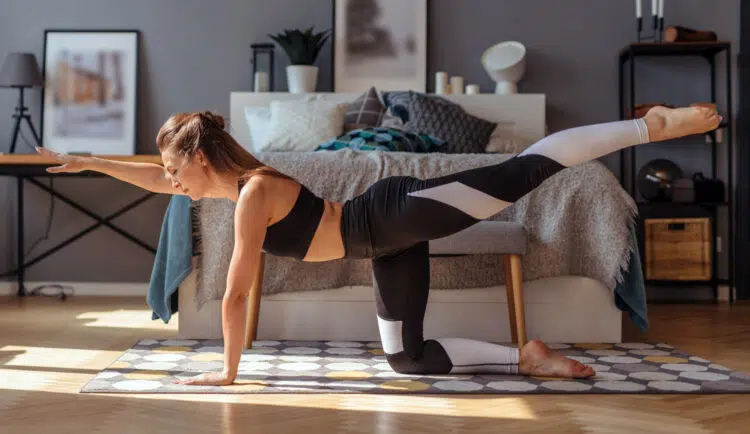
The 90-90 hip drill is an excellent standalone mobility exercise, but it also pairs well with other movements that support hip function and stability. For example:
- Add glute bridges to reinforce hip extension.
- Include bird dogs or side planks to build core control, which supports healthy hip movement.
- Finish with a few reps of deep bodyweight squats or lunges to test your new range of motion.
None of these add-ons are compulsory, but if you’ve got time and want to reinforce your gains, combining the 90-90 drill with a few simple bodyweight exercises will accelerate your progress.
Variations and Adjustments
There are numerous ways to perform the 90-90 hip mobility drill. Some make it easier while others make it more challenging. Use the following variations and adjustments to customize the 90-90 hip drill according to your needs and abilities.
Place Your Hands Behind You for Support
Are you struggling to maintain good posture while doing the 90-90 hip drill? This is a common problem, especially for beginners. Fix it by sitting with your hands resting lightly on the floor behind you. This provides support and reduces the strain on your lower back as you rotate your hips.
Sit on a Cushion or Pad
You need a reasonable level of mobility to sit on the floor in good posture. Make it easier by sitting on a folded towel, yoga block, or cushion. This raises your hips, so the hip joint angle is less extreme, allowing for smoother rotation.
Pause for a Deeper Stretch
Turn the 90-90 hip mobility drill into a hip stretch by pausing at the mid-point of each rep. When you reach your comfortable range of rotation on each side, hold the position for 15-30 seconds before returning to the center. This helps increase muscle elasticity and length over time.
Add a Bend and Reach
Increase your range of motion by leaning your torso slightly forward and over your outermost leg while reaching forward with your arms. This more advanced 90-90 hip drill variation provides an intense stretch for your gluteus minimus and medius, both located on the outside of your hips.
Use a Wall for More Back Support
Another way to make it easier to maintain good posture is to do the 90-90 hip drill with your back against a wall. This provides stability and ensures all the movement comes from your hips and not your spine. This variation is more challenging than the conventional 90-90 hip drill.
Perform the Drill Lying Down
If sitting on the floor is uncomfortable, lie on your back with hips and knees bent to 90 degrees, feet flat. Slowly rotate your knees side to side while keeping your hips grounded. This modification eliminates any postural restrictions and improves comfort while providing a similar hip movement.
When Should You Do the 90-90 Hip Drill?
There are no hard and fast rules for doing the 90-90 hip drill, and it’s up to you to find a convenient time and place to do it. That said, you’ll probably get better results if you make it a habit rather than just slot it haphazardly into your day whenever it crosses your mind.
Good options include:
- Right after brushing your teeth:Pair it with your morning or evening routine to build consistency without adding “one more thing” to your day.
- As part of your warm-up: The 90-90 hip drill is especially useful before lower-body workouts, especially sessions involving squats, deadlifts, or lunges.
- After your workout: Use it during your cooldown to restore range of motion and reduce post-training stiffness.
- During TV time or while listening to a podcast: Get in a few minutes of mobility work while relaxing in front of a screen or catching up on audio content.
- After long periods of sitting:Ideal for lunch breaks or after work to undo hip stiffness from sitting at a desk or in a car.
- Before bed: Gentle mobility work can help calm your nervous system and promote better sleep.
- Anytime your hips feel tight:Use the 90-90 hip drill as a quick diagnostic tool to assess tightness or as a mini reset whenever you feel stiffness creeping in.
Above All, Be Consistent

Mobility improvements don’t happen overnight, but they don’t need to take months, either. Many of my clients report better squat depth, reduced hip stiffness, or smoother walking mechanics after just a week or two of consistent practice.
The key is frequency. Doing a few reps once in a while won’t cut it. But spend 3 to 5 minutes a day on the 90-90 drill, and you’ll start seeing results pretty darn quick. You may even find that other hip-focused stretches or foam rolling become unnecessary. Once your hips start to loosen up, your entire body will feel better.
Related: The 12 Best Stretches for Flexible, More Mobile Hips
Closing Thoughts
Most people don’t realize they have tight hips until they start to loosen up. As if by magic, your squat depth improves, lunges feel smoother, and your walking and running stride length increases.
You may even notice that your knees and back don’t ache as much.
However, modern life is conspiring to rob you of hip mobility, so it’s something you need to stay on top of. Working at a desk, driving your car, and even chilling on your couch can all contribute to tight, immobile hips.
The solution? Do the 90-90 hip drill every day.
All you need is five minutes, and your hips will feel and function better than ever before. Plus, as your mobility improves, you will only need a few sessions a week to preserve it.
So, tight hips? Fix them with the 90-90 hip drill. Start today—you won’t regret it!
Questions? Drop me a line in the comments section below, and I’ll get back to you ASAP.
References:
1 – Alizadeh S, Daneshjoo A, Zahiri A, Anvar SH, Goudini R, Hicks JP, Konrad A, Behm DG. Resistance Training Induces Improvements in Range of Motion: A Systematic Review and Meta-Analysis. Sports Med. 2023 Mar;53(3):707-722. doi: 10.1007/s40279-022-01804-x. Epub 2023 Jan 9. PMID: 36622555; PMCID: PMC9935664.\
2 – Steinberg N, Dar G, Dunlop M, Gaida JE. The relationship of hip muscle performance to leg, ankle, and foot injuries: a systematic review. Phys Sportsmed. 2017 Feb;45(1):49-63. doi: 10.1080/00913847.2017.1280370. Epub 2017 Jan 19. PMID: 28067582.