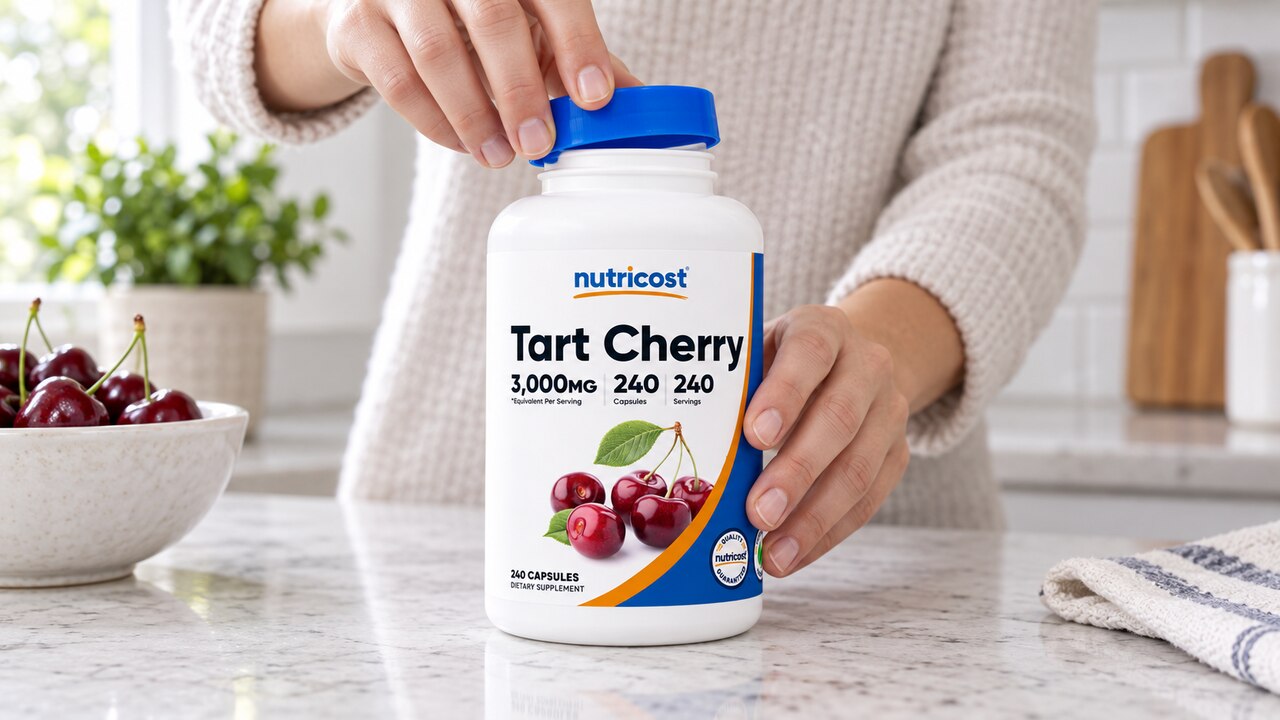
Nutricost’s 240-serving Tart Cherry Extract bottle looks like a simple capsule purchase until you compare it with the brand’s newer packaging. The reviewed ASIN uses one 300 mg capsule of 10:1 extract per serving, described as equivalent to 3,000 mg of tart cherry. Nutricost also shows a newer three-capsule, 1,200 mg label in the same official gallery, so the version on the delivered bottle matters.
For the exact 240-serving formula, the September 8 Amazon price of $14.95 works out to about 6.2 cents per capsule and per label-directed day. That is strong bottle-count value. It does not prove recovery results, however, because the label gives no anthocyanin or total polyphenol amount and cannot be matched cleanly to most tart cherry trials.
FitnessVolt may earn a commission from purchases through our links. Tom Miller used the one-capsule routine from Nutricost Tart Cherry Extract, ASIN B07TD6KJS3, checking capsule size, bottle handling, and daily convenience. He also confirmed the exact 300 mg label, current price, formula transition, and relevant human exercise research.
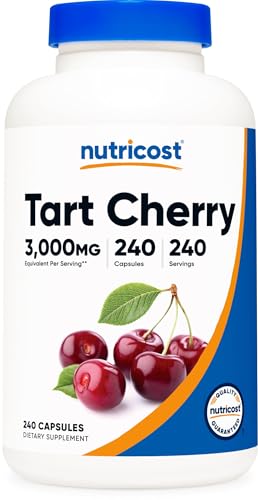
Nutricost Tart Cherry Extract 240 Vegetarian Capsules
Low-Cost 240-Serving BottleA one-capsule tart cherry extract with 240 servings and excellent cost arithmetic, tempered by no declared anthocyanin amount and an active label transition.
Pros
- One capsule per serving and 240 servings per bottle
- 300 mg of 10:1 tart cherry extract per capsule
- Vegetarian capsule, gluten-free, non-GMO, and labeled third-party tested
Cons
- No anthocyanin or total polyphenol amount is declared
- Research on other extracts and juices does not validate this exact capsule
- Nutricost's gallery also shows a newer 80-serving formula
Confirm the 240-Serving Formula Before Using the Math
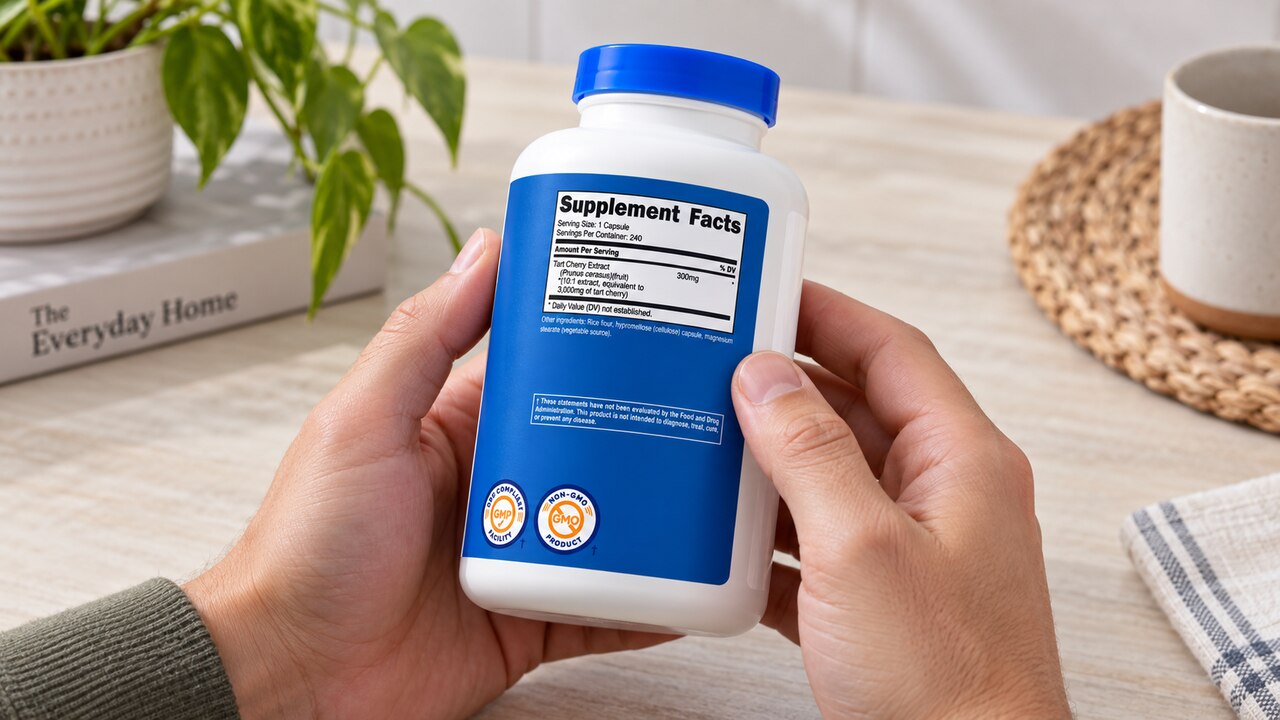
The official Nutricost product page currently describes 240 capsules and 240 servings. Its exact 300 mg Supplement Facts image lists one capsule per serving and 300 mg of Prunus cerasus fruit extract at a 10:1 ratio, which the label describes as equivalent to 3,000 mg of tart cherry. The suggested-use image directs healthy adults to take one capsule daily with 8 to 12 ounces of water, or as directed by a healthcare professional.
The same gallery also contains newer package images for 400 mg capsules taken three at a time. That version has 80 servings per 240-capsule bottle and claims a 12,000 mg fruit equivalent per serving. It is not the formula reviewed here. The current Amazon title for ASIN B07TD6KJS3 says 240 vegetarian capsules, and the primary image matches the older 240-serving bottle, but a marketplace listing can transition before every page element changes.
| Label version | Reviewed ASIN formula | Newer gallery formula |
|---|---|---|
| Capsules per serving | 1 | 3 |
| Extract per serving | 300 mg | 1,200 mg |
| Stated ratio | 10:1 | 10:1 |
| Stated fruit equivalent | 3,000 mg | 12,000 mg |
| Servings per 240 capsules | 240 | 80 |
Read all three numbers on the received bottle: serving size, extract milligrams, and servings per container. If it says three capsules and 80 servings, the cost and duration calculations in this review do not apply. Do not keep taking one capsule simply to preserve the cheaper daily number; follow the label you actually receive.
What $14.95 Buys on the Reviewed Label
The Amazon listing showed the exact ASIN at $14.95 and in stock on September 8, 2026. The table below excludes tax, shipping, subscription discounts, and future price changes. It assumes the delivered product is the reviewed one-capsule, 240-serving version.
| Calculation | Result | Buying implication |
|---|---|---|
| $14.95 / 240 capsules | About $0.062 each | Same as cost per label-directed day |
| 30 days x $0.0623 | About $1.87 consumed | Monthly consumption cost, not checkout spend |
| 240 capsules / 30 days | 8 months | One bottle carries a long open-container commitment |
| 90-day routine | 90 capsules | 150 capsules remain after three months |
| $14.95 / 72 g extract | About $0.21 per gram | Uses 240 x 300 mg, not fruit-equivalent marketing |
The eight-month duration is mathematically attractive, but it also makes storage and version identity more important. Keep the cap closed, store the bottle in a cool, dry place as directed, and check the expiration date before treating 240 capsules as 240 usable days. A low per-day cost is not good value if the bottle expires or the routine is abandoned.
Do not compare 3,000 mg “equivalent” with another product’s actual extract milligrams as though they were the same unit. The reviewed capsule contains 300 mg of 10:1 extract. The larger number is the manufacturer’s source-material equivalence calculation. For the broader category comparison, including softgels and other capsule counts, see our best tart cherry supplements guide.
The Recovery Evidence Does Not Identify This Capsule
Tart cherry research is promising enough to examine, but not consistent enough to turn a generic ingredient name into a product guarantee. A 2021 systematic review and meta-analysis pooled 14 studies and reported small effects on soreness and moderate effects on recovery of muscular strength and power. It found no significant pooled effect on creatine kinase or tumor necrosis factor alpha. [2] The products, doses, training protocols, and outcome timings varied.
A newer 2026 review of 19 trials found benefits for selected strength and inflammatory outcomes, but no significant pooled effects for soreness, creatine kinase, IL-6, TNF-alpha, range of motion, or most subgroup time points. The authors rated the certainty from very low to moderate and reported substantial heterogeneity. [3] That is a useful summary for buyers: there may be context-specific benefit, but the evidence does not support certainty about every symptom or every athlete.
The format mismatch is especially important here. Many studies used juice or concentrates with known polyphenol or anthocyanin exposure. Nutricost’s reviewed panel declares 300 mg of 10:1 tart cherry extract but no anthocyanin, total polyphenol, or marker-compound amount. We cannot calculate whether one capsule resembles a trial dose from the fruit-equivalent number alone.
Evidence from capsules does not settle the product question. A 2015 randomized trial in 23 resistance-trained men used 480 mg per day of a specific powdered Montmorency tart cherry product for 10 days around a high-volume squat session and reported some recovery-related advantages. [4] That result still cannot establish an effect for a different extract with no declared anthocyanin amount.
Neither result can be assigned to Nutricost. The studies used different identified preparations, different amounts, different participants, and short protocols. The most defensible reason to buy this product is that a one-capsule routine is inexpensive and simple, not that “3,000 mg equivalent” promises faster recovery after every hard session. Sleep, adequate energy and protein, and training-load management still carry the recovery plan. Our sleep supplements for recovery guide also explains why supplement decisions should follow, rather than replace, the basics.
Third-Party Tested Is Not a Lot Report
Nutricost labels the product third-party tested and says it is made in a GMP-compliant, FDA-registered facility. The official facts image lists rice flour, hypromellose for the cellulose capsule, vegetable-source magnesium stearate, and silica as other ingredients. Those are useful label details, and hypromellose supports the vegetarian-capsule description.
No public lot-matched report accompanies the testing claim, so it does not establish this bottle’s tart cherry potency, contaminant results, or prohibited-substance status. Drug-tested athletes should verify the exact product and certification required by their governing body before ordering.
Who Should Choose Something Else?
Choose a standardized product if research matching matters. Without an anthocyanin or total polyphenol amount, the reviewed label cannot be aligned confidently with most study preparations. A transparent marker-compound specification is more useful than the biggest fruit-equivalent number.
Choose juice only if its tradeoffs fit. Juice can resemble some study formats more closely, but it brings liquid volume, carbohydrates, storage, and travel considerations. Capsules are easier to pack. Neither format is automatically more effective without matching the actual preparation and intake.
Verify the bottle if the listing image changes. The one-capsule and three-capsule versions create dramatically different serving counts. Return or clarify a product that does not match what you intended to buy rather than silently applying the old directions.
Follow the manufacturer’s health warning. The reviewed bottle is labeled for healthy adults 18 and older. Nutricost directs people who are pregnant or nursing, taking medication, or managing a medical condition to consult a healthcare professional before use. That broad label warning supports a conversation with a clinician or pharmacist; it does not establish a specific drug interaction. The current label does not provide a separate surgery warning, while NCCIH advises telling healthcare providers about all supplements because some can affect medications, health conditions, or surgical care. [5]
Bottom Line
Nutricost Tart Cherry Extract is compelling on arithmetic, not certainty: one capsule daily, 240 label-directed servings, and about 6.2 cents per day at the captured $14.95 price. The reviewed 300 mg 10:1 extract is easy to count, but its undeclared anthocyanin content prevents a clean match to exercise studies. I would choose it for a low-cost capsule routine after confirming the 240-serving label. I would choose a standardized product when research comparability matters more than bottle count.
Sources
- Nutricost. (n.d.). Tart Cherry Extract Capsules: product details and official 300 mg label images. Accessed September 8, 2026.
- Hill JA, Keane KM, Quinlan R, Howatson G. (2021). Tart cherry supplementation and recovery from strenuous exercise: a systematic review and meta-analysis. International Journal of Sport Nutrition and Exercise Metabolism, 31(2), 154-167. doi:10.1123/ijsnem.2020-0145.
- Daab W, et al. (2026). Effects of tart cherry juice supplementation on recovery from exercise-induced muscle damage in athletes: a systematic review and meta-analysis. Sports Medicine – Open, 12, 40. doi:10.1186/s40798-026-00993-3.
- Levers K, et al. (2015). Effects of powdered Montmorency tart cherry supplementation on an acute bout of intense lower body strength exercise in resistance trained males. Journal of the International Society of Sports Nutrition, 12, 41.
- National Center for Complementary and Integrative Health. (n.d.). Using Dietary Supplements Wisely. Accessed September 8, 2026.