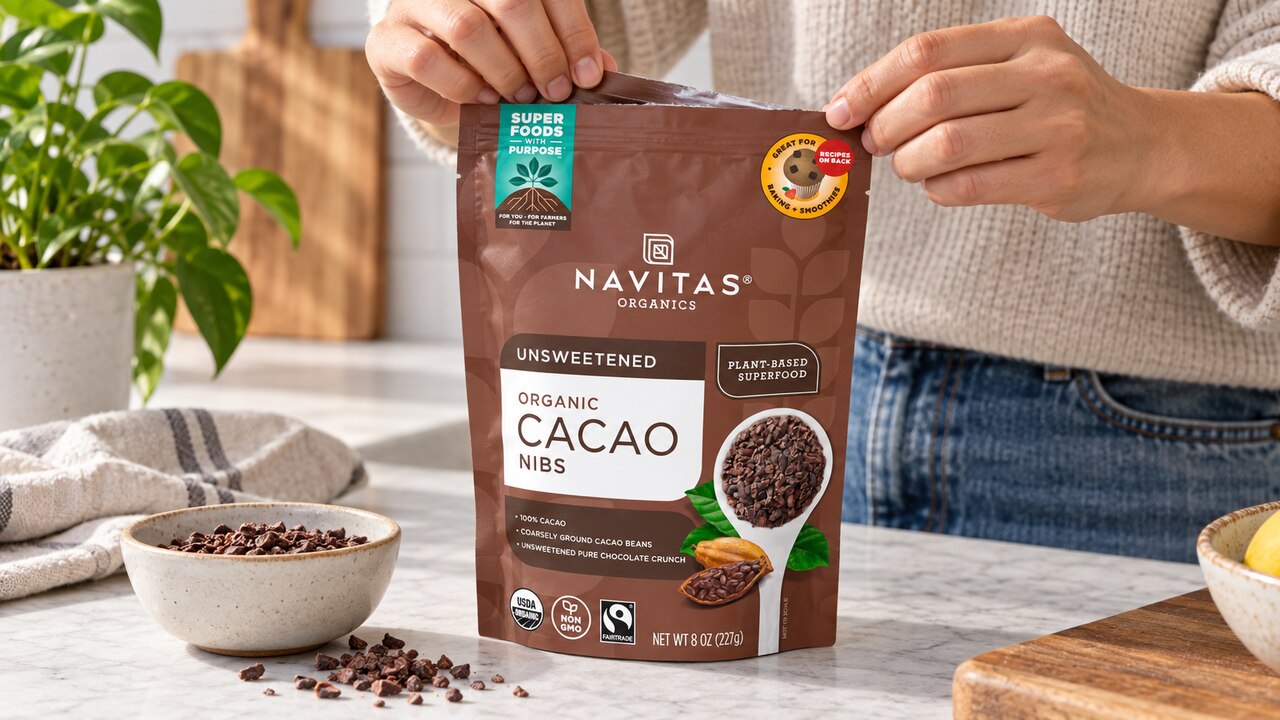
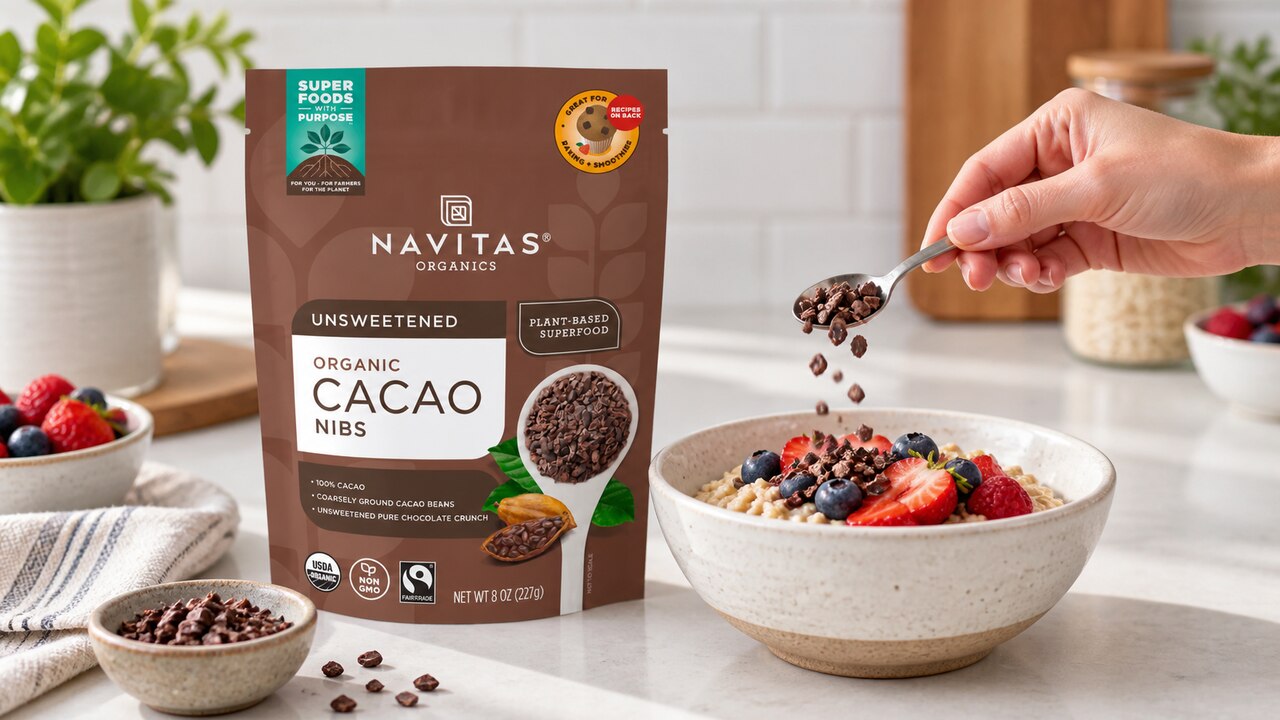
Navitas Organics Cacao Nibs is an 8 oz bag of fermented, briefly roasted cacao bean pieces with no sugar or other ingredient added. The small bag lowers the commitment for a first purchase, while USDA Organic and Fairtrade marks strengthen the sourcing story. The catch is a one-teaspoon nutrition serving that makes the bag’s 76-serving headline sound more generous than most people will experience.
I see this exact product as a good fit for an occasional cacao user who wants a traceable, certified option and understands that “unsweetened dark chocolate crunch” means bitter bean pieces, not snackable chocolate chips. I would look elsewhere for a raw-only product, a bulk-value bag, or a cacao product backed by a public lot-specific laboratory report.
FitnessVolt may earn a commission from purchases through our links. Tom Miller tasted and used the current 8 oz package sold as ASIN B000OQ4A3S, checking bitterness, crunch, package handling, and kitchen use. He also confirmed the manufacturer page, label, price, and relevant human and food-safety research.

Navitas Organics Cacao Nibs, 8 oz
Organic and Fairtrade 8 oz NibsA small one-ingredient bag with strong certification and unusually clear processing disclosure, balanced by a tiny serving and no public lot-specific test result.
Pros
- One certified-organic ingredient with no added sugar
- USDA Organic, Non-GMO, Fairtrade, kosher, vegan, and gluten-free signals
- Brand clearly says the nibs are fermented and briefly roasted
- 8 oz bag is a lower-commitment way to try unsweetened nibs
Cons
- One-teaspoon serving makes the 76-serving count easy to overread
- Current package carries a Proposition 65 cadmium warning
- Brand describes third-party testing, but no public lot result was reviewed
The Label Is Simple, but the Serving Needs Translation
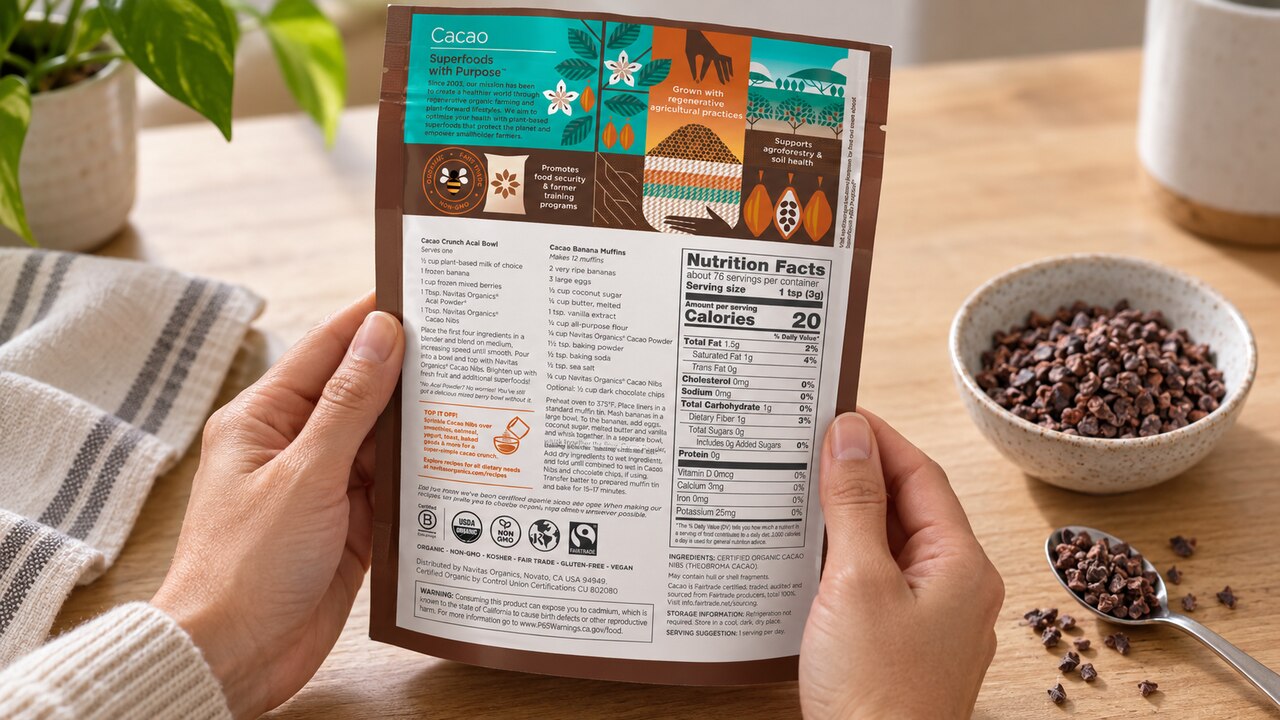
The current Navitas product page lists certified organic cacao nibs (Theobroma cacao) as the only ingredient. The 8 oz bag contains about 76 servings because the serving size is only one teaspoon, or 3 g. That is a legitimate label serving, but it is much smaller than the 28 g or 30 g references buyers often use when comparing foods.
| Current label fact | Per 1 tsp (3 g) | Buyer implication |
|---|---|---|
| Calories | 20 | A tablespoon is roughly three label servings |
| Total and saturated fat | 1.5 g and 1 g | Scale the serving before comparing with another bag |
| Carbohydrate and fiber | 1 g and 1 g | Rounding has a large effect at this tiny portion |
| Total and added sugars | 0 g and 0 g | The nibs are unsweetened |
| Potassium | 25 mg | A food contribution, not a mineral-supplement dose |
One tablespoon is approximately three teaspoons, so a tablespoon of these nibs is about 9 g and three listed servings. The manufacturer’s FAQ separately states 14 mg of caffeine per tablespoon. That is more decision-useful than pretending cacao is caffeine-free, but it remains a brand figure rather than our own assay.
The one-teaspoon panel is not a good foundation for scaling every nutrient to an ounce. Labels round small amounts, and multiplying a rounded one-gram value nine or ten times can magnify the rounding error. Use the package serving to track the amount you actually eat, and use price per ounce for a clean value comparison.
What the Current Price Buys
The Amazon listing showed $11.88 and in-stock availability on September 8, 2026. That equals about $1.49 per ounce, $0.16 per one-teaspoon serving, or roughly $0.47 for a tablespoon. These are snapshot calculations before tax, shipping, coupons, or subscription discounts.
The low cost per serving looks attractive until you notice the 3 g denominator. Price per ounce is the honest number for comparing different cacao nib bags. Navitas costs more per ounce at this snapshot than the $19.99 Viva Naturals 1 lb bag, but Navitas asks for a smaller total purchase. Paying a little more per ounce can still be rational if eight ounces prevents an unwanted pound from going stale.
Buy the smaller bag when you are testing whether unsweetened cacao belongs in your routine. Buy bulk only after you know your usage. FitnessVolt’s cacao nibs comparison covers the category and alternative bag sizes; this review stays with the exact Navitas 8 oz product.
It Is Fermented and Roasted, Not Raw
Navitas deserves credit for a plain answer in its FAQ: these nibs are not technically raw. The company says the cacao is naturally fermented, then briefly roasted to develop flavor and support food safety. That is more precise than the loose use of “raw cacao” across the category.
Fermentation and roasting are normal cacao-processing steps. They shape acidity, bitterness, aroma, and the composition of cacao compounds. Without a time, temperature, and finished-product assay, however, readers cannot calculate how many flavanols remain in this bag. The phrase “contains antioxidants” is not a measured dose.
That distinction matters when health research enters the conversation. The COSMOS randomized trial tested a standardized extract supplying 500 mg cocoa flavanols daily in more than 21,000 older adults. It did not significantly reduce the trial’s primary outcome of total cardiovascular events. The intervention was not Navitas nibs, and the current label does not state a flavanol amount. It would be wrong to convert that trial into a serving recommendation for this food.
Flavor and Kitchen Use
Navitas cacao nibs taste bright, slightly bitter, and close to unsweetened dark chocolate. They add small, hard pieces and do not melt when heated. In our kitchen test they softened slightly in warm food but remained crunchy and structurally different from chocolate chips.
That makes them most logical as a crunchy topping or mix-in. Oatmeal, yogurt, smoothie bowls, trail mix, and baked goods can supply sweetness or moisture around the nibs. Eating them alone may appeal to people who already enjoy very dark chocolate, yet the package should not be judged as a sweet snack. No added sugar is a benefit only when that is the flavor you actually want.
For baking, decide what job the ingredient has. Use nibs for roasted cacao character and crunch. Use chocolate chips or chopped chocolate for sweetness and melted pockets. Swapping one for the other changes both texture and flavor, even if the volume in the measuring cup is the same.
Fairtrade and Sourcing Are Real Differentiators
The current 8 oz bag displays USDA Organic, Non-GMO, and Fairtrade marks, and the product page also shows kosher, vegan, and gluten-free indicators. Navitas says its cacao comes through smallholder farmer organizations and that the nibs are traceable. Those are more concrete sourcing signals than a vague “ethically sourced” sentence.
Certification still has limits. It does not tell you the flavor of the bag, the amount of flavanols, or the measured metals in the lot on your shelf. It also does not make one brand automatically superior on every issue. I treat Fairtrade as a meaningful reason to prefer Navitas when producer standards matter to the buyer, not as a blanket nutrition or purity guarantee.
Caffeine, Theobromine, and Timing
The brand’s 14 mg caffeine-per-tablespoon figure is modest next to typical coffee, but modest is not zero. Cacao also naturally contains theobromine, another methylxanthine. No per-serving theobromine amount appears on the current page.
If caffeine affects your sleep, start with a measured teaspoon earlier in the day rather than scattering an unknown amount over dinner. Parents, pregnant buyers, and people following clinical advice about stimulants should use individualized guidance. A “superfood” label does not override sensitivity, medication questions, or a clinician’s recommendation.
What the Proposition 65 Warning Does and Does Not Say
The current 8 oz back label warns that consuming the product can expose users to cadmium, which California lists for reproductive harm. California’s official food-warning guidance describes Proposition 65 as a right-to-know framework. The warning does not provide the amount in a serving or decide the risk for an individual buyer.
Navitas says all its products undergo independent third-party testing for heavy metals, microbials, and nutrition values. That is a useful quality-control claim, but an FDA-affiliated market study found substantial variation in cadmium and lead across sampled cocoa powders, chocolate, and nib products. It did not test or clear the Navitas bag you may receive.
If metals exposure drives your purchase, ask the company for the report tied to your lot code. Look for the laboratory, test date, cadmium and lead results, units, serving basis, and reporting limits. “Third-party tested” is the start of the answer, not the numerical answer.
Who Should Buy It, and Who Should Skip It?
Buy it if you want a small, one-ingredient organic bag, value Fairtrade sourcing, and plan to use measured nibs as a crunchy topping or mix-in. The 8 oz size is especially reasonable for a first trial or occasional use, even though its snapshot price per ounce is not the lowest.
Skip it if you specifically require raw cacao. Navitas itself says this product is fermented and briefly roasted. It is also a poor match for someone expecting sweetness, a melting baking chip, a caffeine-free evening topping, or bulk pricing.
I would also pause if the Prop 65 cadmium warning conflicts with your risk tolerance and the company cannot supply the lot documentation you need. No one needs cacao nibs to complete a balanced diet. A different topping is a perfectly valid choice.
Bottom Line
Navitas Organics Cacao Nibs earns a 4.1 out of 5 editorial rating for its one-ingredient formula, organic and Fairtrade credentials, clear processing disclosure, and approachable 8 oz size. At the $11.88 snapshot, it costs about $1.49 per ounce. The tiny one-teaspoon serving, naturally bitter non-melting format, caffeine, and Proposition 65 cadmium warning all deserve attention. I would choose it as a lower-commitment, sourcing-conscious introduction to unsweetened nibs, not as a raw cacao product or a clinically dosed antioxidant supplement.
Sources
- Navitas Organics. (Accessed September 8, 2026). Cacao Nibs product page, current 8 oz label, and manufacturer FAQ.
- Sesso HD, et al. (2022). Effect of cocoa flavanol supplementation for the prevention of cardiovascular disease events: the COSMOS randomized clinical trial. American Journal of Clinical Nutrition.
- Abt E, Fong Sam J, Gray P, Robin LP. (2018). Cadmium and lead in cocoa powder and chocolate products in the US Market. Food Additives & Contaminants: Part B.
- California Office of Environmental Health Hazard Assessment. (Updated 2025). Foods and Beverages: Proposition 65 Warnings.