
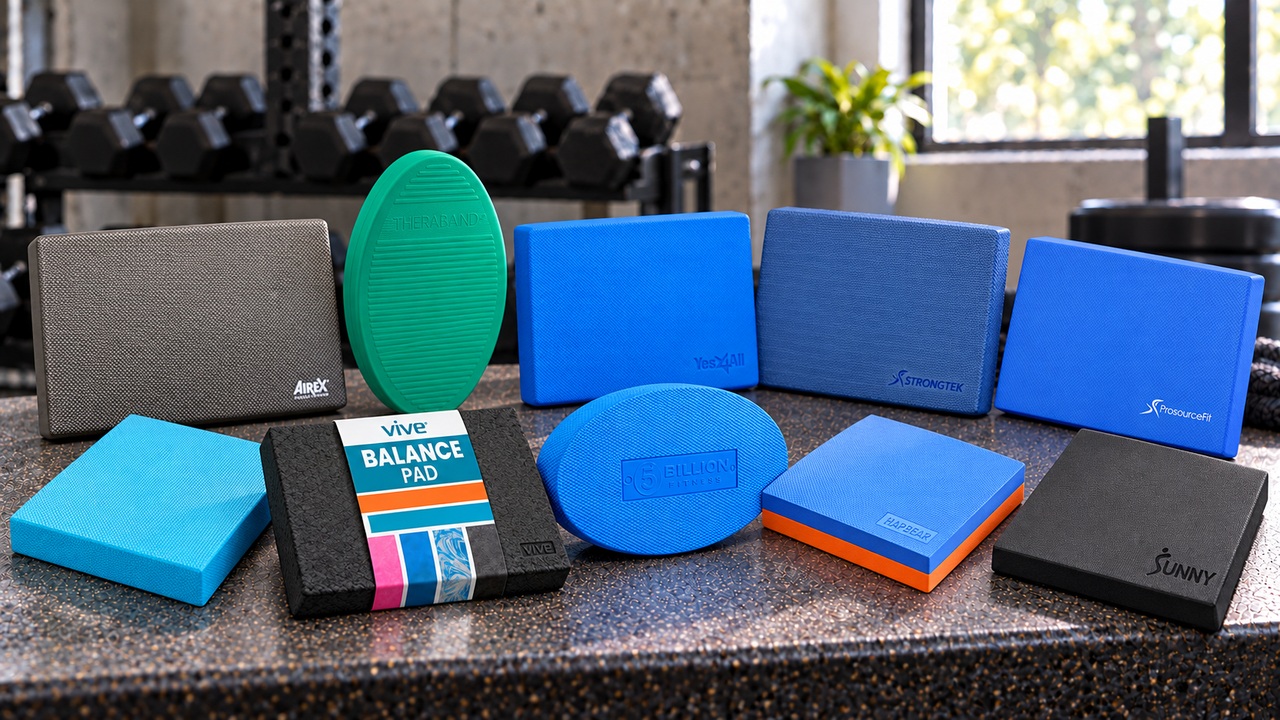
A foam balance pad changes the surface under your feet, hands or knees. It compresses as you move, adding a balance challenge without a rocker board or an inflatable cushion. Footprint, thickness and the manufacturer’s firmness description matter more than the color. These ten distinct pads suit different home setups, from a compact oval to a broad rectangle.
Written by Tom Miller, CSCS. Updated: November 2026.
Short on time? The AIREX Balance-pad Elite is our overall pick for its closed-cell foam, two-sided waffle texture and clear care instructions. Choose THERABAND’s firm green trainer for a compact oval with a defined place in the brand’s progression. Start balance work beside a sturdy support; an unstable pad increases the challenge and does not make standing safer.
How We Chose
We compared ten solid-foam models by construction, published footprint, thickness, shape, care instructions and useful distinctions between versions. We excluded inflatable discs, wobble boards and generic kneeling cushions. Our scores favor clear specifications and a practical buying purpose. We kept conflicting size claims visible rather than treating a precise-looking number as a measurement. Manufacturer load limits describe the product, not a guarantee that an individual can balance on it. Prices change, so compare the selected size and quantity before ordering.
Our Verdict
AIREX Balance-pad Elite
Closed-cell foam, waffle texture on both faces and manufacturer care guidance make the Elite a strong general-purpose choice for controlled home balance practice.
Best for: Home balance practice with room for a rectangular pad and sturdy nearby support
Check Price on AmazonOur Top Picks
Best Overall: AIREX Balance-pad Elite

AIREX Balance-pad Elite Lava Grey Single Pad
Best OverallA rectangular closed-cell foam Elite pad in lava grey, with waffle texture on both faces and a manufacturer-stated six-centimeter thickness for balance practice.
Pros
- Closed-cell foam
- Waffle texture on both faces
- Manufacturer specifies 6cm thickness
Cons
- Larger footprint than compact ovals
- Manufacturer says no sneakers
The Elite uses yielding closed-cell foam and a waffle texture on its upper and lower faces. AIREX specifies a nominal thickness of 6cm. It distinguishes the Elite from its other pads by surface and balance challenge, so check the family name rather than buying any AIREX rectangle that looks similar.
AIREX recommends barefoot use or socks, no sneakers, and cleaning with soapy water followed by thorough air drying. Its rounded inch dimensions vary across charts; confirm the current dimensions if you need a tight storage fit. Skip this if you want a shoe-on workout surface or a small one-foot oval. THERABAND’s green trainer takes less floor space, while OPTP also carries a no-shoes instruction.
Best Firm Foam Progression: THERABAND Green Stability Trainer

THERABAND Stability Trainer Firm Green Single Foam Pad
Best Firm Foam ProgressionOne firm green foam oval from THERABAND's progression system, with a ribbed surface and a smaller training footprint than the rectangular pads.
Pros
- Firm foam within the brand's range
- Compact oval shape
- Single pad without inflation
Cons
- Dimension graphics conflict; confirm footprint
- Not a broad two-foot platform
THERABAND places green before blue and black in its progression toward greater instability. The selected green trainer uses firm foam; the black version uses a different construction and is not the product here. The ribbed oval provides a focused contact area rather than a broad rectangular platform.
The maker’s guidance calls for a sturdy object nearby and suggests flat-soled shoes if the user needs footwear. Current dimension graphics conflict, so confirm the footprint instead of planning a shelf around one chart. Skip this if you want a wide two-foot stance on one pad. The 19-inch OPTP gives you substantially more rectangular space. Firm green also means relative firmness within this range, not universal beginner safety.
Best Straightforward 2-Inch Pad: Yes4All Large

Yes4All Exercise Balance Pad Large Blue Single
Best Straightforward 2-Inch PadA single blue Large TPE foam pad measuring 15.5 by 13 by 2 inches, with a textured surface for home balance exercises.
Pros
- 15.5 by 13-inch footprint
- 2-inch TPE foam
- One standard rectangular pad
Cons
- Smaller than AIREX and OPTP
- Texture does not eliminate slipping
Yes4All publishes a 15.5 by 13-inch footprint and 2-inch thickness for this Large blue pad. Its original size illustration agrees with those figures. Choose this version if you want a plain rectangular TPE pad and do not need the larger XL footprint.
Its listed length is close to StrongTek’s 15.8 inches, but that small difference does not establish how either foam feels under load. Compare checkout prices without assuming the thicker-looking photograph represents a different resistance level. Skip this if your stance needs more than 13 inches across the short edge. OPTP offers 15.25 inches of width. The color choices pictured beside Yes4All are alternatives, not extra pads in this single-pad purchase.
Best Slightly Longer Compact Rectangle: StrongTek

StrongTek High-Density TPE Balance Pad Blue Single
Best Slightly Longer Compact RectangleA blue high-density TPE rectangle with published 15.8 by 13 by 2-inch dimensions, for buyers comparing compact pads with the same two-inch thickness.
Pros
- 15.8 by 13 by 2 inches
- High-density TPE construction
- Water-resistant surface
Cons
- No measured firmness scale
- Only a small size increase over Yes4All
StrongTek’s selected single pad measures a published 15.8 by 13 by 2 inches. The maker describes high-density TPE and a water-resistant surface. Its size illustration rounds the length to 15.75 inches, which is consistent with treating these dimensions as nominal rather than measured clearance guarantees.
The main buying distinction from Yes4All is the slightly longer listed footprint, not a proven advantage in grip or durability. Check the current price for one pad; StrongTek also sells multi-packs under separate listings. Skip this if you expect a much larger standing area than the other compact rectangles. Move up to OPTP’s 19 by 15.25 inches instead. Do not confuse the description high-density with a quantified firmness grade.
Best Lightweight Standard Rectangle: ProsourceFit

ProsourceFit Exercise Balance Pad Blue 15.5 by 12.75 Inches
Best Lightweight Standard RectangleA standard blue TPE pad with published 15.5 by 12.75 by 2.25-inch dimensions and a twelve-ounce weight, separate from ProsourceFit's larger model.
Pros
- Published 12-ounce weight
- 15.5 by 12.75-inch footprint
- 2.25-inch TPE foam
Cons
- Narrower short edge than OPTP
- Not the brand's larger 19-inch version
ProsourceFit pairs a 15.5 by 12.75-inch footprint with 2.25-inch TPE foam and a published weight of 12 ounces. Those dimensions make it a compact rectangular option for carrying between rooms or storing with a mat. Its larger 19-inch model is a separate choice.
The extra quarter-inch of thickness over Yes4All does not prove that ProsourceFit will create more instability for you. Foam density, contact area and your movement also matter. Skip this if you want the widest platform for two-foot positions. OPTP adds several inches along the long edge. For a smaller bag, compare 5BILLION’s oval, but remember that its usable contact area narrows toward the ends.
Best Larger Rectangular Platform: OPTP Pro Balance Pad

OPTP Pro Balance Pad Large Blue
Best Larger Rectangular PlatformThe Large blue OPTP closed-cell foam pad measures 19 by 15.25 by 2.25 inches, providing more platform space than the compact rectangles.
Pros
- 19 by 15.25-inch footprint
- 2.25-inch closed-cell foam
- Clear no-shoes instruction
Cons
- Needs more storage room
- Not intended for standing in shoes
OPTP’s Large Pro Balance Pad measures 19 by 15.25 by 2.25 inches. That gives you more room to position your feet than the 15.5 by 12.75-inch ProsourceFit. The maker uses closed-cell foam and includes a clear warning in its specification image: do not stand on the pad while wearing shoes.
This is the Large version, not the much longer XL. Reserve the full footprint on the floor and on your shelf; larger dimensions do not make the surface stable. Skip this if you intend to keep your training shoes on or need a pad that fits a small tote. The compact rectangles use less storage space, and footwear instructions need a separate check for whichever model you choose.
Best Clearly Stated 300-Pound Rating: Vive Standard

Vive Standard Balance Pad Midnight Black
Best Clearly Stated 300-Pound RatingA black latex-free TPE pad with a manufacturer-stated 300-pound limit and illustrated manual; the maker lists 15.8 by 13.4 by 2.4-inch dimensions.
Pros
- Maker states a 300-pound limit
- Latex-free TPE foam
- Illustrated exercise manual
Cons
- Size artwork differs from maker's written specs
- Capacity does not establish balance safety
Vive’s written specifications list 15.8 by 13.4 by 2.4 inches, latex-free TPE and a 300-pound user limit. Its illustrated manual offers suggested exercises. The maker also states a 60-day guarantee; check current terms rather than treating that as lifetime coverage.
Some size artwork shows different figures, so use the written specifications as your starting point and confirm them if exact fit matters. Wipe the pad with a damp cloth and mild detergent, then dry it. Skip this if you exceed the maker’s limit or need a rigid support surface. A capacity number does not prevent a fall. Sunny lists a higher 330-pound limit, but it remains an unstable foam trainer.
Best Small Solid-Foam Oval: 5BILLION

5BILLION Blue Oval Solid Foam Balance Pad
Best Small Solid-Foam OvalOne blue solid TPE foam oval measuring approximately 11.8 by 7.5 by 2.4 inches, for routines that call for a small contact area.
Pros
- Approximately 11.8 by 7.5 inches
- Solid TPE foam rather than inflation
- Compact one-pad package
Cons
- Narrow contact area
- Not a wide two-foot platform
5BILLION’s blue oval measures approximately 11.8 by 7.5 by 2.4 inches in its size illustration. It uses solid TPE foam, so you do not need a pump or have an inflation setting to maintain. The curved ends reduce the available platform compared with a rectangle of similar outside dimensions.
Buy it for a movement that calls for that compact contact area, not as a smaller substitute for every exercise pictured on a larger pad. Check your foot placement on firm ground before deciding the footprint works. Skip this if you need room for both feet in a normal-width stance. Yes4All gives you a broad rectangle, and THERABAND offers a different oval with a defined relative firmness level.
Best Two-Sided Color Contrast: HAPBEAR

HAPBEAR Blue and Orange Single Foam Balance Pad
Best Two-Sided Color ContrastOne blue-and-orange TPE foam pad with two textured faces; its chart gives 15.8 by 13 by 2.4 inches, but the title lists smaller dimensions.
Pros
- Textured blue and orange faces
- TPE foam construction
- One pad, no inflation
Cons
- Title and size chart disagree
- Different colors do not establish different firmness
HAPBEAR uses blue and orange faces on one TPE pad. The contrast makes it easy to recognize which face you have placed upward, but the maker does not establish that those faces have different firmness. Both carry a diamond-style texture.
The size chart and specification field show about 15.8 by 13 by 2.4 inches, while the title names a smaller pad. Confirm dimensions with the seller before ordering for a tight space. Skip this if you need an unambiguous published footprint. Yes4All’s selected Large size agrees across its description and size image. Choose HAPBEAR for the two-sided color layout, not a claim that turning it over changes the difficulty.
Best Higher Published User Limit: Sunny Large

Sunny Health & Fitness Large Grey Foam Balance Pad
Best Higher Published User LimitA single grey Large closed-cell TPE pad measuring 15.7 by 13 by 2 inches, with a manufacturer-stated user limit of 330 pounds.
Pros
- Manufacturer states a 330-pound limit
- 15.7 by 13 by 2 inches
- Closed-cell TPE foam
Cons
- Manufacturer limit is not a fall-risk assessment
- Large is smaller than the brand's XL
Sunny publishes a 330-pound user limit for this grey foam balance pad. The selected Large measures 15.7 by 13 by 2 inches and uses closed-cell TPE. Its XL listing has a larger footprint and thickness, so check the size choice before comparing prices.
The 330-pound figure exceeds Vive’s stated 300-pound limit, but neither number tells you how well you will balance. Sunny recommends wiping the surface clean and letting it dry before indoor storage. Skip this if you exceed the published limit or need a wider platform for your exercise. OPTP offers more rectangular space. Do not add weights to a balance drill just because the combined load stays under a stated capacity.
Balance Pad Comparison
| Product | Key Spec | Best For | Price |
|---|---|---|---|
| AIREX Balance-pad Elite Lava Grey Single Pad | Elite lava grey; closed-cell foam; waffle texture both sides; 6cm nominal thickness | Best Overall | Check Price |
| THERABAND Stability Trainer Firm Green Single Foam Pad | Firm green single foam oval; first foam level in three-level trainer family; confirm footprint | Best Firm Foam Progression | Check Price |
| Yes4All Exercise Balance Pad Large Blue Single | 15.5 x 13 x 2 inches; TPE foam; one blue Large pad | Best Straightforward 2-Inch Pad | Check Price |
| StrongTek High-Density TPE Balance Pad Blue Single | 15.8 x 13 x 2 inches; high-density TPE foam; one blue pad | Best Slightly Longer Compact Rectangle | Check Price |
| ProsourceFit Exercise Balance Pad Blue 15.5 by 12.75 Inches | 15.5 x 12.75 x 2.25 inches; TPE foam; published 12 oz | Best Lightweight Standard Rectangle | Check Price |
| OPTP Pro Balance Pad Large Blue | 19 x 15.25 x 2.25 inches; closed-cell foam; no-shoes instruction | Best Larger Rectangular Platform | Check Price |
| Vive Standard Balance Pad Midnight Black | 15.8 x 13.4 x 2.4 inches per maker; latex-free TPE; 300-lb manufacturer rating | Best Clearly Stated 300-Pound Rating | Check Price |
| 5BILLION Blue Oval Solid Foam Balance Pad | 11.8 x 7.5 x 2.4 inches approximately; solid TPE foam oval; one pad | Best Small Solid-Foam Oval | Check Price |
| HAPBEAR Blue and Orange Single Foam Balance Pad | 15.8 x 13 x 2.4 inches per size chart; title differs; dual-color TPE pad | Best Two-Sided Color Contrast | Check Price |
| Sunny Health & Fitness Large Grey Foam Balance Pad | 15.7 x 13 x 2 inches; closed-cell TPE foam; 330-lb manufacturer rating | Best Higher Published User Limit | Check Price |
Choosing and Using a Balance Pad
Decide Whether You Need Instability
A foam trainer yields under pressure. That is the reason to buy it for a balance exercise, and the reason to avoid it when you need stable support. A yoga block, firm floor and foam balance pad serve different purposes. Do not replace a stable step, transfer aid or walking surface with a soft pad.
For step-ups or aerobic choreography, compare our aerobic step platforms instead. For protecting a room’s floor, use our home gym flooring guide. Neither purpose requires introducing an unstable surface under your feet.
Match the Footprint to the Movement
Check the long and short edges, not a size name such as Large. OPTP’s Large is 19 by 15.25 inches; Yes4All’s Large is 15.5 by 13. A narrow oval can suit a focused contact point but leaves less space for two feet. Keep your entire intended contact area on the pad rather than letting a heel hang off an edge.
Thickness alone does not rank difficulty. The maker’s foam formulation, your body weight and the movement change how much the surface deforms. Few listings provide a comparable firmness measurement. Treat high-density and extra-thick as descriptions, then use your instructor’s guidance to choose the appropriate challenge.
Set Up Support Before Stepping On
Check quantity as well as dimensions. The selections here each contain one pad. Two small ovals do not provide the same continuous surface as one rectangle, and a photograph showing several colors does not establish a multi-pack. Follow the equipment arrangement your instructor demonstrates. Do not stack pads to create more height or instability without individualized instruction.
Plan where you will step off before beginning. A pad beside an open floor area gives you a different exit from one squeezed between a bed and a table. Keep children, pets and loose exercise equipment out of that space. Place the pad for the exercise, then put it away afterward rather than leaving an unexpected soft obstacle in a walkway.
The National Institute on Aging advises keeping a sturdy chair, person or wall nearby during balance exercises. Use a fixed counter or secure rail if you need reliable hand support; avoid a rolling chair. Start on firm ground if you cannot maintain the intended position there. A softer surface adds difficulty.
Keep the floor dry, clear nearby objects and check that the pad cannot slide in your chosen setup. Remain close enough to use your support without lunging for it. Begin with eyes open and controlled movements. Closing your eyes, removing support and adding load are separate progressions, not steps to combine on your first attempt.
If you have fallen, feel dizzy, have neuropathy or need exercise after injury or surgery, ask a qualified clinician whether a foam pad belongs in your plan. Stop for pain or concerning symptoms. No texture, user rating or product capacity removes fall risk.
Check Footwear and Care Instructions
OPTP says not to stand on its pad wearing shoes. AIREX specifies barefoot use or socks, while THERABAND allows flat-soled shoes when the user needs them. Follow the exact model’s instructions rather than carrying one brand’s rule across the list. Avoid slick socks or footwear that undermines your footing.
Inspect for tears, damaged edges and contamination before use. Wipe the pad as directed, let it dry and store it without heavy objects compressing the foam. Closed-cell construction does not mean you should leave the pad wet or assume any household cleaner is suitable. Check the maker’s cleaning guidance before applying a disinfectant.
Frequently Asked Questions
Do Older Adults Need a Balance Pad?
No. The CDC recommends balance activity alongside aerobic and strength work for adults 65 and older, but does not require this accessory. An instructor can build appropriate balance practice on firm ground. Choose a pad only when the added instability suits your ability and plan.
Can I Build Strength on a Foam Pad?
You can add a balance challenge to selected exercises, but instability can limit how much force or load you control. Keep a firm base for heavy strength work. Our resistance band guide covers another compact training option without requiring you to stand on foam.
Is a Foam Pad the Same as a Pilates Ring?
No. A pad changes your support surface; a Pilates ring supplies resistance between contact points. Follow the equipment specified for the movement. Neither small accessory replaces a full exercise program.
Is an inflatable balance disc the same purchase?
No. These selections use solid foam and need no pump. An inflatable cushion changes shape through its air-filled construction and comes with its own setup instructions. THERABAND’s firm green foam trainer and its different black version illustrate why the exact model matters. Follow the exercise’s intended equipment rather than substituting a disc because it has a similar outline.
Can I keep my training shoes on?
Check the exact pad. AIREX recommends bare feet or socks, and OPTP says not to stand on its pad in shoes. THERABAND allows flat-soled footwear when needed. One manufacturer’s rule does not apply to the others. If footwear is essential for your exercise plan, resolve that requirement before ordering, and keep sturdy support within reach when you practice.
Bottom Line
Choose the AIREX Elite for its two-sided waffle texture and established closed-cell design, THERABAND green for a firm oval within a defined progression, or OPTP Large for more rectangular space. Keep sturdy support within reach and pick the footprint your routine needs before comparing colors or accessories.
Sources
- CDC: Older adult physical activity recommendations
- National Institute on Aging: Exercise types and balance safety
- Performance Health: THERABAND progression, support and footwear guidance
- AIREX: Elite construction and care instructions
- OPTP: Pro Balance Pad sizes