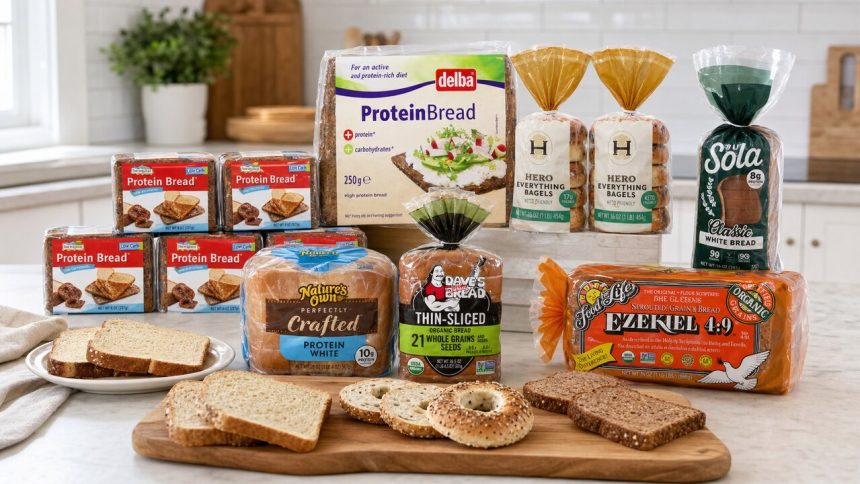
High-protein bread can make breakfast or a sandwich easier to plan, but the package name tells only part of the story. The useful comparison lives on the Nutrition Facts panel: serving size, protein, calories, fiber, sodium, ingredients, and the number of slices you will eat. A bread that adds protein can still fit poorly if you dislike the texture, need gluten-free food, or overlook a two-bagel serving.
Editorial review updated July 2026. Tom Miller tasted the breads plain and toasted and used them for breakfast and sandwich meals. Prices and availability can change.
Short on time? Hero Everything Bagels is the clearest protein-forward record here, with 17 g of protein, 5 g net carbs, and 140 calories per stated serving. Read the serving size before deciding whether two bagels fit your meal.
Our Verdict
Hero Everything Bagels
Its label gives the most complete stated macro snapshot: 17 g protein, 5 g net carbs, high fiber, and 140 calories per serving.
Best for: Shoppers who want a specifically protein-forward bagel serving and will check the current label
Check Price on AmazonHow we evaluated high-protein bread
Tom compared softness, density, chew, toast quality, freshness, and how well each option held common sandwich or breakfast toppings. We paired those results with serving size, protein, calories, fiber, sodium, ingredients, allergens, package size, availability, and price. The current Nutrition Facts panel decides whether a particular loaf or bagel fits your meal.
At a glance
| Product | Key detail | Package | Best fit | |
|---|---|---|---|---|
| Hero Everything Bagels | 17 g protein per stated serving | 10 bagels | Protein-forward bagel meal | Check price |
| Nature’s Own Life Protein Loaf | Protein loaf | 16 oz | Standard loaf format | Check price |
| Delba Protein Bread | Protein bread | 8.1 oz | Small package comparison | Check price |
| Mestemacher Protein Bread | Whole-grain rye positioning | 8.8 oz | Pantry-format bread | Check price |
| Ezekiel 4:9 Bread | Organic bread | 24 oz | Conventional grocery-style loaf | Check price |
| Mestemacher Protein Bread, 2-pack | Smaller rye-bread commitment | Two 8.8 oz packages | Try-first rye pack | Check price |
| Dave’s Killer Bread | Organic whole-grain alternative | 20.5 oz | Thin-sliced whole-grain loaf | Check availability |
| Sola Protein White Bread | Protein white-bread format | 20.2 oz | Soft white-bread comparison | Check availability |
Our eight picks
Best protein-forward option: Hero Everything Bagels

Hero Everything Bagels, 10-Count Package
Best Protein-Forward PickPros
- 17 g protein per stated serving
- 5 g net carbs stated
- 140 calories and high fiber stated
Cons
- Serving is two bagels
- Bagel format is not a sandwich-loaf substitute
Hero stands apart because the supplied record gives actual macros: 17 g protein, 5 g net carbs, high fiber, and 140 calories per serving. It is also the only item here where the record calls out a two-bagel serving. That makes it useful for a planned breakfast, especially with eggs, Greek yogurt, or another protein source.
Skip this if: you want one loaf for lunch sandwiches or you prefer to keep portions visually simple. A serving of two bagels is a different meal from two slices of bread, so check the live Nutrition Facts panel and your toppings.
Best standard-loaf starting point: Nature’s Own Life Protein Loaf

Nature's Own Life Protein Loaf
Loaf Format PickPros
- 16-ounce loaf stated
- Protein loaf positioning
- Useful format for measured sandwiches
Cons
- Only 11 left at review time
- Record does not state macros
Nature’s Own gives you the familiar 16-ounce loaf format, which makes it easier to build a sandwich around a known number of slices. The record does not state grams of protein, calories, fiber, or sodium, so do not assign it a macro advantage until you read the current package.
Skip this if: you need a confirmed protein number before buying. Hero provides a stated 17 g per serving in the supplied record, while this product needs a label check. The recorded inventory was limited, which also makes it a poor choice for a routine you cannot replace easily.
Best small-package protein bread: Delba Protein Bread

Delba Protein Bread
Small PackagePros
- Protein-bread positioning
- 8.1-ounce package
- Lower listed price than most loaves
Cons
- Small package may not suit family meals
- Macros absent from product record
Delba is a useful smaller-package comparison at 8.1 ounces. That can suit one person who wants to sample a denser-style bread without storing a large loaf. It should not earn a place in your macros merely because the name says protein: protein per slice and serving size still need a label check.
Skip this if: you need a larger sandwich loaf for several meals. Nature’s Own lists a 16-ounce loaf, almost twice the package weight, and Ezekiel lists 24 ounces.
Best pantry-style rye comparison: Mestemacher Protein Bread, pack of nine

Mestemacher Protein Bread Pack of 9
Pantry Rye ComparisonPros
- Whole-grain German rye positioning
- Nine 8.8-ounce packages stated
- Non-GMO claim in product record
Cons
- Highest listed price in the bread group
- Large multi-pack commitment
The pack-of-nine listing is for a whole-grain European rye-style bread, not a soft white sandwich loaf. The separate packages may help with storage planning, but $49.99 is a major upfront commitment. Its protein positioning and whole-grain rye description are reasons to inspect the label, not a substitute for comparing fiber, sodium, and protein per serving.
Skip this if: you want a first try or you dislike dense rye bread. Delba’s smaller 8.1-ounce package costs far less at the recorded price, while Nature’s Own has the more familiar loaf format.
Best single-pack Mestemacher comparison

Mestemacher Protein Bread Pack of 2
Try-First Rye PackPros
- Two 8.8-ounce packages
- Protein bread stated
- Lower upfront price than pack of nine
Cons
- Still a rye-style product
- Fewer packages raise cost per package versus the nine-pack
This two-pack solves the main issue with the nine-pack: you can decide whether the format works in your meals before buying nine packages. It shares the 8.8-ounce package size and protein-bread description. Compare the per-package cost when you know you like it, but do not let bulk pricing force a food you will not finish.
Skip this if: a standard sliced loaf is the goal. Nature’s Own and Ezekiel fit that shopping pattern better, subject to current local availability.
Best familiar organic-bread alternative: Food for Life Ezekiel 4:9

Food for Life Ezekiel 4:9 Bread
Organic Bread AlternativePros
- 24-ounce loaf stated
- Organic positioning
- Lowest listed price among available full loaves
Cons
- Record does not call it high protein
- Check storage and allergen information
Ezekiel 4:9 is the value-oriented conventional-bread comparison, not the list’s clearest high-protein claim. It can help you avoid a common mistake: treating any bread with a health-forward reputation as a macro equivalent to Hero’s stated 17 g serving. Put the current label next to the rest of your meal before choosing.
Skip this if: you require a product expressly positioned as protein bread. Hero, Delba, Mestemacher, Nature’s Own, and Sola have that wording in their supplied records.
Honorable mention: Dave’s Killer Bread 21 Whole Grains & Seeds

Dave's Killer Bread 21 Whole Grains and Seeds
Whole-Grain AlternativePros
- Organic whole-grain positioning
- 20.5-ounce loaf stated
- Thin-sliced format stated
Cons
- Currently unavailable in supplied record
- Not positioned as protein bread
Dave’s Killer Bread is here as a whole-grain alternative, not a top protein pick. The supplied record labels it thin-sliced and whole grain, yet gives no protein number and reports it unavailable. That combination makes it unsuitable for a plan that needs a specific macro target today.
Skip this if: you need a purchasable, explicitly protein-forward option now. Hero lists in stock with stated macros, while Dave’s record shows no current availability.
Skip for now: Sola Protein White Bread

Sola Protein White Bread
UnavailablePros
- Protein white-bread positioning
- 20.2-ounce package stated
- White-bread format may appeal to some shoppers
Cons
- Currently unavailable in supplied record
- No current price or macro details in record
Sola appears because the product record identifies it as protein white bread in a 20.2-ounce package. We cannot recommend it now because the same record says it is currently unavailable and gives no current price. Availability is part of a useful food recommendation.
Skip this if: you are buying this week. Choose an in-stock option, then compare the Nutrition Facts panel with the rest of your day.
How to choose high-protein bread
Use the serving size as your unit
Protein claims become meaningful only with a serving size. Hero’s record makes this obvious: the stated 17 g belongs to a serving of two bagels. A sandwich may use two slices, while breakfast may use a bagel plus eggs. Log the serving you actually eat, then add the fillings. Our TDEE calculator can help place that meal within a daily energy target.
Compare protein with calories, fiber, and sodium
FDA’s Nutrition Facts guidance puts the information on one label for a reason. Read protein alongside calories and dietary fiber, then look at sodium and added sugars. A bread with more protein may work poorly if its serving creates a sodium or calorie tradeoff you did not intend. The better choice is the one that supports the whole meal you can repeat.
Match the bread to the job
Choose Hero for a bagel meal with its clearly stated macro record. Choose a loaf only after you have checked protein per slice and texture expectations. Dense rye-style options, thin-sliced whole-grain loaves, and soft white loaves solve different lunch problems. For a high-protein breakfast, see our Greek yogurt guide and protein pacing guide for ways to add protein without expecting bread to carry the whole meal.
Build the bread comparison around a real meal
For a two-slice sandwich
Start by recording the protein, calories, fiber, and sodium for two slices, even when the package defines one slice as a serving. Then add the filling, cheese or spread, and any side. Nature’s Own and the conventional sliced loaves are easier to compare in this format than Hero bagels or compact rye packs. A bread that contributes a few extra grams of protein may still be a poor sandwich choice if you dislike its density, cannot fit the package in your routine, or need two servings to create the meal you expected.
For breakfast or a pre-training meal
Hero’s bagel format makes sense when you want a substantial base for eggs, yogurt, fruit, or a lean filling. The product record lists a two-bagel serving, so scale that information if you eat one. Before training, comfort and timing matter as much as the headline macros. A high-fiber, dense rye bread may feel very different from a soft sliced loaf. Use a familiar portion on normal training days before relying on a new product around an important session.
For shelf-stable backup food
Delba and Mestemacher attract shoppers who want compact packaged bread that can sit in a pantry until needed. Check the unopened storage directions and the instructions after opening. Once opened, a dense small loaf may need a different plan from a standard family loaf. Calculate value by slices you will actually use before quality declines, not by multipack price alone. A nine-pack is efficient only when the storage window and household demand support it.
Protein quality, quantity, and meal context
The grams on a bread label are useful, but bread does not need to supply the entire protein target. A sandwich with chicken, tuna, eggs, tofu, tempeh, or dairy can reach a useful meal total even when the loaf is not the highest-protein option on the shelf. This is why protein per calorie should be viewed with the full meal rather than used as a standalone score. The filling often changes the meal more than switching between two similar loaves.
Also check where the product’s protein comes from in the ingredient list. Wheat proteins, seeds, legumes, or added protein ingredients can change texture and allergen considerations. The ingredient list does not need to look short to be useful, but it should match what you are comfortable buying. Anyone managing an allergy or a prescribed eating pattern should follow the current package and professional guidance rather than relying on a marketplace title.
Texture and storage are part of value
Dense bread is not a failed soft loaf
German-style protein and rye breads are often compact, moist, and closely sliced. Toasting can make them more appealing for savory toppings, but shoppers expecting a soft sandwich loaf may be disappointed. Hero bagels, thin-sliced whole-grain bread, white bread, and dense rye belong to separate texture categories. Choose the category first, then compare macros within it.
Freeze before waste changes the math
If a loaf is larger than your normal weekly use, freezing slices in meal-size portions can make a better product economical. Follow the package’s storage instructions, separate slices before freezing when practical, and thaw only what you need. For multipacks, note the delivered expiration dates before deciding that a lower unit price is a bargain. Marketplace bread can also arrive with a shorter window than a local grocery item.
Recheck unavailable or changing listings
Dave’s Killer Bread and Sola are included as useful format comparisons, but the supplied product records did not support an immediate buy at drafting time. Do not substitute a similarly named ASIN without checking its size, flavor, count, Nutrition Facts, and seller. Bread listings frequently combine multiple flavors or package counts under one page, so the selected variation matters.
A five-minute label workflow
- Confirm the selected flavor, loaf size, and package count.
- Write down serving size and servings per package.
- Scale protein, calories, fiber, sodium, and added sugars to the portion you will eat.
- Read the ingredient and allergen lines.
- Compare delivered price per usable meal, including likely waste.
This workflow turns a vague high-protein claim into a meal decision. It also exposes when a normal whole-grain loaf plus a protein-rich filling is the more practical option.
Safety and label caveats
Wheat and other allergens matter more than a marketing claim. Check the ingredient list, allergen statement, storage instructions, expiration date, and current Nutrition Facts panel each time a package changes. Anyone with a celiac diagnosis or a diagnosed wheat allergy needs a product that meets their clinician’s dietary instructions; none of the supplied records establishes that fit. High-fiber or low-net-carb products can change how a meal feels, so introduce a new bread in a portion that fits your normal eating pattern.
Frequently asked questions
What counts as high-protein bread?
Use the Nutrition Facts panel rather than the name alone. Compare protein per serving, serving size, calories, and how much of the bread you will eat with the rest of the meal.
Are bagels the same as sandwich bread for macros?
No. Hero’s supplied record states that a serving is two bagels. A bagel meal and a two-slice sandwich need separate comparisons.
Does more protein mean fewer calories?
No. Protein, calories, fiber, sodium, and serving size can move independently. Read all of them on the current label.
Can bread cover my daily protein target?
Bread can contribute, but most lifters reach daily targets with a mix of foods. Use our strength nutrition guide to plan the broader day.
Should I buy a bulk pack?
Buy bulk only after you know the format fits your meals, storage space, and preferences. The Mestemacher nine-pack costs less per package only if you use it.
Why is an unavailable product included?
Sola and Dave’s show why availability belongs in a buying decision. Their records identify relevant formats, but neither record supports buying them now.
Bottom line
Hero Everything Bagels is the strongest pick because its label states the information shoppers need to make a real decision: protein, net carbs, calories, fiber, and serving size. Nature’s Own is the standard-loaf option to investigate, while Mestemacher gives rye-bread shoppers a smaller try-first route. Build the meal, read the label, and use bread as one contributor to your daily protein plan. For more meal structure, visit our bulking meal plan.
Sources
- U.S. Food and Drug Administration: How to Understand and Use the Nutrition Facts Label
- U.S. Food and Drug Administration: Daily Value on Nutrition and Supplement Facts Labels
- Dietary Guidelines for Americans