

Powerlifting performance is almost entirely about strength, and strength is heavily influenced by what you eat. Food provides the energy to train, the raw materials to build muscle, and the substrate for recovery. Suboptimal nutrition means leaving progress on the bar - regardless of how well your programming is designed.
The good news is that powerlifting nutrition is not complicated. You do not need to track every micronutrient or follow a rigid meal plan. A few principles applied consistently produce the majority of results.
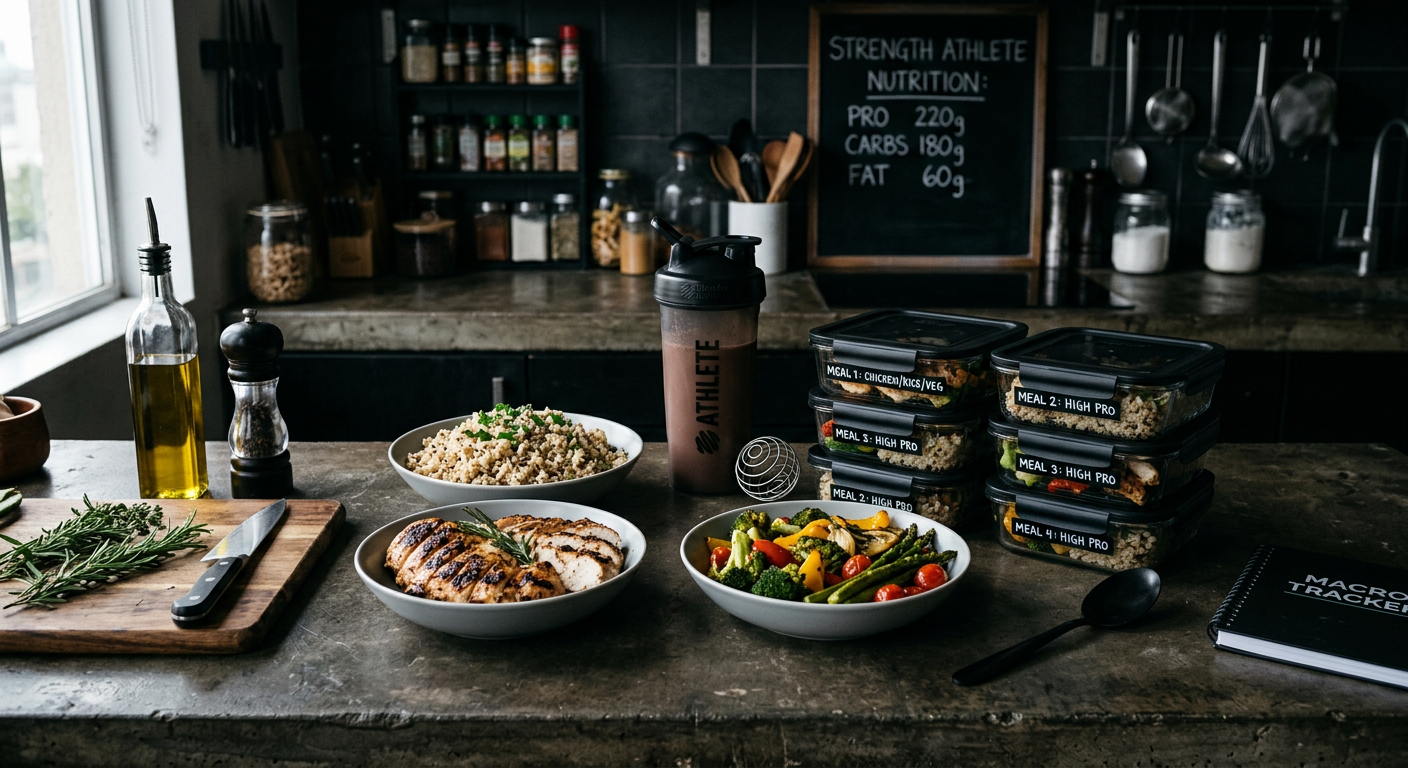
Nutrition for Powerlifting: Fueling Strength and Performance
A practical guide to eating for powerlifting - covering calorie targets, protein intake, weight class management, meet-day nutrition, and the most common dietary mistakes that cost lifters progress.
Updated March 1, 2024Why Nutrition Matters in Powerlifting
Calories: The Foundation
Total calorie intake is the primary lever for body composition. Eating above your maintenance (a caloric surplus) creates conditions for muscle growth. Eating below (a caloric deficit) causes fat loss but risks muscle and strength loss if the deficit is too aggressive or protein is insufficient.
For most powerlifters:
- Gaining phase: 200-500 kcal above maintenance. Modest surplus to build muscle without excessive fat gain.
- Cutting phase: 300-500 kcal below maintenance. Slow cut to preserve strength.
- Maintaining: Eat at or near maintenance to hold weight for a competition weight class.
Estimate your maintenance using a TDEE calculator, then adjust based on real-world weight trends over 2-3 weeks.
Protein: The Most Important Macronutrient
Protein is the primary building block for muscle tissue. It is also the macronutrient most lifters under-consume.
Target: 1.6-2.2 g of protein per kg of bodyweight per day. Heavier lifters may trend toward the lower end; those in a caloric deficit should trend toward the upper end to protect muscle.
Practical sources: Chicken breast, eggs, Greek yogurt, cottage cheese, lean beef, salmon, tuna, whey protein. Vegetarian lifters can meet targets through a combination of legumes, tofu, tempeh, and dairy.
Timing: Total daily protein matters more than timing, but spreading intake across 3-5 meals of 30-50 g each maximises muscle protein synthesis throughout the day.
Carbohydrates and Fats
After hitting your calorie and protein targets, carbohydrates and fats fill the remaining calories. Both are important; neither needs to be eliminated.
Carbohydrates are the primary fuel for high-intensity training. Low carbohydrate intake directly impairs training performance - squats feel harder, you fatigue earlier, and your capacity for volume drops. Prioritise carbs around training (pre- and post-workout meals).
Fats are essential for hormone production, including testosterone. Dropping fat intake too low suppresses anabolic hormones and can impair recovery. A minimum of 0.8-1.0 g per kg bodyweight is a reasonable floor.
For most powerlifters eating at maintenance or a surplus: roughly 40-50% carbohydrates, 25-35% protein, 20-30% fat is a workable starting split.
Weight Class Management
Competing in the right weight class is a strategic decision. Lifting at the top of your weight class gives you a strength advantage over lighter competitors. Cutting aggressively to a lower class often backfires if the cut impairs performance.
Staying in class: If you are comfortably within 1-3 kg of your weight class limit during training, this is straightforward - manage your diet normally.
Water cutting: Cutting 2-4% of bodyweight through water manipulation before weigh-ins is common in experienced lifters, especially at federations that allow 24-hour weigh-ins. Water cuts beyond this range are risky and often hurt performance more than the weight class advantage helps.
Moving up a class: If you are consistently 5+ kg over your weight class limit, it is almost always better to move up a class rather than chronic dieting that suppresses recovery and training quality.
Meet Week and Meet Day Nutrition
The week before a meet, avoid dramatic dietary changes. This is not the time to start a new diet protocol. Eat roughly as you have been training.
If you are doing a water cut: Restrict sodium and carbohydrates 2-3 days out to reduce water retention, then cut fluid intake in the 24 hours before weigh-ins. After weigh-ins, prioritise rapid rehydration with electrolytes and carbohydrate refeeding.
Meet day eating (no water cut): Eat a familiar pre-competition meal 2-3 hours before your first lift - something high in carbohydrates, moderate in protein, low in fat and fibre to minimise gastrointestinal discomfort. Between lifts, small carbohydrate snacks (fruit, rice cakes, gels) and electrolytes maintain blood glucose and hydration.
Avoid: New foods, large meals immediately before lifting, excess caffeine if you are not adapted to it, and alcohol the night before.
Supplements Worth Considering
Most supplements have minimal evidence behind them. The exceptions for strength athletes:
Creatine monohydrate: The most well-researched performance supplement. Increases phosphocreatine stores, supporting ATP regeneration during maximal efforts. 3-5 g per day consistently. No loading phase needed. Cheap and effective.
Caffeine: Acutely improves performance on strength tasks and reduces perceived effort. 3-6 mg/kg bodyweight, 45-60 minutes pre-training. Build tolerance gradually and avoid using it for every session to preserve sensitivity.
Protein powder: Not a supplement in the pharmacological sense - just a convenient protein source. Useful when hitting protein targets from whole food alone is difficult.
Vitamin D: Many people are deficient, especially in low-sunlight climates. Deficiency correlates with reduced testosterone and muscle function. 1,000-2,000 IU/day is a reasonable maintenance dose.
Common Nutrition Mistakes
Eating too little protein: The most common and most costly mistake. If your total is stalling despite good programming, check your protein intake first.
Cutting calories aggressively: A 1,000 kcal deficit is appropriate for rapid fat loss but will tank training performance and strength. Powerlifters need to be patient with fat loss - slow cuts preserve strength.
Ignoring carbohydrates: Low-carb diets are mismatched with high-intensity strength training. If you follow a low-carb protocol, expect reduced training performance.
Under-eating on training days, over-eating on rest days: Muscles need fuel when you train. Carbohydrate and calorie intake should be higher on training days.
Trying new foods or supplements meet week: Save any dietary experiments for training. Competition day is not the time to discover that a new pre-workout causes an upset stomach.