
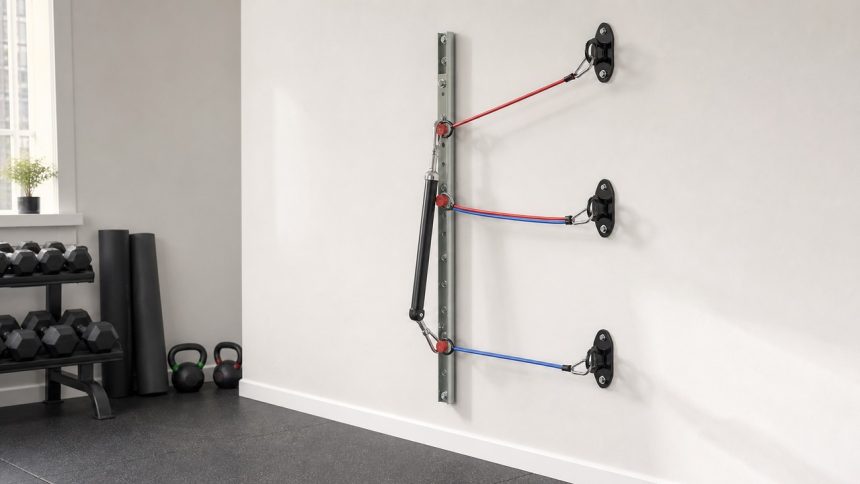
8 Best Resistance Band Wall Anchors of 2026
A setup-first guide to resistance band wall anchors, where the mounting surface, usable anchor heights, band-friendly contact point, and room to move matter more than the number of hooks in the box.
A resistance band wall anchor can turn a clear wall into a compact training zone. It can also create a dangerous weak link when hardware goes into drywall alone, the band rubs a sharp edge, or the exercise path sends a stretched band toward a doorway or mirror. The anchor is part of the system, not an accessory you can judge from a product photo.
Tom Miller handled and compared the selected anchors, inspecting their band-contact surfaces and adjustment mechanisms and running controlled pull checks after installation. Editorial scores are not customer ratings and do not prove a product’s durability or suitability for a particular wall. Our resistance band bars guide can help when a floor-based tension setup makes more sense; use the home gym safety checklist for wall, floor, and walking-space questions.
Short on time? The VIDOR Wall Mount Resistance Band Anchor System is the most complete option in this group because its title specifies two 23-inch adjustable aluminum rails and a 300-pound pull-capacity claim. That gives it a clearer multi-height case than a three-hook pack, but a listed pull capacity still depends on the exact wall, fasteners, installation, band condition, and exercise direction.
Our Verdict
VIDOR Wall Mount Resistance Band Anchor System
The selected VIDOR system is the strongest overall choice because it combines two stated 23-inch adjustable rails with a stated 300-pound pull-capacity claim. It is a more deliberate way to create repeatable anchor heights than a fixed three-hook kit, provided it is installed to the maker's instructions on a verified structural surface.
Best for: Home-gym owners who need flexible high, mid, and low anchor positions and can verify the wall structure and installation hardware
Check Price on AmazonChoose the Wall and Exercise Zone Before the Hardware
Wall anchors are only as sound as the load path behind them. A product may include screws or describe itself as heavy duty, but that does not tell you whether the fasteners are suitable for your stud spacing, concrete block, masonry, or plywood backing. Resistance Band Training Systems’ installation instructions require structural studs, concrete, or plywood for its wall-mounted bar. Use that as the practical standard for any drilled resistance-band anchor unless the manufacturer of your exact product documents another approved mounting method.
Find and mark the structural members first. Then use the exact mount pattern and hardware specified by the product manual. Do not substitute light-duty picture-hanging hardware, rely on a single drywall anchor, or turn an uncertain screw location into a test pull. If you rent, share a wall, cannot identify the construction, or have a framed mirror, utility chase, or wiring concern in the intended zone, a drilled wall anchor may be the wrong purchase. A qualified installer is a sensible expense when the substrate or fastener choice is unclear.
Next, measure the training zone, not just the wall. The American Council on Exercise notes that resistance changes with band choice and distance from the anchor, so usable distance is part of progression. A rail that supplies low, mid, and high positions is useful only when each position has enough floor depth and side clearance for the full movement.
Run a layout and inspection check before the first session
After installation, walk through each planned exercise without a loaded band. Check the standing position, the path of your hands and elbows, and where the band would travel at the longest part of the range. Then attach the lightest suitable band and apply minimal, controlled tension while checking that the anchor, fasteners, and connector remain stable. Stop if any component shifts, the band rubs a rough edge, the line of pull crosses a walkway, or the movement forces you too close to a wall or fixture. Repeat this check when you change anchor height, use a different band style, add a carabiner or handle, or rearrange nearby equipment. A clear setup is easier to train with consistently and safer to share with another person.
Resistance Band Wall Anchors at a Glance
| Product | Recorded price | Listed design detail | Best for | |
|---|---|---|---|---|
| VIDOR 23-Inch Rail System | $89.99 | Two adjustable aluminum rails; 300 lb pull-capacity claim | Multi-height home-gym setup | Check Price |
| Honsary Aluminum Anchor System | $89.99 | Wall-mounted aluminum system | Buyers who want an aluminum system and can verify height layout | Check Price |
| KOMOHOM Adjustable System | $44.99 | Adjustable, compact wall-mounted system | Adjustability at a lower recorded price | Check Price |
| KOMOHOM 6-Piece Wall Kit | $35.99 | Six wall anchors stated in the listing | More fixed locations around a planned wall zone | Check Price |
| KOMOHOM Non-Slip Rubber Hook | $19.99 | Non-slip rubber coating stated in listing | Buyers prioritizing a protected band-contact point | Check Price |
| KOMOHOM Welding-Free Anchor | $18.99 | Welding-free design stated in listing | Low-cost fixed-anchor shoppers who verify every mounting detail | Check Price |
| Wuno Shop 3-Piece System | $17.99 | Three wall anchors stated in listing | Simple low, mid, and high fixed positions | Check Price |
| hoeslaw 3-Pack Wall Mounts | $14.99 | Three-pack wall-mount hook set | Lowest-cost fixed-height starting point | Check Price |
Prices are recorded from the exact Amazon listings selected for this editorial batch and can change. Design details reflect the supplied listing titles. Verify the current listing, any included hardware, approved mounting surface, and band-contact shape before checkout or installation.
Our Eight Picks
1. Best Overall: VIDOR Wall Mount Resistance Band Anchor System

VIDOR Wall Mount Resistance Band Anchor System
Best OverallA two-rail wall system for home-gym owners who need repeatable high, mid, and low anchor positions and can install it on a confirmed structural surface.
Pros
- Two 23-inch adjustable aluminum rails stated
- 300-pound pull-capacity claim stated
- Lets one wall support more than three fixed heights
Cons
- Highest recorded price in this comparison
- Load claim does not establish suitability for every wall or movement
VIDOR is the clearest all-around pick because the selected listing gives more than a generic heavy-duty description. It states two 23-inch rails, adjustable aluminum construction, and a 300-pound pull-capacity claim. Rails make sense for a lifter who regularly alternates between low rows, chest-height presses, and high pulldown-style work. You can change the anchor location instead of buying a separate hook for every height.
Skip this if: you only need one or two fixed positions, cannot verify your substrate, or are looking for a travel solution. At $89.99, VIDOR costs $75 more than the hoeslaw three-pack. The extra spend makes sense only when changing heights without repeatedly uninstalling hardware is a real part of your training.
2. Best Premium Aluminum Option: Honsary Aluminum Anchor Fitness System

Honsary Aluminum Anchor Fitness System for Wall-Mounted Training
Best Premium Aluminum OptionA premium-priced aluminum wall anchor system for shoppers who want a dedicated training format but will verify the exact height layout and installation guidance first.
Pros
- Aluminum wall-mounted system stated in listing
- Purpose-built fitness anchor format
- Recorded price matches VIDOR
Cons
- Supplied title does not state a capacity or rail length
- Confirm height options and fastening requirements before purchase
Honsary is a credible premium alternative for buyers who prefer an aluminum wall-mounted fitness system and do not need the product title to do all the explaining. The selected title identifies it as a dedicated resistance-band wall mount, which is already more relevant than a general utility hook. However, its supplied information does not state a pull rating, rail length, number of anchor positions, or included fasteners.
3. Best Adjustable Value: KOMOHOM Adjustable Resistance Band Wall Anchor

KOMOHOM Adjustable Resistance Band Wall Anchor
Best Adjustable ValueA compact adjustable wall anchor for a small home gym where changing band height matters but the premium rail-system price does not fit the budget.
Pros
- Adjustable compact system stated in listing
- Costs roughly half of the selected rail systems
- Space-saving focus suits a small dedicated wall
Cons
- No stated capacity, rail length, or anchor-count detail in supplied title
- Verify the adjustment lock and wall hardware before use
KOMOHOM’s adjustable system is the best value route to changing anchor heights. The title calls it both adjustable and compact, which is the right combination for a small training zone that has to handle more than a single press or row. At $44.99, it is less than half the recorded price of VIDOR and Honsary.
Skip this if: you need a stated load claim or you are mounting where the wall build is uncertain. For a planned fixed-height setup, the six-piece KOMOHOM kit costs $9 less and can provide more permanent stations without a moving mechanism.
4. Best for a Dedicated Multi-Height Wall: KOMOHOM 6-Piece Wall Anchor Kit

KOMOHOM Resistance Band Wall Anchor Kit, 6 Pieces
Best Multi-Height Wall KitA six-piece fixed-anchor kit for owners who can plan their training wall around multiple low, mid, and high positions before drilling.
Pros
- Six anchors stated in listing
- Lets a planned wall offer several fixed heights
- Lower recorded price than the adjustable KOMOHOM system
Cons
- Each installed point needs the same structural mounting discipline
- Fixed placement cannot be moved as quickly as a rail
A six-piece kit is useful when you know your movements and can lay out the wall deliberately. Instead of adding one hook and making every exercise fit its height, you can reserve low positions for rows and leg work, mid positions for presses and rotations, and high positions for pulldown patterns or face pulls. The value is not the piece count by itself. It is the ability to create an organized setup with repeated positions.
Skip this if: you have only a narrow wall, need frequent micro-adjustments, or do not have approval to drill multiple holes. The three-pack options are cheaper and simpler for a basic high, mid, and low arrangement.
5. Best Protected Contact Point: KOMOHOM Non-Slip Rubber-Coated Wall Anchor

KOMOHOM Resistance Band Wall Anchor with Non-Slip Rubber Coating
Best Protected Contact PointA fixed anchor for buyers who value a stated rubber-coated contact surface and will confirm the mounting and band-routing details before purchase.
Pros
- Non-slip rubber coating stated in listing
- Low recorded price
- The coating claim directly relates to band contact
Cons
- No capacity, quantity, or mounting-surface detail in supplied title
- Rubber coating does not replace band inspection or correct hardware
The band-contact point deserves more attention than it gets in most buying guides. A band drawn over a narrow, rough, or sharp metal edge can experience repeated abrasion exactly where tension is highest. KOMOHOM’s title specifically calls out non-slip rubber coating, so it is the best fixed-hook candidate for a shopper who wants an explicitly protected contact surface.
Skip this if: you need a multi-height system or want a capacity number stated before you install. At $19.99, it is close in price to the welding-free KOMOHOM and Wuno options, but its contact-protection claim is the reason to choose it.
6. Best Budget Fixed Anchor: KOMOHOM Welding-Free Wall Anchor

KOMOHOM Resistance Band Wall Anchor, Welding-Free Design
Best Budget Fixed AnchorA low-cost fixed anchor for a buyer who has a verified mounting surface and can obtain the current installation details before committing to the wall.
Pros
- Welding-free design stated in listing
- Recorded price stays under $20
- Simple fixed-anchor format
Cons
- Supplied title does not state a load claim, quantity, or approved substrate
- Welding-free wording is not a complete safety specification
This KOMOHOM option earns the budget fixed-anchor spot because it is a low-cost way to add a permanent band point without pretending that price is the main safety criterion. The listing calls out a welding-free design. That may matter to a buyer evaluating the product’s construction approach, but it does not tell you the allowable pull, fastener size, wall material, or whether the curved contact surface is appropriate for your exact band.
Skip this if: you want multiple stations from one purchase or need fully stated technical specifications. Wuno and hoeslaw have three-piece kits at nearly the same price, while KOMOHOM’s rubber-coated option provides a more specific contact-point claim for one dollar more.
7. Best Simple Three-Height Setup: Wuno Shop 3-Piece Wall Anchor System

Wuno Shop 3-Piece Resistance Band Wall Anchor System
Best Simple Three-Height SetupA three-piece fixed-wall system for a home gym that needs a simple low, mid, and high resistance-band arrangement without adjustable hardware.
Pros
- Three-piece wall-anchor system stated
- Fits a planned low, mid, and high layout
- Low recorded price
Cons
- Fixed positions require planning before installation
- Capacity and mounting details are not stated in supplied title
Wuno Shop is a practical starting point for a simple three-height plan. Three fixed anchors can cover a lot of common work when they are placed well: a low point for rows and hip patterns, a mid point for presses and anti-rotation work, and a high point for pulldown-style or face-pull work. The $17.99 recorded price makes that idea accessible without buying a rail system.
Skip this if: you need height changes between users, want a published pull rating, or cannot map three structurally supported locations. The hoeslaw three-pack costs $3 less, but Wuno is the more explicit three-piece system in the supplied title.
8. Best Lowest-Cost Starter Set: hoeslaw 3-Pack Resistance Band Wall Mounts

hoeslaw 3-Pack Resistance Band Wall Mounts
Best Lowest-Cost Starter SetA low-cost three-pack for a buyer who can verify the wall, hardware, and exercise layout before using it as a high, mid, and low anchor system.
Pros
- Three-pack wall-mount format stated
- Lowest recorded price in this list
- Intended for bands, suspension trainers, and stretching in listing
Cons
- No stated capacity or substrate guidance in supplied title
- Lowest price leaves the most installation questions to answer
hoeslaw is the lowest-cost way into a three-anchor wall arrangement. The selected listing calls out a three-pack that can be used with resistance bands, suspension trainers, and stretching. That broad intended-use language makes planning even more important, since bodyweight-supported suspension work and resistance-band work should not be treated as the same loading scenario unless the exact manufacturer documentation explicitly approves both for the mounted configuration.
Skip this if: you want a protected band-contact claim, a stated capacity, or a height-adjustable system. Wuno costs $3 more and is framed explicitly as a three-piece system; the KOMOHOM six-piece kit is the better choice when a permanently equipped training wall is the goal.
Products We Do Not Recommend for Most Buyers
We would not make Honsary, the KOMOHOM welding-free anchor, or hoeslaw a default purchase without current documentation. Their supplied titles leave key questions about capacity, hardware, substrate, and height layout unresolved.
How to Choose a Resistance Band Wall Anchor
Rail versus fixed hooks: decide how often you need to change height
An adjustable rail suits a changing program or multiple users: high for pulldown-style work, chest height for presses and rows, or low for curls and hip patterns. Fixed kits such as Wuno, hoeslaw, or KOMOHOM six-piece make sense when you can plan the heights once. The NSCA notes that elastic resistance changes with setup and movement, so choose positions for the exercises you actually perform, not simply the highest mounting point.
Protect the band at the contact point
Look for a smooth, broad contact area, particularly with loop bands. KOMOHOM’s non-slip rubber-coated option identifies a relevant surface feature, but you still need to inspect hook edges, connectors, and the band path. Retire bands with cracking, thinning, cuts, damaged stitching, corroded clips, or deformed connectors.
Interpret a load claim as one piece of the system
VIDOR’s title states a 300-pound pull capacity, but that is not a target to test. Force at the wall changes with band tension, stretch, stacking, pull angle, anchor position, and movement speed. Start light after installation, verify that nothing shifts, then progress only within the band maker’s direction. Do not use a resistance-band claim to justify suspension-bodyweight work or explosive pulls unless the exact documentation explicitly approves that use.
Measure clearance for the full movement, not the starting position
For presses, leave room to step back and for elbows and bands to travel. A row needs a straight low path that does not drag on a bench or plate tree; high pulls need safe clearance below the ceiling. Use our small home gym ideas to map the zone, and keep the full line of tension clear of doors, shared walkways, glass, screens, and other people.
A wall anchor is not a door anchor
A door anchor is portable and depends on a closed, stable door and the direction of pull. A wall anchor is a permanent mount whose safety depends on structural substrate and correct fasteners. It is not a substitute for a portable door anchor, and a door anchor is not a substitute for fixed, repeatable wall positions.
For portable training, a door anchor can be appropriate when the band maker’s instructions are followed, the door closes securely away from you, and the entire setup is checked before tension is applied. For a lasting home-gym station, structural mounting and a clear training zone are the more important priorities. Pairing a mounted system with the right resistance bands still requires you to follow the instructions for both products, not just the anchor.
Frequently Asked Questions
Can I mount a resistance band anchor directly into drywall?
Do not assume that you can. A drill-in anchor should be mounted only to the substrate and with the hardware its manufacturer approves. Resistance Band Training Systems specifies structural studs, concrete, or plywood for its wall-mounted installation. If you cannot verify the wall construction or fastener engagement, do not use ordinary drywall anchors as a substitute.
What height should a resistance band wall anchor be?
Low anchors suit rows and hip work, chest-height positions suit presses and anti-rotation patterns, and high anchors suit pulldown-style work and face pulls. Check room for the full movement at each height.
Will a rubber-coated wall anchor make resistance bands last longer?
A smooth protected contact surface can reduce rubbing at that point. It cannot make a damaged, over-stretched, twisted, or poorly routed band safe. Inspect the band and connector before use.
Bottom Line
The VIDOR Wall Mount Resistance Band Anchor System is the best resistance band wall anchor in this comparison because two stated 23-inch adjustable rails give it the clearest route to useful high, mid, and low training positions. Its listed 300-pound pull capacity is a helpful detail, but it is not a substitute for structural mounting, approved hardware, careful band routing, and a clear exercise zone.
For a lower-cost adjustable option, KOMOHOM Adjustable is the better starting point once its locking and installation details are verified. For a fixed wall, choose the KOMOHOM six-piece kit when you can plan several permanent positions, or Wuno for a basic three-height setup. In every case, the right anchor is the one that fits the actual wall and movement plan, not the one with the most optimistic name on the listing.
Sources
- Resistance Band Training Systems. B.A.R. Installation Instructions. Structural-wall mounting guidance for resistance-band equipment.
- American Council on Exercise. A Primer on How to Use Resistance Bands. Tension adjustment and damaged-band safety guidance.
- National Strength and Conditioning Association. Elastic Bands: Resisted and Assisted. Elastic-resistance setup considerations.
- FitnessVolt. Home Gym Safety Checklist; Best Resistance Bands.