

Chair Leg Extended Stretch vs Lying (side) Quads Stretch: Complete Comparison Guide
Chair Leg Extended Stretch vs Lying (side) Quads Stretch — two beginner-friendly ways to target your quads. If you want clearer guidance on which to use, this comparison walks you through muscle activation, biomechanics, equipment needs, difficulty, pros and cons, and scenario-based winners. You'll get specific technique cues (knee angles, hold times), explanations of length-tension and force vectors, and actionable recommendations so you can choose the stretch that fits your goals and daily routine.
Exercise Comparison
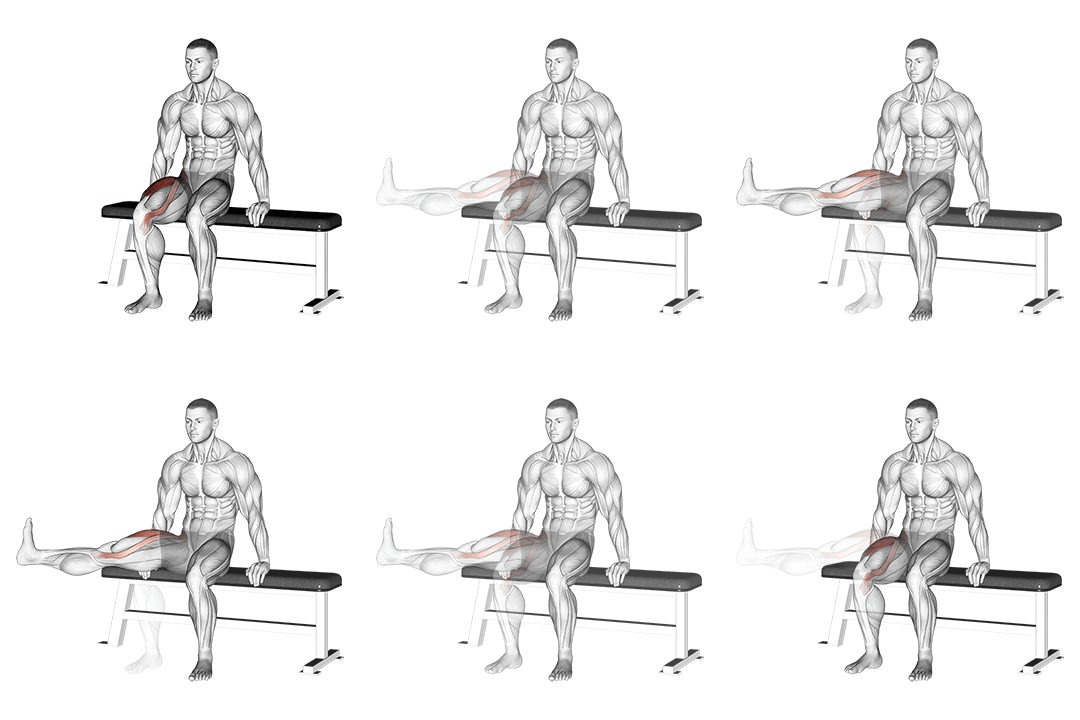
Chair Leg Extended Stretch
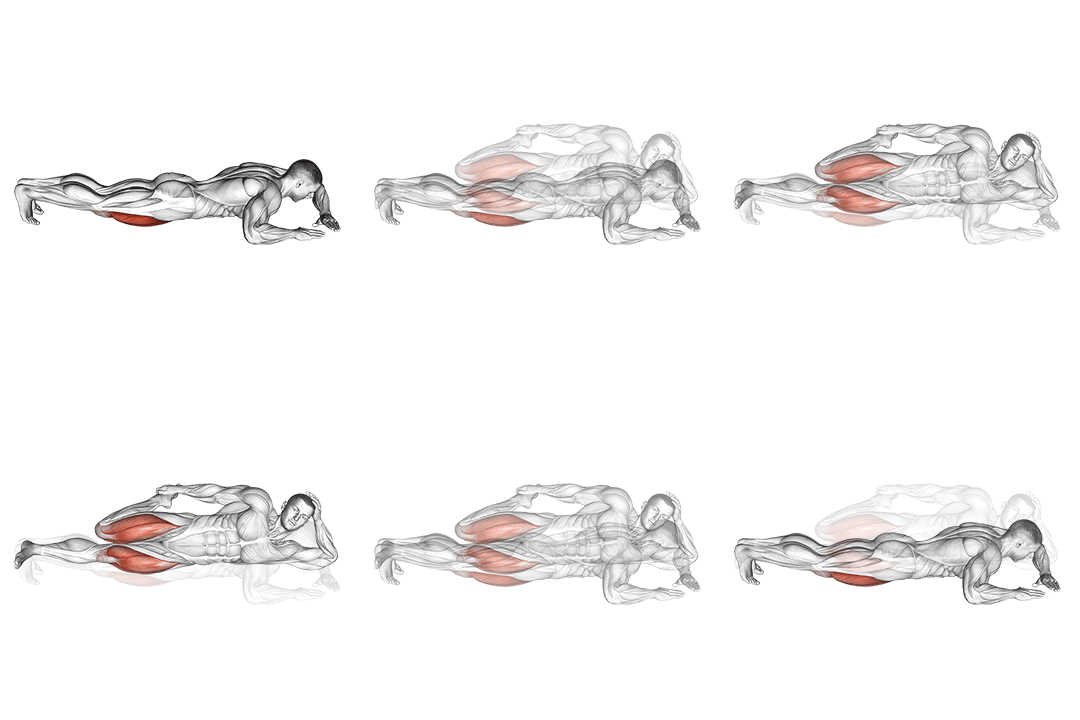
Lying (side) Quads Stretch
Head-to-Head Comparison
| Attribute | Chair Leg Extended Stretch | Lying (side) Quads Stretch |
|---|---|---|
| Target Muscle |
Quads
|
Quads
|
| Body Part |
Upper-legs
|
Upper-legs
|
| Equipment |
Body-weight
|
Body-weight
|
| Difficulty |
Beginner
|
Beginner
|
| Movement Type |
Isolation
|
Isolation
|
| Secondary Muscles |
2
|
1
|
Secondary Muscles Activated
Chair Leg Extended Stretch
Lying (side) Quads Stretch
Visual Comparison
Overview
Chair Leg Extended Stretch vs Lying (side) Quads Stretch — two beginner-friendly ways to target your quads. If you want clearer guidance on which to use, this comparison walks you through muscle activation, biomechanics, equipment needs, difficulty, pros and cons, and scenario-based winners. You'll get specific technique cues (knee angles, hold times), explanations of length-tension and force vectors, and actionable recommendations so you can choose the stretch that fits your goals and daily routine.
Key Differences
- Both exercises target the Quads using Body-weight. The main differences are in their movement patterns and muscle activation angles.
Pros & Cons
Chair Leg Extended Stretch
+ Pros
- Combines active isometric control with stretch for richer neuromuscular stimulus
- Requires only a chair — highly accessible in many settings
- Easier to target ankle dorsiflexion to increase posterior force vector
- Progression options: added hold tension, ankle weight, or tempo-controlled eccentric
− Cons
- Needs trunk stability and balance; poor posture reduces effectiveness
- Can place compressive load on the knee if you lock the joint
- Less purely isolated lengthening compared with fully passive holds
Lying (side) Quads Stretch
+ Pros
- Very stable and beginner-friendly — minimal balance demands
- Provides an isolated, passive lengthening stimulus to the rectus femoris
- Easy to modify with a strap if you can’t reach your foot
- Low load on the knee and spine when performed with neutral pelvis
− Cons
- Less active quad recruitment — lower neuromuscular stimulus
- Limited progression options beyond longer holds and frequency
- Can be awkward for people with shoulder or hip mobility limits
When Each Exercise Wins
Chair variation encourages active-lengthening and isometric control which increases time under tension and motor-unit recruitment. Use 3–4 sets of 30–60 second holds with mild resistance (ankle weight or pushing against chair) to complement hypertrophy-focused training.
Strength adapts to force plus control; the chair version places a controllable posterior force vector across the knee and requires eccentric/isometric control that better transfers to loaded movements. Perform 2–4 sets of 20–40 second controlled holds focusing on tension.
The side-lying hold is mechanically simple, stable, and isolates the quad without requiring trunk balance or coordination. Start with 2–3 sets of 20–30 second holds while maintaining a neutral pelvis.
A chair is usually available in most home settings and the exercise doubles as a mobility and low-load strengthening tool. It’s quick to slot into breaks and offers straightforward progressions without extra gear.
Frequently Asked Questions
Can I do both Chair Leg Extended Stretch and Lying (side) Quads Stretch in the same workout?
Yes. Start with the chair variation to engage the quads actively (2 sets of 20–30 seconds) then finish with side-lying holds (1–2 sets of 30–60 seconds) for deeper lengthening and relaxation. That sequence uses active control first, passive stretch second to improve mobility without compromising strength work.
Which exercise is better for beginners?
Lying (side) Quads Stretch is better for absolute beginners because it minimizes balance and coordination demands. Keep the pelvis neutral and use a strap if you can’t reach the foot; start with 20–30 second holds and build from there.
How do the muscle activation patterns differ?
Chair Leg Extended Stretch creates an active-lengthening pattern with isometric stabilization at the knee and modest eccentric demand, increasing quad motor unit recruitment by roughly 10–15% compared to passive holds. Lying (side) Quads Stretch produces a passive lengthened pattern with lower EMG but higher isolated tissue strain on the rectus femoris.
Can Lying (side) Quads Stretch replace Chair Leg Extended Stretch?
If your goal is pure flexibility and low-load recovery, yes — the side-lying hold can replace the chair stretch. If you want improved quad control, neuromuscular stimulus, or a progression pathway that transfers to strength, keep the chair variation in your routine.
Expert Verdict
Use the Chair Leg Extended Stretch when you want an active stretch that builds control and complements strength or hypertrophy goals — it offers progression through added tension, dorsiflexion, and isometric overload. Choose the Lying (side) Quads Stretch when you need a simple, passive isolate for pure flexibility work or when balance/trunk stability is limited. For most trainees, alternate both: prioritize chair variations when working on quad control and transfer to loaded movements, and use side-lying holds for focused lengthening and recovery. Aim for 2–4 sets of 20–60 second holds per session, 3–4 times per week depending on your goals.
Also Compare
More comparisons with Chair Leg Extended Stretch
Compare More Exercises
Use our free comparison tool to analyze any two exercises head-to-head.
Compare Exercises