

EZ Barbell Reverse Grip Curl vs EZ Barbell Seated Curls
Compare target muscles, equipment, difficulty, movement type, and secondary muscles for EZ Barbell Reverse Grip Curl and EZ Barbell Seated Curls.
Get comparison link
Select the link and use your device's Copy command.
Comparison overview
AI-generatedExercise Comparison
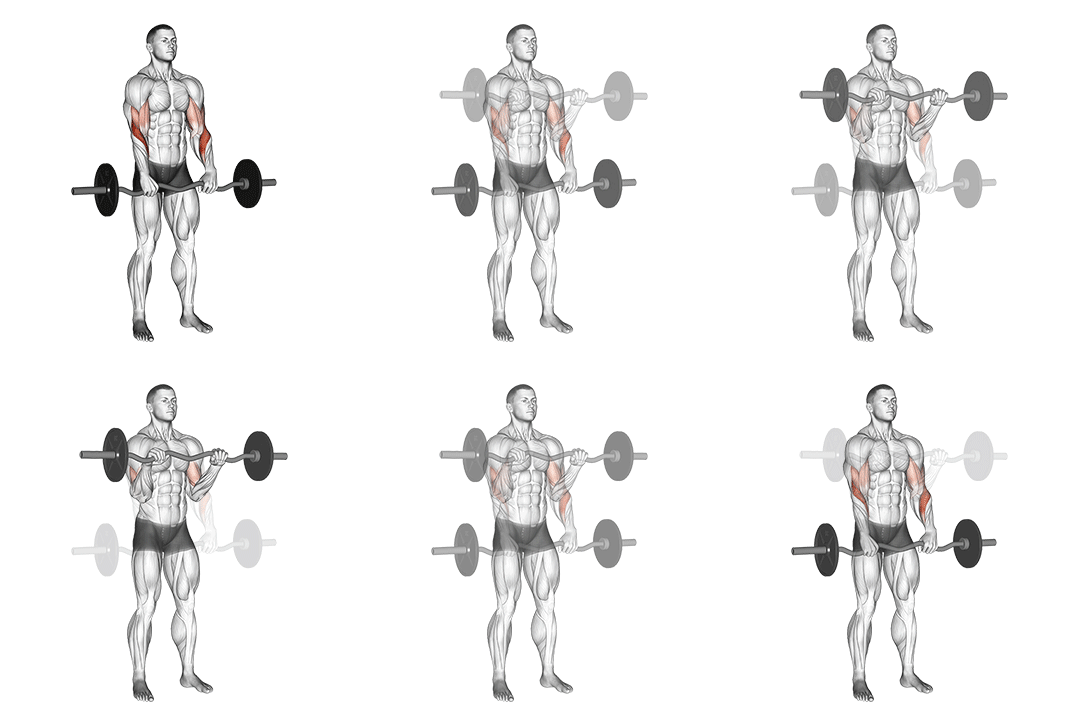
EZ Barbell Reverse Grip Curl
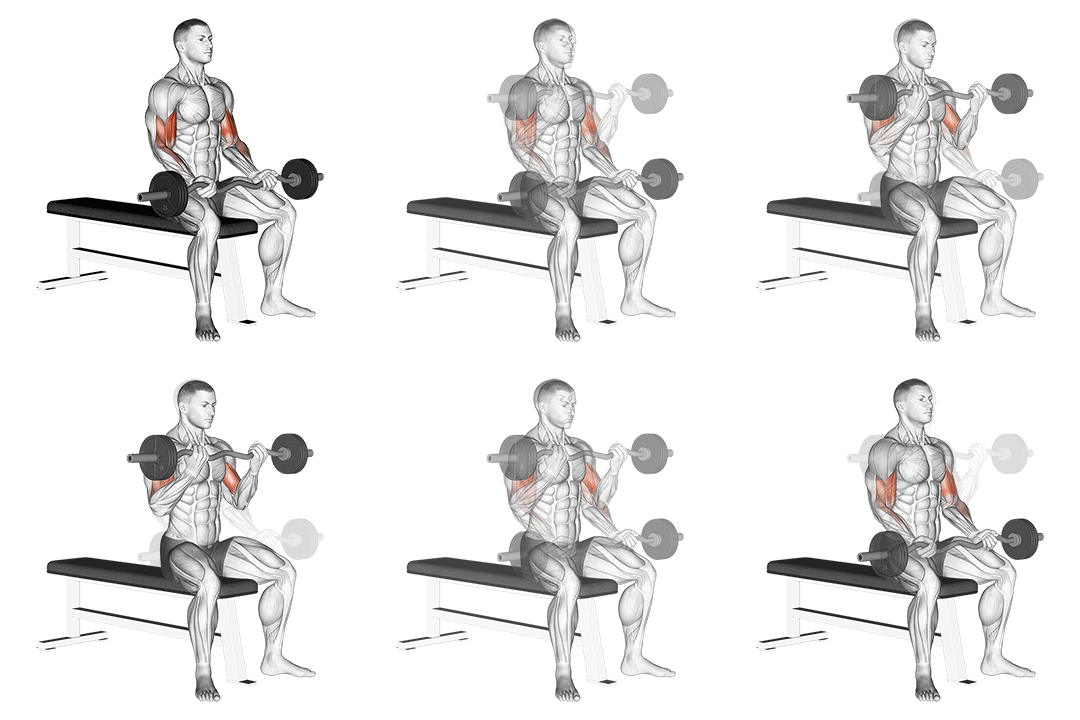
EZ Barbell Seated Curls
Head-to-Head Comparison
Different values are marked. These are catalogue attributes, not performance scores.
Muscles used
Listed target and secondary muscles, shown on the body. Locations, not activation or strength scores.
- Target
- Secondary
- Not highlighted
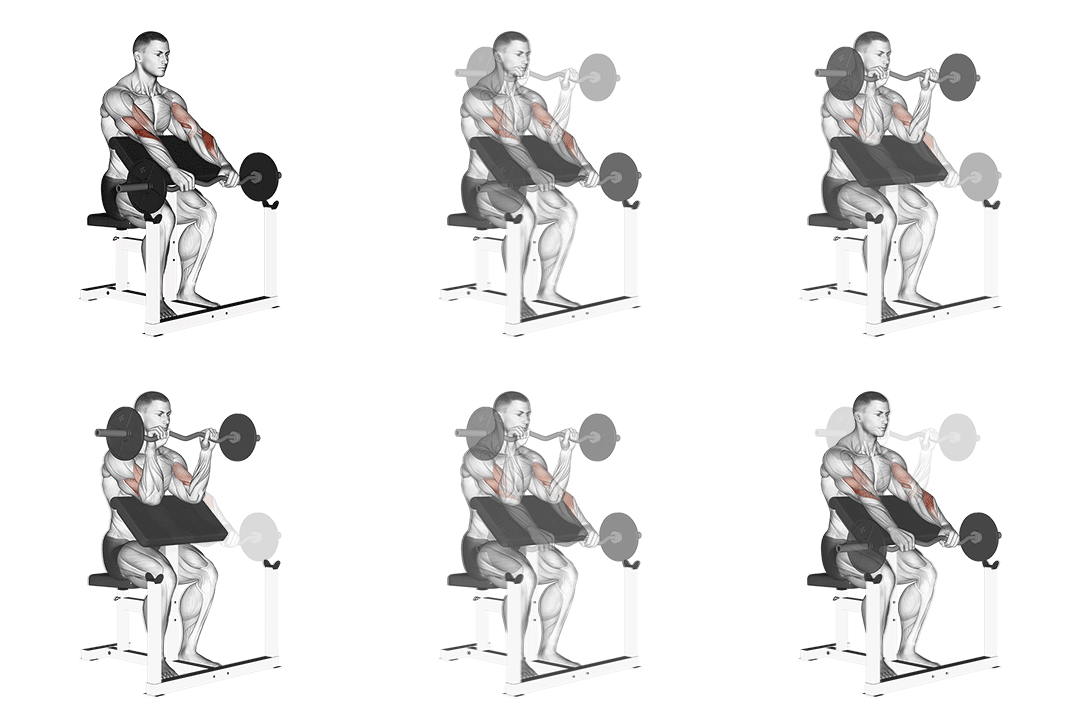
EZ Barbell Reverse Grip Curl
- Target
- Biceps
- Secondary
- Forearms
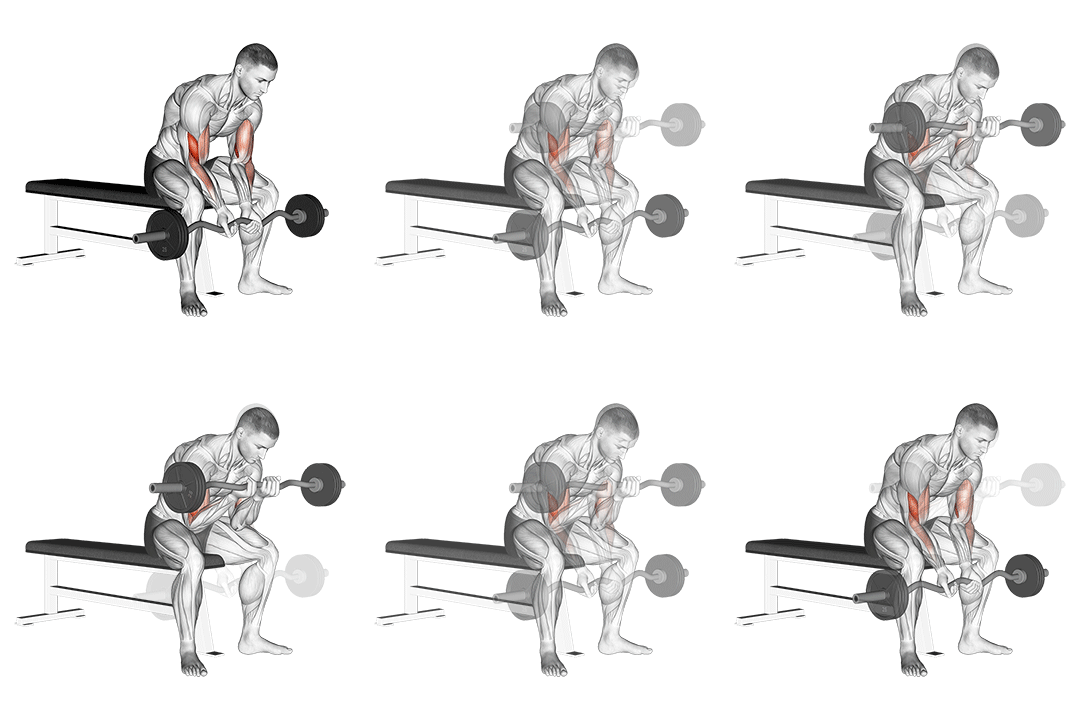
EZ Barbell Seated Curls
- Target
- Biceps
- Secondary
- Forearms
Grey does not mean a muscle is unused. The diagrams show only the mapped catalogue labels.
| Attribute | EZ Barbell Reverse Grip Curl | EZ Barbell Seated Curls |
|---|---|---|
| Target Muscle | Biceps |
Biceps |
| Body Part | Upper-arms |
Upper-arms |
| Equipment | Ez-barbell |
Ez-barbell |
| Difficulty Different | Intermediate |
Beginner |
| Movement Type | Isolation |
Isolation |
| Secondary Muscles | Forearms |
Forearms |
Visual Comparison
An illustrative 1–10 profile derived from catalog difficulty, equipment, and listed-muscle fields—not measured performance or muscle activation.
Key Differences
- Difficulty levels differ: EZ Barbell Reverse Grip Curl is intermediate, while EZ Barbell Seated Curls is beginner.
- Both exercises target the Biceps using Ez-barbell. The catalogue does not establish which exercise is better for an individual goal.
Muscle comparison
Shared target muscles
Secondary muscle differences
Muscle involvement analysis
Equipment and setup
EZ Barbell Reverse Grip Curl: setup
EZ Barbell Seated Curls: setup
Access and practicality
Learning and progression
Learning the movements
Progression considerations
Limitations and precautions
Pros & Cons
EZ Barbell Reverse Grip Curl
+ Pros
- Greater brachioradialis and brachialis recruitment, building forearm thickness and elbow flexor strength
- Requires only an EZ-bar and standing space—good for minimal-equipment setups
- Allows slight variation in force vector to overload different elbow angles
- Can be loaded heavier in some lifters due to stronger forearm contribution
− Cons
- Lower peak biceps brachii activation compared to supinated curls
- Higher wrist and forearm stress; pronation may irritate tendons for some lifters
- More technical control needed to avoid momentum and keep elbows stable
EZ Barbell Seated Curls
+ Pros
- Higher peak biceps activation due to supination and favorable length-tension mechanics
- Seated position reduces cheating and stabilizer involvement for cleaner isolation
- Lower wrist strain with a supinated grip and neutral forearm alignment
- Ideal for prescribed hypertrophy rep ranges (8–12) with precise tempo control
− Cons
- Requires a bench, making it less accessible in minimal setups
- Less transfer to forearm thickness compared with pronated variations
- Can become monotonous—may require tempo or grip tweaks to continue progressive overload
When Each Exercise Wins
Seated curls maximize biceps brachii activation through supination and a stable torso, making it easier to hit 8–12 reps with strict form. The predictable length-tension curve and reduced momentum make progressive overload and time under tension simpler to prescribe.
Reverse grip curls recruit brachioradialis and brachialis more, enabling heavier loads for elbow flexion and improving overall forearm strength. That broader muscle involvement supports increases in blunt elbow-flexion loading and functional pulling strength.
Seated curls have a gentler learning curve because the bench stabilizes the body and isolates the biceps, letting beginners practice elbow flexion, supination, and tempo control without compensatory movement.
Reverse grip curls need only an EZ-bar and a bit of space—no bench required—making them the better pick when equipment is limited. They also add forearm work, giving more bang for the minimal kit.
Frequently Asked Questions
Can I do both Ez Barbell Reverse Grip Curl and Ez Barbell Seated Curls in the same workout?
Which exercise is better for beginners?
How do the muscle activation patterns differ?
Can Ez Barbell Seated Curls replace Ez Barbell Reverse Grip Curl?
Comparison Summary
Exercise instructions
Steps from the exercise catalogue. Read the full sequence before starting.
EZ Barbell Reverse Grip Curl
- Stand up straight with your feet shoulder-width apart and hold the ez barbell with an underhand grip.
- Keep your elbows close to your torso and your upper arms stationary throughout the exercise.
- Curl the barbell upwards by contracting your biceps, while exhaling.
Read remaining steps for EZ Barbell Reverse Grip Curl
- Continue to raise the barbell until your biceps are fully contracted and the barbell is at shoulder level.
- Hold the contracted position for a brief pause as you squeeze your biceps.
- Slowly begin to bring the barbell back to the starting position as you inhale.
- Repeat for the desired number of repetitions.
EZ Barbell Seated Curls
- Sit on a bench with your feet flat on the ground and your back straight.
- Hold the ez barbell with an underhand grip, palms facing up, and your hands shoulder-width apart.
- Rest your upper arms on your thighs, allowing the ez barbell to hang down in front of you.
Read remaining steps for EZ Barbell Seated Curls
- Keeping your upper arms stationary, exhale and curl the ez barbell upwards towards your shoulders.
- Pause for a moment at the top, squeezing your biceps.
- Inhale and slowly lower the ez barbell back to the starting position.
- Repeat for the desired number of repetitions.
Also Compare
More comparisons with EZ Barbell Reverse Grip Curl
Compare another pair
Choose two exercises to see their differences side by side.