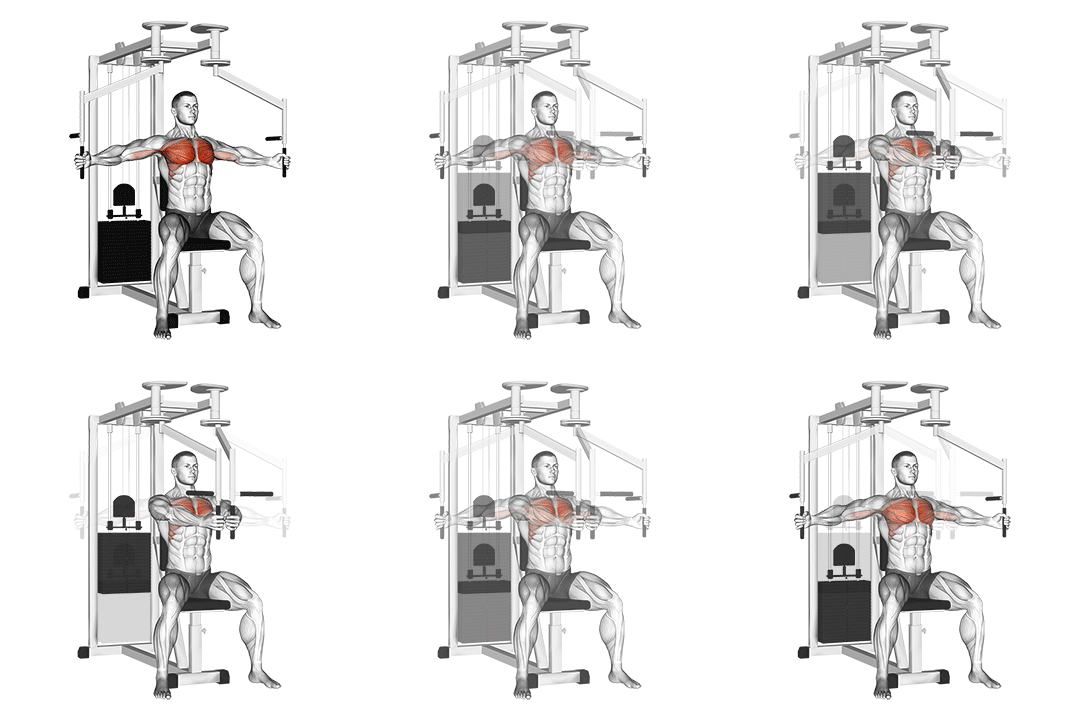
Lever Chest Press vs Lever Decline Chest Press

Compare target muscles, equipment, difficulty, movement type, and secondary muscles for Lever Chest Press and Lever Decline Chest Press.

Change comparison Share

Get comparison link

Select the link and use your device's Copy command.

Comparison overview

AI-generated
Lever Chest Press vs Lever Decline Chest Press — if you're deciding which lever press belongs in your program, this guide has your back. I'll walk you through how each variation loads the pectorals, how the force vector and body angle change secondary muscle recruitment, and which movement suits beginners versus intermediate trainees. You'll get clear technique cues, rep ranges for hypertrophy and strength, and practical guidance on equipment and progression so you can pick the most effective press for your goals and avoid common setup mistakes.

Exercise Comparison

Exercise A
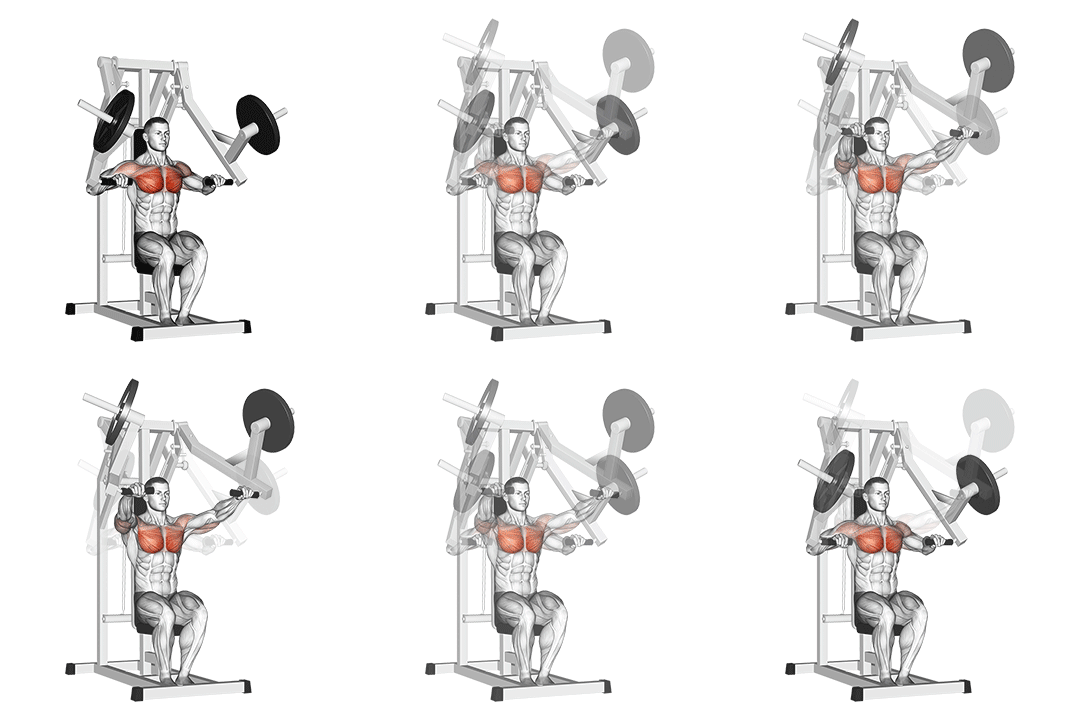
Lever Chest Press demonstration

Lever Chest Press

Target Pectorals
Equipment Lever
Body Part Chest
Difficulty Beginner
Movement Compound
Secondary Muscles
Triceps Shoulders
VS
Exercise B
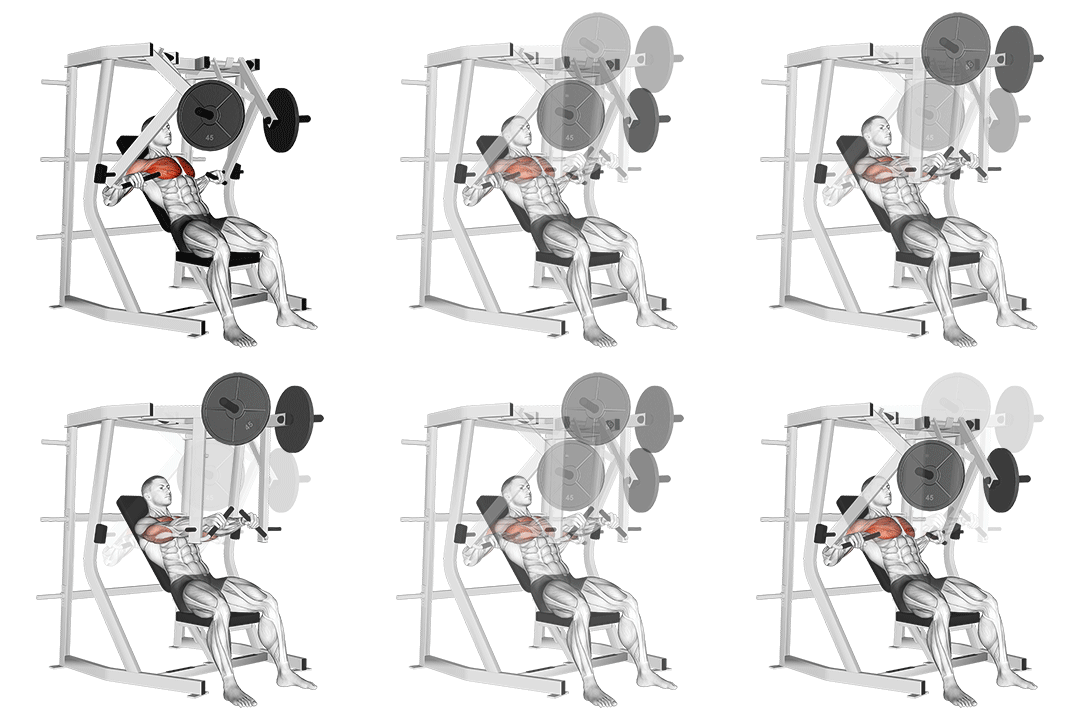
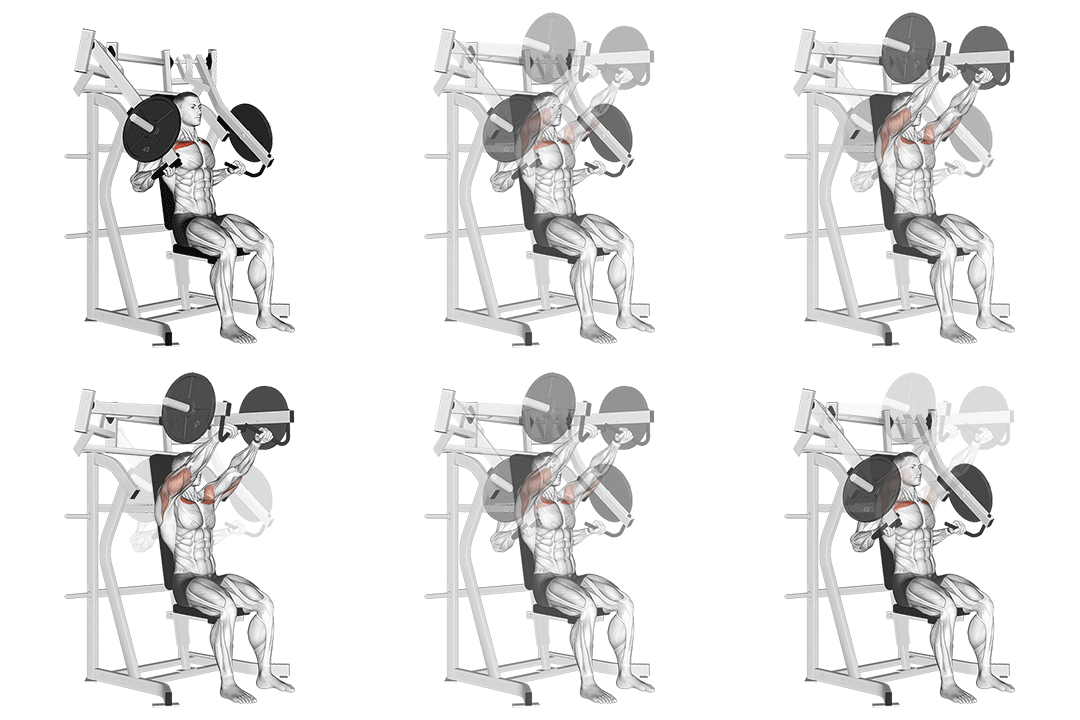
Lever Decline Chest Press demonstration

Lever Decline Chest Press

Target Pectorals
Equipment Lever
Body Part Chest
Difficulty Intermediate
Movement Compound
Secondary Muscles
Triceps Shoulders

Head-to-Head Comparison

Different values are marked. These are catalogue attributes, not performance scores.

Muscles used

Listed target and secondary muscles, shown on the body. Locations, not activation or strength scores.

  • Target
  • Secondary
  • Not highlighted

Lever Chest Press

Front
Lever Chest Press: front muscle locationsSolid: listed target. Striped: listed secondary. Grey: not highlighted. Locations, not activation or strength scores. See the muscle names below.
Back
Lever Chest Press: back muscle locationsSolid: listed target. Striped: listed secondary. Grey: not highlighted. Locations, not activation or strength scores. See the muscle names below.
Target
Pectorals
Secondary
Triceps, Shoulders

Not shown on diagram: Shoulders. These labels do not identify a precise region on this map.

Lever Decline Chest Press

Front
Lever Decline Chest Press: front muscle locationsSolid: listed target. Striped: listed secondary. Grey: not highlighted. Locations, not activation or strength scores. See the muscle names below.
Back
Lever Decline Chest Press: back muscle locationsSolid: listed target. Striped: listed secondary. Grey: not highlighted. Locations, not activation or strength scores. See the muscle names below.
Target
Pectorals
Secondary
Triceps, Shoulders

Not shown on diagram: Shoulders. These labels do not identify a precise region on this map.

Grey does not mean a muscle is unused. The diagrams show only the mapped catalogue labels.

Attribute Lever Chest Press Lever Decline Chest Press
Target Muscle
Pectorals
Pectorals
Body Part
Chest
Chest
Equipment
Lever
Lever
Difficulty Different
Beginner
Intermediate
Movement Type
Compound
Compound
Secondary Muscles
Triceps, Shoulders
Triceps, Shoulders

Visual Comparison

An illustrative 1–10 profile derived from catalog difficulty, equipment, and listed-muscle fields—not measured performance or muscle activation.

Key Differences

  • Difficulty levels differ: Lever Chest Press is beginner, while Lever Decline Chest Press is intermediate.
  • Both exercises target the Pectorals using Lever. The catalogue does not establish which exercise is better for an individual goal.

Muscle comparison

Shared target muscles

Both exercises primarily target the pectoralis major. They produce similar peak activation near mid-range elbow flexion, but the lever decline shifts the line of pull so the lower sternal fibers work harder. Expect roughly similar overall pectoral EMG across the two, with the decline increasing lower-pec emphasis by about 8–15% compared with a neutral-lever press.

Secondary muscle differences

Secondary recruitment differs mainly in the anterior deltoid and upper chest. The flat lever press involves more anterior deltoid and clavicular pec involvement because the force vector has a larger upward component. The decline lever press reduces shoulder elevation demand and increases triceps contribution at lockout due to a more horizontal pressing line.

Muscle involvement analysis

Biomechanically the decline shortens pectoral fibers at the start and places the muscle in a slightly stronger mechanical position during drive, altering length-tension relationships. The flat lever press produces a more even activation curve across clavicular and sternal fibers. Expect greater triceps torque at end-range on the decline because the horizontal bar path increases elbow extension moment arm.

Equipment and setup

Lever Chest Press: setup

Lever Chest Press requires a lever press machine or plate-loaded lever with an adjustable seat and back pad; you need 1 machine and enough load (weights or plates) to match your strength.

Lever Decline Chest Press: setup

Lever Decline Chest Press requires a lever machine that allows decline seat/back adjustment or a dedicated decline lever station and similar loading. It often needs a machine with an adjustable chest pad angle or a fixed decline angle (typically 15–30°).

Access and practicality

Lever Chest Press — more gyms have a flat/neutral lever press and it's easier to set up for beginners; decline-specific lever machines are less common and require extra adjustments so the flat lever wins for accessibility.

Learning and progression

Learning the movements

Lever Chest Press is easier to learn: stable back support, straightforward path, and a natural elbow path make it beginner-friendly. Decline lever press requires body positioning adjustments and awareness of bar path to protect the shoulders.

Progression considerations

Lever Decline Chest Press offers slightly more progression variety for intermediate trainees because changing decline angle (15–30°) alters fiber emphasis. Both allow linear load progression, micro-loading, and rep-range strategies (6–12 for hypertrophy, 3–6 for strength).

Limitations and precautions

Decline has moderately higher risk for lifters with poor setup or limited shoulder stability because the horizontal force can increase anterior shoulder shear. Flat lever press has lower relative risk when you maintain scapular retraction and control the eccentric phase.

Pros & Cons

Lever Chest Press

+ Pros

  • Beginner-friendly setup and stable back support
  • Even pectoral activation across clavicular and sternal fibers
  • Easier to find in commercial gyms
  • Lower shoulder shear when performed with proper scapular retraction

Cons

  • Less emphasis on lower pec fibers than decline variations
  • Can over-recruit anterior deltoid if elbows flare beyond 45°
  • Limited angle variation compared with adjustable decline machines

Lever Decline Chest Press

+ Pros

  • Greater emphasis on lower sternal pectorals (often 8–15% higher activation)
  • Stronger mechanical advantage for heavy lockouts due to horizontal force vector
  • Useful variation for addressing lower-chest lag in physique training
  • Allows angle manipulation (15–30°) to fine-tune fiber targeting

Cons

  • Requires more precise setup and often a specific machine
  • Higher shoulder and sternum pressure if body position is poor
  • Less suitable for true beginners without supervision

When Each Exercise Wins

1
For muscle hypertrophy: Lever Chest Press

For overall pectoral size the flat lever press produces balanced load across clavicular and sternal fibers and lets you control volume in the 6–12 rep range efficiently. If you want to target lower pecs specifically, add decline sets as accessory work.

2
For strength gains: Lever Decline Chest Press

The decline line of pull creates a more horizontal force vector and a favorable mechanical advantage at lockout, allowing heavier loads for 3–6 rep strength phases and improving triceps-driven extension moments.

3
For beginners: Lever Chest Press

The flat lever press has a simpler setup, lower coordination demand, and safer shoulder mechanics when you keep elbows ~45° and scapulae retracted, making it ideal for new trainees learning pressing mechanics.

4
For home workouts: Lever Chest Press

Flat lever stations are more common in compact home gyms and require fewer angle adjustments. The decline lever often needs a dedicated decline bench or adjustable machine that takes more space.

Frequently Asked Questions

Can I do both Lever Chest Press and Lever Decline Chest Press in the same workout?

Yes — pair the flat lever press as your main heavy or volume movement and add 2–4 decline sets as an accessory to target lower-pec fibers. Keep total weekly chest volume in recommended hypertrophy ranges (8–20 sets per muscle) to avoid overtraining.

Which exercise is better for beginners?

Lever Chest Press is better for beginners because it has a simpler setup and safer shoulder mechanics when you maintain scapular retraction and control the eccentric. Start with the flat lever to learn elbow path and breathing before introducing decline angles.

How do the muscle activation patterns differ?

The decline shifts the force vector to emphasize lower sternal pectorals and increases triceps torque at lockout, altering length-tension relationships so lower fibers fire more. The flat lever press produces a more even activation across clavicular and sternal regions and involves the anterior deltoid to a greater degree.

Can Lever Decline Chest Press replace Lever Chest Press?

Only if your goal is primarily lower-chest development or strength at specific joint angles; decline can’t fully replace the flat press for balanced pectoral development. For comprehensive chest progress, keep the flat lever as a primary movement and use decline to address targeted weaknesses.

Comparison Summary

Choose the Lever Chest Press as your foundational chest movement: it’s easier to learn, widely available, and gives balanced pectoral activation for steady muscle growth in the 6–12 rep range. Use precise cues — scapular retraction, feet planted, elbows about 45° to the torso, and a controlled 2–3 second eccentric — to maximize safety and hypertrophy. Add the Lever Decline Chest Press when you need extra lower-pec emphasis or a strength-focused block (3–6 reps) because the decline angle shifts the force vector and increases lower-sternal activation. Rotate both across microcycles for balanced development and to target weak points.

Exercise instructions

Steps from the exercise catalogue. Read the full sequence before starting.

Lever Chest Press

  1. Adjust the seat height and position yourself on the machine with your back flat against the pad.
  2. Grasp the handles with an overhand grip and position your elbows at a 90-degree angle.
  3. Push the handles forward until your arms are fully extended, exhaling during the movement.
Read remaining steps for Lever Chest Press
  1. Pause briefly at the end of the movement, then slowly return to the starting position, inhaling as you do so.
  2. Repeat for the desired number of repetitions.

Lever Decline Chest Press

  1. Adjust the seat height and backrest of the leverage machine to a comfortable position.
  2. Sit on the machine with your back against the backrest and your feet flat on the floor.
  3. Grasp the handles with an overhand grip and position your hands slightly wider than shoulder-width apart.
Read remaining steps for Lever Decline Chest Press
  1. Push the handles forward and away from your body until your arms are fully extended.
  2. Slowly lower the handles back towards your chest, keeping your elbows slightly bent.
  3. Pause for a moment at the bottom, then push the handles back to the starting position.
  4. Repeat for the desired number of repetitions.

Also Compare
Compare another pair

Choose two exercises to see their differences side by side.

Compare Exercises