


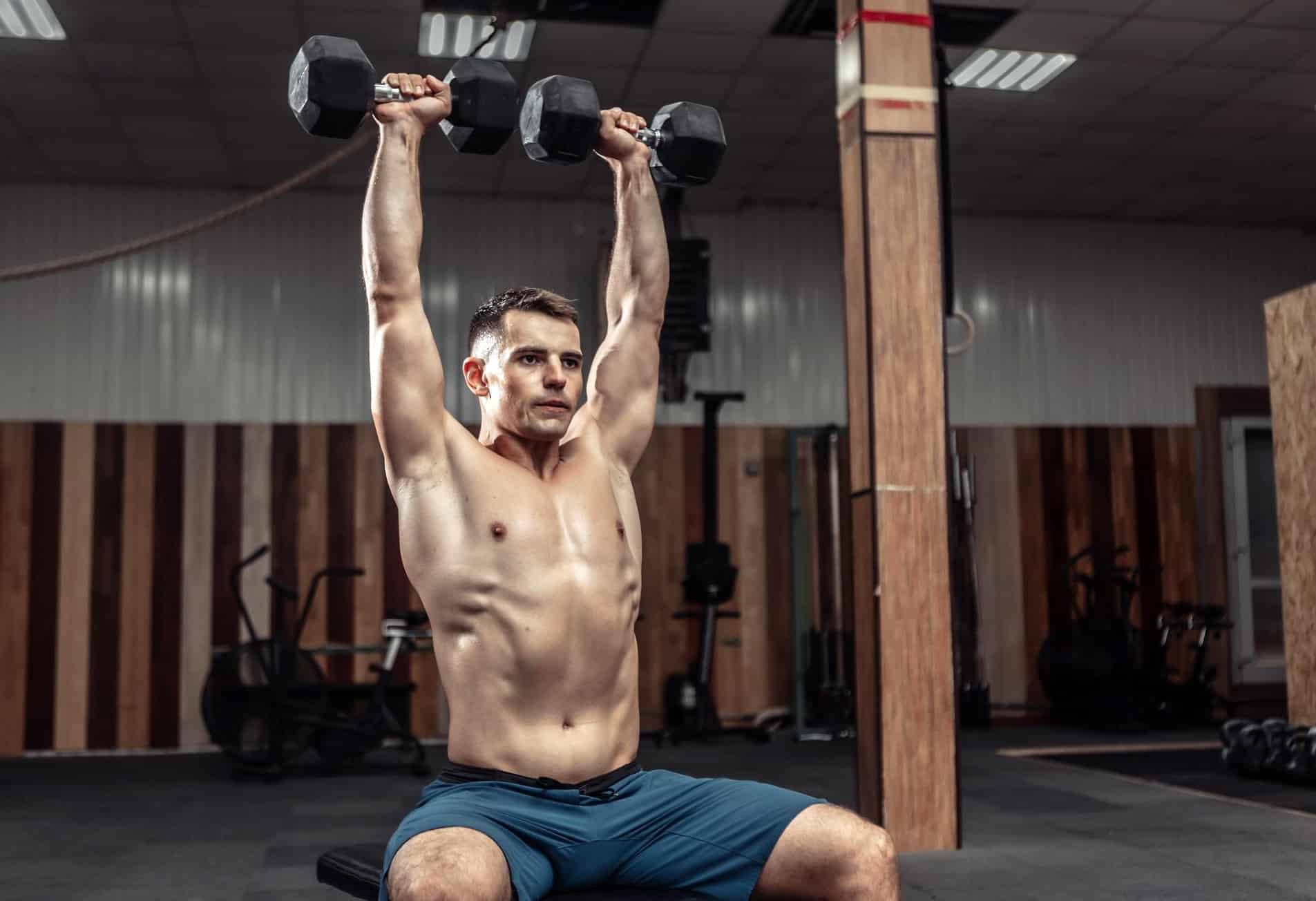
The seated dumbbell shoulder press mainly trains the anterior and middle deltoids, with the triceps extending the elbows. The upper chest, upper trapezius, serratus anterior, rotator cuff, and trunk muscles assist or stabilize the press depending on bench angle, grip, range, and load.
Sitting against a backrest reduces the balance and lower-body demands of a standing press. Safety still depends on the load, range, setup, training history, and the lifter. A useful setup keeps the feet planted, ribs controlled, wrists stacked over the elbows, and dumbbells moving to a stable overhead position.
| Muscle group | Role in the press |
|---|---|
| Anterior deltoid | Produces much of the shoulder flexion that drives the dumbbells upward. |
| Middle deltoid | Assists as the upper arms move out and upward. |
| Triceps | Extend the elbows through the upper half of the press. |
| Upper chest | Assists more as the bench reclines and the movement becomes closer to an incline press. |
| Upper trapezius and serratus anterior | Help the shoulder blades rotate upward as the arms move overhead. |
| Rotator cuff | Helps center and control the upper arm in the shoulder joint. |
| Core and back musculature | Brace the trunk against the bench and resist excessive rib flare or arching. |
How to Do the Seated Dumbbell Shoulder Press
Set the bench close to upright, plant both feet, and begin with each dumbbell stacked over its elbow. Brace against the backrest, press to a balanced overhead position, and lower only through the range you can repeat without pain or a change in torso position.
- Set the bench: Use a stable backrest that is close to upright. A slight recline is often more practical than a perfectly vertical pad.
- Plant your feet: Sit with both feet flat and wide enough to make the bench stable. Keep your hips on the pad.
- Bring the dumbbells up: Rest them on your thighs, then use one knee at a time to guide each weight to shoulder height.
- Choose the grip: Use palms-forward, semi-neutral, or neutral hand position. Keep the wrists stacked over the elbows.
- Brace: Keep the ribs controlled and the upper back against the pad. A small natural lower-back arch is normal; a large change in arch is not.
- Press: Drive the dumbbells up and slightly inward while the elbows extend. Finish with the weights balanced over the shoulders rather than far in front of the face.
- Lower with control: Bring the dumbbells back toward shoulder level through the deepest range that remains comfortable and repeatable.
There is no universal bottom position. Some lifters can lower the handles to shoulder height; others need to stop higher because of limb length, shoulder history, bench design, or available motion. Use the largest controlled range you can repeat without pain or a sudden change in shoulder position.
Watch the seated dumbbell press
Bench Angle Changes the Exercise
A more upright backrest keeps the press closer to vertical, while a larger recline shifts the movement toward an incline press. Record the bench setting because changing the angle changes the exercise and makes load comparisons less useful.
| Backrest position | Likely effect | Main caution |
|---|---|---|
| Near vertical | More vertical shoulder press pattern | May encourage rib flare if overhead motion is limited |
| Slight recline | Stable press with room for the elbows to travel slightly forward | Keep the hips and upper back on the pad |
| Moderate incline | Greater upper-chest contribution and less pure overhead orientation | Do not call it the same exercise when comparing loads |
Record the bench setting when tracking progress. Moving the backrest changes the mechanics enough that a heavier set at a lower angle is not a clean strength comparison with a more upright press.
Grip and Elbow Position
A palms-forward grip places the upper arms farther out to the sides. A neutral or semi-neutral grip lets the elbows travel slightly forward and may feel more comfortable for some lifters. Neither grip is universally safer or better for muscle growth.
Keep the forearms roughly vertical from the front. If the elbows move far inside the wrists, the dumbbells become harder to balance. If they flare far outside the wrists, the shoulder and wrist positions become inefficient. Let the elbows follow the grip rather than forcing one fixed angle.
Common Mistakes
The most common errors change the intended press path: the torso reclines, the weights drift behind the elbows, or the range exceeds what the shoulder can control. Reduce the load before using more arch, speed, or joint motion to complete a rep.
Turning it into an incline press
As fatigue rises, lifters often slide forward and arch hard so the dumbbells move over the chest. Reduce the load or end the set when your torso angle changes.
Starting with the weights too far behind you
The dumbbells should begin over the elbows, not behind the head. A stacked start gives you a stronger and more repeatable press path.
Crashing the dumbbells together
The weights do not need to touch overhead. Finish with control and keep tension through the shoulders and arms.
Forcing a fixed depth
Parallel upper arms are a reference point, not a universal safety boundary. Choose the deepest range your shoulders can control without pain or a sudden positional change.
Using the knees to launch the weights during the set
The knee kick helps move the dumbbells into the starting position. Once the set begins, keep the feet planted and the torso stable.
Seated vs. Standing Shoulder Press
The backrest gives the seated press more external stability, while the standing version asks the lifter to control the trunk and balance without bench support. That difference can change the load used and the exercise’s role in a program.
| Feature | Seated dumbbell press | Standing dumbbell press |
|---|---|---|
| External stability | Backrest and bench provide support | Body must control balance and trunk position |
| Lower-body contribution | Minimal when performed strictly | Must be controlled to keep it a strict press |
| Typical loading | Often allows more weight | Often limited by stability and setup |
| Trunk support | Backrest reduces balance demand; the lifter still braces | No backrest; the lifter controls trunk position |
| Best use | Stable shoulder and triceps loading | Whole-body overhead pressing control |
A study of 15 healthy men compared seated and standing shoulder presses with dumbbells and barbells. The standing dumbbell condition produced the lowest one-repetition maximum, while activity in the measured shoulder and arm muscles differed across conditions. The researchers did not measure core activity, and this acute EMG study cannot establish which variation produces more long-term muscle growth. See the study on PubMed and our detailed standing versus seated overhead press comparison.
Sets, Reps, and Progression
The examples below are practical programming starting points, not prescriptions tested by the cited shoulder-press study.
| Goal | Starting range | Priority |
|---|---|---|
| Learn the press | 2 to 3 sets of 8 to 12 | Light dumbbells and repeatable setup |
| Muscle-focused training | 3 to 4 sets of 6 to 15 | Controlled range with one to three sound reps in reserve |
| Strength-focused accessory work | 3 to 5 sets of 4 to 8 | Stable torso and consistent bench angle |
Progress by adding repetitions within the chosen range, then use the next dumbbell pair when every rep remains controlled. Because dumbbell jumps can be large, repeating the same load for more reps is often more practical than increasing weight every week. The seated dumbbell press standards can provide a reference point, but modeled standards are not a training prescription.
Useful Variations
Change one variable at a time so you know what affects comfort and performance. Grip changes elbow travel, unilateral versions alter the balance task, and a machine trades dumbbell freedom for a guided path.
| Variation | What changes | When it may fit |
|---|---|---|
| Neutral-grip press | Palms face each other and elbows travel slightly forward | When a palms-forward grip feels awkward |
| Alternating press | One arm presses while the other holds position | For lighter loading and longer sets |
| Single-arm seated press | One dumbbell creates an uneven trunk demand | For unilateral control and side-to-side comparison |
| Arnold press | Adds forearm and upper-arm rotation through the rep | For variation when the rotation is comfortable |
| Machine shoulder press | Fixed path reduces dumbbell balance demands | When setup or stability limits the free-weight version |
Our shoulder press machine guide covers the fixed-path option, while the shoulder workout guide shows how pressing fits with lateral and rear-delt work.
In a study of 13 healthy resistance-trained men, a seated barbell shoulder press performed for 12 repetitions at 60% 1RM produced higher acute anterior and middle deltoid activity than the tested bench press and dumbbell fly. Another laboratory study of 16 healthy men found that a military press performed with 2-kilogram weights produced greater scapular upward rotation and posterior tilt than shoulder flexion with or without 2-kilogram weights, particularly from the starting through middle range. These studies help describe muscle activity and shoulder-blade motion; they do not identify one best press or predict long-term results. See the deltoid EMG study and military-press kinematics study.
When to Modify or Stop
Hard muscular effort is expected. Stop the set if you experience sharp shoulder, neck, elbow, or back pain. Before retrying, reduce the load, adjust the bench or grip, or shorten the range. Do not continue if pain returns or if you experience instability, catching, numbness, or sudden weakness.
People managing a recent injury, surgery, repeated dislocation, or unexplained loss of strength should use individualized guidance. A backrest can reduce balance demands, but it cannot guarantee a pain-free or risk-free press.
Sources
- Saeterbakken, A. H., and Fimland, M. S. (2013). Effects of body position and loading modality on muscle activity and strength in shoulder presses. Journal of Strength and Conditioning Research. DOI: 10.1519/JSC.0b013e318276b873.
- Campos, Y. A. C., et al. (2020). Different shoulder exercises affect the activation of deltoid portions in resistance-trained individuals. Journal of Human Kinetics. DOI: 10.2478/hukin-2020-0033.
- Ichihashi, N., et al. (2014). Kinematic characteristics of the scapula and clavicle during military press exercise and shoulder flexion. Journal of Shoulder and Elbow Surgery. DOI: 10.1016/j.jse.2013.11.014.
Interested in measuring your progress? Check out our strength standards for Dumbbell Hang Clean, Seated Dumbbell Tricep Extension, Dumbbell Shrug, and more exercises.





Good training tips right there..