

10 Best Yoke Walk Alternatives for Quad Strength
If you can't perform the Yoke Walk, use quad-dominant carries and unilateral leg moves that replicate its knee-extension demand and trunk bracing. Effective options include front squats, sled pushes, walking lunges, Bulgarian split squats, and Zercher carries. Cue: keep an upright torso, knees tracking over toes, and drive through the mid-foot to load the quadriceps.
Original Exercise: Yoke Walk
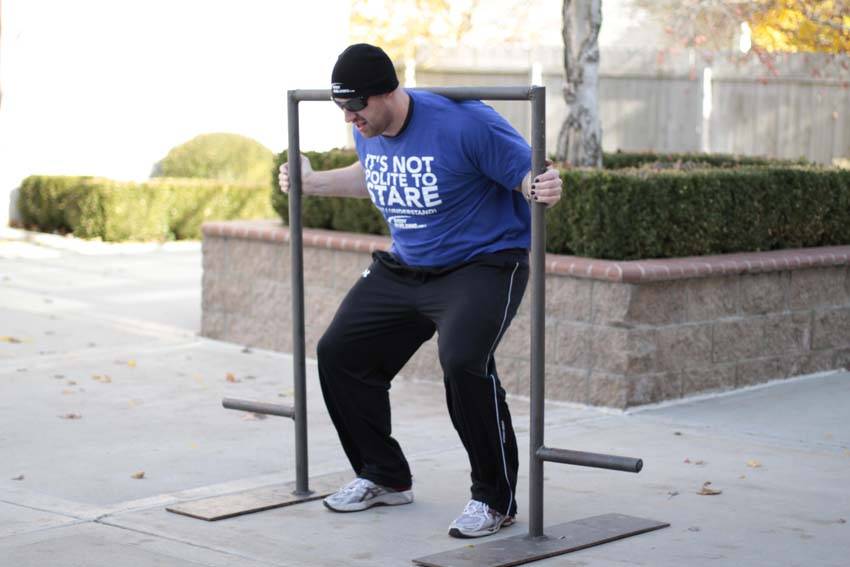
How to Perform Yoke Walk
- The yoke is usually done with a yoke apparatus, but is sometimes seen with refrigerators or other heavy objects.
- Begin by racking the apparatus across the back of the shoulders. With your head looking forward and back arched, lift the yoke by driving through the heels.
- Begin walking as quickly as possible using short, quick steps. You may hold the side posts of the yoke to help steady it and hold it in position. Continue for the given distance as fast as possible, usually 75-100 feet.
Pro Tips
- Category: Strongman
- Movement type: Compound
Best Yoke Walk Alternatives
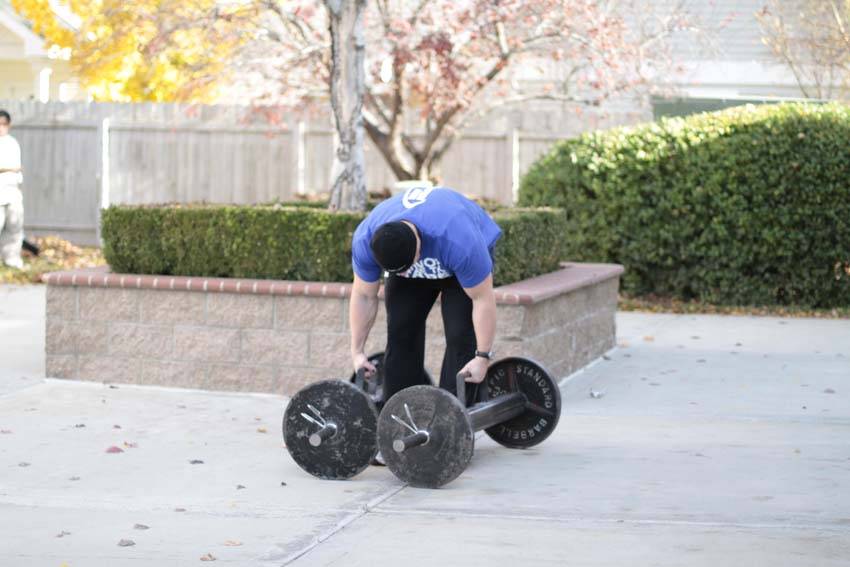
1. Farmer's Walk
79.7% MatchHow to perform this exercise
- There are various implements that can be used for the farmers walk. These can also be performed with heavy dumbbells or short bars if these implements aren't available. Begin by standing between the implements.
- After gripping the handles, lift them up by driving through your heels, keeping your back straight and your head up.
- Walk taking short, quick steps, and don't forget to breathe. Move for a given distance, typically 50-100 feet, as fast as possible.
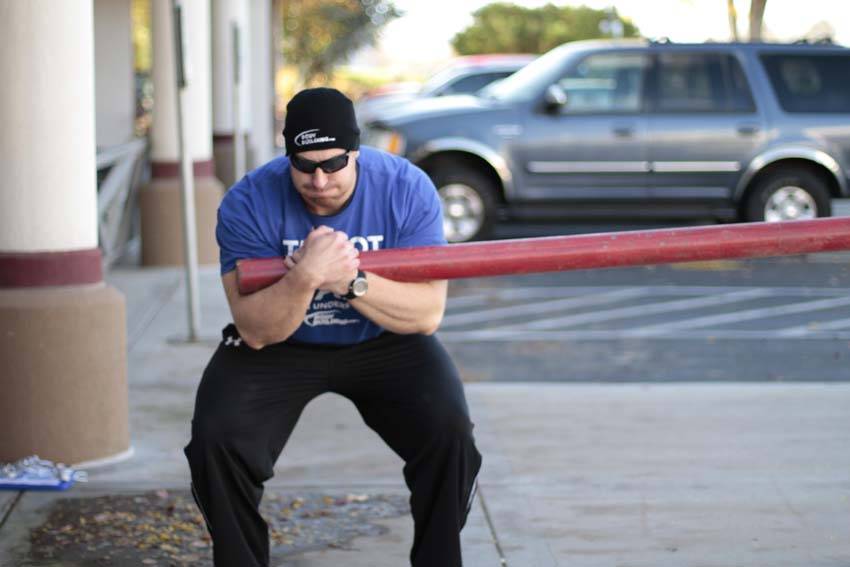
2. Conan's Wheel
72.1% MatchHow to perform this exercise
- With the weight loaded, take a zurcher hold on the end of the implement. Place the bar in the crook of the elbow and hold onto your wrist. Try to keep the weight off of the forearms.
- Begin by lifting the weight from the ground. Keep a tight, upright posture as you being to walk, taking short, fast steps. Look up and away as you turn in a circle. Do not hold your breath during the event. Continue walking until you complete one or more complete turns.
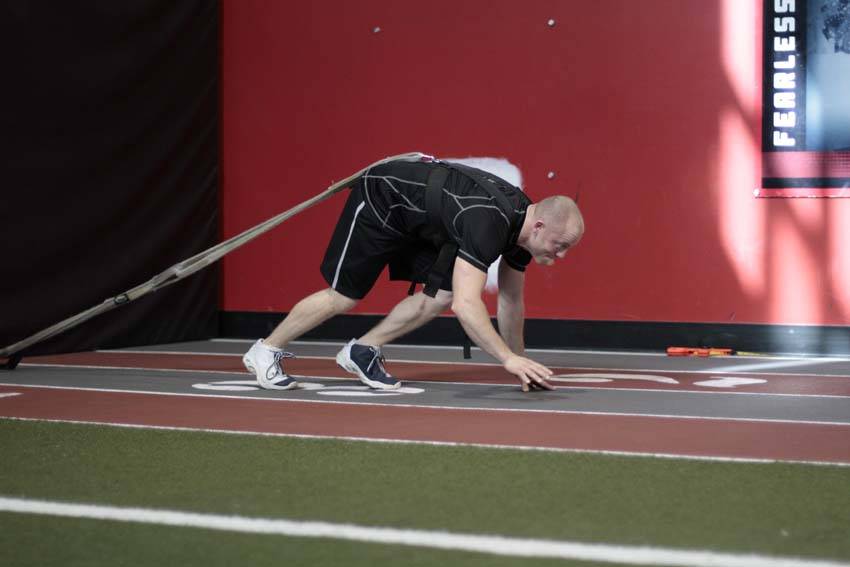
3. Bear Crawl Sled Drags
70.1% MatchHow to perform this exercise
- Wearing either a harness or a loose weight belt, attach the chain to the back so that you will be facing away from the sled. Bend down so that your hands are on the ground. Your back should be flat and knees bent. This is your starting position.
- Begin by driving with legs, alternating left and right. Use your hands to maintain balance and to help pull. Try to keep your back flat as you move over a given distance.
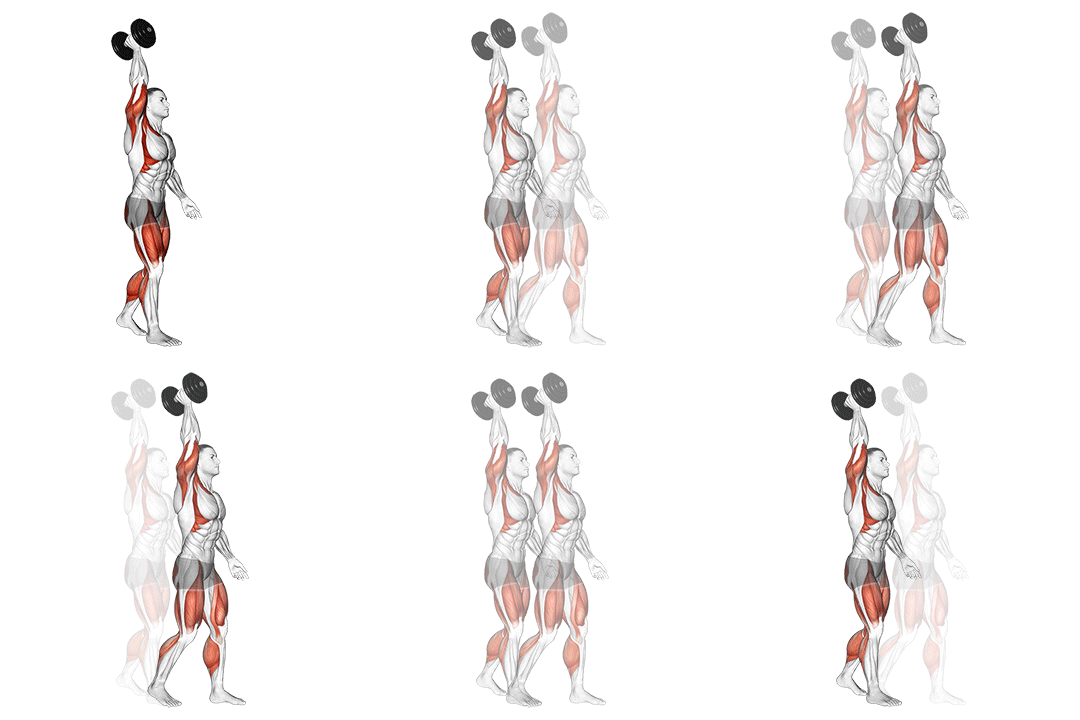
4. Dumbbell Single Arm Overhead Carry
63.2% MatchHow to perform this exercise
- Stand tall with your feet shoulder-width apart, holding a dumbbell in one hand.
- Raise the dumbbell overhead, fully extending your arm.
- Engage your core and keep your back straight as you walk forward, maintaining the dumbbell overhead.
- Continue walking for the desired distance or time.
- Switch hands and repeat the exercise.
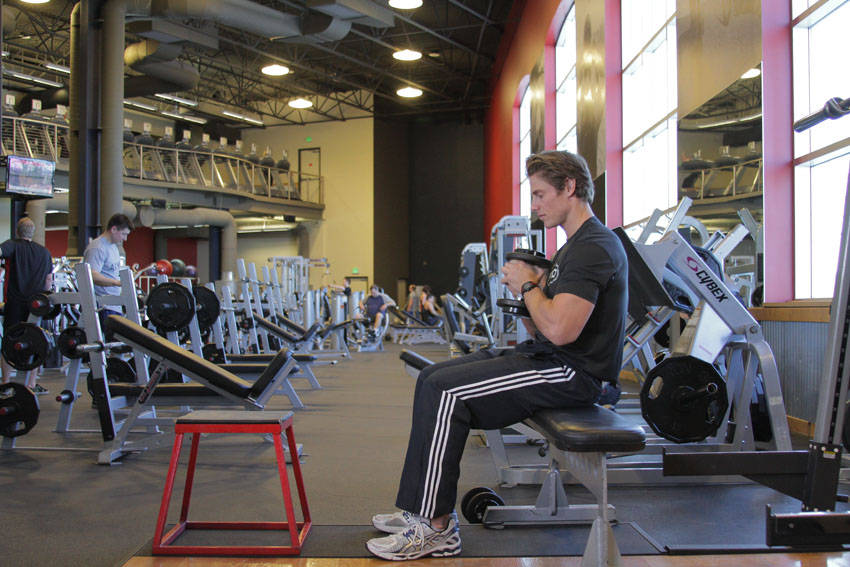
5. Dumbbell Seated Box Jump
59.9% MatchHow to perform this exercise
- Position a box a couple feet to the side of a bench. Hold a dumbbell to your chest with both hands and seat yourself on the bench facing the box. This will be your starting position.
- Plant your feet firmly on the ground as you lean forward, extending through the hips and knees to jump up and forward.
- Land on the box with both feet, absorbing the impact by allowing the hips and knees to bend.
- Step down and return to the starting position.
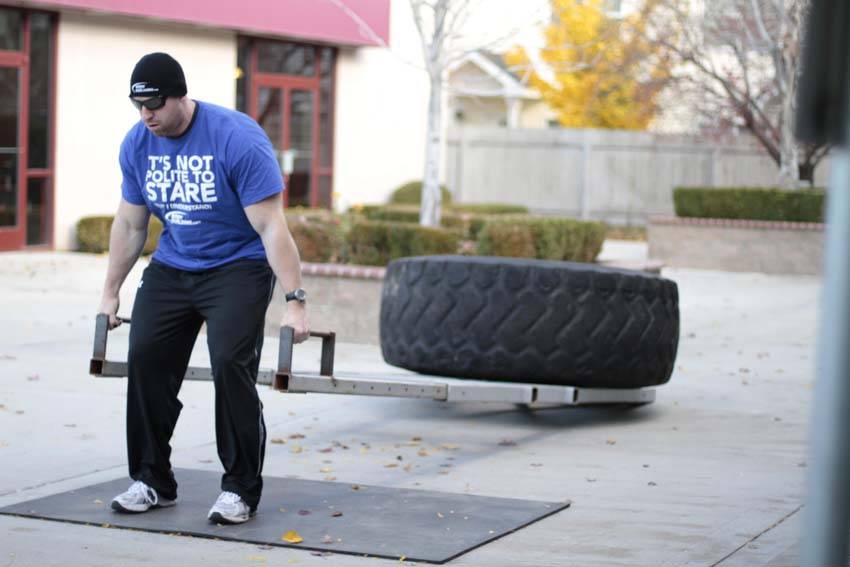
6. Car Deadlift
59.7% MatchHow to perform this exercise
- This event apparatus typically has neutral grip handles, however some have a straight bar that you can approach like a normal deadlift. The apparatus can be loaded with a vehicle or other heavy objects such as tractor tires or kegs.
- Center yourself between the handles if you are a strong squatter, or back a couple inches if you are a strong deadlifter. You feet should be about hip width apart. Bend at the hip to grip the handles. With your feet and your grip set, take a big breath and then lower your hips and flex the knees.
- Look forward with your head, keep your chest up and your back arched, and begin driving through the heels to move the weight upward. As the weight comes up, pull your shoulder blades together as you drive your hips forward.
- Lower the weight by bending at the hips and guiding it to the floor.
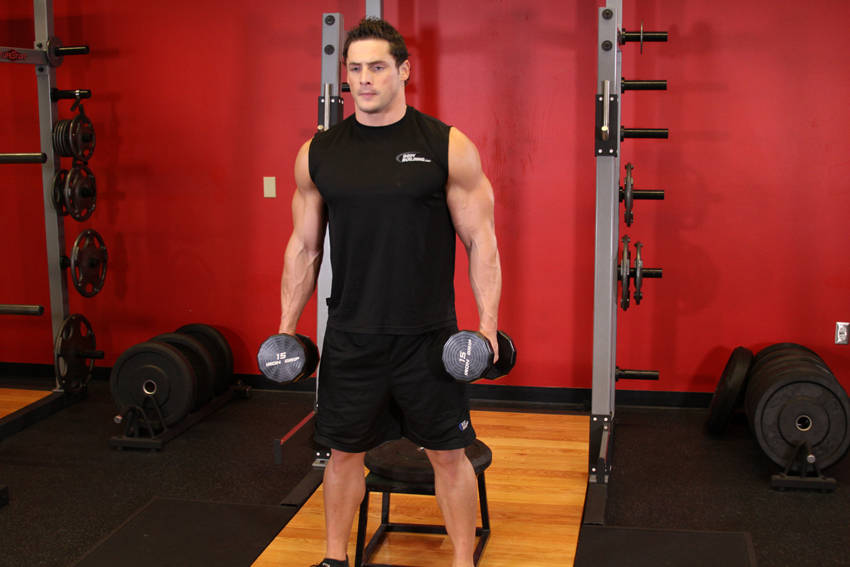
7. Dumbbell Squat To A Bench
59.4% MatchHow to perform this exercise
- Stand up straight with a flat bench behind you while holding a dumbbell on each hand (palms facing the side of your legs).
- Position your legs using a shoulder width medium stance with the toes slightly pointed out. Keep your head up at all times as looking down will get you off balance and also maintain a straight back. This will be your starting position. Note: For the purposes of this discussion we will use the medium stance described above which targets overall development; however you can choose any of the three stances discussed in the foot stances section.
- Begin to slowly lower your torso by bending the knees as you maintain a straight posture with the head up. Continue down until you slightly touch the bench behind you. Inhale as you perform this portion of the movement. Tip: If you performed the exercise correctly, the front of the knees should make an imaginary straight line with the toes that is perpendicular to the front. If your knees are past that imaginary line (if they are past your toes) then you are placing undue stress on the knee and the exercise has been performed incorrectly.
- Begin to raise the bar as you exhale by pushing the floor with the heel of your foot mainly as you straighten the legs again and go back to the starting position.
- Repeat for the recommended amount of repetitions.
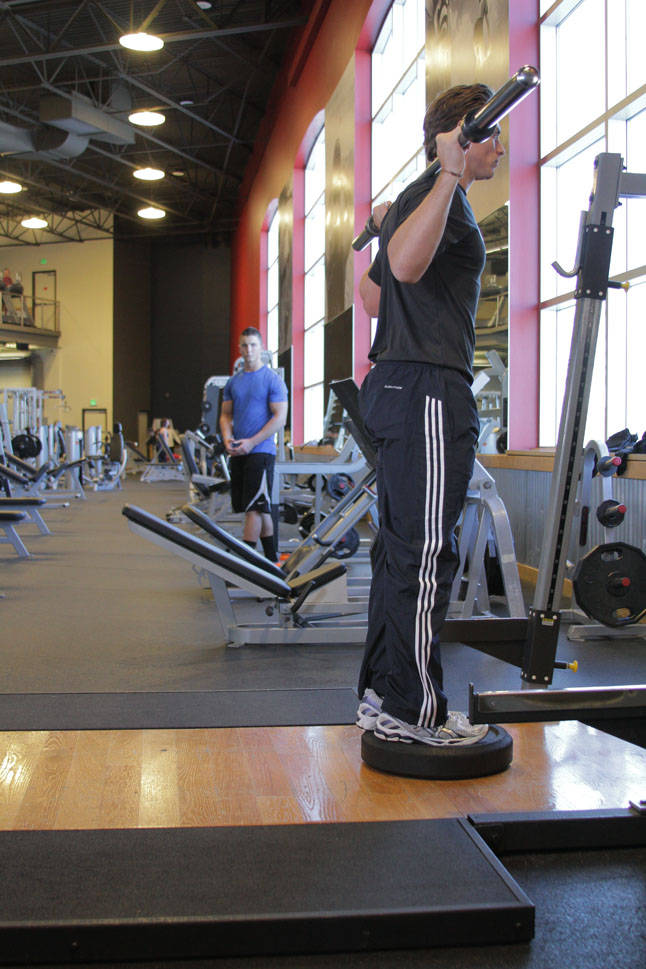
8. Elevated Back Lunge
57.7% MatchHow to perform this exercise
- Position a bar onto a rack at shoulder height loaded to an appropriate weight. Place a short, raised platform behind you.
- Rack the bar onto your upper back, keeping your back arched and tight. Step onto your raised platform with both feet. This will be your starting position.
- Begin by stepping backwards with one leg. Descend by flexing your hips and knees until your knee touches the floor.
- Pause, and extend through the hips and knees to rise up, returning all the way to the starting position before alternating.
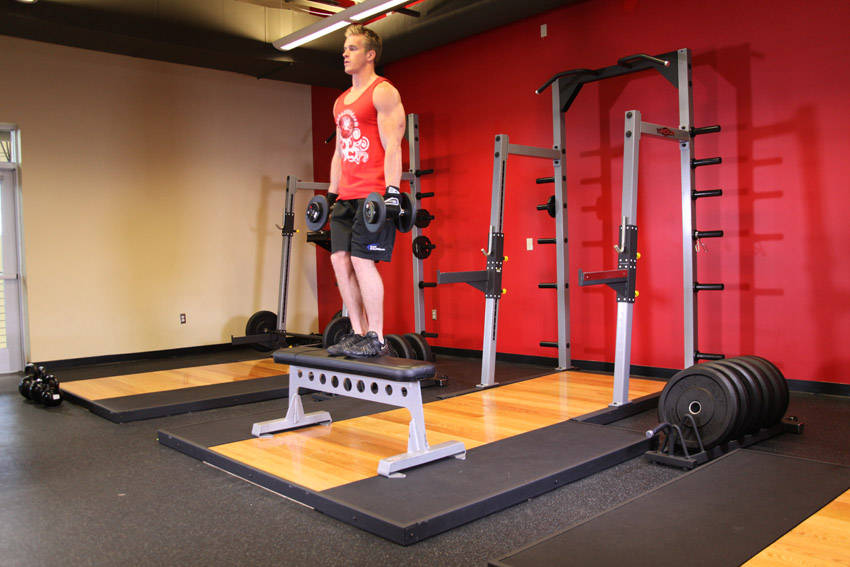
9. Dumbbell Step Ups
57.4% MatchHow to perform this exercise
- Stand up straight while holding a dumbbell on each hand (palms facing the side of your legs).
- Place the right foot on the elevated platform. Step on the platform by extending the hip and the knee of your right leg. Use the heel mainly to lift the rest of your body up and place the foot of the left leg on the platform as well. Breathe out as you execute the force required to come up.
- Step down with the left leg by flexing the hip and knee of the right leg as you inhale. Return to the original standing position by placing the right foot of to next to the left foot on the initial position.
- Repeat with the right leg for the recommended amount of repetitions and then perform with the left leg.
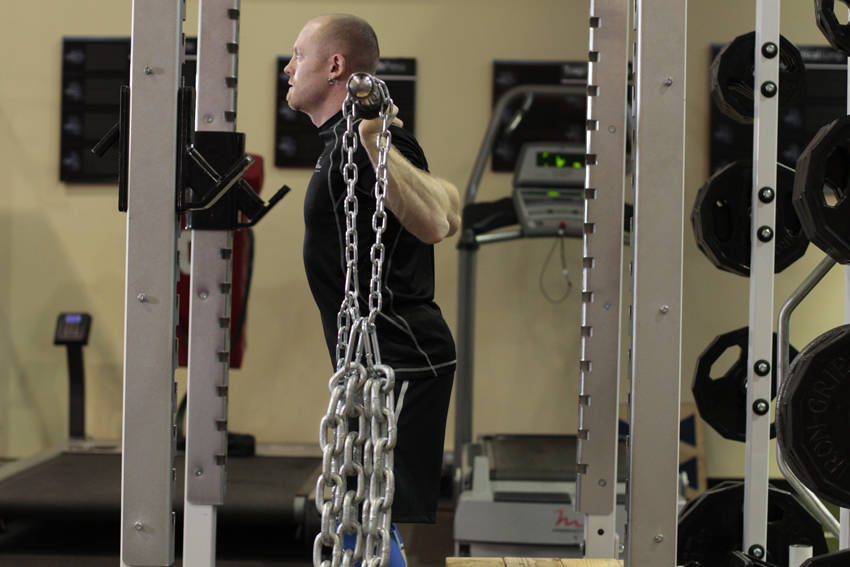
10. Box Squat With Chains
55.7% MatchHow to perform this exercise
- Begin in a power rack with a box at the appropriate height behind you. Typically, you would aim for a box height that brings you to a parallel squat, but you can train higher or lower if desired.
- To set up the chains, begin by looping the leader chain over the sleeves of the bar. The heavy chain should be attached using a snap hook. Adjust the length of the lead chain so that a few links are still on the floor at the top of the movement.
- Begin by stepping under the bar and placing it across the back of the shoulders. Squeeze your shoulder blades together and rotate your elbows forward, attempting to bend the bar across your shoulders. Remove the bar from the rack, creating a tight arch in your lower back, and step back into position. Place your feet wider for more emphasis on the back, glutes, adductors, and hamstrings, or closer together for more quad development. Keep your head facing forward.
- With your back, shoulders, and core tight, push your knees and butt out and you begin your descent. Sit back with your hips until you are seated on the box. Ideally, your shins should be perpendicular to the ground. Pause when you reach the box, and relax the hip flexors. Never bounce off of a box.
- Keeping the weight on your heels and pushing your feet and knees out, drive upward off of the box as you lead the movement with your head. Continue upward, maintaining tightness head to toe.
Why You Might Need a Yoke Walk Alternative
You might substitute the Yoke Walk because you lack a yoke, have shoulder or collarbone pain, or need lower-impact quad loading. Some athletes avoid it when they can't sustain a heavy shoulder-loaded carry or when mobility limits safe torso position. Alternatives let you maintain strong knee-extension stimulus and core tension while changing loading planes. For example, sled pushes reproduce horizontal drive and continuous quad torque—push through the toes with a slight forward lean to maximize rectus femoris activation and reduce spinal shear.
How to Choose the Right Substitute
Match the substitute to the movement quality you need: carry, loaded gait, unilateral stability, or pure knee extension. Prioritize exercises that reproduce quad activation through knee extension (front squat, Bulgarian split squat) if hypertrophy is the goal. If you want conditioning plus quad torque, choose sled pushes or walking lunges with short, powerful steps. Consider joint stress, range of motion, and progressive overload options. Cue for selection: pick an exercise where you can maintain a neutral spine, full knee travel, and controlled tempo to target the quads without compensatory hip-dominant patterns.
Frequently Asked Questions
What muscles does Yoke Walk work?
The Yoke Walk primarily taxes the quadriceps via sustained knee extension while demanding hip extensors and glutes for support. It also loads the spinal erectors and traps for trunk stabilization, requiring strong core bracing to transfer force through the hips and knees.
What is the best bodyweight alternative to Yoke Walk?
Bulgarian split squats are the best bodyweight alternative because they create high unilateral quad torque and force you to control knee travel. Cue: keep the front shin vertical and drive through the mid-foot to maximize quad activation and avoid hip-dominant compensation.
Can I build muscle without doing Yoke Walk?
Yes — you can hypertrophy the quads with exercises that produce sufficient mechanical tension and volume, like front squats, sled pushes, and split squats. Focus on progressive overload, full knee extension range of motion, and tempo control to stimulate quad fibers effectively.
More Exercise Alternatives
Find Alternatives for Any Exercise
Use our free tool to discover the best substitute exercises based on your available equipment and goals.
Try the Exercise Substitution Finder →