
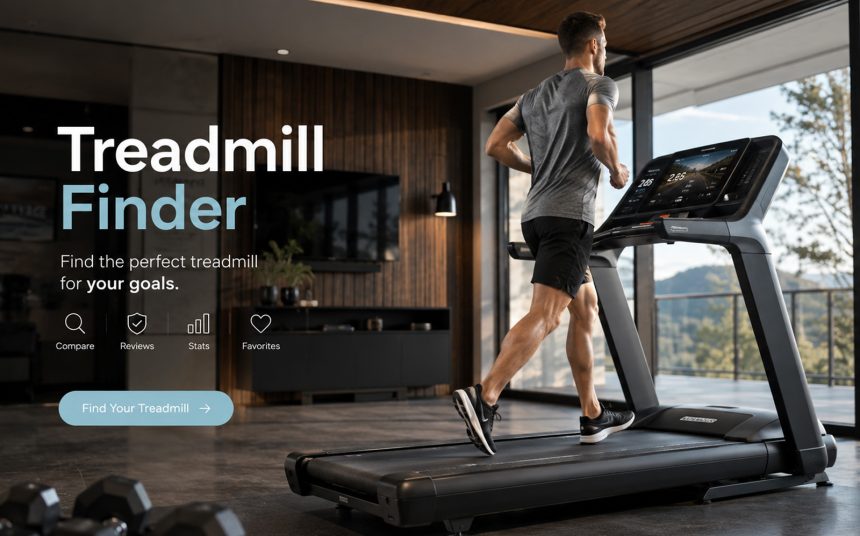
Most treadmill listings bury the numbers that matter under ones that don’t. Peak horsepower looks impressive and tells you almost nothing. A long spec sheet hides the three or four things that actually decide whether a machine suits you. Answer the questions above and this tool narrows the field to treadmills built for how you will really use it, then you can use the guide below to read a spec sheet the way a buyer should.
Find the right treadmill
Four questions. Only the first one matters, the rest are optional.
What to look for
- Motor2.0 to 2.5 CHP
- Deck length50 inches or more
- Top speedAround 4 mph is enough
For walking, a smaller motor is fine and a shorter deck saves floor space. Paying for a running motor you will not use is the most common way to overspend.
See walking treadmills on AmazonWe earn a commission if you buy through these links. We have not tested these machines: the guidance above is spec advice, not a review, and prices come from Amazon and change.
How to choose a treadmill that actually fits you
The finder asks four things: how you will use it, whether it has to fold, the heaviest person who will run on it, and your budget. Those four answers do most of the work, because they map directly onto the specs that separate a treadmill you keep from one you resent. Here is what each one is really deciding.
Match the motor to how you will use it
Ignore peak horsepower. It is a marketing figure the motor can hit for a second or two, not the output it sustains. The number that matters is continuous duty horsepower, written as CHP. That is what the motor holds for the length of a workout without overheating.
For walking, 1.5 to 2.5 CHP is plenty. For a mix of walking and jogging, look for 2.5 to 3.0 CHP. For regular running, especially if the runner is heavier or the sessions are long, start at 3.0 CHP and go up from there. An underpowered motor asked to run all day does not just feel weak, it wears out early, so buying more motor than you need today is usually the cheaper decision over the life of the machine.
Deck size is about your stride, not your room
The running surface has two measurements, and both are set by your body rather than your floor space. Belt width should be at least 20 inches for anyone who runs, because a narrow belt forces you to concentrate on staying centered instead of on your run. Walkers can live with 18 inches.
Belt length matters more the faster you move. A walking stride fits comfortably on a 55 inch belt. Running lengthens your stride and, at speed, your feet land further apart, so runners want 58 to 60 inches. Taller runners should treat 60 inches as the floor, not the target. A deck that is too short makes you shorten your stride to avoid running off the back, which changes your gait and defeats the point.
Cushioning decides what your joints feel
A treadmill deck absorbs some of the impact your knees and hips would otherwise take on pavement. How much depends on the cushioning system under the belt, and manufacturers describe it in language that is hard to compare between brands. The practical test is simpler than the spec sheet: firmer decks feel more like the road and give better feedback for race training, softer decks are kinder over long easy miles and to anyone coming back from injury. If you can, stand on the deck in a shop and shift your weight before you buy. If you are buying online, weight the reviews from people who mention their own joint history.
Incline, and sometimes decline
Incline turns a flat belt into a hill, which raises the effort without raising the speed. It is the single most useful feature for anyone walking for fitness, and it is what makes routines like 12-3-30 work. Most treadmills reach 10 to 15 percent, which is more than enough for walking and steep enough to build real running strength. A handful add decline, which trains the muscles that control you on the way down a hill. Decline is a genuine extra rather than a gimmick, but only pay for it if you will use it.
Weight capacity is a build-quality signal
The stated maximum user weight is partly a safety limit and partly a clue about how the whole machine is built. A treadmill rated for 300 pounds is built with a sturdier frame, better rollers and a stronger motor mount than one rated for 220, even for a lighter user, because it has to be. As a rule, choose a machine rated at least 50 pounds above the heaviest person who will use it. That margin keeps the treadmill inside its comfortable working range rather than at its limit, which is where parts fail first.
Speed range
Most treadmills top out between 10 and 12 miles per hour. Walkers and joggers never approach that. Faster runners and anyone doing sprint intervals should check the top speed and, just as important, how smoothly the machine changes pace, because a treadmill that lurches between speeds is unpleasant to run on regardless of its ceiling.
Folding or not: the real trade-off
A folding treadmill lifts its deck up and out of the way so the footprint on the floor shrinks when you are not using it. That is the whole appeal, and for a shared room or a small home it is a real one. The trade-off is that the folding mechanism is another set of hinges and locks, it usually means a slightly less rigid frame, and the heaviest, most stable running machines tend not to fold at all.
If a treadmill has to disappear between sessions, fold is worth the compromise and modern folding decks are far better than they used to be. If it can live in a fixed spot, a non-folding machine generally gives you more treadmill for the money and a more solid feel underfoot. The finder treats this as an honest either-or rather than assuming everyone wants to fold.
Walking pads versus full treadmills
A walking pad is a stripped down treadmill: low to the ground, often no handrail, a slim motor, and a top speed built for walking rather than running. Under a standing desk or slid beneath a bed, it does one job well and takes up almost no room. What it does not do is run. The motor, deck length and stability are not built for it, and pushing a walking pad past a brisk walk is how they break.
If you want to move more during the workday and never intend to run indoors, a walking pad is the right tool and a full treadmill is wasted money. If there is any chance you will want to run, buy the treadmill. A walking pad cannot grow into one.
What your budget actually buys
Treadmill prices sort into rough tiers, and knowing which tier you are shopping in sets honest expectations before you start reading listings.
Under $500
Walking pads and light folding treadmills. Fine for walking and the occasional slow jog, with smaller motors, shorter decks and lower weight ratings. Buy in this range for walking, not for running.
$500 to $1,000
The heart of the home market. This is where you find genuine running treadmills with enough motor and deck for regular use, incline, and a build that lasts. Most people who want to run at home are best served here.
$1,000 to $2,000
Sturdier frames, larger decks, quieter and more powerful motors, better cushioning, and extras like decline or interactive screens. Worth it for serious runners, heavier users, or a machine that several people will share hard.
Over $2,000
Commercial grade build for the home. Overkill for most, the right call for a dedicated runner training seriously or a household that will put in the miles for years.
Mistakes people make buying a treadmill
Chasing peak horsepower. It is the most quoted number and the least useful. Read continuous duty horsepower instead.
Buying too small a deck. A belt that fits your walk will feel cramped the first time you try to run on it, and you cannot make a deck longer after the fact.
Ignoring the ceiling height. Deck height plus your own height plus incline can be more than a low basement or attic room allows. Measure before you buy.
Buying right at the weight limit. A machine run at its rated maximum is a machine run at its limit. Leave a margin.
Paying for a screen you will not use. Interactive subscriptions add to the price and often to a monthly bill. They are excellent if you will use them and dead weight if you will not.
Questions people ask
How much should I spend on a treadmill?
For most people who want to run at home, $500 to $1,000 buys a machine with enough motor, deck and durability to last. Walkers can spend less, dedicated runners and heavier users should plan to spend more. Match the tier to how hard the machine will actually work.
Do I need incline?
If you walk for fitness, yes, it is the most useful feature you can have and it is what makes incline walking routines effective. If you only run, incline is still valuable for building strength but less essential day to day.
Is a folding treadmill worth it?
If floor space is tight or the room is shared, yes. If the treadmill can stay set up in one place, a non-folding machine usually gives you a more solid feel and more treadmill for the same money.
Can a walking pad handle running?
No. Walking pads are built for walking speeds, and running on one wears it out fast. If you might ever want to run, buy a full treadmill from the start.
What motor size do I need?
Look at continuous duty horsepower, not peak. Around 1.5 to 2.5 CHP for walking, 2.5 to 3.0 for a walk and jog mix, and 3.0 CHP or more for regular running.