
What 12-3-30 actually burns
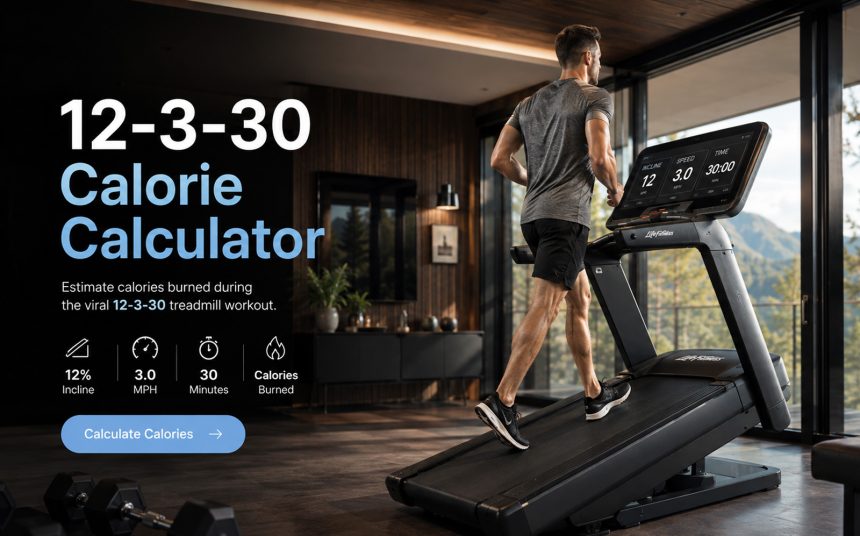
Twelve percent incline, three miles an hour, thirty minutes. The routine is fixed, so the only thing that changes the number is you.
—
calories burned
How this is worked out
The ACSM walking equation at a fixed 3 mph and 12% grade, the same equation the calorie calculator uses. Twelve percent is close to the 15% ceiling that equation was validated to, so it is inside the evidence but near its edge. It assumes you are not holding the handrails, which at 12% is a real assumption: gripping the rails takes weight off your legs and lowers the true cost considerably.
What Is the 12-3-30 Workout?
The 12-3-30 workout is a viral treadmill routine created by social media influencer Lauren Giraldo: walk at 12% incline, 3.0 mph, for 30 minutes. Since going viral on TikTok with over 400 million views, it’s now backed by 2024 peer-reviewed research from the International Journal of Exercise Science showing 42% less joint stress than running while providing comparable cardiovascular benefits.
12-3-30 Calories Burned by Body Weight
The calories you burn during a 12-3-30 workout depend primarily on your body weight. Here’s a comprehensive breakdown for different weights and durations:
| Body Weight | 15 min | 30 min | 45 min | 60 min |
|---|---|---|---|---|
| 120 lbs (54 kg) | 100 cal | 200 cal | 300 cal | 400 cal |
| 140 lbs (64 kg) | 117 cal | 235 cal | 352 cal | 470 cal |
| 160 lbs (73 kg) | 134 cal | 268 cal | 402 cal | 536 cal |
| 180 lbs (82 kg) | 150 cal | 301 cal | 451 cal | 602 cal |
| 200 lbs (91 kg) | 167 cal | 334 cal | 501 cal | 668 cal |
| 220 lbs (100 kg) | 183 cal | 367 cal | 550 cal | 734 cal |
These are actual calories burned. Treadmill displays typically show 15-20% higher numbers.
Why 12-3-30 Burns So Many Calories
The secret is in the 12% incline. Research shows each 1% of incline adds approximately 8% more energy expenditure. At 12% incline, you’re nearly doubling your calorie burn compared to flat walking at the same speed:
- 3 mph at 0% incline: ~3.8 MET (95 cal/30 min for 150 lb person)
- 3 mph at 12% incline: ~7.4 MET (186 cal/30 min for 150 lb person)
This makes 12-3-30 one of the most efficient low-impact cardio workouts available.
Benefits of the 12-3-30 Workout
- Low impact, joint-friendly: 2024 research confirms 42% less joint stress than running at the same calorie burn. Ideal for those with knee or hip concerns.
- Optimal fat-burning zone: The moderate intensity means approximately 41% of energy comes from fat, compared to 33% during high-intensity running.
- Targets glutes and hamstrings: The steep incline significantly increases posterior chain activation, building strength while burning calories.
- Beginner-friendly: Walking pace is accessible to most fitness levels. You can start with lower inclines and work up.
- Time-efficient: 30 minutes provides a complete cardiovascular workout with no additional equipment needed.
- Easy to track: Fixed settings mean consistent, comparable workouts every time.
- Mental health benefits: Walking is proven to reduce stress and anxiety, and the achievable pace makes it sustainable long-term.
12-3-30 vs. Running: Which Burns More?
| Workout | MET | Calories (30 min, 150 lb) | Joint Impact | Fat Burned % |
|---|---|---|---|---|
| 12-3-30 | 7.4 | ~250 cal | Low | 41% |
| Running 5 mph | 8.3 | ~280 cal | High | 33% |
| Running 6 mph | 9.8 | ~330 cal | High | 30% |
While running burns slightly more total calories, 12-3-30 burns more fat calories per session and is far more sustainable for most people long-term.
Common 12-3-30 Mistakes to Avoid
- Holding the handrails: This is the #1 mistake. Research shows gripping handrails reduces actual calorie burn by 20-25%, completely defeating the purpose of the incline. If you need to hold on, the incline is too steep for your current fitness level.
- Starting at 12% immediately: If you’re new to incline walking, build up gradually over 2-3 weeks. Start at 6-8% and add 1-2% each week.
- Doing it every day: Your muscles and joints need recovery. 3-5 sessions per week is optimal for results without overtraining.
- Skipping the warmup: Always spend 3-5 minutes at 0% incline to warm up muscles and prepare your cardiovascular system.
- Leaning forward too much: Maintain upright posture. Leaning forward reduces glute activation and can strain your lower back.
- Going too fast: The workout is specifically designed for 3.0 mph. Going faster turns it into a different exercise and may reduce the fat-burning benefits.
How to Progress with 12-3-30
Once the standard 30-minute workout feels manageable, you can progress in several ways:
- Increase duration: Try 45 or 60 minutes (use our calculator to see the calorie difference)
- Add weighted vest: 10-20 lbs increases intensity without changing speed or incline
- Increase frequency: Move from 3x to 5x per week
- Add intervals: Alternate between 12% and 15% incline every 5 minutes
12-3-30 for Weight Loss: What to Expect
Assuming a 150 lb person doing 12-3-30 five times per week:
- Weekly calorie burn: ~1,250 calories
- Monthly calorie burn: ~5,000 calories
- Potential monthly weight loss: ~1.5 lbs (from exercise alone)
Combined with a modest calorie deficit of 250 cal/day from diet, you could expect 2-3 lbs of fat loss per month – a sustainable, healthy rate.
12-3-30 Frequently Asked Questions
How many calories does the 12-3-30 workout burn?
The 12-3-30 workout burns approximately 200-350 calories in 30 minutes, depending on your body weight. A 150 lb person burns around 250 calories, while a 200 lb person burns approximately 335 calories. These are actual calories – treadmill displays typically show 15-20% higher numbers.
Is the 12-3-30 workout effective for weight loss?
Yes, the 12-3-30 is highly effective for sustainable weight loss. Done 5x per week, it burns 1,000-1,750 calories weekly depending on your weight. The moderate intensity (41% fat burning) is optimal for fat loss, and the low-impact nature means you can stick with it long-term without joint issues.
Can beginners do the 12-3-30 workout?
Beginners should work up to the full 12-3-30 gradually. Start with 6-8% incline for 15-20 minutes and increase by 1-2% incline and 5 minutes duration each week. Most people can reach the full 12-3-30 within 2-4 weeks. Listen to your body and don’t hold the handrails.
How often should I do the 12-3-30 workout?
For optimal results, do the 12-3-30 workout 3-5 times per week. Your muscles and joints need recovery time, especially when you’re new to incline walking. Avoid doing it every day – rest days allow your body to adapt and get stronger.
Why does my treadmill show more calories than this calculator?
Treadmill displays consistently overestimate calorie burn by 15-20% according to research. They use simplified formulas and don’t account for individual factors. Our calculator uses MET values from the 2024 Compendium of Physical Activities – the scientific gold standard for exercise energy expenditure.
Does holding the handrails affect calorie burn?
Yes, significantly. Research from ACE (American Council on Exercise) shows holding handrails reduces actual calorie burn by 20-25%. The support reduces the work your legs and core perform. If you need to hold on for balance, try a lower incline until you build stability.
Is 12-3-30 better than running?
It depends on your goals. 12-3-30 burns slightly fewer total calories than running but has 42% less joint impact, burns a higher percentage of fat (41% vs 33%), and is more sustainable long-term. For fat loss and general fitness with minimal injury risk, many experts prefer 12-3-30 over running.
Can I modify the 12-3-30 settings?
Yes! If 12% is too challenging, start lower and work up. Common modifications include: 8-3-30 (8% incline) for beginners, 12-3-15 (15 minutes) for time constraints, or 12-3.5-30 (3.5 mph) for more challenge. Our main treadmill calculator lets you input any settings.
What muscles does 12-3-30 work?
The 12% incline significantly targets your posterior chain: glutes, hamstrings, and calves. Your core also works harder to maintain upright posture against the incline. This makes 12-3-30 excellent for building lower body strength while burning calories.
How long until I see results from 12-3-30?
Most people notice improved endurance within 2-3 weeks. Visible body composition changes typically appear after 4-6 weeks of consistent training (3-5x weekly) combined with a balanced diet. Track your progress by how clothes fit rather than just scale weight.