
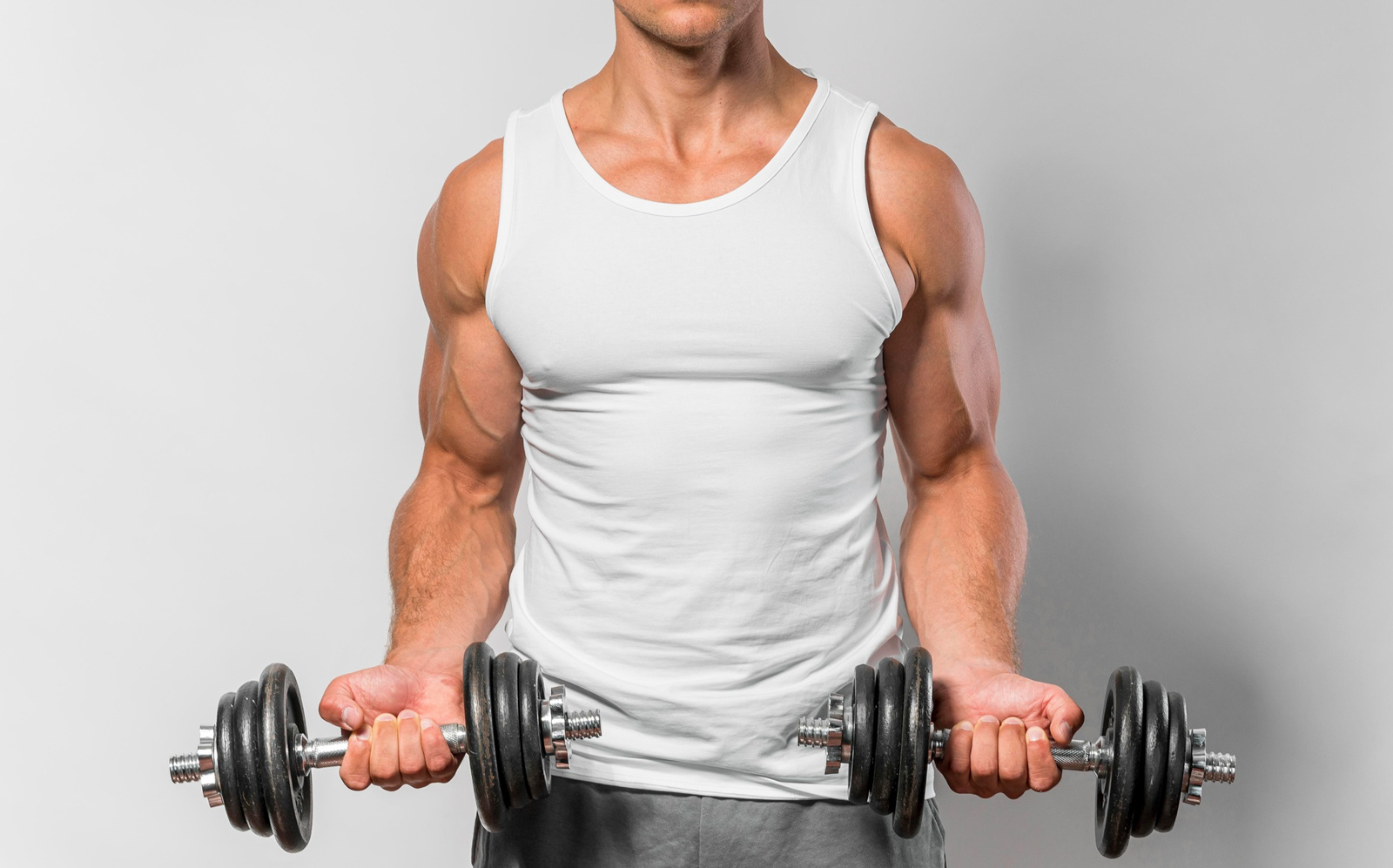
Push-ups seem like the holy grail of beginner bodyweight exercises. However, they don’t work for everyone. Push-ups can lead to significant wrist and shoulder rotator cuff strain, which can cause discomfort and hinder training performance.
As a personal trainer with almost two decades of hands-on experience, I’ve seen countless clients ditch push-ups because of joint pain. The good news is that you don’t need to rely on this move to build upper-body strength.
In this article, I share my tried and tested five-exercise 15-minute standing dumbbell routine that builds upper body strength, including the chest, back, shoulders, and arms, without overloading your joints, tendons, and muscle tissues. We have a lot to unpack, so sit tight and read on.
Why Skip Push-Ups? Understanding the Need for Alternatives
Each individual is unique, and the exercise that works great for your training partner might not work for your biomechanics.
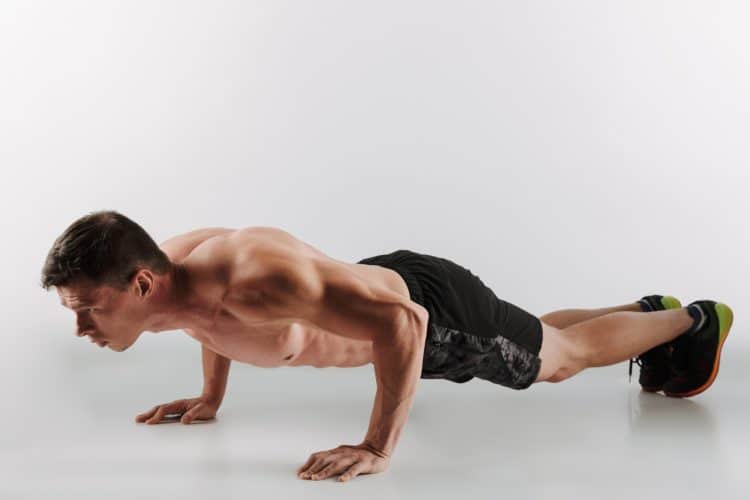
Push-ups require your wrists to bear your weight at an awkward angle, which can spell trouble for people dealing with carpal tunnel or tendonitis. Furthermore, some beginners perform the kneeling variation of this exercise, which can further strain the knees.
Dumbbells are an incredibly versatile tool that can be used to train multiple muscle groups from different angles using varying resistance to isolate or combine muscle groups.
Standing dumbbell exercises shift the load from your joints to your muscles, reducing strain while packing a punch. Push-ups lock you in a fixed plane, but standing movements allow fluid, natural motions that mimic daily activities.
These exercises can help sculpt your chest, shoulders, and arms without any sacrifices.
The 15-Minute Strength-Building Standing Dumbbell Routine
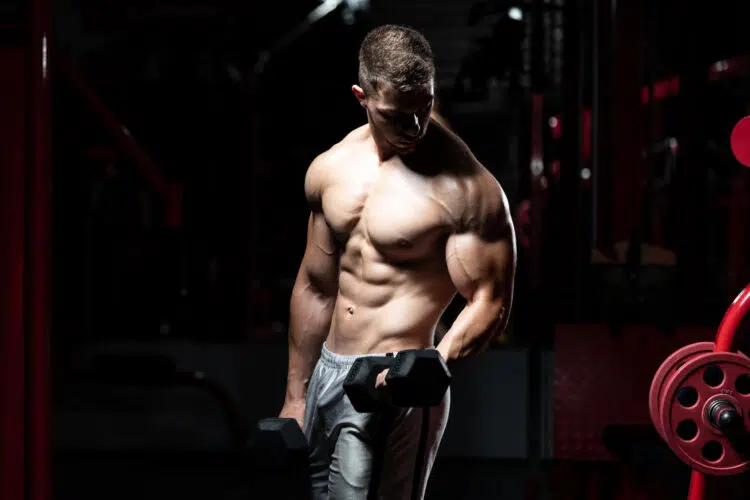
We’ll take a slightly different approach to this workout. Instead of performing each exercise for a certain number of reps, you’ll be doing it for a set time. This will ensure you wrap up the session within 15 minutes, making it suitable for people with hectic schedules.
Timed workouts also push your training intensity, making every rep and second count. That said, I highly recommend using a wall clock for this session, as looking at your wristwatch continuously might not be feasible. The fact that you’ll perform this workout standing makes this much easier.
With all that out of the way, complete three rounds of the following standing dumbbell training routine to unlock your strength gains:
| Exercise | Work Time | Rest Time |
| Standing Dumbbell Squeeze Press | 45 Seconds | 15 Seconds |
| Dumbbell Overhead Press | 45 Seconds | 15 Seconds |
| Bent-Over Dumbbell Rows | 45 Seconds | 15 Seconds |
| Standing Dumbbell Lateral Raises | 45 Seconds | 15 Seconds |
| Dumbbell Bicep Curls | 45 Seconds | 15 Seconds |
Advanced trainers can treat this workout as a 15-minute EMOM (every minute on the minute) session. Aim to complete 20 reps (without compromising form) within the 45-second window and use the remainder to rest and catch your breath.
Exercise Breakdown For Maximum Results
I channeled my experience training hundreds of clients with varying experience levels to devise a five-exercise upper-body training split that builds strength and boosts confidence while sparing your joints.
Each exercise targets your muscles from different angles, ensuring overall development.
Standing Dumbbell Squeeze Press (Chest, Triceps, Shoulders)
Many believe that push-ups are the only exercise they can do to train their chest if they don’t have access to a bench or specialized training equipment. However, this isn’t true.
You just need to get a little creative, and you can train almost every muscle group using a pair of dumbbells. Enter, standing dumbbell squeeze presses.
Stand upright with a shoulder-wide stance, chest proud, and core braced. Hold a single dumbbell with both hands by the weight plate against your chest. Your palms should be facing each other. Push your hands together with all your might, so you feel a deep contraction in the starting position.
Extend your elbows while maintaining this tension. Your arms should be parallel to the floor at the top of your range of motion. Hold the peak contraction for a couple of seconds before slowly returning to the starting position.
This exercise mimics push-ups but spares your wrists and knees.
Coach Tip: Keep your shoulders relaxed and pulled down throughout the exercise. Lifting them towards your ears results in trapezius and deltoid engagement.
Dumbbell Overhead Press (Shoulders, Upper Chest)
Broad shoulders have long been associated with masculinity and strength, and are indispensable when it comes to achieving an aesthetically-appealing V-taper.
Dumbbell overhead presses are one of the best exercises for targeting the front and medial deltoids. Performing this exercise while standing results in a much greater core and stabilizer muscle engagement compared to the seated variation.
Step-by-Step Instructions:
- Stand upright with a hip-width stance.
- Grab a dumbbell in each hand and hold them at shoulder height, palms facing forward, elbows bent.
- Brace your core and press the weight overhead until your elbows are fully extended.
- Lower the weight slowly, resisting the pull of gravity.
Employing a full ROM during this exercise results in optimal deltoid and upper chest recruitment, which is a weak muscle group for most people. Avoid arching your back during this movement to minimize the risk of lower back strain and injury.
Also, contract your triceps during dumbbell chest squeezes and overhead presses, as we don’t have standalone tricep moves in this workout.
You must always begin a workout with a proper warm-up routine, including dynamic stretches like arm circles and torso twists to prime the target muscles, enhance performance, and limit injury risk.
Similarly, end with a five-minute cool-down routine to flush the metabolites out of the muscle tissues and promote mobility and recovery.
Bent-Over Dumbbell Rows (Back, Biceps)
This exercise biases the upper back muscles while prioritizing the lats, helping you achieve the coveted cobra back. The pulling motion also engages the biceps, which can help improve your performance in day-to-day and athletic activities.
Begin by hinging at your hips, knees slightly bent, and back flat, while holding a dumbbell in each hand with your palms facing each other. Your torso should be at 45 degrees, and your arms should be perpendicular to the floor at the starting position.
Initiate the movement by driving your elbows toward the ceiling while keeping them close to your body. The dumbbells should be at your side at the top.
Pause in the fully shortened position, squeezing your shoulder blades together as if pinching a pencil between them. Lower the weights with control to avoid swinging, as it takes the tension away from the target muscles and transfers it to the secondary movers.
Besides building a jacked back, this movement will strengthen your posterior chain, enhancing your posture.
Keep your core tight to protect your lower back. I recommend my clients wear a weightlifting belt while performing this exercise, as it can protect the spine and help generate thoracic pressure.
Standing Dumbbell Lateral Raises (Shoulders)
Capped deltoids give your shoulders a 3D aesthetic, which can create the illusion of a bigger and stronger physique.
Unlike the three compound exercises above, standing dumbbell lateral raises are an isolation move that focuses on the medial deltoids. Get into position by standing upright with a dumbbell in each hand at your sides, palms facing inward.
Brace your core and raise the weights to shoulder height while keeping your elbows slightly bent. Your upper arms should be parallel to the floor at the top of your ROM.
Pause in the fully shortened position before slowly lowering your arms to the starting position.
Use slow, controlled eccentric (4-5 seconds) as you gain more experience, to increase the time under tension and maximize target muscle fiber stimulation and subsequent adaptations. (1)
Pro Tip: Avoid letting your arms fully hang at the bottom. Reverse the motion just before reaching the starting position to maintain constant tension on the target muscles.
Dumbbell Bicep Curls (Biceps)
These are the darling of almost everyone; after all, who doesn’t want big, bulging biceps? While most people perform curls at least once in the gym, only a handful use the correct form. Here is how to do it to get the best bang for your training buck:
- Stand tall while holding a pair of dumbbells against your thighs, with your palms facing inward.
- Brace your core and initiate the curl while internally rotating your wrists and keeping your elbows glued to your sides.
- Your palms should face your shoulder at the top.
- Pause and contract your biceps as hard as possible to fire up every muscle fiber in your guns.
- Turn your pinkies toward your shoulders at the top without overloading your wrists for peak contraction.
- Slowly lower the dumbbell to the starting position while resisting the urge to drop the weights.
- Avoid rocking your torso during the movement to isolate the biceps brachii.
Customizing the Routine for Different Fitness Levels
A fitness program must be highly customized for it to be effective. You shouldn’t expect to achieve your goals while following a cookie-cutter routine. Adjust the exercises and training intensity and volume depending on your progress.
For instance, beginners can start with a 10-minute session using lighter resistance, whereas advanced trainers can employ advanced training techniques like supersets and drop sets to push their muscles to mechanical failure and ignite hypertrophy.
You should never underestimate the power of a quick workout. Even a 10-minute session can boost confidence and reduce stress, thanks to the release of mood-enhancing hormones called endorphins.
Also, learn to work around your limitations and overcome them. People with weak grip should add fat grips to their DBs, as it results in greater forearm and brachioradialis recruitment.
On the flip side, folks dealing with limited shoulder mobility should add stretching exercises to their warm-up and cool-down flows. Doing them consistently for 8-12 weeks can improve their performance in overhead pressing exercises.
Avoid Overtraining
It’s tempting to perform this 15-minute workout daily. However, this can increase the risk of overuse injuries and exhaustion. Begin by doing this workout 2-3 times weekly on non-consecutive days.
Pair them with a lower-body or cardio session for balanced growth.
Progressive overload is the name of the game when it comes to making consistent progress in the gym. Scale up these workouts by increasing the time, weights, sets, reps, and intensity as you gain more experience.
Training is only half the equation when it comes to achieving your fitness goals. You must also pay close attention to your nutrition and recovery.
Use this TDEE calculator to determine your daily calorie and macronutrient needs. Then, divide them up into equal meals throughout the day. Drink at least a gallon of water daily to prevent the risk of dehydration and its hazardous side effects.
Finally, sleep for at least eight hours each night to give your muscles enough time to rest and recuperate.
Conclusion
This 15-minute standing dumbbell workout engages your core, improves posture, and mimics real-world movements like lifting or pushing. It also enhances your balance and posture, boosting your overall work capacity and productivity.
The routine is simple enough for newcomers and adaptable for advanced lifters. Consistency is one of the most important factors when it comes to making gradual progress. Start small and increase the training intensity and volume as you gain more experience. Best of luck!
References:
- Burd NA, Andrews RJ, West DW, Little JP, Cochran AJ, Hector AJ, Cashaback JG, Gibala MJ, Potvin JR, Baker SK, Phillips SM. Muscle time under tension during resistance exercise stimulates differential muscle protein sub-fractional synthetic responses in men. J Physiol. 2012 Jan 15;590(2):351-62. doi: 10.1113/jphysiol.2011.221200. Epub 2011 Nov 21. PMID: 22106173; PMCID: PMC3285070.