

The dumbbell curl, or dumbbell bicep curl, is the basic arm exercise: you stand with a dumbbell in each hand, palms facing forward, and bend your elbows to bring the weights to your shoulders. It trains the biceps directly, along with the two other muscles that bend the elbow.
It is also the easiest curl to set up. You need one pair of dumbbells and enough room to stand, and each arm lifts its own weight, so a stronger side cannot cover for a weaker one. That makes it a sound first biceps exercise for beginners and a staple for experienced lifters.
How to Do Dumbbell Bicep Curls Correctly

- Stand tall with your palms facing forward. Hold a dumbbell in each hand with your feet hip-width apart and your arms straight at your sides. You should feel your elbows fully straight before the first rep. Do not begin with them already bent.
- Lock your shoulders and trunk. Draw your shoulders back and down, lift your chest and tighten your abs and glutes. Your elbows should sit directly under your shoulders. You should feel steady from the floor up. Do not let your shoulders round forward.
- Bend your elbows and curl. Breathe out and bend your elbows, keeping your palms up and your upper arms against your sides. You should feel your biceps tighten from the first inch of the lift. Do not rock your hips or lean back to get the weights moving.
- Hold the top position. Stop when the dumbbells reach shoulder height, with your forearms just short of vertical, and hold for 1 second. You should feel the biceps fully shortened. Do not rest the dumbbells on your shoulders, because that takes the load off the muscle.
- Lower slowly. Breathe in and let the dumbbells down over 2 to 3 seconds, all the way to straight elbows. You should feel the biceps working the whole way down. Do not let the weights drop.
- Pause, then repeat. Come to a full stop at the bottom so the next rep starts without a swing. If you have to lean back to begin a rep, the dumbbells are too heavy.
Some lifters start with their palms facing their thighs and turn them up as they curl. That version has its own guide: the dumbbell supinated curl.
Muscles Worked in the Dumbbell Curl
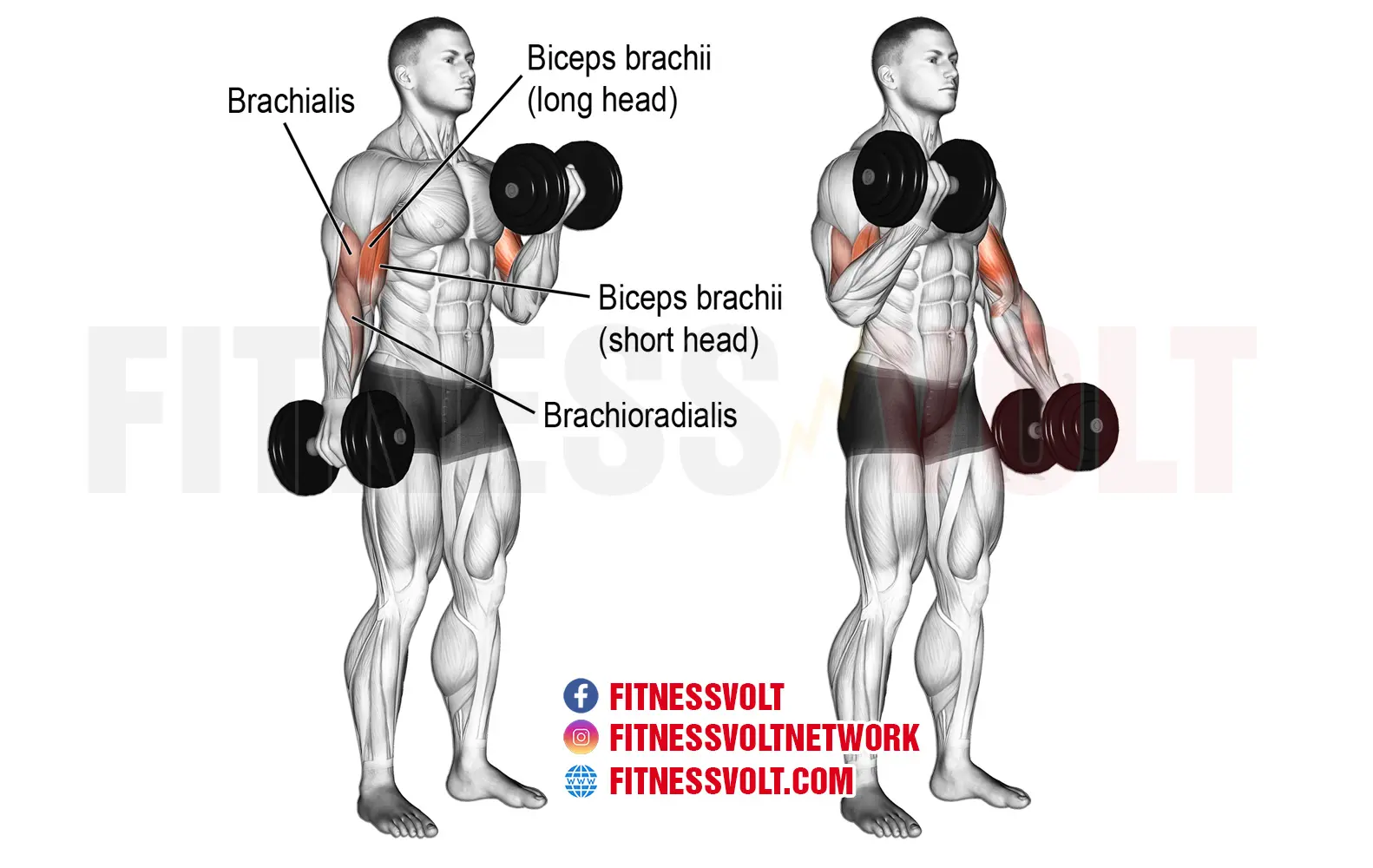
Three muscles bend the elbow. The palms-up grip of the dumbbell curl favors the biceps.
Biceps Brachii
The biceps brachii runs down the front of the upper arm in two heads. It has two jobs at the elbow: bending it and turning the palm up. With your palms up, it can do both at once, which is why this grip is the standard for biceps training.
Grip changes how hard it works. In a 2023 study of ten competitive bodybuilders, biceps activity during the lifting phase was about 12% greater with a palms-up grip than with a neutral, palms-in grip, and about 19% greater than with a palms-down grip (Coratella et al., 2023). For how the two grips compare in a program, see our bicep curl vs hammer curl guide.
Brachialis
The brachialis sits underneath the biceps and attaches to the ulna, which stays fixed when the forearm turns. It bends the elbow whatever your grip, so it works on every rep of every curl. A well-developed brachialis pushes the biceps up and adds width to the upper arm.
Brachioradialis
The brachioradialis runs along the thumb side of the forearm, from just above the elbow to the wrist. It helps bend the elbow and makes up much of the upper forearm.
Stabilizers
The front of the shoulder holds your upper arm still while the forearm moves. The muscles of the forearm grip the dumbbells and keep your wrists straight, and your abs and glutes stop your torso from rocking back as the weights come up.
Benefits of Dumbbell Bicep Curls
Loads the Biceps Through the Whole Rep
A Brazilian study recorded biceps activity in 22 people during the standard dumbbell curl, the incline curl and the preacher curl (Oliveira et al., 2009). The standard curl and the incline curl kept the biceps working through the whole range of motion, reaching up to 95% of its peak activity near the top of the lift. The preacher curl produced high activity only over a short part of the range.
Trains Each Arm on Its Own
With a barbell, both hands share one load, and a stronger arm can do more than its half. With dumbbells, each arm has to lift its own weight. If one side fails first, you know which arm needs the work, and that arm gets it on every set.
Lets Your Wrists Find Their Position
A straight bar locks your hands at a fixed angle. Dumbbells move freely, so you can turn your hands a few degrees until the curl feels comfortable at the wrists and elbows.
Needs Very Little Equipment
One pair of dumbbells is enough, which makes this the most practical curl for home training. Dumbbells also go up in small steps, so you can add weight gradually.
Where a Bar Does Better
Dumbbells are not the best tool for everything. In a study of 12 participants curling at 65% of their one-rep max, the EZ-bar curl produced more biceps and brachioradialis activity than the dumbbell curl (Marcolin et al., 2018). You can use both in one program. Our barbell curl vs dumbbell curl comparison covers how to combine them.
Common Dumbbell Curl Mistakes
Swinging the Weights Up
The hips push forward and the upper body leans back to start the rep. It happens when the dumbbells are too heavy to lift from a straight arm. Your lower back and momentum do the work the biceps should be doing. Use lighter dumbbells, or do your sets with your back against a wall for a few weeks. Planned cheating is an advanced method with its own rules, covered in our cheat curls guide.
Letting the Elbows Travel Forward
The elbows move in front of the body as the weights rise, so the front of the shoulder lifts the upper arm and the biceps does less near the top. Keep your elbows under your shoulders for the whole rep.
Resting at the Top
The dumbbells come all the way up and sit on the shoulders, with the forearms vertical. In that position the weight is stacked over the elbow and the biceps has almost nothing to hold. Stop just short of vertical and squeeze.
Stopping Short at the Bottom
The arms stay bent at the end of each rep, which shortens the range and lets you use more weight than you can lift properly. Straighten your arms fully, pause, then curl again.
Bending the Wrists Back
The wrists fold backward under the load, often late in a set when your grip is tiring. The weight becomes harder to control and the strain moves to the wrist joint. Keep your knuckles in line with your forearms and hold the handle firmly in the palm, not the fingers.
Dumbbell Curl Variations
Each of these changes one thing about the standard curl: the timing, your body position or the grip.
Alternating Dumbbell Curl
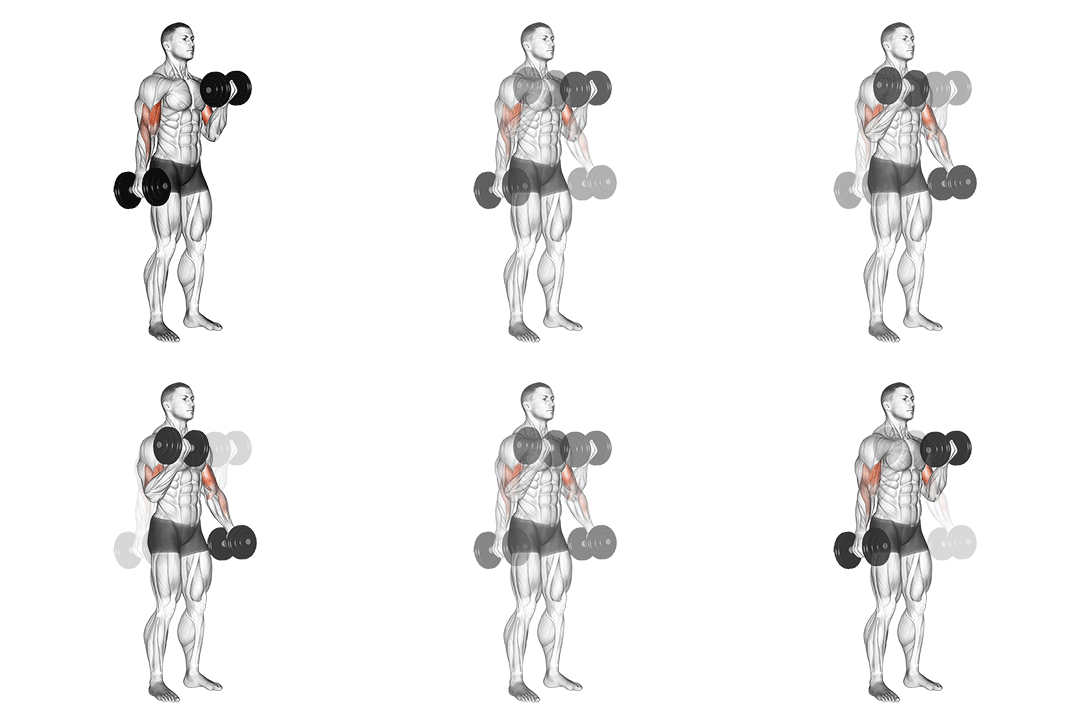
Curl one arm while the other hangs straight, then switch. Each arm gets a short rest between reps, and you can give one side your full attention. Complete the rep on one arm before the other starts to move.
Seated Dumbbell Curl
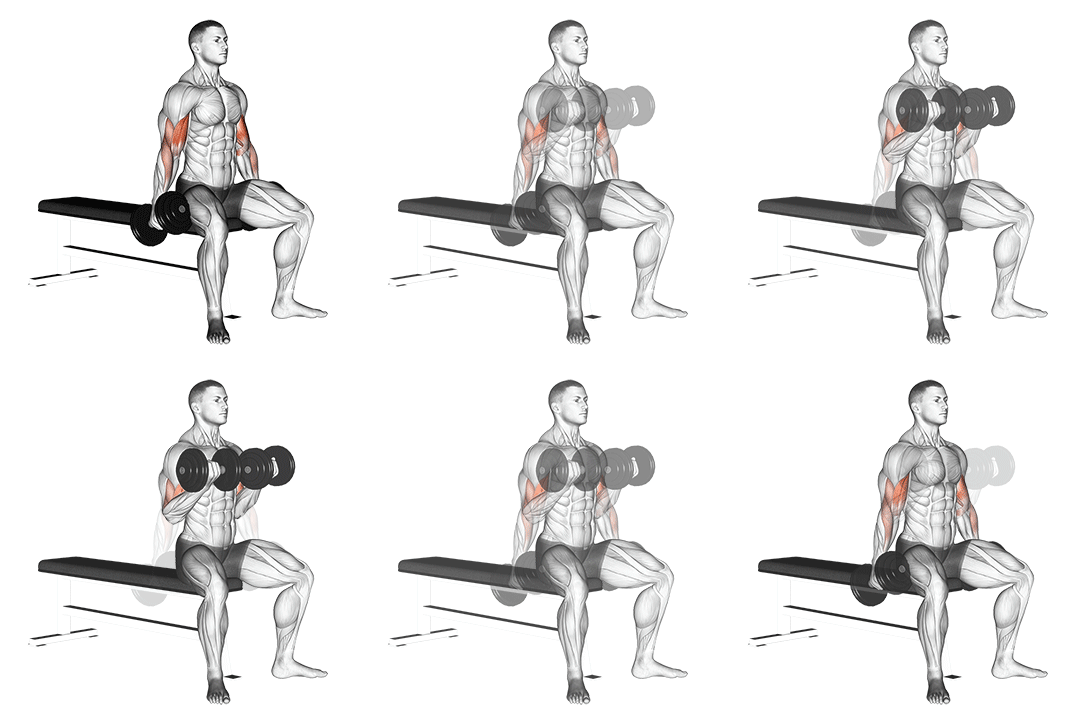
Sit on the end of a bench with your feet flat on the floor. Sitting takes your legs and hips out of the lift, which makes it harder to swing the weights. Use it if your standing curls turn loose as the set goes on.
Incline Dumbbell Curl
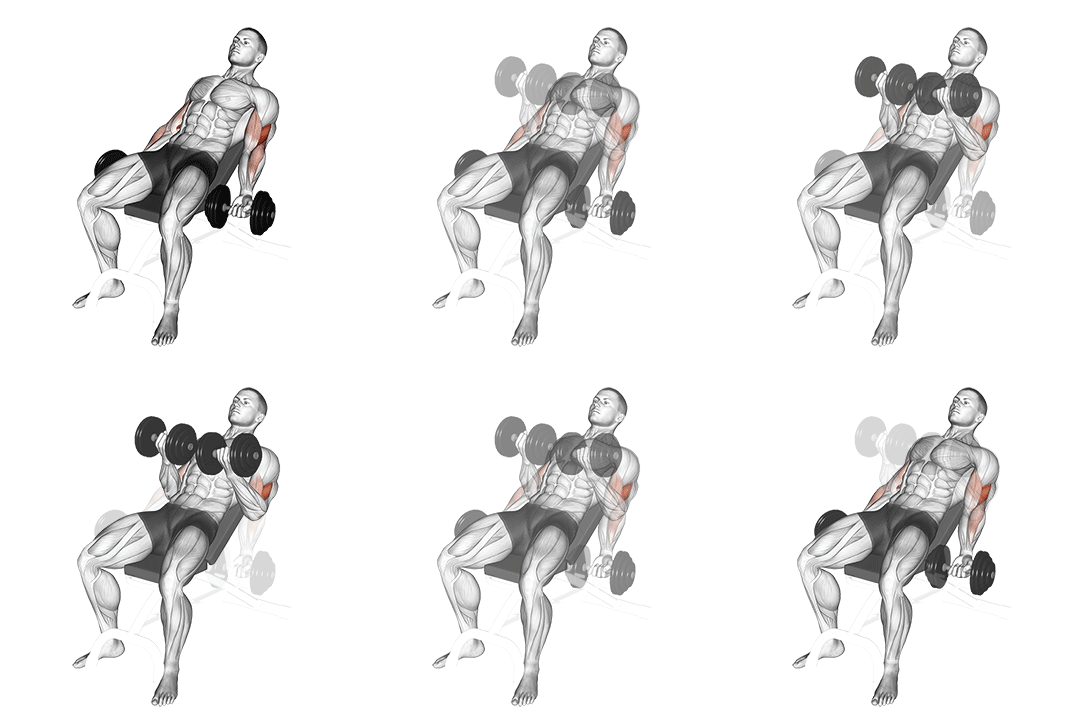
Lie back on an incline bench and let your arms hang straight down behind your body. The biceps starts each rep in a stretched position, and your back stays against the pad, so you cannot lean. Our incline dumbbell curl guide covers the bench angle and setup.
Hammer Curl
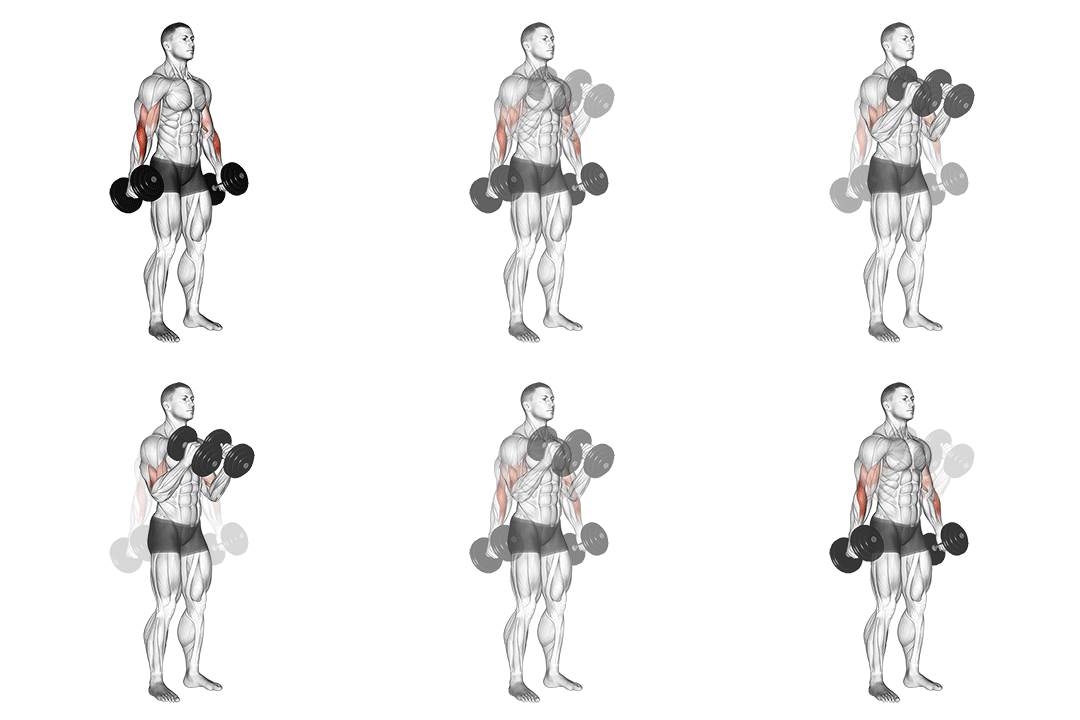
Turn your palms to face each other and curl with your thumbs on top. The biceps works less in this position, so the brachialis underneath it likely takes a larger share. The dumbbell hammer curl pairs well with the palms-up curl in the same workout.
Want to curl one arm with the elbow braced against your thigh? Use the concentration curl. For a longer list, see our biceps curl variations. No dumbbells to hand? Our dumbbell bicep curl alternatives page lists swaps by equipment.
Dumbbell Curl Sets and Reps
| Goal | Sets | Reps | Rest |
|---|---|---|---|
| Strength | 3-4 | 6-8 | 2-3 min |
| Hypertrophy | 3-4 | 8-12 | 1-2 min |
| Endurance | 2-3 | 12-15 | 30-60 sec |
Muscle can be built across a wide range of loads (Schoenfeld et al., 2021), so the best rep range is the one you can perform strictly. Start with 8 to 12 reps. Sets of 6 to 8 are worth using only when your form holds with the heavier dumbbells. Stop each set with 1 to 2 reps still in reserve.
Choose dumbbells you can curl 12 times with no movement from your hips or shoulders. When every set reaches the top of the range, move up to the next pair. To see how your numbers compare, use our dumbbell curl strength standards and the average curl weight for men and women.
More weekly sets for a muscle generally mean more growth (Schoenfeld et al., 2017), and your biceps also work during rows, pulldowns and chin-ups. Count those sets before adding curls. Plan two curl sessions a week, with a day or more between them.
Do your curls after your back training, or first on an arm day while your biceps are fresh. For ways to pair them with other biceps exercises, see our biceps superset workouts. Training at home? Try this at-home shoulder and biceps workout.
Dumbbell Curl FAQs
Are dumbbell curls enough to build bigger biceps?
Yes, if you train them hard and add reps or weight over time. The curl works all three elbow flexors, and the biceps gets more work from every pulling exercise in your program. A second curl from a different angle, such as the incline curl, adds variety. It is not a requirement.
Why is one arm weaker than the other on dumbbell curls?
Almost everyone has a stronger side, and dumbbells show it because each arm works alone. When you alternate, start every set with the weaker arm and stop both arms at the number of reps it manages. Do not add extra sets for the weaker side at first. Matching the reps is usually enough.
Why do I feel dumbbell curls in my forearms?
The brachioradialis and the gripping muscles of the forearm work in every curl, so some effort there is normal. If your forearms give out before your biceps, check that your wrists are straight and that you are not squeezing the handles harder than you need to. Dumbbells that are too heavy cause the same problem.
Can you do bicep curls every day?
You can, but it is not the fastest way to grow. More weekly sets build more muscle (Schoenfeld et al., 2017), but hard sets need recovery time. Two sessions a week leaves room for that.
Are dumbbell curls good for beginners?
Yes. The movement is simple, the weights are light and there is little that can go wrong if you stay strict. Begin with dumbbells you can curl 12 times, and learn to keep your elbows still before you add weight.
References:
Coratella, G. et al. (2023). Biceps brachii and brachioradialis excitation in biceps curl exercise: Different handgrips, different synergy. Sports, 11(3), 64. PubMed
Oliveira, L.F. et al. (2009). Effect of the shoulder position on the biceps brachii EMG in different dumbbell curls. Journal of Sports Science and Medicine, 8(1), 24-29. PubMed
Marcolin, G. et al. (2018). Differences in electromyographic activity of biceps brachii and brachioradialis while performing three variants of curl. PeerJ, 6, e5165. PubMed
Schoenfeld, B.J. et al. (2021). Loading recommendations for muscle strength, hypertrophy, and local endurance: A re-examination of the repetition continuum. Sports, 9(2), 32. PubMed
Schoenfeld, B.J. et al. (2017). Dose-response relationship between weekly resistance training volume and increases in muscle mass: A systematic review and meta-analysis. Journal of Sports Sciences, 35(11), 1073-1082. PubMed
Interested in measuring your progress? Check out our strength standards for Dumbbell Curl, and more exercises.