
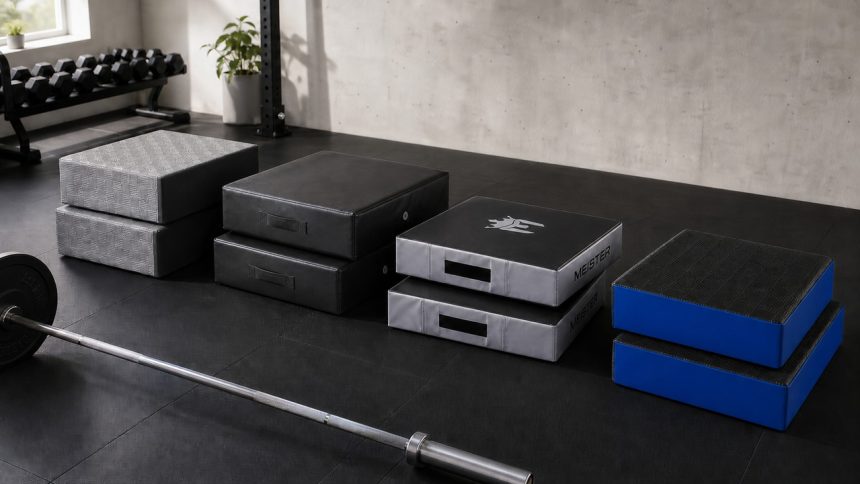
8 Best Weightlifting Crash Pads of 2026 for Home Gyms
Eight weightlifting crash pads compared by stated size, nominal thickness, pair format, portability, noise-control intent, and the floor and technique limits every home lifter should understand.
Weightlifting crash pads can make a home gym more considerate of the people and surfaces around it. They are not a permission slip to throw a loaded bar wherever it lands. The useful pair is wide enough for the plates, thick enough for the intended controlled contact, stable on the floor, and easy to position before every set. The wrong pair can change your pulling height, drift apart, crowd a lifting lane, or hide a floor problem until it becomes expensive.
Start with the job, not the marketing language. A lifter who needs a compact pair for controlled deadlift returns has different needs from someone protecting a garage slab under occasional bar contact. A 6-inch pad creates a noticeably higher landing and starting surface than a thin rubber mat. That can be helpful for some pulls, but it also changes the exercise. It is not the same thing as a full lifting platform, and it is not a substitute for sound technique, bumper plates, collars, a clear drop zone, or a floor that is suitable for loaded training.
Fitness Volt’s home gym safety checklist is the right starting point for floor condition, walkways, and equipment inspection. Pair it with our home gym essentials guide when deciding whether pads, better flooring, a rack, or a barbell upgrade is the next useful purchase. If you are still selecting the bar itself, see our best Olympic barbells guide.
Short on time? The Philosophy Gym 24 x 30 x 6-inch Crash Drop Pads are the clearest all-around pick in this group. The listing specifies a set of two and gives the working dimensions, so a buyer can plan both plate coverage and the nominal 6-inch height change before checkout.
Our Verdict
Philosophy Gym Weightlifting Crash Drop Pads
A two-pad, 24 x 30 x 6-inch option with the clearest stated dimensions in the group. It is the strongest starting point for a home lifter who wants to plan plate coverage, storage, and the changed bar height before buying.
Best for: Home-gym lifters who want a stated 24 x 30-inch landing area and understand that 6-inch pads alter the pull height
Check Price on AmazonCrash Pads Are Not Just Thick Floor Mats
A crash pad is designed to sit under each end of a loaded bar. The pair format matters because both plates need a level, consistent landing surface. A general floor mat can help with scuffs and grip, but it rarely supplies the depth, sidewall structure, and separate landing zones of a crash-pad pair. Conversely, a crash pad cannot correct an uneven slab, replace a platform, or make an unsafe drop safe.
Thickness is the first number to take seriously. A pair marked 6 inches raises the bar’s nominal plate-contact point by about 6 inches before any compression. On a conventional deadlift, that moves the starting position and can turn the setup into a partial-range pull. On an Olympic lift, the landing can be affected by pad movement, plate rebound, bar direction, and whether both ends contact at the same time. Measure the pad height after it is positioned and use the same setup on both sides. Do not guess from a product photo.
The next question is usable landing area. A 20 x 20-inch pad can be easy to carry and store, but leaves less room for a plate to land squarely than a 24 x 30-inch pad. Smaller dimensions are not automatically unsafe; they simply demand more exact placement and less tolerance for a bar that travels. The selected titles do not publish a consistent foam-density or compression test, so no pad here earns credit for a claimed long-term rebound or settling performance. Inspect a new pair under light controlled loading, check the seams and handles regularly, and stop using it if the landing surface becomes uneven or damaged.
Weightlifting Crash Pads at a Glance
| Product | Recorded price | Stated size or feature | Best fit | |
|---|---|---|---|---|
| Philosophy Gym Crash Drop Pads | $119.99 | Pair, 24 x 30 x 6 in. | Planned home-gym landing area | Check Price |
| Titan Fitness HeftyGrip Silencer Pads | $189.99 | Set, 6 in., HeftyGrip | Buyers who want a stated 6-inch set | Check Price |
| Meister Crash Pad Pair | $179.99 | Pair format | Brand-led drop-pad shopper | Check Price |
| PRx Performance Weight Plate Crash Pads | $239.99 | Sound dampening and bar protection stated | Premium brand shoppers who confirm dimensions | Check Price |
| Wintogo Deadlift Silencer Pads | $95.99 | Pair, 20 x 20 x 6 in. | Compact, portable pair | Check Price |
| Foilswirl Weightlifting Crash Pads | $89.99 | 2-pack, 20 x 20 x 6 in., PVC cover | Compact 6-inch pad pair | Check Price |
| Colaxi Crash Pads | $39.49 | 50 x 33 x 4 cm, nonslip and shock-absorbing stated | Low-cost compact pair | Check Price |
| Menolana Crash Drop Pads | $28.09 | 2-pack, 40 x 33 x 4 cm | Smallest budget setup | Check Price |
Prices are the August 11, 2026 snapshot before tax and shipping. Dimensions, pack quantity, material references, and other stated features are taken from the selected product listings. Confirm the live listing, complete dimensions, warranty, and current compatibility before buying.
Eight Weightlifting Crash Pad Picks
1. Best Overall: Philosophy Gym Weightlifting Crash Drop Pads

Philosophy Gym Weightlifting Crash Drop Pads, Set of 2
Best OverallA dimensionally clear pair for a home lifter who needs to plan plate coverage and a nominal 6-inch bar-height change before setting up a lifting lane.
Pros
- Set of two is explicitly stated
- 24 x 30 x 6-inch dimensions make planning easier
- Larger stated surface than 20 x 20-inch compact options
Cons
- 6-inch thickness changes the nominal pull height
- Foam density and compression data are not stated in supplied listing
Philosophy Gym takes the top spot because the title gives the most useful information for an actual room: two pads, 24 inches by 30 inches, and 6 inches thick. The 24 x 30-inch surface gives a more forgiving stated landing area than the compact 20 x 20-inch options. It is still essential to measure your plates, not simply assume that the larger rectangle fits every training style.
The 6-inch specification is a benefit only when you want that height. It can be useful for controlled pulls where an elevated start is intentional, but it should not accidentally redefine your usual deadlift. Position the pads square to the bar, check that both are on the same floor surface, and use a tape measure to verify their height after any compression. Use the setup as a variation, not an invisible add-on.
Skip this if: you need the smallest possible pair to move after each session or you want the lowest checkout price. Wintogo and Foilswirl offer stated 20 x 20 x 6-inch pairs for less, but their smaller landing area leaves less positioning margin.
2. Best 6-Inch Set for Grip-Minded Handling: Titan Fitness HeftyGrip Silencer Pads

Titan Fitness Silencer Drop Pad Set, 6-Inch HeftyGrip
Best 6-Inch SetA named 6-inch silencer-pad set for buyers who prefer Titan's HeftyGrip format and will confirm the actual pad footprint before committing a home-gym lane to it.
Pros
- Set format is explicit
- 6-inch thickness is stated
- HeftyGrip name signals a handling-focused feature
Cons
- Higher recorded price than the dimensioned Philosophy Gym pair
- Full dimensions and foam specification need live-listing confirmation
Titan’s listing is clear on two fundamentals: this is a set, and it is 6 inches thick. The HeftyGrip name gives the product a distinct handling identity, which can matter when pads need to be lifted from a shelf, carried to a driveway, or repositioned between movements. The listing title does not establish the full length and width, however, so it cannot displace Philosophy Gym as the easiest-to-plan option.
At $189.99 in this snapshot, Titan is an investment rather than a default. Before buying, calculate the complete working zone: pad footprint, bar length, plate diameter, and enough room to walk around the loaded bar. The pad cannot live half under a rack foot, along a sloped garage threshold, or in a narrow lane where a plate can strike a wall.
Skip this if: you need stated surface dimensions before you can decide. Choose Philosophy Gym for an explicitly 24 x 30-inch pair, or compare the Wintogo and Foilswirl compact alternatives when portability is the main requirement.
3. Best Straightforward Pair: Meister Crash Pad Weight Lifting Drop Pads

Meister Crash Pad Weight Lifting Drop Pads, Pair
Best Straightforward PairA dedicated crash-pad pair for a buyer who values a simple, purpose-specific format but will check current measurements and materials before deciding whether it fits the room.
Pros
- Explicit pair format
- Dedicated weightlifting crash-pad product
- Simple purpose avoids mat-versus-pad confusion
Cons
- Dimensions are not stated in supplied title
- Recorded price is above several more fully dimensioned options
Meister is a dedicated pair rather than a generic gym mat. That gives it a cleaner buyer fit than products whose title tries to cover every exercise category. The limitation is equally clear: the supplied listing title does not provide the dimensions, thickness, or material details that decide whether the pads can sit under your plate diameter and still leave a clear working lane.
This makes Meister a product to verify, not one to buy on brand recognition alone. Open the current listing and note the complete pad length, width, thickness, handle placement, cover material, and care instructions. Then put tape on the floor at the listed dimensions. It is a fast way to see whether your bar and plates can land centered without forcing the pads against a wall or rack.
Skip this if: you want the article’s most complete dimensional disclosure at purchase time. Philosophy Gym supplies a 24 x 30 x 6-inch title, while Wintogo and Foilswirl supply 20 x 20 x 6-inch titles for materially less.
4. Best Premium Brand Option: PRx Performance Weight Plate Crash Pads

PRx Performance Weight Plate Crash Pads
Best Premium Brand OptionA premium-priced crash-pad option for a PRx Performance buyer who confirms the exact dimensions, pair contents, and setup requirements before paying more than the more clearly specified alternatives.
Pros
- Listing states sound-dampening and bar-protection intent
- Purpose-built for home-gym barbell use
- PRx Performance product identity
Cons
- Highest recorded price in this comparison
- Dimensions and pack details are not stated in supplied title
PRx Performance calls these weight plate crash pads and identifies sound dampening and bar protection as the goal. That is the right kind of intent for a home gym where the question is controlled impact, not merely avoiding scuffs. Still, intent is not a measurement. The supplied title does not state the size, thickness, foam density, or number of pads in the purchase, and the $239.99 snapshot is the highest in this lineup.
Consider PRx only once the live listing answers those basic questions. You want the width to match your plates, a pair if both ends of the bar need support, and an inspection path for the cover, seams, handles, and base. A premium name does not cancel the recurring checks that all protective pads need after a hard session.
Skip this if: you need the best information-to-price ratio. Philosophy Gym costs $120 less in this snapshot and states its pair format and 24 x 30 x 6-inch size.
5. Best Compact Portable Pair: Wintogo Deadlift Silencer Drop Pads

Wintogo Deadlift Silencer Drop Pads, Pair
Best Compact Portable PairA compact two-pad option for a home gym that needs 6-inch pads to be stored or moved after training, provided 20 x 20 inches gives each plate enough landing margin.
Pros
- Pair, 20 x 20 x 6-inch size is stated
- Portable and compact positioning is stated
- Recorded price stays below $100
Cons
- Smaller stated landing area than Philosophy Gym
- 6-inch height still alters the nominal pull height
Wintogo presents a very clear compact proposition: a pair measuring 20 x 20 x 6 inches that is easy to store and carry. For a garage that also parks a car or a multipurpose room that changes use, that portability matters. The tradeoff is the 20 x 20-inch surface. It demands precise bar centering and may be less forgiving with a large plate diameter or a bar that does not settle straight down.
Use the compact footprint as a cue to be more exacting, not more casual. Lay both pads parallel, leave a visible buffer between the plate edge and pad edge, and confirm the pads do not slide when you set down an unloaded bar. A pair that shifts in a light setup should not be asked to manage a heavy one.
Skip this if: your plates or training style need a larger stated contact area. The 24 x 30-inch Philosophy Gym pair offers more room on paper for $24 more in this price snapshot.
6. Best Compact PVC-Cover Pair: Foilswirl Weightlifting Crash Pads

Foilswirl 2-Pack Weightlifting Crash Pads with PVC Leather Cover
Best Compact PVC-Cover PairA compact, explicitly two-pad 6-inch set with a stated PVC leather cover for buyers who want a clear small-footprint option and will inspect it regularly for wear.
Pros
- Two-pad pack and 20 x 20 x 6-inch size are stated
- PVC leather cover is stated
- Lower recorded price than Wintogo's similar-size pair
Cons
- Small landing footprint needs careful plate centering
- Cover material alone does not establish foam density or drop rating
Foilswirl is the comparison’s lower-cost compact 6-inch option. The title gives the most important setup facts: two pads, 20 x 20 inches, 6 inches thick, with a PVC leather cover. That makes it easier to evaluate than a vague “silencer” claim. It costs $6 less than Wintogo, although the right choice may still come down to the current listing’s detailed photos, handles, and return terms.
A cover material is not a complete durability rating. Check the stitching, zipper or closure areas, corners, handles, and bottom surface before first use. Clean away grit that can abrade the cover, do not drag it across rough concrete, and do not use a damaged pad in a barbell landing zone. The exact foam density and long-term compression behavior are not supplied in the title, so they should not be invented into the decision.
Skip this if: you want more surface area than 20 x 20 inches. Philosophy Gym is the larger-surface choice, while the small Menolana and Colaxi options are better understood as budget compact pads, not direct replacements for a 6-inch pair.
7. Best Low-Cost Compact Pick: Colaxi Weightlifting Crash Pads

Colaxi Weightlifting Crash Pads, 50 x 33 x 4 cm
Best Low-Cost Compact PickA low-cost, 4-centimeter compact crash-pad choice for controlled home-gym floor contact, not a substitute for a full platform or a proof of suitability for every loaded drop.
Pros
- 50 x 33 x 4-centimeter size is stated
- Nonslip and shock-absorbing positioning are stated
- Under-$40 recorded price
Cons
- Smaller and thinner stated format than 6-inch picks
- Exact foam density and weight-use limit are not stated in supplied title
Colaxi is the strongest low-cost choice because it gives an actual size, 50 x 33 x 4 centimeters, rather than relying only on a broad product label. The title also describes it as nonslip and shock absorbing. Those are useful design intentions, but not a published load limit, foam-density test, or permission to use it for any kind of bar drop.
The 4-centimeter thickness is much lower than the 6-inch picks above. That can mean a smaller change to the pull height, but it is not automatically equal to a thicker pad for impact management. Plan for controlled contact, use appropriate plates and a sound floor, and judge the real setup after light, deliberate reps. A thin pad can help buffer a contact point while still being inadequate for repeated high-energy drops.
Skip this if: you specifically want a stated 6-inch pair or larger named landing area. Wintogo, Foilswirl, Philosophy Gym, and Titan serve that planning need more directly.
8. Best Smallest Budget Pair: Menolana Crash Drop Pads

Menolana 2X Weightlifting Crash Drop Pads, 40 x 33 x 4 cm
Best Smallest Budget PairThe least expensive two-pad option here for a highly controlled, compact home setup, but its small stated dimensions demand the most careful fit and placement checks.
Pros
- Two-pad format is stated
- 40 x 33 x 4-centimeter dimensions are stated
- Lowest recorded price in the comparison
Cons
- Smallest stated landing area in the lineup
- No foam-density, load-limit, or long-term compression details in supplied title
Menolana is the lowest-priced selected option and its title makes the small format plain: two pads at 40 x 33 x 4 centimeters. That can work only when your plates have enough room to land fully on the pad with a comfortable buffer. The smaller rectangle makes it less suitable as a default recommendation for a wide lifting lane or for a lifter who wants generous placement tolerance.
At $28.09, it is tempting to read this as a cheap answer to floor protection. Resist that shortcut. Confirm the purchase includes the two pads described, check the live measurements against your plates, and inspect the nonslip contact surfaces before use. If your normal bar path is not reliably controlled, solve that technique and setup issue first rather than asking a small pad to catch it.
Skip this if: your main goal is maximum sound control, large plate coverage, or a listed 6-inch format. This is a compact budget choice, not a platform replacement.
Products We Do Not Recommend for Most Heavy Drop Training
The compact Colaxi and Menolana pads are not poor products simply because they rank lower. They are poor defaults for lifters looking to accommodate uncontrolled, frequent, or high-energy bar drops. Their titles state small 4-centimeter formats and do not provide a load limit, foam-density specification, or long-term compression test. The PRx Performance pads also are not a default value choice at $239.99 when the selected listing title leaves key size and pack details unanswered. In every case, a full platform, proper bumper plates, coaching, and a clear lifting area matter more than trying to upgrade a marginal setup with a protective accessory.
How To Buy Crash Pads Without Creating a New Problem
Measure the plate, the pad, and the working lane
Measure your largest plate diameter, then compare it with the pad’s usable top surface. You want the plate to land fully on the pad with a buffer for slight bar movement. Then measure the full working lane: bar length, room for the lifter, space beyond each plate, and a clear way to step away. The pad’s footprint is only the start. The NSCA’s facility checklist emphasizes clear access, properly spaced Olympic bars, maintained protective padding, and unobstructed training areas.
Account for the new bar height
A nominal 6-inch pad changes the bar’s plate-contact height by 6 inches before compression. That affects the setup for deadlifts, pulls, rows, and any movement that begins from the floor. It can be a deliberate partial-range variation, but do not call it your normal floor pull or use it to hide a mobility problem. If you need a specific competition-style bar height, a crash pad is not the appropriate measuring tool. Use a calibrated platform setup and coaching appropriate to the lift.
Choose pair versus single based on the bar, not storage convenience
A loaded bar has two plate ends. Two matching pads make it possible to level those ends and keep the bar path consistent. A single pad or a mismatched pair can create a tilted contact point that changes the pull and makes reracking unpredictable. Before training, position the pads on the same surface, square them to the bar, and confirm they are not sitting on a mat seam, drain, slope, loose tile, or uneven concrete patch.
Inspect foam, cover, seams, and handles
Foam settles and covers wear. Because the supplied listings do not provide a shared laboratory compression metric, practical inspection matters more than inferred performance. Look for a permanent low spot, a torn cover, exposed foam, split seams, loose handles, or a bottom surface that no longer grips. Keep the pads dry, remove grit, and store them flat when possible. Replace a damaged pair instead of rotating the worse pad to the less visible side.
Use pads for controlled contact, not as a license to abandon a bar
Crash pads can help reduce noise and spread contact forces, but they cannot make a bad drop controlled. A dropped bar can move sideways, bounce, roll, or hit the pad edge. Keep people, mirrors, walls, vehicles, benches, and loose equipment out of the lane. Use collars where plates can move, do not train in a cramped corridor, and lower the bar under control when the movement and training environment require it. Fitness Volt’s renter-friendly home gym guide makes the same core point: removable flooring and accessories do not turn an apartment into a lifting platform.
Frequently Asked Questions
Are crash pads a replacement for a weightlifting platform?
No. Pads protect a localized landing area and may dampen some sound, but a platform is a complete stable lifting surface with a defined construction and footprint. Pads do not repair uneven flooring, create a competition-height pull, or eliminate the need for clear space and appropriate technique.
Do 6-inch crash pads change deadlift height?
Yes. A 6-inch pad raises the nominal plate-contact point by roughly 6 inches before compression. That changes the starting position compared with a floor pull. Measure the actual setup and use it as a planned variation.
How large should a crash pad be?
It should be large enough that your loaded plates land fully on the pad with room for normal bar movement. Compare the pad’s usable top surface with the diameter of your largest plates. A 24 x 30-inch pad gives more stated landing area than a 20 x 20-inch pad, but your plates and lift still decide the fit.
Can I use a crash pad with iron plates?
Do not assume any pad makes iron-plate drops appropriate. Read the current manufacturer guidance for the pad, your bar, and your plates, and use controlled lowering unless the complete equipment setup and training environment are designed for the movement. The selected listing titles do not establish universal compatibility or a universal drop rating.
Why do pads move apart during a lift?
They may be on uneven or dusty flooring, too close to a seam, unevenly loaded, or contacted off-center. Reset the lane, clean the floor, test placement with an unloaded bar, and stop using the arrangement if it cannot stay stable. Do not wedge the pads against walls or rack feet to stop movement.
How often should crash pads be inspected?
Check their placement before each barbell session and inspect covers, seams, handles, and the landing surface routinely. Replace a pad that is torn, permanently uneven, saturated, or slippery. Protective padding is equipment, not decoration.
Bottom Line
Philosophy Gym Weightlifting Crash Drop Pads are the best overall choice because the listing specifies a two-pad, 24 x 30 x 6-inch format, making it easier to plan the landing area and height change. Titan and Meister are purpose-built alternatives for buyers who confirm their live-listing measurements, while Wintogo and Foilswirl make the compact 20 x 20 x 6-inch lane clear. Colaxi and Menolana are lower-cost options for controlled, compact use, not a shortcut around poor flooring or barbell technique. Choose the pad only after measuring your plates, work area, nominal height change, and storage path.
Sources
- Fitness Volt. Home Gym Safety Checklist: What to Bolt, Pad, Lock, and Never DIY.
- National Strength and Conditioning Association. NSCA Safety Checklist for Exercise Facility and Equipment Maintenance.
- National Strength and Conditioning Association. Setting Up a Home Gym Facility.
- National Strength and Conditioning Association. Anaerobic and Muscle Endurance Development: Lifting Guidelines.