You’d be hard-pressed to find a bodybuilder who doesn’t know that they need to consume protein for muscle repair and growth. That’s why so many lifters are religious users of protein powders.
Intense training is highly catabolic. That means it causes microtrauma to your muscles which results in tissue breakdown. Your body needs protein to fuel anabolism, which is when your body super compensates after your workout and your muscles bounce back bigger and stronger.
While opinions vary, evidence indicates that most bodybuilders need about two grams of dietary protein per kilo of body weight, which equates to about one gram per pound. You can determine your ideal protein using our handy protein calculator.
Protein is your primary source of amino acids. Think of these substances as the building blocks of life. When you eat protein, your body breaks it down into its constituent amino acids so it can use them as required.
There are 20 amino acids, all of which play a critical role in your metabolism. However, they’re also divided into groups.
In this article, we take a look at Essential Amino Acids (EAAs) and Branched-Chain Amino Acids (BCAAs), revealing their functions, differences, and how to make sure you’re getting enough of what you need for muscle repair and growth.
What Are EAAs?
Essential Amino Acids, there are 20 amino acids in total. These organic compounds make up the “protein alphabet.” When you eat a high-protein food, your body breaks it down into individual amino acids, then reorders and restructures them to meet your metabolic needs. This could be for muscle growth, renewing skin cells, immunology, energy, hormones, or many other biological processes.
In many ways, this is like an anagram word game. Your body takes the amino acids in your food, e.g., fish, and turns them into something else, e.g., muscle tissue. Amazing, right?!
Broadly speaking, amino acids fall into two groups – essential (EAAs) and non-essential. The essential aminos are so-called because your body cannot manufacture them, and you must obtain EAAs from food.
There are nine essential amino acids:
- Phenylalanine
- Valine
- Threonine
- Tryptophan
- Methionine
- Leucine
- Isoleucine
- Lysine
- Histidine
The EAAs are present in all complete protein foods. In fact, that’s what defines a complete protein – a food that contains all nine essential acids. Examples of complete protein foods include meat, fish, eggs, dairy, and soy. EAAs are also available in supplement form.
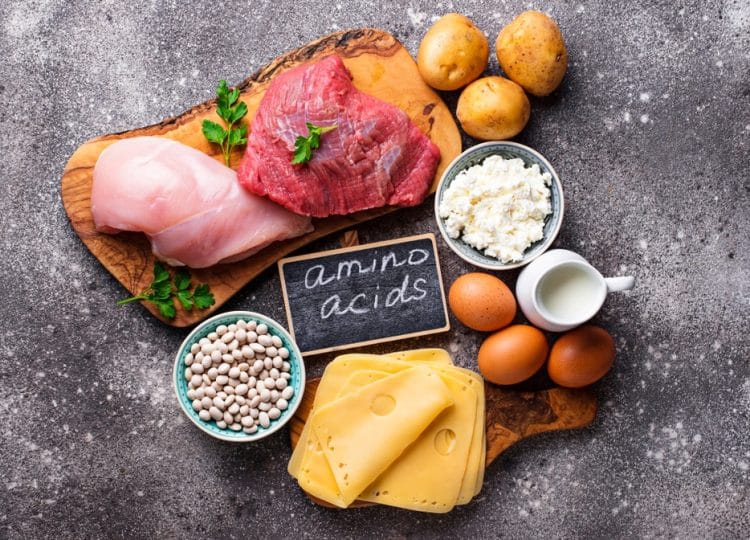
It’s also possible to get all the essential amino acids from combinations of incomplete proteins, which are plant foods deficient in one or more of the EAAs.
For example, most grains are deficient in the amino acid lysine, while nuts and pulses contain it in abundance. However, nuts and pulses are usually low in tryptophan, methionine, and cystine, but those amino acids are found in grains. Put these two types of food together, and they overlap, filing in one another’s amino acid gaps.
Consuming grains with nuts or pulses makes something called complementary proteins. When you combine them, you get all of the nine essential amino acids. They literally complement one another. This is how vegetarian and vegan bodybuilders can make sure they’re getting enough protein, despite not eating meat, fish, eggs, etc.
EAAs earn their essential name for another reason; your body needs them so it can manufacture the remaining 11 non-essential amino acids. Without sufficient EAAs, your body would not be able to make the non-essentials.
Related: Whey Vs. Beef Protein – Which is Best?
What are BCAAs?
BCAAs (branched-chain amino acids) are so-called because of their branched structure. There are three BCAAs, all of which are also essential amino acids. Your muscles contain an abundance of BCAAs, and they’re heavily catabolized during intense workouts.

The three BCAAs are:
- Leucine
- Isoleucine
- Valine
The branched structure of BCAAs means that broken down quickly. Unlike almost every other amino acid and nutritional compound, BCAAs do not pass through your liver. Instead, bypass the liver and go straight to your muscles, where they are used for energy and tissue repair.
BCAAs are often used for their muscle-sparing effect. For example, they could reduce catabolism when training in a fasted state, such as early morning cardio for cutting/fat loss (1).
BCAA supplements have long been popular in bodybuilding. They’re added to pre-workouts to allow lifters to train harder and longer and used after training to speed up recovery (2). Whey protein contains lots of BCAAs. There are also isolated BCAA supplements that contain just leucine, isoleucine, and valine.
EAAs vs. BCAAs
Firstly, it’s essential to understand that BCAAs are EAAs. They’ve just been separated from the other nine. So, if you eat meat, fish, eggs, etc., or consume complementary proteins, you are already getting both BCAAs and EAAs.
That said, BCAAs are a popular supplement, and EEAs supplements are becoming more widespread. As such, it may be helpful to compare these two types of products.
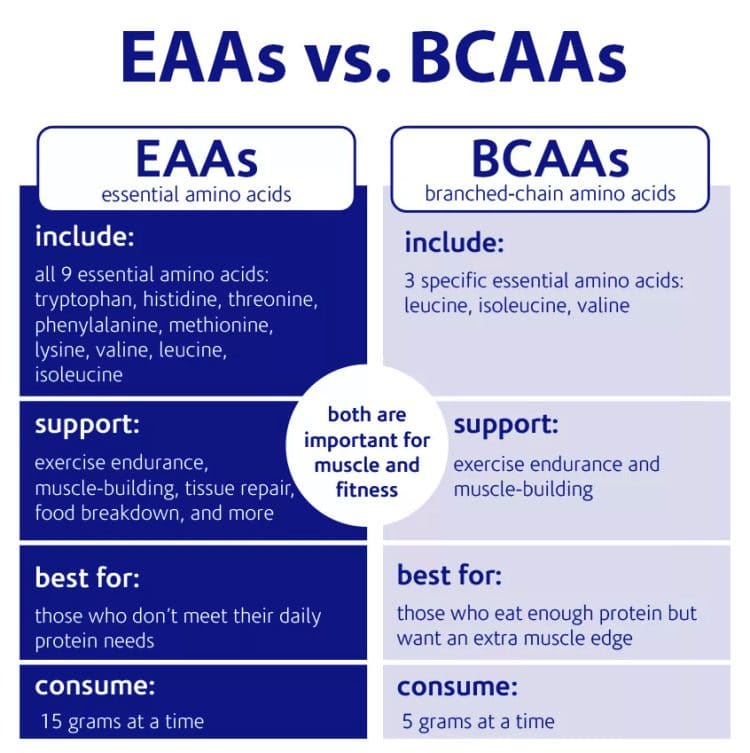
While some studies suggest that using BCAAs can be beneficial, others indicate that the BCAAs may work better when taken alongside the other EAAs. For example, it seems that the essential amino acids are more potent when they’re consumed together, rather than taking leucine, isoleucine, and valine on their own (3).
In fact, the same research suggests that taking BCAAs alone could actually be mildly catabolic because, when taken in isolation, they pull amino acids away from other sources.
While it’s highly unlikely that using BCAAs will cause muscle loss, it does mean that BCAAs may not be as effective as once thought, and EAAs are a better choice (4).
Does this mean that BCAAs are a waste of money or that they’re ineffectual? Certainly not! But evidence is emerging that EAAs could be marginally superior for stimulating muscle protein synthesis (MPS), which means they may be preferable, especially after exercise (5).
It’s worth noting that whey protein is already high in EAAs, so taking an EAA supplement may be unnecessary if you already chug down a protein shake or eat high-protein foods shortly after training.
In fact, in order of potency, the best post-exercise nutritional choices are:
- Complete protein foods
- Whey protein
- EAAs
- BCAAs
- Nothing
Wrapping Up
It’s an inescapable fact that you need to consume adequate protein to fuel hypertrophy. That’s because protein contains amino acids, which your body uses as building blocks for muscle repair and growth. Inadequate protein means fewer amino acids for hypotrophy and slower progress.
Amino acid supplements are popular as they provide a concentrated, fast-acting dose of the raw materials your muscles need. BCAAs are widely used, but EAAs are gaining popularity. Studies indicate that EAAs are potentially more effective than isolated BCAAs.
However, if you consume enough high-protein foods and use whey protein powder, you’re probably getting all the amino acids you need. After all, these foods contain both EEAs and BCAAs. Acid amino acid deficiencies by eating enough high-protein foods, and consuming around two grams of protein per kilogram of bodyweight.
Taking amino acids after training may enhance recovery. It could also reduce post-exercise muscle soreness (6). Still, you can easily get these substances from real food instead of supplements if you prefer.
That said, if you find it impractical to eat after training, a whey protein shake or an EEA supplement could help kickstart the recovery process until you’ve got time to consume a solid, high-protein meal.
Remember, though, there is no rush to consume amino acids/protein within the so-called anabolic window. That’s because you’ve got several hours to feed your muscles, and not just the 30 minutes that many people believe.
References:
1- PubMed: Effects of Supplementation of Branched-Chain Amino Acids to Reduced-Protein Diet on Skeletal Muscle Protein Synthesis and Degradation in the Fed and Fasted States in a Piglet Model https://www.ncbi.nlm.nih.gov/pmc/articles/PMC5295061/
2- PubMed: Branched-Chain Amino Acid Ingestion Stimulates Muscle Myofibrillar Protein Synthesis following Resistance Exercise in Humans https://pubmed.ncbi.nlm.nih.gov/28638350/
3- PubMed: Branched-Chain Amino Acids and Muscle Protein Synthesis in Humans: Myth or Reality https://pubmed.ncbi.nlm.nih.gov/28852372/
4- PubMed: Activation of Mtorc1 by Leucine Is Potentiated by Branched-Chain Amino Acids and Even More So by Essential Amino Acids Following Resistance Exercise https://pubmed.ncbi.nlm.nih.gov/27053525/
5- PubMed: Essential Amino Acids (EAA) Mixture Supplementation: Effects of an Acute Administration Protocol on Myoelectric Manifestations of Fatigue in the Biceps Brachii After Resistance Exercise https://www.ncbi.nlm.nih.gov/pmc/articles/PMC6107748/
6- PubMed: Effect of Branched-Chain Amino Acid Supplementation on Recovery Following Acute Eccentric Exercise https://pubmed.ncbi.nlm.nih.gov/30275356/