Archer Push Up vs Band Bench Press

Compare target muscles, equipment, difficulty, movement type, and secondary muscles for Archer Push Up and Band Bench Press.

Change comparison Share

Get comparison link

Select the link and use your device's Copy command.

Comparison overview

AI-generated
Archer Push Up vs Band Bench Press — two chest-focused compound moves that look similar on paper but load your pecs and stabilizers very differently. You’ll get a direct comparison of primary and secondary muscle activation, equipment needs, difficulty, progression options, and clear technique cues so you can pick the right exercise for your program. I’ll show rep ranges (3–6 for strength, 6–12 for hypertrophy), joint angles and force-vector differences, plus simple progressions and safety tips so you can train smarter and protect your shoulders while maximizing chest growth.

Exercise Comparison

Exercise A
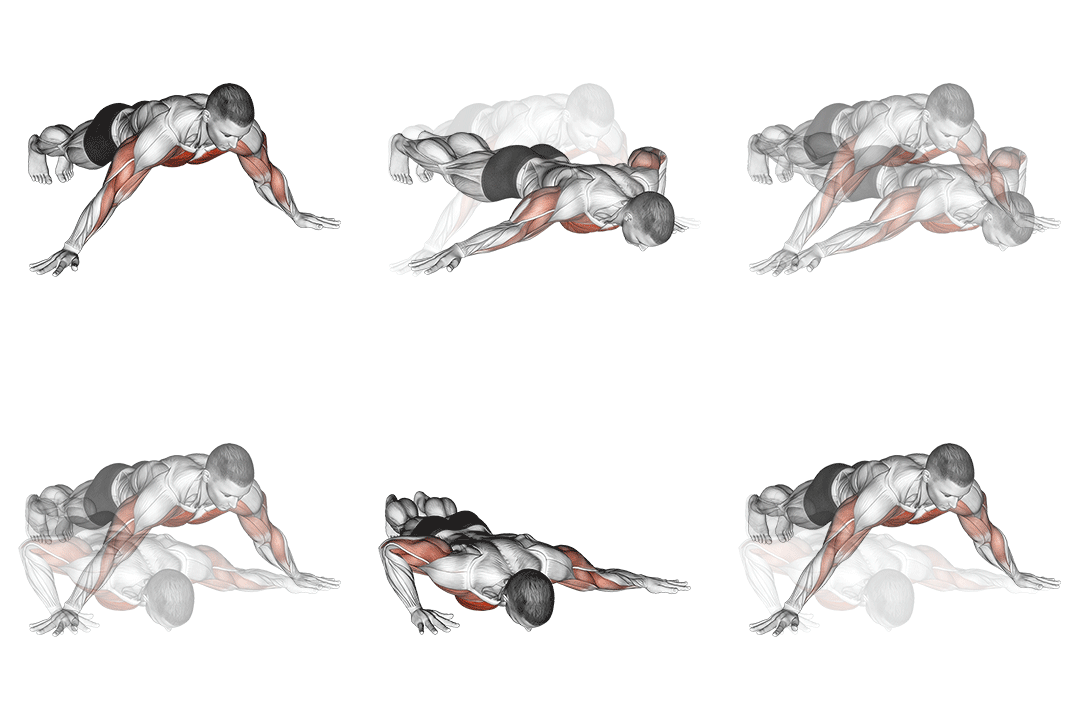
Archer Push Up demonstration

Archer Push Up

Target Pectorals
Equipment Body-weight
Body Part Chest
Difficulty Advanced
Movement Compound
Secondary Muscles
Triceps Shoulders Core
VS
Exercise B
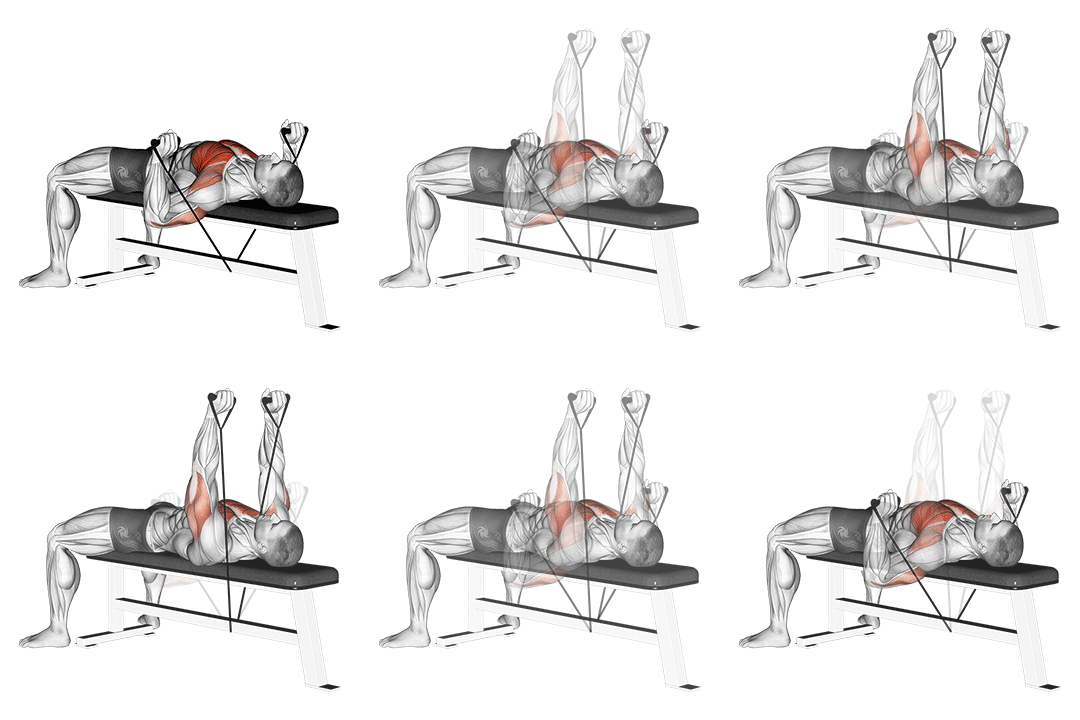
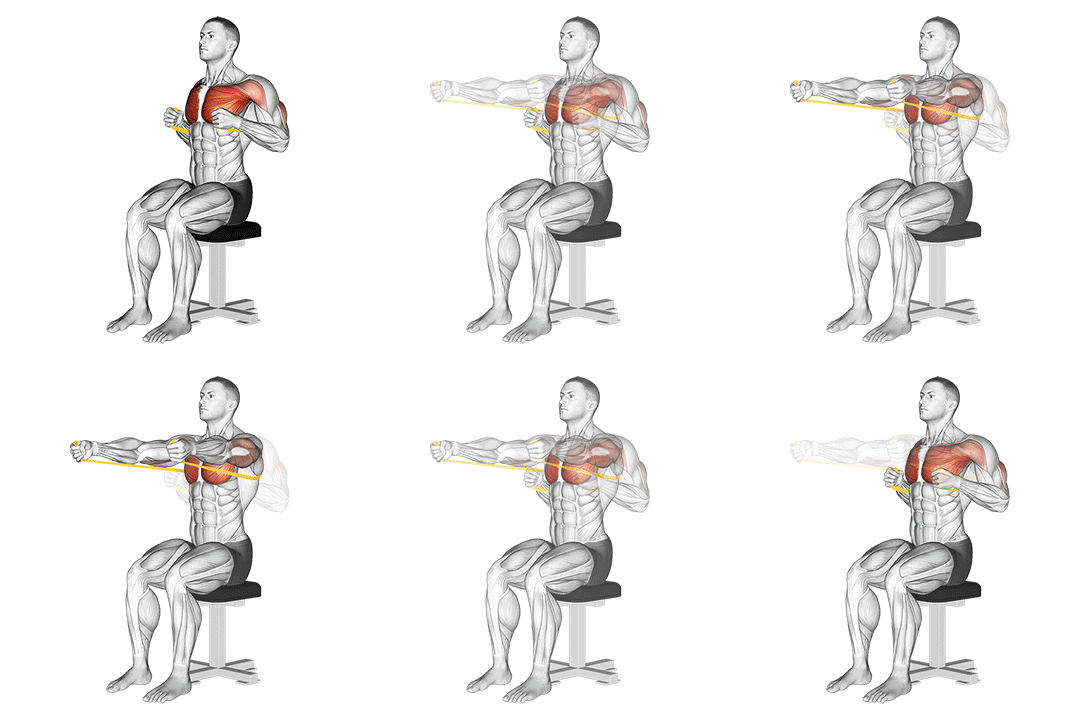
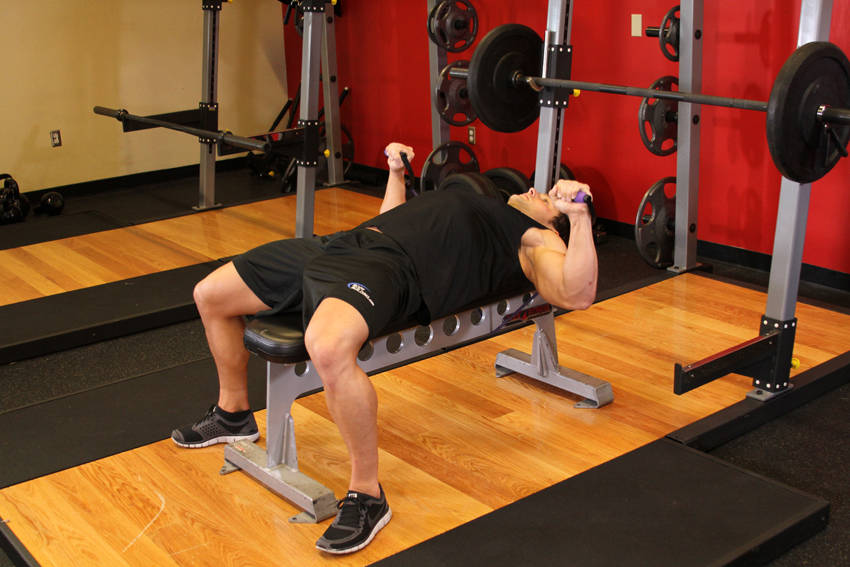
Band Bench Press demonstration

Band Bench Press

Target Pectorals
Equipment Band
Body Part Chest
Difficulty Intermediate
Movement Compound
Secondary Muscles
Triceps Shoulders

Head-to-Head Comparison

Different values are marked. These are catalogue attributes, not performance scores.

Muscles used

Listed target and secondary muscles, shown on the body. Locations, not activation or strength scores.

  • Target
  • Secondary
  • Not highlighted

Archer Push Up

Front
Archer Push Up: front muscle locationsSolid: listed target. Striped: listed secondary. Grey: not highlighted. Locations, not activation or strength scores. See the muscle names below.
Back
Archer Push Up: back muscle locationsSolid: listed target. Striped: listed secondary. Grey: not highlighted. Locations, not activation or strength scores. See the muscle names below.
Target
Pectorals
Secondary
Triceps, Shoulders, Core

Not shown on diagram: Shoulders, Core. These labels do not identify a precise region on this map.

Band Bench Press

Front
Band Bench Press: front muscle locationsSolid: listed target. Striped: listed secondary. Grey: not highlighted. Locations, not activation or strength scores. See the muscle names below.
Back
Band Bench Press: back muscle locationsSolid: listed target. Striped: listed secondary. Grey: not highlighted. Locations, not activation or strength scores. See the muscle names below.
Target
Pectorals
Secondary
Triceps, Shoulders

Not shown on diagram: Shoulders. These labels do not identify a precise region on this map.

Grey does not mean a muscle is unused. The diagrams show only the mapped catalogue labels.

Attribute Archer Push Up Band Bench Press
Target Muscle
Pectorals
Pectorals
Body Part
Chest
Chest
Equipment Different
Body-weight
Band
Difficulty Different
Advanced
Intermediate
Movement Type
Compound
Compound
Secondary Muscles Different
Triceps, Shoulders, Core
Triceps, Shoulders

Visual Comparison

An illustrative 1–10 profile derived from catalog difficulty, equipment, and listed-muscle fields—not measured performance or muscle activation.

Key Differences

  • Equipment differs: Archer Push Up uses Body-weight, while Band Bench Press requires Band.
  • Difficulty levels differ: Archer Push Up is advanced, while Band Bench Press is intermediate.

Muscle comparison

Shared target muscles

Both exercises primarily target the pectoralis major through horizontal adduction of the humerus, with the sternal (mid/lower) head strongly engaged when the arms travel across the torso. The Archer Push Up loads one side more intensely during the concentric phase by shifting the body laterally, increasing unilateral pectoral demand and requiring the working pec to produce both push force and stabilization. The Band Bench Press creates variable resistance: band tension increases through the concentric range, raising load near lockout and emphasizing the mid-to-shortened portion of the pec’s length-tension curve.

Secondary muscle differences

Archer Push Up recruits core and anti-rotational muscles (obliques, transverse abdominis) and the scapular stabilizers (serratus anterior, lower trapezius) far more than the band press due to the wide support base and unilateral leverage. Band Bench Press imposes greater progressive triceps and anterior deltoid demand at lockout because band tension increases as the elbows extend; this shifts some work from stabilizers to prime movers and can raise triceps activation by comparison.

Muscle involvement analysis

Archer Push Up produces a longer time under tension on the working pec during the eccentric and concentric phases because the lever arm increases as you push away from the supportive arm. That increases eccentric load at longer muscle lengths. Band Bench Press follows an ascending resistance curve: lower absolute load near the chest (longer muscle length) and higher load near lockout (shortened length), so peak force occurs at smaller muscle lengths and changes how fiber recruitment scales across the range.

Equipment and setup

Archer Push Up: setup

Archer Push Up: no equipment required — just floor space. You may want a mat for comfort and a raised surface (rings or elevated handles) if you regress or progress the movement.

Band Bench Press: setup

Band Bench Press: one or more resistance bands plus a stable anchor or bench. Bands with known resistance ratings let you quantify load; you can double or stack bands to increase tension.

Access and practicality

Band Bench Press — because you can scale resistance precisely with different band tensions and anchors, and it’s easier for most lifters to modify load than to achieve the raw unilateral strength needed for full Archer Push Ups.

Learning and progression

Learning the movements

Band Bench Press is easier to learn: pressing with a band keeps a familiar horizontal push pattern and stable body position. Archer Push Up requires significant unilateral strength, scapular control, and wrist/shoulder resilience, making the learning curve steeper.

Progression considerations

Band Bench Press offers clearer progression: swap bands to change resistance, increase sets/reps, or pair with barbell work. Archer Push Up progresses via elevated feet, slower tempo, weighted vests, or moving toward one-arm push variations, but incremental load steps are smaller and require more skill.

Limitations and precautions

Archer Push Up carries higher shoulder and wrist stress for inexperienced athletes because of increased lever arm and rotation demands; poor scapular control raises impingement risk. Band Bench Press has lower shoulder shear if you keep elbows at ~30–45° from the torso, though improper anchor setup or snapping bands create hazards.

Pros & Cons

Archer Push Up

+ Pros

  • High unilateral load increases strength and balance between sides
  • Strong core and anti-rotation recruitment enhances stability
  • No equipment required — ideal for bodyweight progressions
  • Builds scapular control and muscular coordination

Cons

  • Very advanced; difficult to scale precisely for progressive overload
  • High wrist and shoulder stress without solid technique
  • Limited maximal external load compared to weighted/ banded presses

Band Bench Press

+ Pros

  • Easy to scale: change bands to alter resistance precisely
  • Variable resistance improves lockout strength by increasing load as you extend
  • Lower technical demand for beginners compared with unilateral bodyweight moves
  • Portable and effective for hypertrophy rep ranges (6–12)

Cons

  • Force curve places less load on the pec at the bottom of the range
  • Band elasticity can change feel and makes exact loading harder to compare to free weights
  • Requires band anchors or bench for optimal setup

When Each Exercise Wins

1
For muscle hypertrophy: Band Bench Press

Band Bench Press is the winner because you can steadily increase resistance and target moderate rep ranges (6–12) with clear progression. The variable tension also increases time under tension near lockout, promoting hypertrophy when paired with controlled eccentrics.

2
For strength gains: Band Bench Press

Band Bench Press allows systematic overload across low-rep ranges (3–6) by stacking heavier bands or combining bands with free weights. While the band’s force curve favors lockout strength, you can still build pressing force more reliably than with a bodyweight-only Archer Push Up.

3
For beginners: Band Bench Press

Band Bench Press is easier to scale and teaches a stable horizontal push pattern with less scapular demand. You can safely manipulate load and elbow angle (~30–45°) to protect the shoulder while building pressing mechanics.

4
For home workouts: Archer Push Up

Archer Push Up wins for minimal equipment — all you need is a floor and space. For experienced trainees it provides heavy unilateral stimulus and significant core work without buying bands or a bench.

Frequently Asked Questions

Can I do both Archer Push Up and Band Bench Press in the same workout?

Yes. Use one as a heavy compound (band bench for low-rep strength sets) and the other as a high-tension accessory or stability finisher. For example, perform band bench 4x4–6, then finish with 3 sets of controlled Archer Push Up or archer negatives for core and unilateral control.

Which exercise is better for beginners?

Band Bench Press is better for beginners because it’s easier to scale load and control mechanics. Keep elbows about 30–45° from the torso and use lighter bands to teach safe pressing before introducing unilateral bodyweight variations.

How do the muscle activation patterns differ?

Archer Push Up increases unilateral pec and core activation due to a longer lever arm and anti-rotation demand, raising eccentric stress at longer muscle lengths. Band Bench Press follows an ascending resistance curve that shifts peak demand toward the shortened muscle lengths near lockout, changing recruitment timing for triceps and anterior delts.

Can Band Bench Press replace Archer Push Up?

Band Bench Press can replace Archer Push Up for hypertrophy and progressive strength work, but it won’t replicate the same unilateral stability and anti-rotational carryover. If you need single-side control or bodyweight skill, keep Archer variations in your program as accessory work.

Comparison Summary

Choose the Band Bench Press if your priority is controlled progression and systematic overload for hypertrophy or measurable strength gains. It scales across rep ranges (3–6 for strength, 6–12 for size), lets you swap band tensions, and reduces technical barriers. Pick the Archer Push Up when you want raw unilateral overload, improved scapular stability, and a demanding core challenge without equipment; use it for skill work, unilateral control, and accessory strength. For most lifters seeking consistent chest progress, the Band Bench Press is the practical daily choice; use Archer Push Ups as a high-skill supplement or conditioning test.

Exercise instructions

Steps from the exercise catalogue. Read the full sequence before starting.

Archer Push Up

  1. Start in a push-up position with your hands slightly wider than shoulder-width apart.
  2. Extend one arm straight out to the side, parallel to the ground.
  3. Lower your body by bending your elbows, keeping your back straight and core engaged.
Read remaining steps for Archer Push Up
  1. Push back up to the starting position.
  2. Repeat on the other side, extending the opposite arm out to the side.
  3. Continue alternating sides for the desired number of repetitions.

Band Bench Press

  1. Lie flat on a bench with your feet flat on the ground and your back pressed against the bench.
  2. Grasp the band handles with an overhand grip, slightly wider than shoulder-width apart.
  3. Extend your arms fully, pushing the bands away from your chest.
Read remaining steps for Band Bench Press
  1. Slowly lower the bands back down to your chest, keeping your elbows at a 90-degree angle.
  2. Repeat for the desired number of repetitions.

Also Compare

Compare another pair

Choose two exercises to see their differences side by side.

Compare Exercises