Barbell Alternate Biceps Curl vs Barbell Curl

Compare target muscles, equipment, difficulty, movement type, and secondary muscles for Barbell Alternate Biceps Curl and Barbell Curl.

Change comparison Share

Get comparison link

Select the link and use your device's Copy command.

Comparison overview

AI-generated
Barbell Alternate Biceps Curl vs Barbell Curl — both target your biceps, but they load the muscle and the nervous system differently. This guide shows you the biomechanics, step-by-step technique cues, equipment needs, and which option best fits goals like muscle growth, strength, or fixing imbalances. You’ll get specific rep ranges, joint angles to watch, and actionable tips to use each exercise safely. Read on to decide which curl to program first in your workouts and when to swap one for the other.

Exercise Comparison

Exercise A
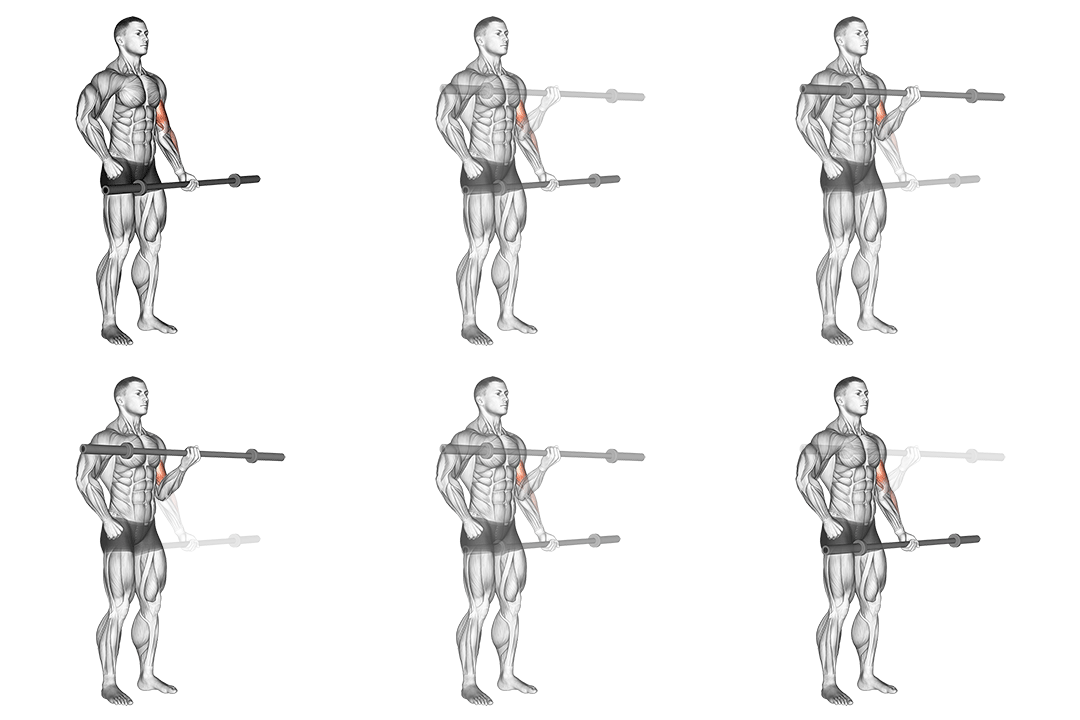
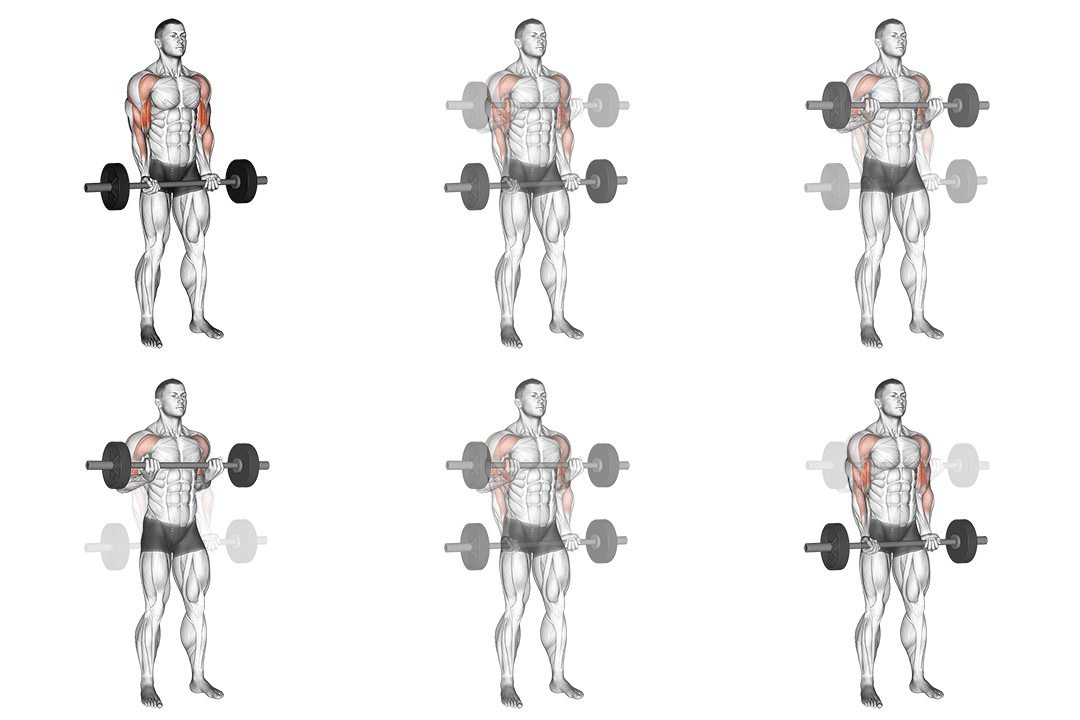
Barbell Alternate Biceps Curl demonstration

Barbell Alternate Biceps Curl

Target Biceps
Equipment Barbell
Body Part Upper-arms
Difficulty Beginner
Movement Isolation
Secondary Muscles
Forearms
VS
Exercise B
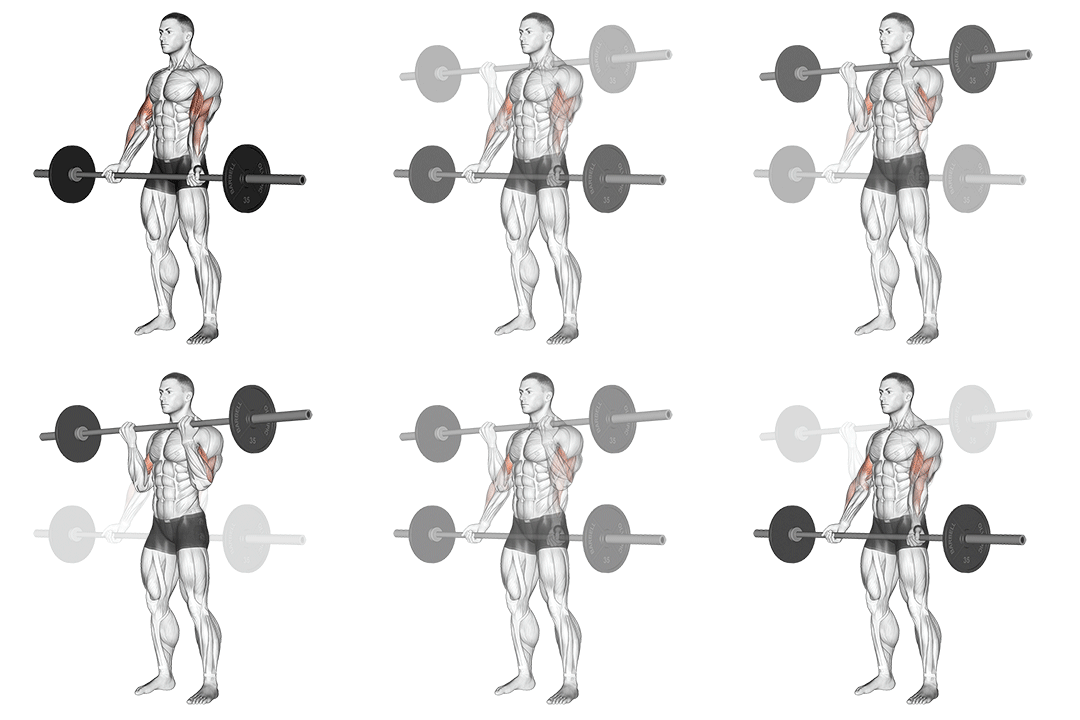
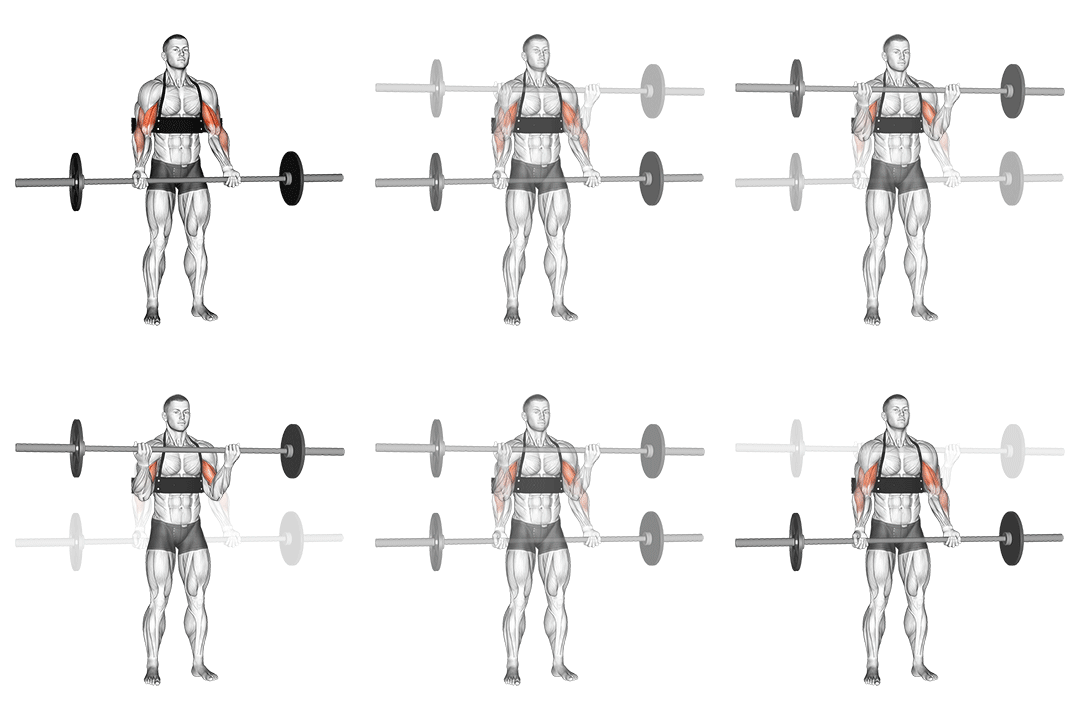
Barbell Curl demonstration

Barbell Curl

Target Biceps
Equipment Barbell
Body Part Upper-arms
Difficulty Beginner
Movement Isolation
Secondary Muscles
Forearms

Head-to-Head Comparison

Different values are marked. These are catalogue attributes, not performance scores.

Muscles used

Listed target and secondary muscles, shown on the body. Locations, not activation or strength scores.

  • Target
  • Secondary
  • Not highlighted

Barbell Alternate Biceps Curl

Front
Barbell Alternate Biceps Curl: front muscle locationsSolid: listed target. Striped: listed secondary. Grey: not highlighted. Locations, not activation or strength scores. See the muscle names below.
Back
Barbell Alternate Biceps Curl: back muscle locationsSolid: listed target. Striped: listed secondary. Grey: not highlighted. Locations, not activation or strength scores. See the muscle names below.
Target
Biceps
Secondary
Forearms

Barbell Curl

Front
Barbell Curl: front muscle locationsSolid: listed target. Striped: listed secondary. Grey: not highlighted. Locations, not activation or strength scores. See the muscle names below.
Back
Barbell Curl: back muscle locationsSolid: listed target. Striped: listed secondary. Grey: not highlighted. Locations, not activation or strength scores. See the muscle names below.
Target
Biceps
Secondary
Forearms

Grey does not mean a muscle is unused. The diagrams show only the mapped catalogue labels.

Attribute Barbell Alternate Biceps Curl Barbell Curl
Target Muscle
Biceps
Biceps
Body Part
Upper-arms
Upper-arms
Equipment
Barbell
Barbell
Difficulty
Beginner
Beginner
Movement Type
Isolation
Isolation
Secondary Muscles
Forearms
Forearms

Visual Comparison

An illustrative 1–10 profile derived from catalog difficulty, equipment, and listed-muscle fields—not measured performance or muscle activation.

Key Differences

  • Both exercises target the Biceps using Barbell. The catalogue does not establish which exercise is better for an individual goal.

Muscle comparison

Shared target muscles

Both exercises place the greatest mechanical tension on the biceps brachii by combining elbow flexion with forearm supination. Peak torque for both occurs in the mid-range of elbow flexion (roughly 40–90°). Because the biceps also acts as a forearm supinator, any supinated hand position increases its moment arm and force output in both lifts, so primary activation is very similar between them.

Secondary muscle differences

Barbell Curl (both-arm) allows you to load both limbs symmetrically, increasing external load and recruiting more stabilizing input from the brachioradialis and wrist flexors under heavier weight. Barbell Alternate Biceps Curl introduces an asymmetrical load pattern that increases anti-rotational core and scapular stabilizer recruitment and slightly more unilateral brachioradialis and forearm activation on the working side.

Muscle involvement analysis

With Barbell Curl the force vector is bilateral and vertical, so activation is concentrated in the biceps through a symmetric concentric-eccentric cycle. In the alternate version the working arm carries a transient higher internal moment, so motor units fire more unilaterally and you often see longer time under tension per arm. Alternate curls can reduce bilateral deficit (commonly 5–15% loss when both limbs act together) and let you focus on side-to-side differences.

Equipment and setup

Barbell Alternate Biceps Curl: setup

Barbell Alternate Biceps Curl requires a straight barbell or cambered bar and enough plate load to challenge one arm at a time while you alternate reps. You’ll need a secure grip and a bit more clear space to control asymmetric movement.

Barbell Curl: setup

Barbell Curl needs the same straight barbell and weight plates but is performed with both hands curling simultaneously, so setup is simpler and you can usually handle heavier total loads.

Access and practicality

Barbell Curl — It’s more accessible because the movement is mechanically simpler, requires the same basic equipment, and adapts easily from light to heavy loads for beginners and gyms with limited equipment.

Learning and progression

Learning the movements

Barbell Curl is easier to learn: the bilateral, symmetrical motion reduces rotational forces and is more intuitive for beginners. The alternate version requires more proprioception to prevent torso rotation and to manage uneven loading.

Progression considerations

Barbell Curl offers clearer progression for mechanical tension—add weight in 2.5–10 lb increments and track multi-set totals. Barbell Alternate Biceps Curl provides progression via increased reps per arm, tempo changes (e.g., 3–0–1–1), and unilateral overload but generally limits absolute load per limb.

Limitations and precautions

Relative injury risk is slightly higher with Barbell Alternate Biceps Curl for inexperienced lifters due to asymmetric torso rotation and wrist stress if form breaks down. Barbell Curl carries risk if you cheat with hip drive—keep strict form to minimize elbow or lower-back strain.

Pros & Cons

Barbell Alternate Biceps Curl

+ Pros

  • Targets unilateral imbalances and corrects side-to-side strength differences
  • Greater core and anti-rotation stabilization demand, improving functional control
  • Allows focused time-under-tension per arm (useful for hypertrophy work with 8–15 reps each side)
  • Good for isolation with controlled tempo (try 2 s concentric, 3 s eccentric)

Cons

  • Harder to load maximally per arm compared to simultaneous bilateral curl
  • Requires more coordination and can encourage torso rotation if form slips
  • May increase wrist/shoulder strain if grip or path deviates

Barbell Curl

+ Pros

  • Simpler motor pattern—easy to teach and learn for beginners
  • Allows heavier total load for mechanical tension and strength progression
  • Consistent bilateral force vector reduces anti-rotation demand
  • Efficient for sets with 6–12 reps to build muscle growth via progressive overload

Cons

  • Can hide left-right imbalances unless you test unilateral strength separately
  • Easy to cheat with shoulder swing or hip drive at heavier loads
  • Less core anti-rotation benefit compared to unilateral options

When Each Exercise Wins

1
For muscle hypertrophy: Barbell Curl

Barbell Curl wins because you can apply greater absolute load and sustain higher mechanical tension across both biceps simultaneously, which supports principle drivers of muscle growth. Use 3–5 sets of 6–12 reps with controlled 2–3 s eccentrics to maximize time under tension.

2
For strength gains: Barbell Curl

Strength favors heavier, bilateral loading—Barbell Curl lets you progressively overload with small jumps in weight and train near 4–8 rep ranges to increase maximal torque. The symmetrical force vector also reduces compensatory movements that limit measurable strength progress.

3
For beginners: Barbell Curl

Beginners benefit from the simpler bilateral pattern and easier coaching cues—keep elbows pinned, wrists neutral-to-supinated, and move through a 40–90° elbow flexion range. Master control here before adding unilateral complexity.

4
For home workouts: Barbell Alternate Biceps Curl

At home, you may have limited total weight; the alternate version lets you focus on one arm with lighter loads and tempo work to increase perceived effort and hypertrophy stimulus. It also doubles as a core-stability challenge when space or equipment is limited.

Frequently Asked Questions

Can I do both Barbell Alternate Biceps Curl and Barbell Curl in the same workout?

Yes. Pair them intelligently: start with Barbell Curl for heavy sets (3–5 sets of 6–8 reps) then use Barbell Alternate Biceps Curl as a finisher for 2–3 sets of 8–12 reps per arm to address imbalances and increase time under tension.

Which exercise is better for beginners?

Barbell Curl is better for beginners because it uses a simpler, symmetrical movement that’s easier to cue and load progressively. Once you’ve built basic control, introduce alternate curls to correct side-to-side weaknesses.

How do the muscle activation patterns differ?

Both exercises activate the biceps brachii maximally in mid-range elbow flexion (~40–90°), but alternate curls create unilateral motor unit recruitment and greater anti-rotation demand. Barbell Curl produces higher absolute load per rep and more uniform bilateral activation.

Can Barbell Curl replace Barbell Alternate Biceps Curl?

Yes for many goals—if your priority is strength or overall muscle growth, Barbell Curl can replace alternate curls. Keep at least occasional unilateral work or single-arm testing to catch and correct any imbalances.

Comparison Summary

Use Barbell Curl as your default when your aim is maximal mechanical tension, linear progression, and efficient strength or hypertrophy work—program 3–5 sets of 6–12 reps, keeping elbows stationary and tempo controlled. Add Barbell Alternate Biceps Curl when you need to fix left-right imbalances, emphasize unilateral time under tension (8–15 reps per side), or want additional anti-rotational core stimulus. Both target the biceps brachii and forearms; choose bilateral loading to push weight and stimulate muscle growth, and alternate curls to refine control and symmetry in your upper-arm development.

Exercise instructions

Steps from the exercise catalogue. Read the full sequence before starting.

Barbell Alternate Biceps Curl

  1. Stand up straight with your feet shoulder-width apart and hold a barbell in each hand, palms facing forward.
  2. Keep your upper arms stationary and exhale as you curl the weights while contracting your biceps.
  3. Continue to raise the barbells until your biceps are fully contracted and the barbells are at shoulder level.
Read remaining steps for Barbell Alternate Biceps Curl
  1. Hold the contracted position for a brief pause as you squeeze your biceps.
  2. Inhale as you slowly begin to lower the barbells back to the starting position.
  3. Repeat for the desired number of repetitions, alternating arms.

Barbell Curl

  1. Stand up straight with your feet shoulder-width apart and hold a barbell with an underhand grip, palms facing forward.
  2. Keep your elbows close to your torso and exhale as you curl the weights while contracting your biceps.
  3. Continue to raise the bar until your biceps are fully contracted and the bar is at shoulder level.
Read remaining steps for Barbell Curl
  1. Hold the contracted position for a brief pause as you squeeze your biceps.
  2. Inhale as you slowly begin to lower the bar back to the starting position.
  3. Repeat for the desired number of repetitions.

Also Compare

Compare another pair

Choose two exercises to see their differences side by side.

Compare Exercises