

I’ve written extensively on the methods that are optimal for building muscle. From sarcoplasmic hypertrophy, the ideal number of reps to grow muscle mass, or the best training frequency to use for optimal mass gains, I’ve covered a lot of what it is that you need to do to get those muscles bigger. What about getting those muscles harder? This involves myofibrillar hypertrophy, and that is achieved by an entirely different method of training, and one that I have incorporated with great success when used with constant tension training.
The difference between sarcoplasmic hypertrophy and myofibrillar hypertrophy is often visible to the naked eye, in a manner of speaking that is. You know those great big guys you see in the gym that don’t lift great big weights? Or conversely, that smaller guy you see who pounds out reps with just as much weight as the big guy but is literally half his size?
Of course, genetics, bone length, tendon strength and a host of other factors come into play, but a large part of the answer lies in the type of muscle growth that the two have achieved.

The biggest guys, including professional bodybuilders, often train largely for sarcoplasmic hypertrophy, whereas the smaller guys with more functional strength usually train for myofibrillar hypertrophy. Not necessarily on purpose, but because each of these individuals adheres to the rep range that will best allow them to achieve their goals. In the case of the bodybuilder, the standard 8 to 12 repetitions per set is the most often prescribed regimen, and the athlete looking to build muscle strength would train most often in the lower rep range.
Now don’t misunderstand where I’m going with this. I undertook myofibrillar hypertrophy training in conjunction with sarcoplasmic hypertrophy and used both methods with constant tension training to reap the largest benefit. Just because the most mass can be gained with one method does not mean that the other method should be ignored as is so often the case. As a muscle grows stronger and more dense, it becomes larger, so if building muscle is the goal, both methods need to be employed.
 Although I’ve covered it in more detail elsewhere, a little context on sarcoplasmic hypertrophy is needed for this to make sense. This type of muscle-building is an increase in the volume of the non-contractile muscle cell fluid, known as sarcoplasm. This fluid accounts for 25-30% of the muscle’s size. Although the cross-sectional area of the muscle increases, the density of muscle fibers per unit area decreases, and there is no increase in muscular strength. This type of hypertrophy, as mentioned above, is mainly a result of high rep, bodybuilder training. The type of training needed to grow the type IIA fibers, which includes all of the non-contractile components of the muscle such as sarcoplasm volume, as well as capillary density and mitochondria proliferation, is not explosive, low rep training that builds muscle fibers, but higher repetition training.
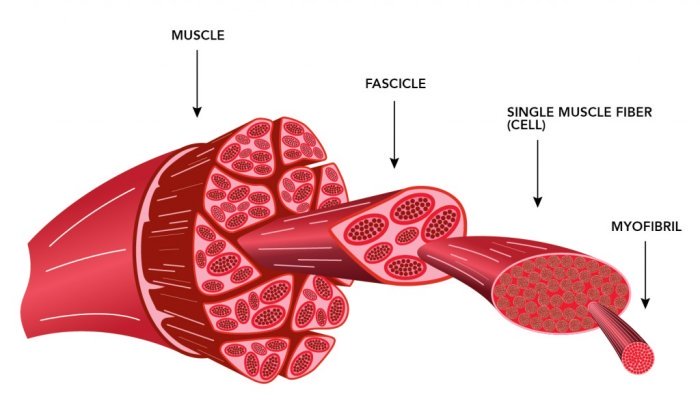 Myofibrillar hypertrophy, on the other hand, is an enlargement of the muscle fiber as it gains more myofibrils, which contract and generate tension in the muscle. With this type of hypertrophy, the area density of myofibrils increases and there is a significantly greater ability to exert muscular strength. This type of hypertrophy is best accomplished by training with heavy weights for low reps. To build maximum muscle mass it is equally important to incorporate maximal strength training methods in the 1 to 5 rep range, which train the part of the muscle responsible for these explosive contractions, into our routines.
Repetitions in the 1-5 rep range, using 85 to 100% of our 1 rep max, also have the added benefit of training the nervous system. This benefit is often an overlooked component of building a training program. Some of the many benefits of training the nervous system are an increased neural drive to the muscle, increased synchronization of motor units, increased activation of the contractile apparatus, and decreased inhibition by the protective mechanisms of the muscle (golgi tendon organ). These training methods also hypertrophy the pure fast twitch fibers – the high-threshold, Type IIB fibers. Incorporating these training methods into your routine at the right time will undoubtedly improve your muscle’s ability to generate more force and contract maximally during any lift.
What does this all mean for someone who is trying to build more muscle mass?
The stronger your muscles become, the increased neural drive and the ability to generate more force will all add up to denser muscles and the ability to build even more sarcoplasmic volume, thereby increasing the size of your muscle by both methods and doing so most effectively. If your goal is to get big and hard, then using all of the available tools just makes sense, doesn’t it?
Happy Lifting!