
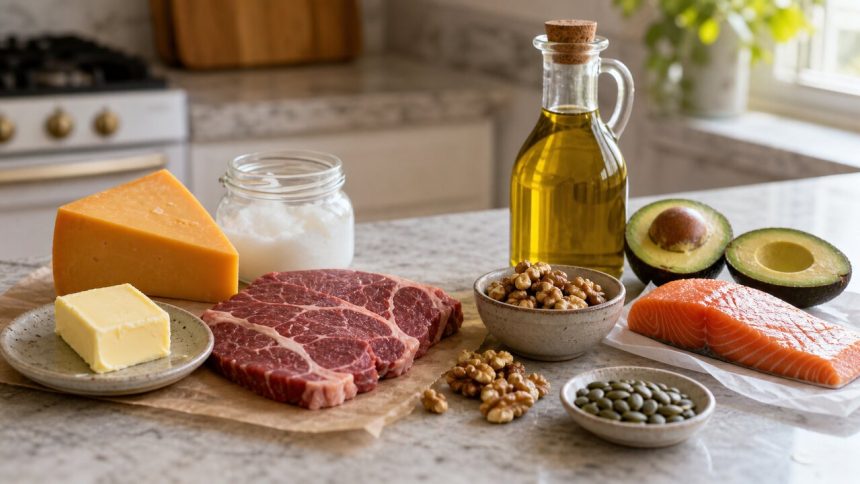
Most people can eat some saturated fat without treating every serving of cheese or steak as a health emergency. The better question is how much you eat, what foods supply it, what replaces it, and whether you already have elevated cardiovascular risk. Current evidence supports replacing some saturated fat with unsaturated fat, especially polyunsaturated fat, rather than swapping it for refined carbohydrates or added sugar.
The current Dietary Guidelines for Americans, 2025-2030 say saturated fat should stay at or below 10% of daily calories. The American Heart Association uses a stricter target of less than 6% for a heart-healthy pattern.[9] These targets are population guideposts, not a biological threshold that changes at a single decimal point.
A 2025 systematic review of 17 randomized trials added useful context. Cutting saturated fat produced small and statistically uncertain changes in major outcomes across all participants, but the estimated absolute benefit was larger in people who already had high cardiovascular risk. Replacing saturated fat with polyunsaturated fat produced the clearest signal for fewer nonfatal heart attacks.[1]
What saturated fat does in the body
Saturated fat is a family of fatty acids with no double bonds in their carbon chains. Butter, cheese, fatty meat, coconut oil, palm oil, pastries, and many fried or packaged foods contain it in different amounts. A food can also contain saturated and unsaturated fats at the same time.
Your body uses fat for energy, cell membranes, hormone production, and absorption of vitamins A, D, E, and K. You need dietary fat, but you do not need to seek out saturated fat as an essential nutrient. Your body can make saturated fatty acids, while the omega-3 and omega-6 fats it cannot make come from unsaturated-fat sources.
The cardiovascular concern starts with blood lipids. Higher saturated-fat intake can raise LDL cholesterol in many people. LDL-C measures the cholesterol carried in low-density lipoproteins, while apolipoprotein B, or apoB, approximates the number of atherogenic particles that can enter artery walls. When LDL-C and apoB disagree, cardiovascular risk often tracks more closely with apoB or non-HDL cholesterol.[2]
What the newest randomized-trial review found
Steen and colleagues reviewed 17 randomized nutrition trials involving 66,337 adults. The interventions were intended to last at least 24 months, and most replaced saturated fat with polyunsaturated fat or carbohydrates.[1]
The pooled relative-risk estimates favored reducing saturated fat, but the confidence intervals crossed the possibility of no effect for the main outcomes. That matters because a favorable estimate does not become a proven benefit unless the uncertainty is narrow enough.
| Outcome over about five years | Relative risk | 95% confidence interval | What it means |
|---|---|---|---|
| All-cause mortality | 0.96 | 0.88 to 1.06 | No conclusive overall reduction |
| Cardiovascular mortality | 0.93 | 0.77 to 1.11 | No conclusive overall reduction |
| Nonfatal heart attack | 0.86 | 0.70 to 1.06 | Possible benefit, still uncertain overall |
| Fatal or nonfatal stroke | 0.83 | 0.58 to 1.19 | Possible benefit with wide uncertainty |
The trials also had limitations. Many were conducted decades ago, dietary adherence varied, and the replacement foods differed. Only one trial primarily used monounsaturated fat, so the review gives a clearer answer for polyunsaturated fat than for every possible substitute.
Why your baseline heart risk changes the answer
A relative-risk number can sound impressive while the real-world difference remains small. For high-risk adults, the review estimated about six fewer all-cause deaths per 1,000 over five years, but the confidence interval ranged from 17 fewer to nine more deaths. The exact size of the benefit remains uncertain. The estimated benefit was below a meaningful threshold for adults at low baseline risk.[1]
When saturated fat was replaced mainly with polyunsaturated fat, the estimate was 21 fewer nonfatal heart attacks per 1,000 high-risk adults over five years, compared with about two fewer per 1,000 among low-risk adults. The relative risk was 0.75, with a 95% confidence interval of 0.58 to 0.99.
A small short-term absolute benefit does not settle the long-term significance of persistently elevated LDL-C or apoB. The short-term payoff from one dietary change is smaller when the starting risk is small. Age, blood pressure, smoking, diabetes, family history, kidney disease, LDL-C, apoB, and lipoprotein(a) can change that starting point.
What replaces saturated fat matters
Removing butter from a meal does not tell us what happens next. Replacing it with olive oil changes the fatty-acid profile. Replacing it with a sugary pastry can lower saturated fat on paper while making the meal less nutritious.
The World Health Organization recommends replacing saturated fat with polyunsaturated fat. It conditionally supports plant-derived monounsaturated fat or carbohydrates from foods rich in naturally occurring fiber, including whole grains, vegetables, fruit, and legumes.[3] The WHO evidence review found the largest average LDL-C reduction with polyunsaturated fat, followed by monounsaturated fat and then carbohydrates.
| Instead of | Use more often | Why the swap helps |
|---|---|---|
| Butter or beef tallow for routine cooking | Olive, canola, soybean, or avocado oil | Shifts the meal toward unsaturated fat |
| Processed or fatty meat at most meals | Fish, beans, lentils, tofu, or leaner cuts | Adds unsaturated fat or fiber while reducing saturated fat |
| Cheese as the main protein | Use a smaller amount for flavor and add beans, fish, poultry, or yogurt | Keeps the food while improving the meal’s protein and fat balance |
| Pastries or fried snacks | Fruit, nuts, seeds, or whole-grain snacks | Improves fiber and nutrient density, not only the fat number |
| Coconut oil as a wellness supplement | Use it for flavor when wanted; choose unsaturated oils routinely | Coconut oil remains very high in saturated fat |
Saturated fat vs. unsaturated fat
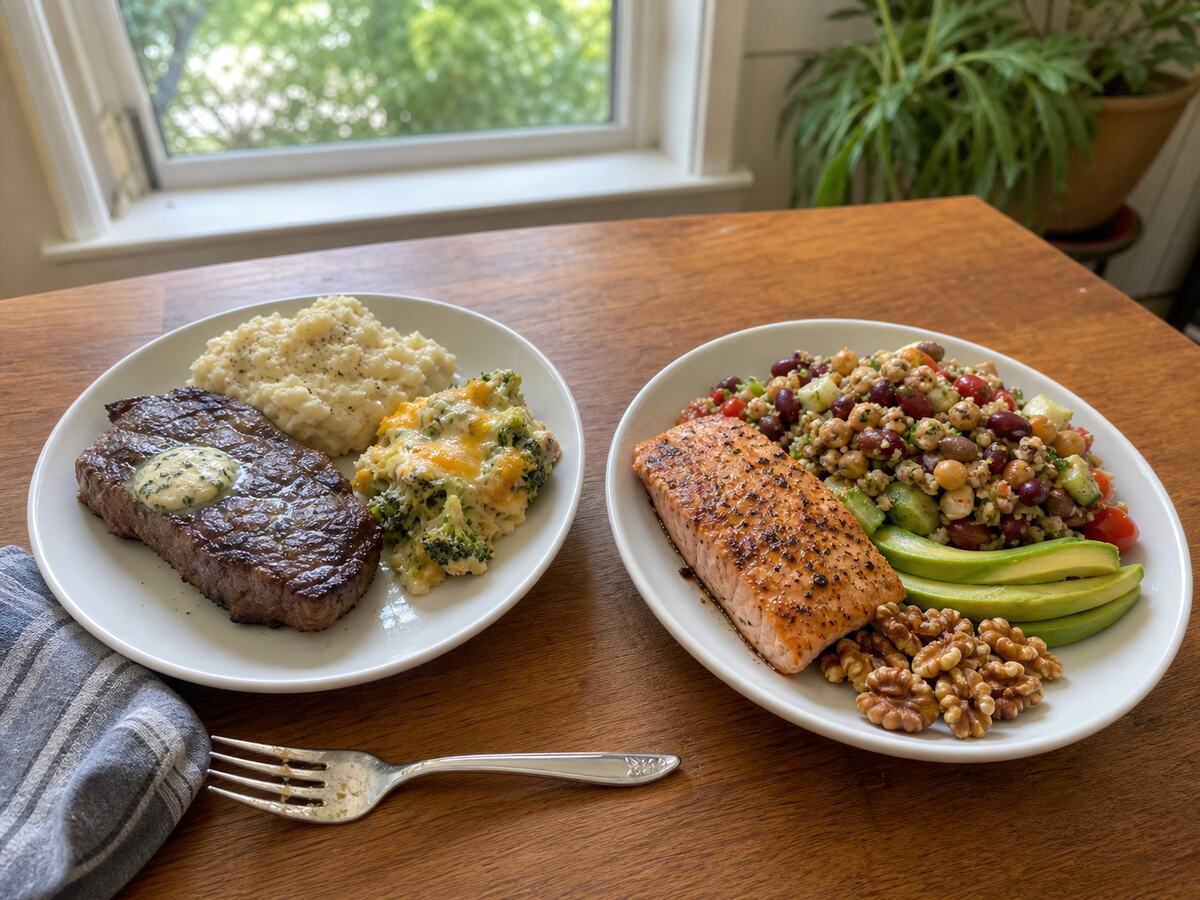
Monounsaturated and polyunsaturated fats contain one or more double bonds. They remain liquid more often at room temperature, although kitchen texture is not a reliable health test. Olive oil, nuts, seeds, avocado, fish, and many non-tropical plant oils provide mostly unsaturated fat.
| Fat type | Common sources | Practical role |
|---|---|---|
| Saturated fat | Butter, cream, cheese, fatty meat, coconut and palm oils | Can fit in a healthy diet, but should not dominate fat intake |
| Monounsaturated fat | Olive oil, avocado, almonds, peanuts | Useful everyday replacement for butter and animal fats |
| Polyunsaturated fat | Walnuts, seeds, soybean oil, fatty fish | Best-supported replacement for lowering LDL-C and reducing heart-attack risk |
A 2025 meta-analysis of randomized trials found that increasing the dietary ratio of polyunsaturated to saturated fat lowered LDL-C, with the response influenced by the saturated-fat content of the comparison diet.[4] The 2026 American Heart Association scientific statement also recommends unsaturated-fat sources in place of saturated-fat sources within a high-fiber, minimally processed dietary pattern.[5]
Does the food source change the effect?
Yes, but the evidence is not clean enough to rank every food by saturated-fat grams alone. Cheese, yogurt, milk, butter, unprocessed meat, processed meat, coconut oil, and pastries differ in protein, sodium, fiber, fermentation, food structure, and processing.
The 2025 Dietary Guidelines Advisory Committee reviewed saturated-fat food sources and cardiovascular outcomes. It found some evidence favoring replacement of dairy with unsaturated-fat foods, but it could not draw firm conclusions for many comparisons within dairy, meat, or plant sources.[6] That uncertainty supports food-level judgment, not a free pass for unlimited butter, cheese, or fatty meat.
The final 2025-2030 federal guidelines reflect that tension. They give more space to full-fat dairy and whole-food sources of fat than the previous edition, and they list butter or beef tallow as possible cooking options. The same document still says saturated fat should not exceed 10% of daily calories and prioritizes oils that supply essential fatty acids.[7]
Coconut oil also needs context. It comes from a plant, but it contains far more saturated fat than olive, canola, or soybean oil. Coconut oil has not been shown to improve cardiovascular outcomes or outperform predominantly unsaturated oils. The available randomized evidence is short-term, small, and low certainty, so it is not a reason to use coconut oil as a routine heart-health substitute for olive, canola, or soybean oil.[8]
How much saturated fat should you eat per day?
For a general ceiling, multiply daily calories by 0.10 and divide by nine. Fat supplies nine calories per gram. A 2,000-calorie diet therefore allows about 22 grams at the 10% level.
The American Heart Association’s 6% target is stricter. It works out to about 13 grams on 2,000 calories. That target makes more sense for someone trying to lower LDL-C or following a clinician-directed heart-health plan than as a universal rule for every active adult.
| Daily calories | 10% ceiling | 6% heart-health target |
|---|---|---|
| 1,600 | 18 g | 11 g |
| 2,000 | 22 g | 13 g |
| 2,400 | 27 g | 16 g |
| 2,800 | 31 g | 19 g |
| 3,000 | 33 g | 20 g |
| 3,500 | 39 g | 23 g |
Use the number as a daily average. One restaurant meal can exceed it, so a weekly pattern tells you more than a single plate. Check serving sizes on Nutrition Facts labels because mixed dishes, desserts, cheese, and cooking fats add up faster than most people expect.
You can use the FitnessVolt macronutrient calculator to estimate total dietary fat after setting calories. Then compare the saturated-fat line on your food log with the gram range above.
What lifters and athletes should do
A high training load can raise calorie needs, which raises the gram allowance at the same percentage. A 3,500-calorie diet reaches 10% at roughly 39 grams. More calories do not make an athlete immune to familial hypercholesterolemia, diabetes, high blood pressure, or elevated apoB.
Build most meals around lean or minimally processed protein, fruit, vegetables, beans, whole grains, and unsaturated fats. Keep butter, cheese, fattier cuts, and desserts in portions that fit the day instead of making them the foundation of every meal.
Dietary fat has roles beyond cardiovascular health, but saturated fat is not a testosterone supplement. Our separate guide to dietary fats and testosterone covers energy availability, low-fat dieting, and hormone claims.
A Mediterranean-style pattern offers an easy template: olive oil, fish, nuts, beans, vegetables, fruit, and whole grains, with meat and dairy used according to preference and health needs. Read our Mediterranean diet guide for meal structure and food ideas.
When your blood work should guide the decision
Population limits cannot replace personal risk assessment. Ask a qualified clinician about your fat intake if you have known cardiovascular disease, diabetes, chronic kidney disease, familial hypercholesterolemia, high lipoprotein(a), or persistently elevated LDL-C, non-HDL-C, or apoB.
If your LDL-C or apoB rises after a diet change, review the foods that changed before defending the diet label. Replacing some butter, coconut oil, fatty meat, or cheese with olive oil, nuts, seeds, beans, fish, or leaner protein provides a clean test. Recheck labs on the timeline your clinician recommends rather than guessing from energy levels or gym performance.
Claims the evidence does not support
| Claim | What the evidence supports |
|---|---|
| All saturated fat is toxic. | Risk depends on dose, food source, replacement, and baseline cardiovascular risk. |
| Saturated fat is harmless because some trials found no mortality benefit. | The overall estimates remain uncertain, while high-risk groups and PUFA replacement show a stronger benefit signal. |
| Natural butter or tallow protects the heart. | Natural origin does not establish cardiovascular benefit. |
| Coconut oil is equivalent to olive oil. | Coconut oil is high in saturated fat and does not match the lipid evidence for unsaturated oils. |
| Lowering saturated fat helps no matter what replaces it. | Unsaturated fats and fiber-rich carbohydrates are better-supported replacements than refined carbohydrates and added sugar. |
Bottom line
Saturated fat can fit in a healthy diet, but the strongest evidence does not support making butter, tallow, coconut oil, fatty meat, or cheese the main sources of dietary fat. Keep the general 10% ceiling in view, use a stricter target when your cardiovascular risk or clinician calls for it, and favor unsaturated fats in routine meals.
The practical move is substitution. Replace some saturated-fat-rich foods with olive oil, nuts, seeds, fish, avocado, beans, or leaner proteins while keeping fiber and overall diet quality high. Your blood work and baseline risk determine how much that change matters for you.
Sources
- Steen JP, Klatt KC, Chang Y, et al. Effect of Interventions Aimed at Reducing or Modifying Saturated Fat Intake on Cholesterol, Mortality, and Major Cardiovascular Events: A Risk-Stratified Systematic Review of Randomized Trials. Annals of Internal Medicine. 2025. DOI: 10.7326/ANNALS-25-02229.
- Soffer DE, Marston NA, Maki KC, et al. Role of Apolipoprotein B in the Clinical Management of Cardiovascular Risk in Adults: An Expert Clinical Consensus from the National Lipid Association. Journal of Clinical Lipidology. 2024. PMID: 39256087.
- World Health Organization. Saturated Fatty Acid and Trans-Fatty Acid Intake for Adults and Children: WHO Guideline. 2023. WHO guideline.
- Hart TL, Damani JJ, DiMattia ZS, et al. Dietary Polyunsaturated to Saturated Fatty Acid Ratio as an Indicator for LDL Cholesterol Response: A Systematic Review and Meta-Analysis of Randomized Clinical Trials. Advances in Nutrition. 2025;16(10):100502. DOI: 10.1016/j.advnut.2025.100502.
- Lichtenstein AH, Khera A, Anderson CAM, et al. 2026 Dietary Guidance to Improve Cardiovascular Health: A Scientific Statement From the American Heart Association. Circulation. 2026. DOI: 10.1161/CIR.0000000000001435.
- 2025 Dietary Guidelines Advisory Committee. Food Sources of Saturated Fat and Risk of Cardiovascular Disease: A Systematic Review. USDA Nutrition Evidence Systematic Review. 2024. Full systematic review.
- U.S. Department of Health and Human Services and U.S. Department of Agriculture. Dietary Guidelines for Americans, 2025-2030. 10th Edition. January 2026. Official guideline.
- Duarte AC, Spiazzi BF, Zingano CP, et al. The Effects of Coconut Oil on the Cardiometabolic Profile: A Systematic Review and Meta-Analysis of Randomized Clinical Trials. Lipids in Health and Disease. 2022;21(1):83. DOI: 10.1186/s12944-022-01685-z.
- American Heart Association. Saturated Fats. Reviewed August 23, 2024. American Heart Association guidance.