

10 Best Middle Back Shrug Alternatives for Limited Equipment
If you can’t perform the Middle Back Shrug, use movements that load the trapezius and improve scapular control. Try dumbbell or barbell shrugs, face pulls, prone Y/T raises, or scapular pull-ups. Cue: retract and hold the shoulder blades for one second at peak contraction to maximize mid-trap activation.
Original Exercise: Middle Back Shrug
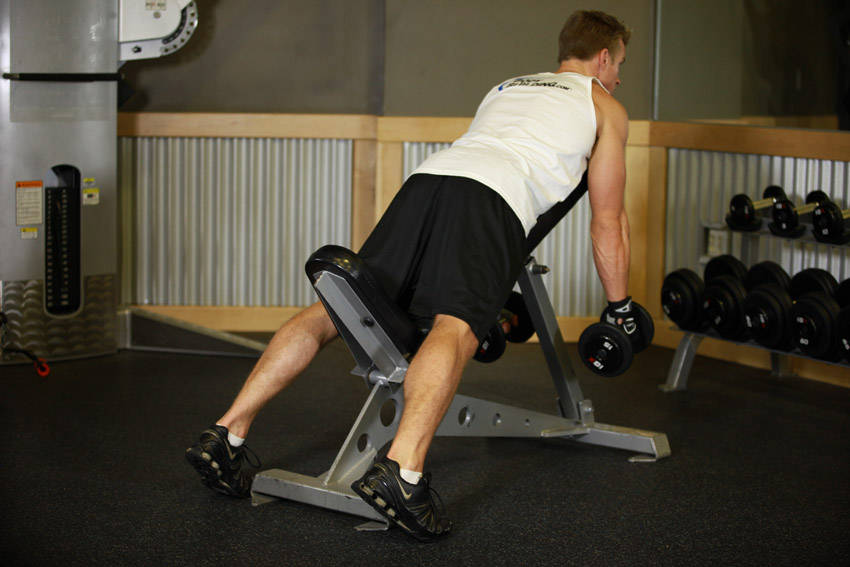
How to Perform Middle Back Shrug
- Lie facedown on an incline bench while holding a dumbbell in each hand. Your arms should be fully extended hanging down and pointing towards the floor. The palms of your hands should be facing each other. This will be your starting position.
- As you exhale, squeeze your shoulder blades together and hold the contraction for a full second. Tip: This movement is just like the reverse action of a hug, or trying to perform rear laterals as if you had no arms.
- As you inhale go back to the starting position.
- Repeat for the recommended amount of repetitions.
Pro Tips
- Category: Strength
- Force: Pull
- Movement type: Isolation
Ranked Middle Back Shrug Alternatives
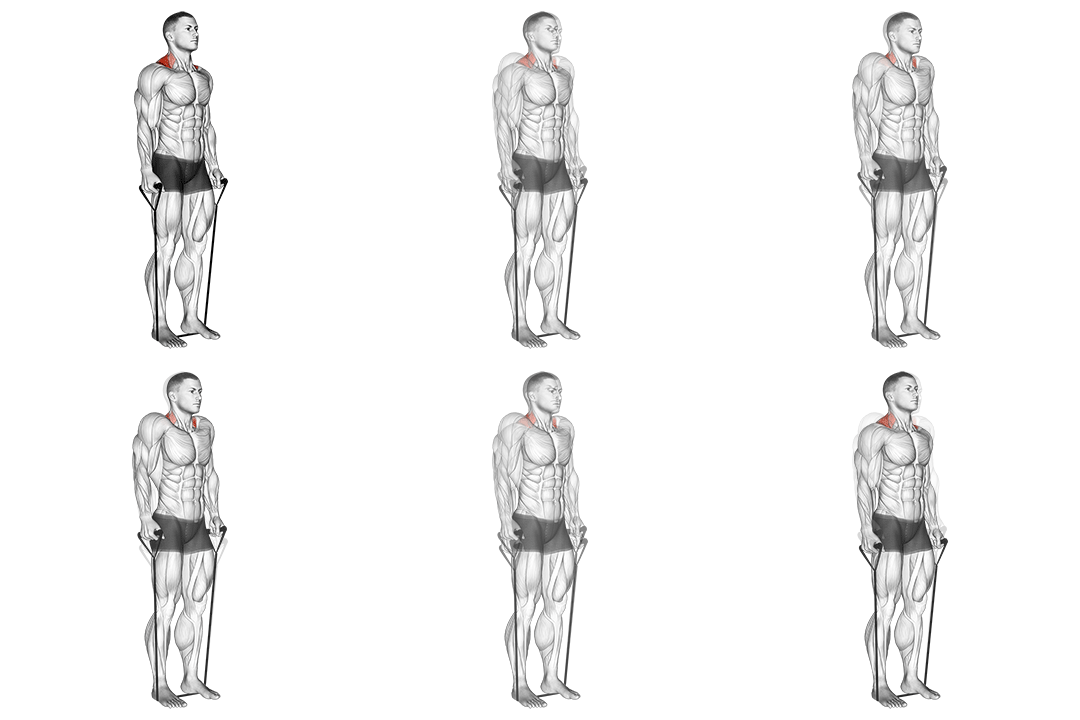
1. Band Shrug
71% MatchHow to perform this exercise
- Stand with your feet shoulder-width apart and place the band under your feet, holding the ends with your hands.
- Keep your arms straight and relaxed, and let the band hang in front of your thighs.
- Engage your traps by shrugging your shoulders upward, lifting the band as high as possible.
- Hold the contraction for a moment, then slowly lower your shoulders back down to the starting position.
- Repeat for the desired number of repetitions.
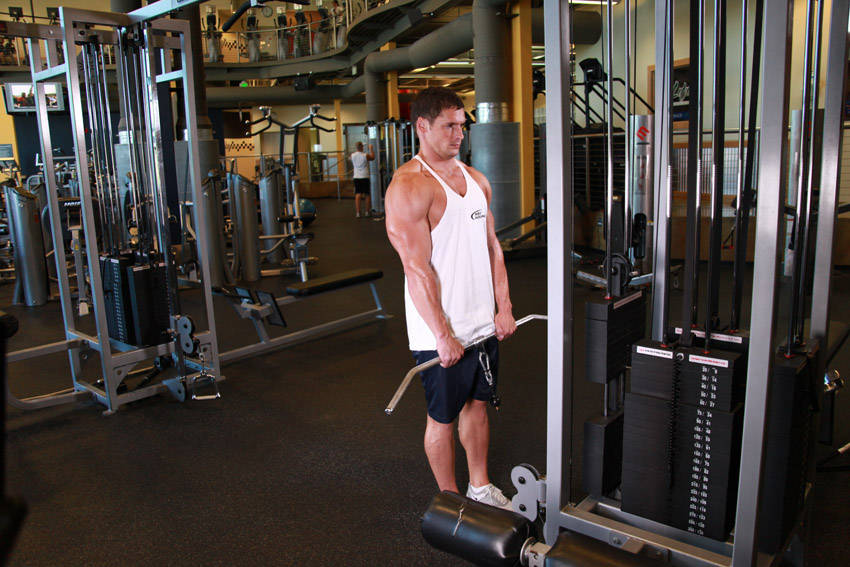
2. Cable Shrugs
69.4% MatchHow to perform this exercise
- Grasp a cable bar attachment that is attached to a low pulley with a shoulder width or slightly wider overhand (palms facing down) grip.
- Stand erect close to the pulley with your arms extended in front of you holding the bar. This will be your starting position.
- Lift the bar by elevating the shoulders as high as possible as you exhale. Hold the contraction at the top for a second. Tip: The arms should remain extended at all times. Refrain from using the biceps to help lift the bar. Only the shoulders should be moving up and down.
- Lower the bar back to the original position.
- Repeat for the recommended amount of repetitions.
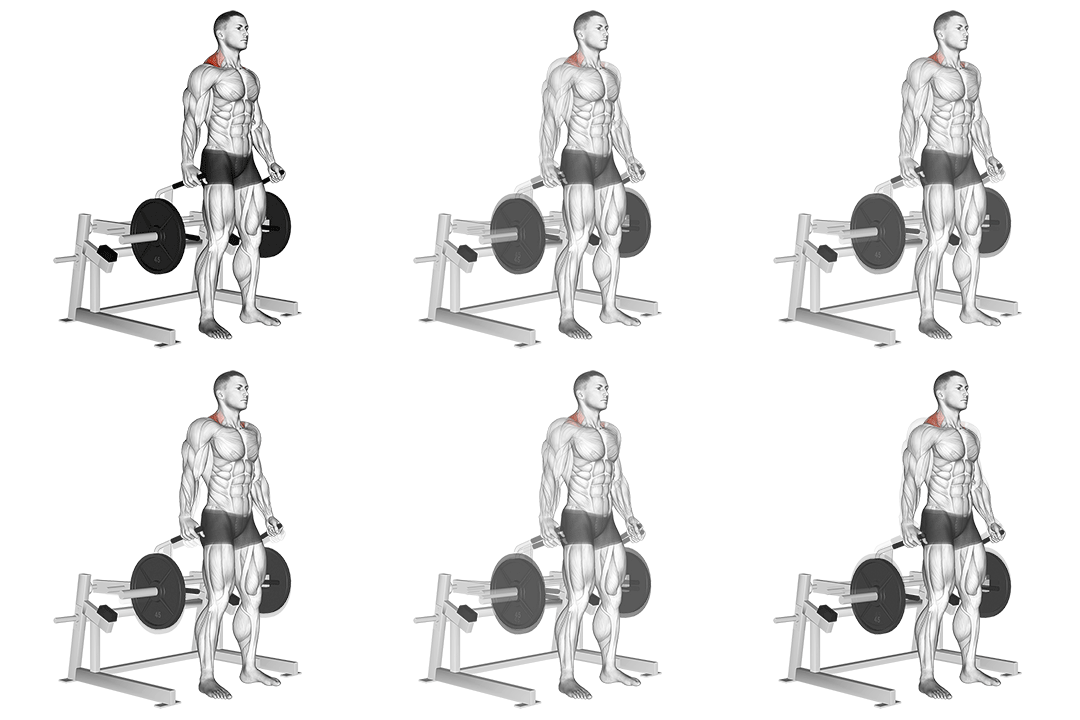
3. Lever Shrug
68.9% MatchHow to perform this exercise
- Adjust the seat height and position yourself on the leverage machine with your back against the pad.
- Grasp the handles with an overhand grip and keep your arms straight.
- Keeping your back straight, lift your shoulders up towards your ears as high as possible.
- Hold the contraction for a moment, then slowly lower your shoulders back down to the starting position.
- Repeat for the desired number of repetitions.
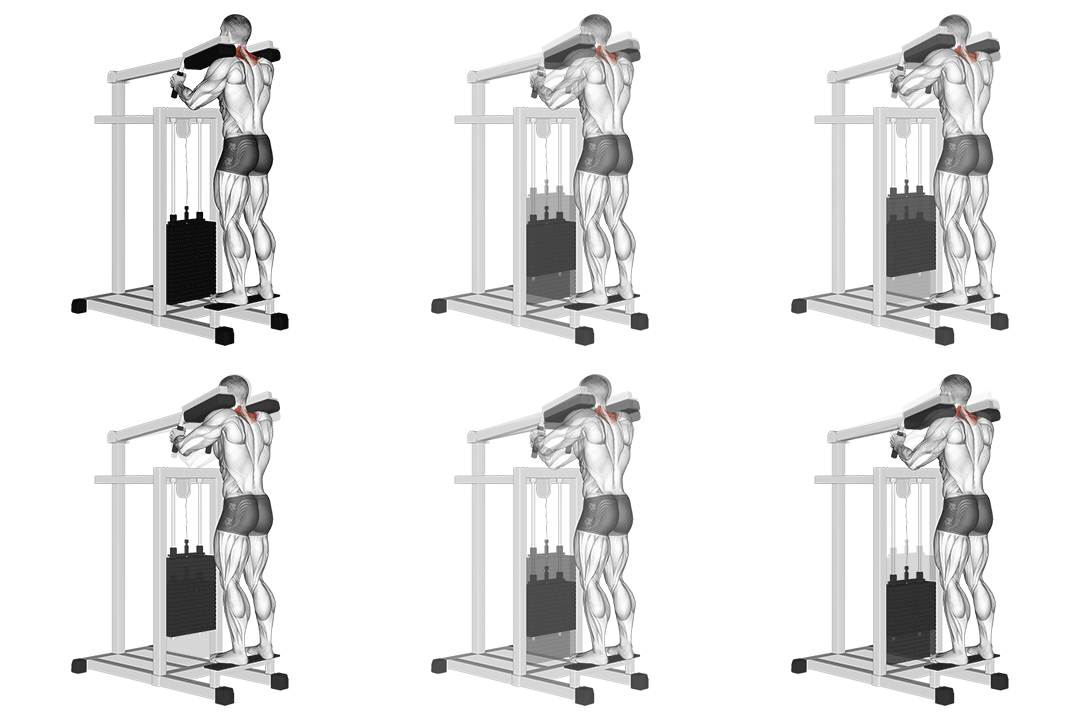
4. Lever Gripless Shrug V. 2
65.4% MatchHow to perform this exercise
- Adjust the seat height and position yourself on the machine with your back against the pad.
- Grasp the handles or bars with an overhand grip, keeping your arms straight.
- Keeping your back straight, lift your shoulders up towards your ears as high as possible.
- Hold the contraction for a moment, then slowly lower your shoulders back down to the starting position.
- Repeat for the desired number of repetitions.
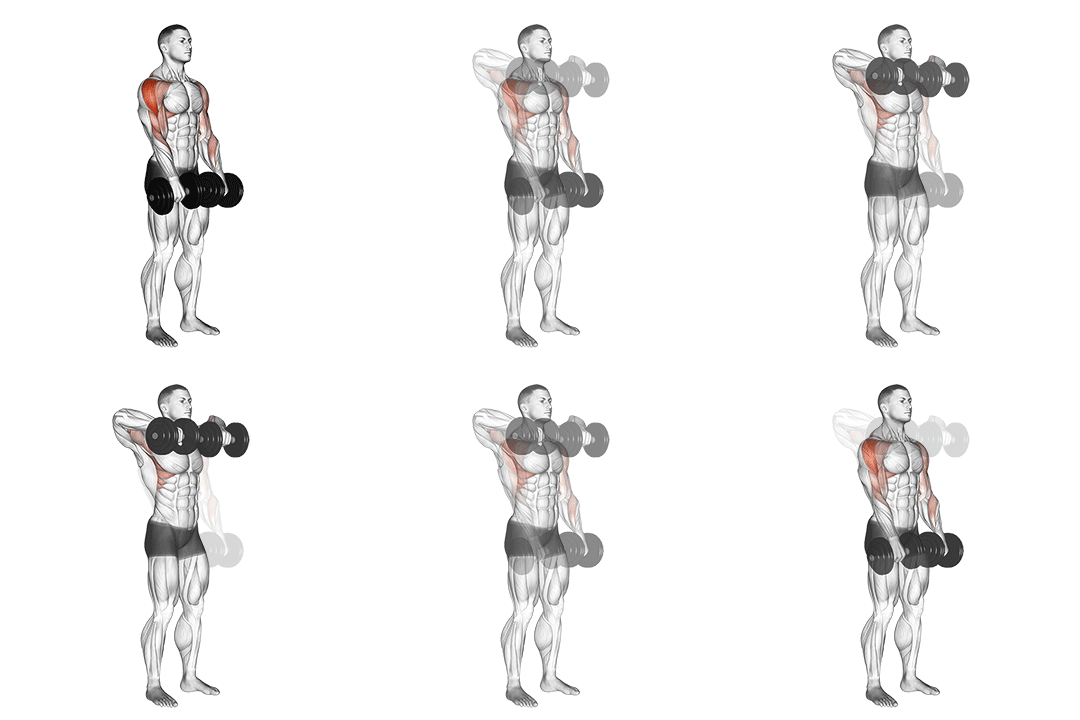
5. Dumbbell Upright Row
64.9% MatchHow to perform this exercise
- Stand with your feet shoulder-width apart, holding a dumbbell in each hand with an overhand grip.
- Let the dumbbells hang in front of your thighs, with your arms fully extended.
- Keeping your back straight and your core engaged, exhale and lift the dumbbells straight up towards your chin, leading with your elbows.
- Pause for a moment at the top, then inhale and slowly lower the dumbbells back down to the starting position.
- Repeat for the desired number of repetitions.
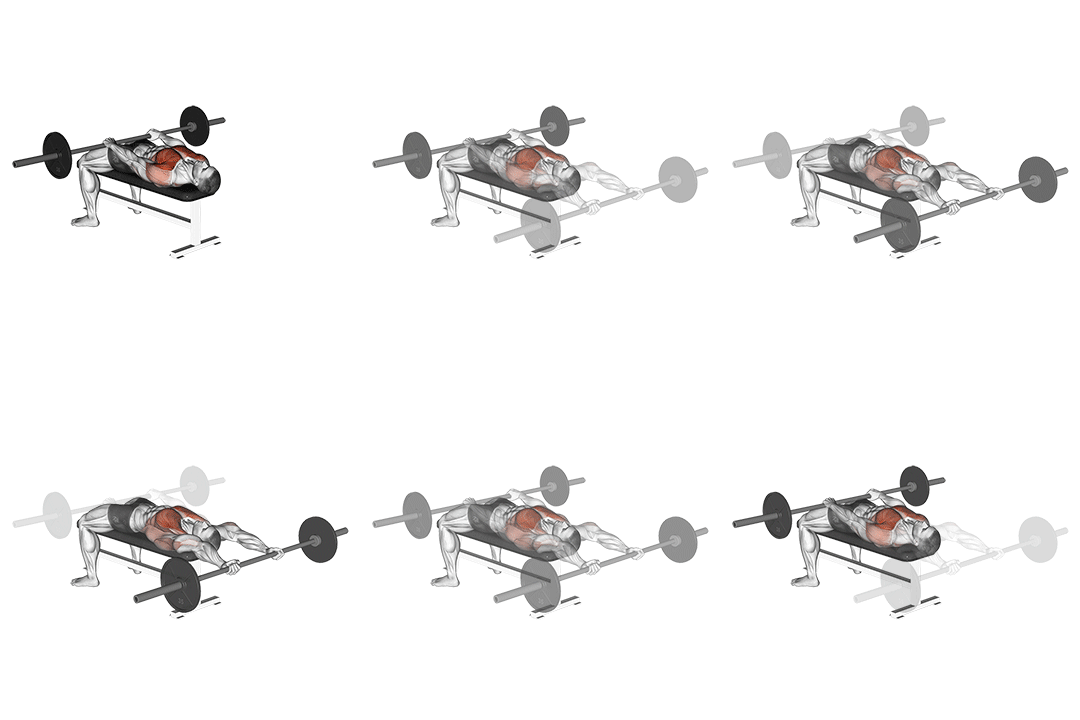
6. Barbell Front Raise And Pullover
64.7% MatchHow to perform this exercise
- Stand with your feet shoulder-width apart and hold a barbell with an overhand grip, palms facing down.
- Keep your arms straight and raise the barbell in front of you until it reaches shoulder height.
- Pause for a moment at the top, then slowly lower the barbell back down to the starting position.
- Next, lower the barbell behind your head, keeping your arms straight.
- Pause for a moment at the bottom, then raise the barbell back up to the starting position.
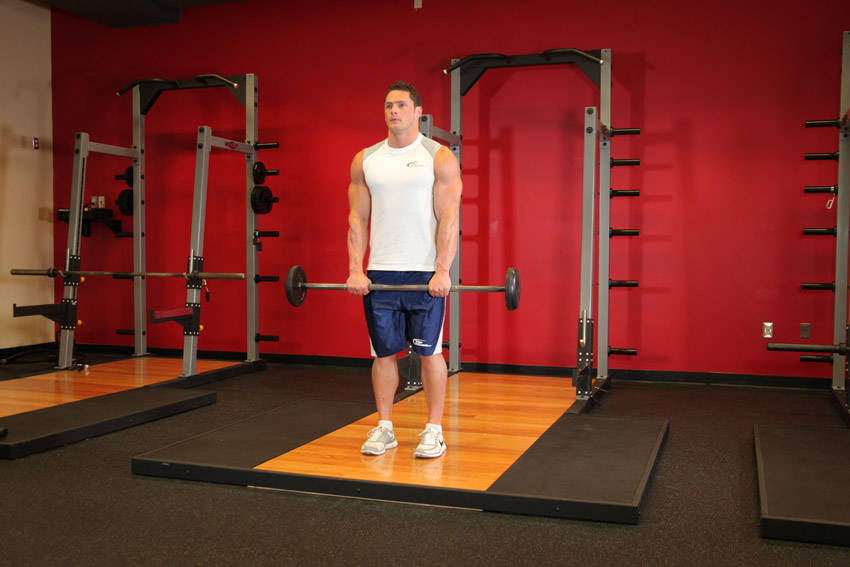
7. Standing Front Barbell Raise Over Head
64.1% MatchHow to perform this exercise
- To begin, stand straight with a barbell in your hands. You should grip the bar with palms facing down and a closer than shoulder width grip apart from each other.
- Your feet should be shoulder width apart from each other. Your elbows should be slightly bent. This is the starting position.
- Lift the barbell up until it is directly over your head while exhaling. Make sure to keep your elbows slightly bent when performing each repetition.
- Once you feel the contraction, begin to lower the barbell back down to the starting position as you inhale.
- Repeat for the recommended amount of repetitions.
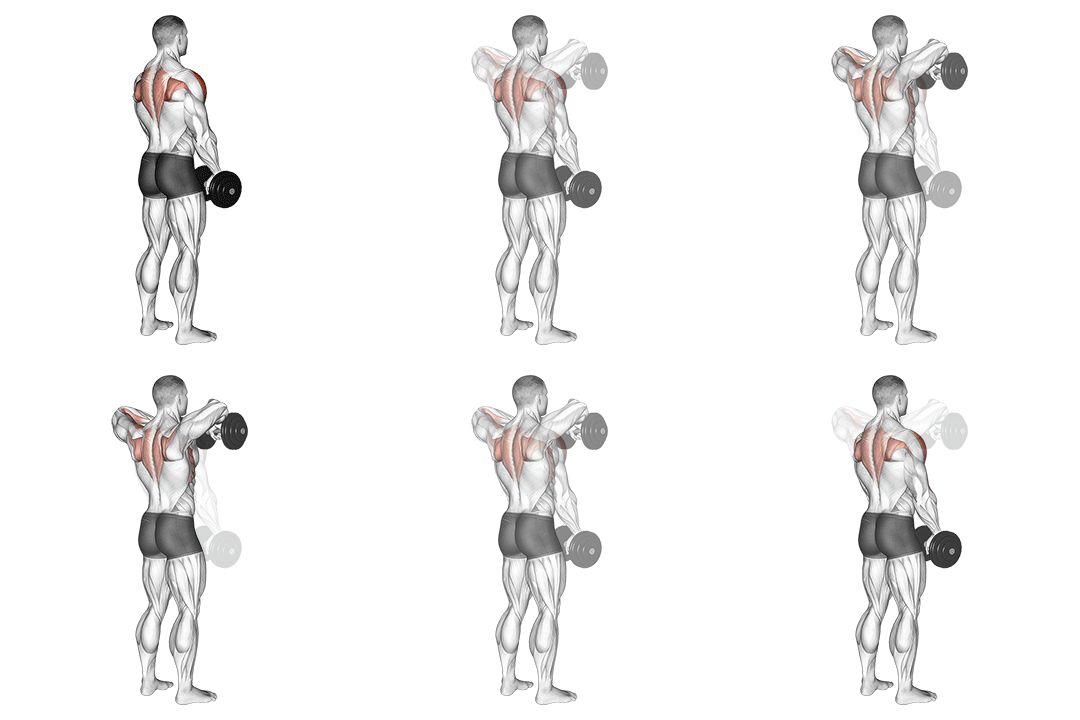
8. Dumbbell Upright Row (back Pov)
61.4% MatchHow to perform this exercise
- Stand with your feet shoulder-width apart, holding a dumbbell in each hand with an overhand grip.
- Let the dumbbells hang in front of your thighs, with your arms fully extended and your palms facing your body.
- Keeping your back straight and your core engaged, exhale and lift the dumbbells straight up towards your chin, leading with your elbows.
- Continue lifting until the dumbbells are at shoulder height, with your elbows pointing out to the sides.
- Pause for a moment at the top, then inhale and slowly lower the dumbbells back down to the starting position.
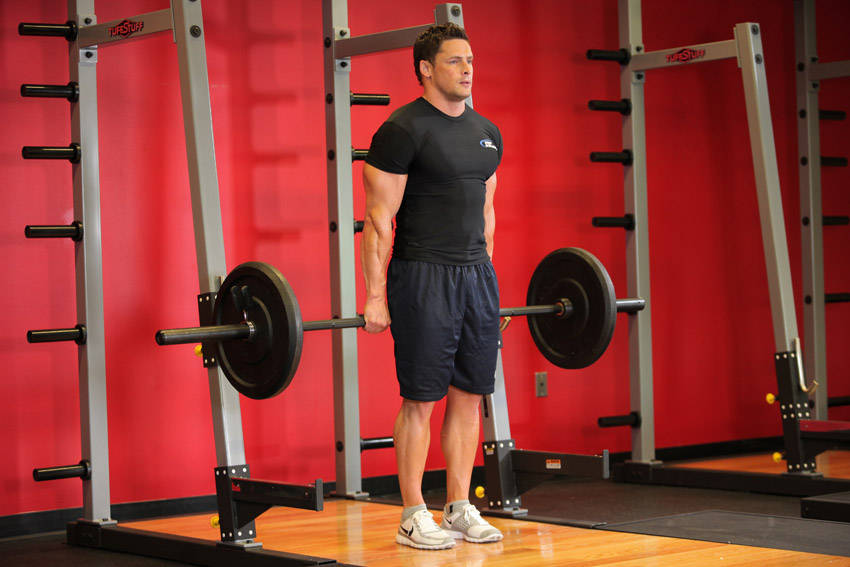
9. Barbell Shrug Behind The Back
60.4% MatchHow to perform this exercise
- Stand up straight with your feet at shoulder width as you hold a barbell with both hands behind your back using a pronated grip (palms facing back). Tip: Your hands should be a little wider than shoulder width apart. You can use wrist wraps for this exercise for better grip. This will be your starting position.
- Raise your shoulders up as far as you can go as you breathe out and hold the contraction for a second. Tip: Refrain from trying to lift the barbell by using your biceps. The arms should remain stretched out at all times.
- Slowly return to the starting position as you breathe in.
- Repeat for the recommended amount of repetitions.
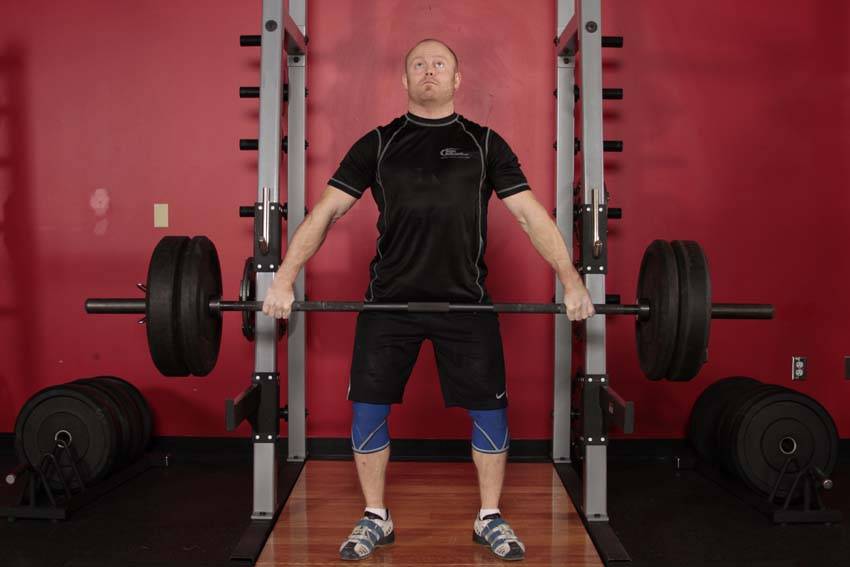
10. Snatch Shrug
60.4% MatchHow to perform this exercise
- Begin with a wide grip, with the bar hanging at the mid thigh position. You can use a hook or overhand grip. Your back should be straight and inclined slightly forward.
- Shrug your shoulders towards your ears. While this exercise can usually by loaded with heavier weight than a snatch, avoid overloading to the point that the execution slows down.
Why You Might Need a Middle Back Shrug Alternative
You may substitute the Middle Back Shrug because of shoulder or neck pain, lack of dumbbells, or a goal shift toward scapular retraction rather than pure elevation. Injuries that limit cervical loading often preclude heavy shrugging. Biomechanically, mid and upper trapezius fibers manage scapular elevation and retraction; choosing an alternative lets you target specific fibers while reducing neck shear. For instance, face pulls bias horizontal abduction and mid-trap activation, cue: pull to eye level, lead with the elbows and squeeze between the shoulder blades. Prone Y/T raises load the lower and middle traps with minimal cervical stress, keep a long neck and initiate each rep from the scapula.
How to Choose the Right Substitute
Pick a substitute by matching the movement pattern, available equipment, and tissue tolerance. If your goal is vertical scapular elevation, choose heavy shrugs or high pulls and cue a neutral cervical spine while driving the scapula straight up. For mid-trap retraction choose face pulls, seated cable rows with a scapular squeeze, or prone T-raises to emphasize horizontal pulling. Consider progressive overload: heavier loads for strength, higher reps for scapular endurance. If you have neck or shoulder issues, avoid neck extension and prefer prone or supported variations that limit cervical compression. Test each option and pause at peak contraction to verify trapezius activation.
Frequently Asked Questions
What muscles does Middle Back Shrug work?
The Middle Back Shrug primarily targets the trapezius, mainly the middle and upper fibers responsible for scapular retraction and elevation. It also recruits the levator scapulae and rhomboids as stabilizers. Cue: squeeze the shoulder blades together and avoid cervical extension to focus trapezius tension.
What is the best bodyweight alternative to Middle Back Shrug?
Scapular pull-ups are the best bodyweight substitute: hang from a bar, depress and retract the scapula without bending the elbows, and hold 1–2 seconds at the top to stimulate the mid-traps. Prone Y raises are a close second, lift the arms overhead with thumbs up and focus on scapular upward rotation.
Can I build muscle without doing Middle Back Shrug?
Yes. You can build trapezius mass using progressive overload with alternatives like heavy shrugs, rows, upright pulls, and loaded carries that apply stress from different vectors. Cue: control the eccentric, use a two-second pause at peak contraction, and track load increases to enhance motor unit recruitment and hypertrophy.
More Exercise Alternatives
Find Alternatives for Any Exercise
Use the exercise substitution finder to compare ranked alternatives for your available equipment and training preference.
Try the Exercise Substitution Finder →