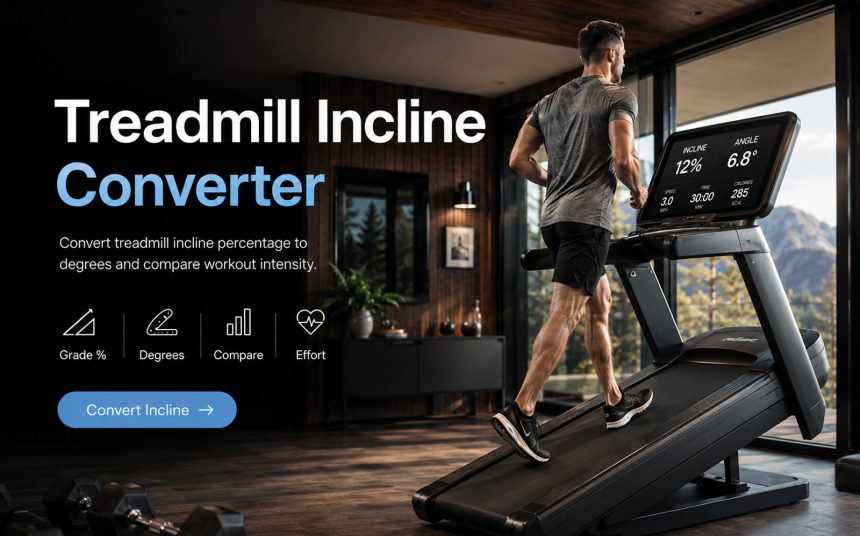
Treadmill incline settings can be confusing. Your gym treadmill shows 12% incline, but what does that actually mean? Is it steep? How does it compare to a real hill? This converter translates between percentage grade and degrees, helping you understand exactly what you’re walking or running on.
Grade-adjusted pace
What running at this incline costs, expressed as the flat pace that would cost the same. Running speeds only, from 4.3 mph up.
—
flat-equivalent pace
How this is worked out
Solves the ACSM running equation twice: once at your speed and incline, then again at zero incline, for the speed that produces the same oxygen cost. That is the same equation set the calorie calculator uses, so the two cannot disagree. It is an energy-cost equivalence, not a claim about how a hill feels or about outdoor conditions. The speed starts at 4.3 mph because that is where ACSM switches from the walking equation to the running one. The two do not meet at that point, so a walking speed has no meaningful flat-running equivalent and the tool does not invent one.
Understanding Treadmill Incline
Treadmill incline is expressed in two ways: percentage grade (%) and degrees. While they both measure steepness, they use different mathematical approaches, which is why the numbers don’t match.
Percentage Grade vs Degrees: What’s the Difference?
Percentage grade measures how much elevation you gain for every 100 units of horizontal distance. A 10% grade means you rise 10 feet for every 100 feet traveled horizontally.
Degrees measure the actual angle from horizontal. A 45-degree angle is halfway between flat and vertical.
| Measurement | Formula | 10% Example |
|---|---|---|
| Percentage | Rise / Run x 100 | 10 ft rise / 100 ft run = 10% |
| Degrees | arctan(Rise / Run) | arctan(0.10) = 5.7 degrees |
Why Treadmills Use Percentage Instead of Degrees
Nearly all treadmills display incline as a percentage rather than degrees for several practical reasons:
- Industry standard: Road grades and hiking trails are measured in percentage, making it easier to translate outdoor terrain to treadmill settings
- More intuitive scaling: Percentage provides finer gradations at lower inclines where most training occurs
- Easier calorie calculations: Exercise physiology research uses percentage grade for energy expenditure formulas
- Simpler mental math: Each 1% adds roughly 8% more effort, making workout planning straightforward
Incline Conversion Chart: Percentage to Degrees
Use this reference table to convert between treadmill percentage settings and the equivalent angle in degrees.
| Incline (%) | Degrees | Rise per 100ft | Equivalent Terrain |
|---|---|---|---|
| 0% | 0.0 | 0 ft | Flat surface |
| 1% | 0.6 | 1 ft | Outdoor running equivalent |
| 2% | 1.1 | 2 ft | Slight incline |
| 3% | 1.7 | 3 ft | Gentle slope |
| 4% | 2.3 | 4 ft | Noticeable hill |
| 5% | 2.9 | 5 ft | Moderate hill |
| 6% | 3.4 | 6 ft | Steady climb |
| 7% | 4.0 | 7 ft | Challenging hill |
| 8% | 4.6 | 8 ft | Steep hill |
| 9% | 5.1 | 9 ft | Very steep |
| 10% | 5.7 | 10 ft | Aggressive climb |
| 11% | 6.3 | 11 ft | Mountain grade |
| 12% | 6.8 | 12 ft | 12-3-30 workout setting |
| 13% | 7.4 | 13 ft | Steep mountain |
| 14% | 8.0 | 14 ft | Very steep grade |
| 15% | 8.5 | 15 ft | Maximum treadmill incline |
The Conversion Formula
To convert percentage to degrees, use the arctangent function:
Degrees = arctan(Percentage / 100) x (180 / PI)
Example: 12% incline = arctan(0.12) x 57.3 = 6.84 degrees
To convert degrees back to percentage:
Percentage = tan(Degrees) x 100
How Incline Affects Your Workout
Understanding incline goes beyond just numbers. Here’s how different incline levels impact your body during exercise.
Calorie Burn Increase
Incline dramatically increases energy expenditure. Each 1% of incline adds approximately 8% more calories burned compared to flat walking or running.
| Incline | Calorie Multiplier | 30 min Walk (150 lb) |
|---|---|---|
| 0% | 1.00x | 125 cal |
| 5% | 1.40x | 175 cal |
| 10% | 1.80x | 225 cal |
| 12% | 1.96x | 245 cal |
| 15% | 2.20x | 275 cal |
Muscle Activation
Different incline levels target different muscle groups:
- 0-3% incline: Primarily quadriceps, similar to flat ground walking
- 5-8% incline: Increased glute and hamstring engagement
- 10-12% incline: Significant posterior chain activation (glutes, hamstrings, calves)
- 13-15% incline: Maximum glute and calf recruitment, core engagement for balance
Higher inclines essentially turn your treadmill session into a lower-body strength workout while still providing cardiovascular benefits.
Joint Impact
One of the biggest advantages of incline walking over running is reduced joint stress:
- 42% less joint impact compared to running at equivalent calorie burn
- Walking uphill reduces the jarring heel strike common in flat running
- Ideal for those recovering from injuries or with joint concerns
- Allows higher-intensity training with lower injury risk
Common Incline Settings Explained
Here’s what each incline range means in practical terms and when to use it.
0% Incline: Flat Surface
- Degrees: 0
- Feel: Walking or running on a perfectly level surface
- Use for: Warm-up, cool-down, high-speed sprints
- Note: Actually easier than outdoor running due to no wind resistance and belt assistance
1-2% Incline: Outdoor Running Equivalent
- Degrees: 0.6 – 1.1
- Feel: Similar effort to running outdoors on flat ground
- Use for: General cardio training, pace work
- Why: Research by Jones & Doust (1996) showed 1% incline compensates for lack of wind resistance
5% Incline: Moderate Hill
- Degrees: 2.9
- Feel: Noticeable effort increase, like walking up a gradual neighborhood hill
- Use for: Fat-burning zone training, building endurance
- Calorie boost: Approximately 40% more calories than flat
10-12% Incline: Steep Climb
- Degrees: 5.7 – 6.8
- Feel: Challenging, like hiking a steep trail or stadium stairs
- Use for: 12-3-30 workout, glute-focused training, high-calorie burn
- Calorie boost: 80-96% more calories than flat (nearly double)
- Muscles: Heavy glute and hamstring engagement
15% Incline: Maximum Treadmill Setting
- Degrees: 8.5
- Feel: Very steep, like climbing a steep mountain trail
- Use for: Short high-intensity intervals, maximum calorie burn
- Calorie boost: 120% more calories than flat (more than double)
- Caution: Most people cannot maintain hands-free walking at this incline for extended periods
What is 12% incline in degrees?
A 12% treadmill incline equals approximately 6.8 degrees. This is the setting used in the popular 12-3-30 workout. While 6.8 degrees might sound small, it nearly doubles your calorie burn compared to walking on a flat surface.
Why is 10% incline only 5.7 degrees?
Percentage and degrees measure steepness differently. Percentage is the ratio of vertical rise to horizontal distance (10 ft rise per 100 ft traveled), while degrees measure the actual angle. The mathematical relationship between them is not linear, which is why a 10% grade doesn’t equal 10 degrees.
What incline should I use to simulate outdoor running?
Set your treadmill to 1% incline to simulate outdoor running conditions. Research shows this compensates for the lack of wind resistance and the slight assistance from the moving belt. For hill training, use 5-10% depending on the terrain you’re preparing for.
Is 15% incline too steep?
15% incline (8.5 degrees) is challenging but not dangerous for most healthy individuals. However, it’s best used for short intervals rather than sustained walking. If you need to hold the handrails at 15%, reduce the incline to a level where you can walk hands-free.
How do I convert outdoor hill grade to treadmill settings?
Hiking trails and roads typically post grades in percentage, which matches treadmill settings directly. If a trail sign says “8% grade,” set your treadmill to 8% incline. If you only know the degrees (uncommon), use this converter to find the equivalent percentage.