
Last updated: July 2026. FitnessVolt rebuilt this guide with current sports nutrition research, a practical meal-timing decision tree, updated internal links, and relevant food-first visuals.
Nutrient timing matters, but only after the big rocks are in place: calories, total protein, food quality, and training consistency. If those are off, eating at perfect times will not save the plan. If those are solid, meal timing can help you train harder, manage hunger, hit protein targets, and recover between sessions.
The old bodybuilding rule was simple: eat every 2-3 hours, keep carbs around training, and never miss the post-workout window. The current evidence is more useful and less rigid. Most lifters do not need a clock-controlled diet. They need a schedule that gives them enough protein across the day, enough carbs to train well, and enough structure to avoid late-night calorie drift.
Key Facts
- Fat loss: Meal timing can help adherence, but it does not beat a calorie deficit when calories are matched.
- Muscle gain: Total daily protein matters most. Spreading protein across 3-5 feedings is a strong default for lifters.
- Workout fuel: A mixed meal 1-3 hours before training works for most people. Very long or hard sessions may need carbs during training.
- Post-workout nutrition: The anabolic window is wider than old gym lore claimed, but eating protein after training is still a practical habit.
- Best schedule: The schedule you can repeat while hitting calories, protein, fiber, and training performance wins.

Does nutrient timing matter as much as calories and protein?
No. Calories control whether body weight trends up or down, and protein intake strongly affects muscle retention, muscle gain, and satiety. Nutrient timing sits below those priorities. It is still useful, but it is a support system, not the engine.
For fat loss, timing can reduce snacking, improve hunger control, or make a calorie deficit easier to follow. That does not mean eating earlier or eating less often creates fat loss independent of calories. A 2026 review in Proceedings of the Nutrition Society concluded that timed eating interventions are not clearly superior to general energy restriction when energy intake is matched. The practical takeaway is not that timing is useless. It is that timing works mainly by shaping behavior and food intake.
For muscle gain, the hierarchy is similar. The FitnessVolt protein calculator can help set a daily target first. After that, distribute protein across meals so you are not trying to cram most of your intake into one or two feedings.
How many meals should you eat for fat loss?
Most people do best with 2-5 meals per day. That range is broad because the best number depends on appetite, schedule, training time, and how easy it is to hit protein without overeating.
Eating six small meals per day is not required for a faster metabolism. Eating one meal per day is not automatically better for fat loss either. Lower meal frequency and time-restricted eating can help some people reduce calories, but they can backfire if they create night eating, poor training, or protein shortfalls.
| Meal Pattern | Best For | Main Risk | FitnessVolt Take |
|---|---|---|---|
| 2 meals per day | People with low appetite in the morning or simple schedules | Harder to hit protein and fiber without large meals | Useful if meals are protein-forward and training performance stays solid. |
| 3 meals per day | Most lifters and fat-loss diets | Long gaps can cause snacking if meals are too small | The best default for simplicity, hunger control, and social eating. |
| 4 meals per day | Lifters with higher protein targets or evening hunger | Can become grazing if portions are not planned | Strong option for muscle gain and controlled fat loss. |
| 5-6 meals per day | Very high-calorie bulks, athletes, or people who dislike large meals | More planning, more chances to overeat | Use only when it solves a real problem. |
If you are choosing between intermittent fasting and smaller meals, use the approach that improves adherence. Our comparison of intermittent fasting vs. small meals breaks down the tradeoffs for weight loss.
How should lifters spread protein across the day?
A strong default is 0.25-0.40 grams of high-quality protein per kilogram of body weight per meal, or about 20-40 grams for many lifters, repeated every 3-5 hours. Larger athletes may need more per meal. Smaller athletes may need less.
The International Society of Sports Nutrition position stand on protein and exercise recommends 1.4-2.0 grams of protein per kilogram of body weight per day for many exercising people, with acute doses around 20-40 grams. That does not mean every meal must be identical. It means the day should not rely on one protein-heavy dinner after three low-protein meals.
For a 180-pound lifter aiming at 160 grams of protein, a simple day might look like this:
| Meal | Example | Protein Target | Why It Works |
|---|---|---|---|
| Breakfast | Greek yogurt, oats, berries, whey if needed | 35-45 g | Starts protein early and reduces catch-up pressure later. |
| Lunch | Chicken, rice or potatoes, vegetables, fruit | 40-50 g | Pairs protein and carbs before afternoon training or work. |
| Post-workout or snack | Protein shake, milk, or cottage cheese with fruit | 25-40 g | Convenient bridge between meals. |
| Dinner | Lean beef, fish, eggs, tofu, or turkey with vegetables | 40-50 g | Finishes the target without making dinner the whole plan. |
What should you eat before a workout?
Most lifters do well with a mixed meal 1-3 hours before training. The meal should contain protein, carbs, and enough fluid. Keep fat and fiber moderate if they make you feel heavy during training.
A practical pre-workout meal is not complicated. Try one of these:
- Chicken, rice, vegetables, and fruit 2-3 hours before lifting.
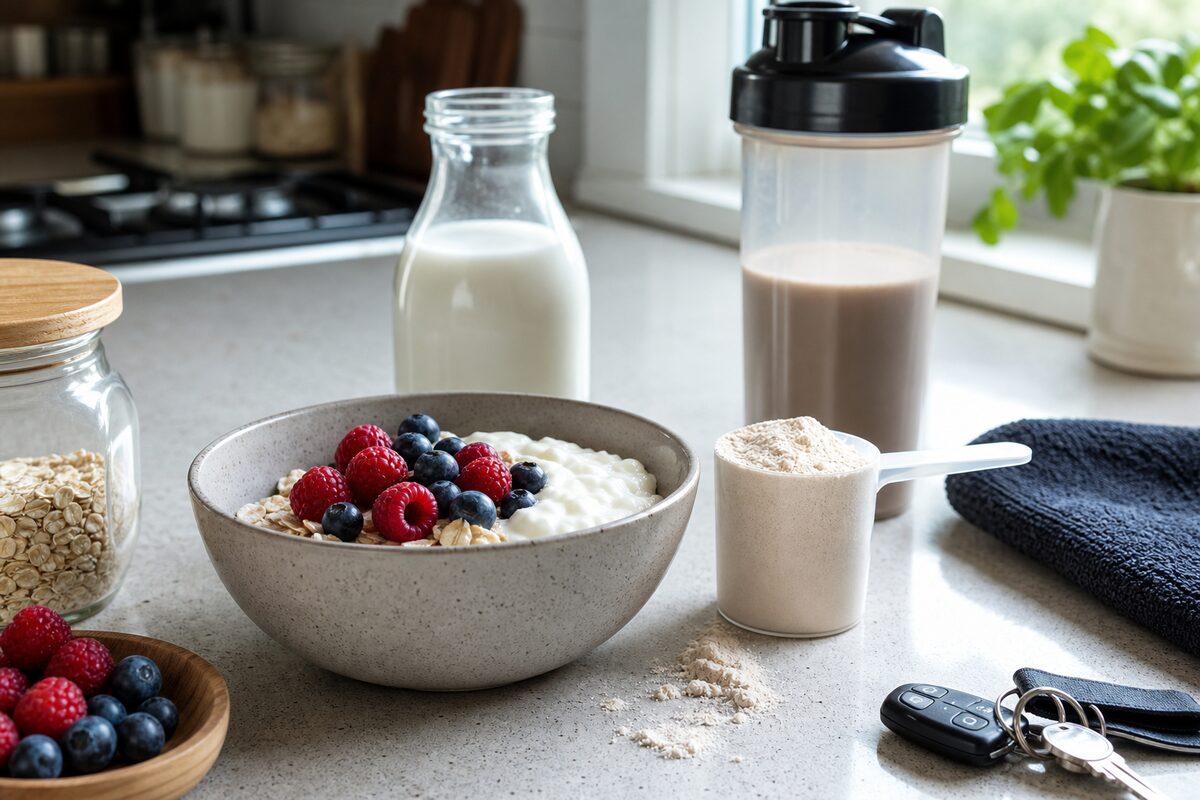
- Greek yogurt, oats, berries, and whey 60-120 minutes before lifting.
- Turkey sandwich, banana, and water 90-150 minutes before lifting.
- Protein shake and a bagel 45-90 minutes before training if digestion is sensitive.
Training fasted is not automatically bad. Some lifters prefer it for short morning sessions. The tradeoff is performance. If fasted training reduces load, reps, focus, or weekly volume, the timing strategy is costing you more than it gives back. Our guide on intermittent fasting for lifters explains when fasting fits and when it fights muscle gain.
What should you eat after lifting?
Eat protein after lifting because it is practical, not because the workout becomes worthless after 30 minutes. Muscle protein synthesis stays elevated for many hours after resistance training. The real question is whether you have eaten enough quality protein before and after the session across the day.
If you trained 1-3 hours after a protein-rich meal, you do not need to panic. Eat your next planned protein meal when convenient. If you trained after a long fast or missed a meal, get protein sooner. Add carbs if you need to train again soon, have a long session coming, or struggle to recover.
| Training Situation | Post-Workout Move | Why |
|---|---|---|
| You ate protein 1-3 hours before lifting | Eat your next protein meal within a few hours | The window is already covered. |
| You trained fasted | Get 25-40 g protein soon after | You have a longer protein gap to close. |
| You train twice in one day | Add carbs and fluids after the first session | Glycogen restoration and hydration matter more. |
| You are dieting aggressively | Use a planned protein meal, not random snacks | Protects satiety and lean mass. |
Do you need carbs during training?
Most lifters do not need intra-workout carbs for a normal 45-75 minute lifting session. Water, electrolytes when sweat is high, and enough carbs in the daily diet are usually enough.
Carbs during training become more useful when sessions are long, glycogen-demanding, or repeated. Think endurance work, high-volume bodybuilding sessions, team-sport practice, CrossFit-style mixed sessions, or two-a-day training. In those cases, carbs can help maintain output and make the next session less compromised.
Does eating earlier in the day help fat loss?
It can help some people, mainly through appetite and calorie control. Recent meal-timing research suggests time-restricted eating, lower meal frequency, and earlier calorie distribution may produce modest weight-loss effects compared with standard advice. The effect is not magic. It is usually small and likely depends on whether the timing pattern reduces total intake and improves consistency.
Earlier meals are worth testing if late eating is your weak point, breakfast improves training energy, or a larger lunch reduces evening snacking. They are not mandatory if your schedule, calories, protein, sleep, and training are already working.
When is nutrient timing most important?
Nutrient timing moves up the priority list when the training demand is high. A recreational lifter training four days per week can be flexible. A competitive athlete with two daily sessions, long practices, weight-class pressure, or poor recovery needs more structure.
| Priority Level | Who It Applies To | Timing Focus |
|---|---|---|
| Low | General fitness, short lifting sessions, stable body weight | Hit daily calories and protein. Timing can stay flexible. |
| Moderate | Muscle gain, fat loss with heavy lifting, evening hunger issues | Protein every 3-5 hours, planned pre-workout meal, controlled late eating. |
| High | Two-a-day training, endurance events, high-volume sport practice | Carbs and fluids around sessions, fast post-session refueling, planned snacks. |
How should timing change by goal?
The same eating schedule should not be used for every goal. A fat-loss phase needs hunger control and protein consistency. A lean bulk needs enough meal opportunities to hit calories without feeling stuffed. A performance block needs fuel around the work that actually costs energy.
| Goal | Best Timing Emphasis | What To Avoid | Simple Rule |
|---|---|---|---|
| Fat loss | Protein at each meal, planned evening food, earlier calories if it reduces cravings | Skipping food all day and losing control at night | Choose the schedule that makes the calorie target easiest to repeat. |
| Muscle gain | 3-5 protein feedings and carbs near the hardest sessions | Trying to gain on two huge meals if appetite is poor | Spread protein first, then add calories where digestion is easiest. |
| Strength performance | Carbs and fluids before heavy sessions | Training heavy while underfed just to keep a fasting window clean | Fuel the sessions that drive progress. |
| Endurance or two-a-days | Carbs before, during, and after key sessions | Waiting too long to refuel between sessions | Recovery starts before the next workout is threatened. |
What are the signs your timing plan is failing?
A timing plan should make training and diet easier. If it adds friction without measurable benefit, it is the wrong plan. Watch for these signs:
- Gym performance is sliding: You may be training too far from food or under-eating carbs.
- Night eating keeps breaking the deficit: Move more protein, fiber, or calories earlier in the day.
- You cannot hit protein: Add one planned protein feeding instead of forcing larger meals.
- You feel bloated during training: Move larger meals farther from the session and use easier carbs closer to training.
- Your plan works only on perfect days: Build a backup meal and a backup snack for travel, work, and late sessions.
The strongest diet is the one that survives normal weeks. If timing rules make you miss workouts, skip social meals, or bounce between restriction and overeating, loosen the rules and protect the fundamentals.
What meal schedule should you use?
Start with your training time, then build meals backward and forward. Do not start with someone else’s meal plan and force it into your day.
Morning training: If you lift soon after waking, choose a small protein and carb option before training or eat a proper dinner the night before and recover with breakfast after. If fasted lifting works and performance is stable, keep it. If performance drops, add food.
Lunch training: Eat breakfast with protein and carbs, then train before lunch or after a small snack. Lunch becomes the recovery meal.
Evening training: Make lunch and a pre-workout snack count. Do not arrive at the gym underfed and then raid the kitchen at night. This is where meal timing often helps fat loss most.
You can also use the FitnessVolt nutrient timing calculator to map food windows around your workout.
What does a realistic day look like?
Here is a realistic evening-lifter template for someone cutting fat while trying to keep strength:
| Time | Meal | Purpose |
|---|---|---|
| 8:00 a.m. | Greek yogurt bowl with oats, berries, and whey | Protein early, fiber, and enough carbs to avoid morning grazing. |
| 12:30 p.m. | Chicken, potatoes, vegetables, fruit, and water | Main workday meal with protein and slow-digesting carbs. |
| 4:30 p.m. | Turkey sandwich or shake plus banana | Pre-workout fuel without a heavy stomach. |
| 7:30 p.m. | Lean protein, rice or beans, salad, and planned dessert if calories allow | Recovery meal that prevents random snacking. |
This is not magic. It works because protein is distributed, the workout is fueled, and the evening has a plan. A morning lifter could use the same logic with a smaller pre-workout snack and a larger breakfast after training.
Common nutrient-timing mistakes
- Chasing the anabolic window while missing total protein: A shake after training cannot fix a low-protein day.
- Eating too little before hard training: If performance drops, the diet is too theoretical.
- Using fasting to hide poor meal quality: A shorter eating window still needs protein, fiber, micronutrients, and enough total food.
- Forcing six meals when three would work: More meals can mean more friction and more calories.
- Ignoring sleep: Late caffeine, late heavy meals, and late training can all affect sleep and appetite the next day.
How to build a simple timing plan today
Use this order:
- Set calories with the FitnessVolt macronutrient calculator.
- Set protein with the protein calculator.
- Choose 3-4 protein feedings you can repeat.
- Place one protein and carb meal 1-3 hours before training when possible.
- Eat protein after training if the previous protein meal was more than 3-4 hours ago.
- Move more calories earlier only if it improves hunger, training, or late-night control.
If your goal is muscle gain, pair this with the practical food structure in our guide to real-world eating for more muscle. If your goal is performance, use our signs that meal timing may be sabotaging your workouts.
Frequently asked questions
Do I need to eat every 2-3 hours to build muscle?
No. Eating every 2-3 hours can work, but it is not mandatory. Most lifters can build muscle with 3-5 protein feedings per day as long as total protein and calories are high enough.
Is the post-workout anabolic window real?
Yes, but it is wider than the old 30-minute rule. Protein around training is useful, especially if you trained fasted or have not eaten protein for several hours. Total daily protein remains the bigger driver.
Should I put all carbs before and after workouts?
No. Put enough carbs near training to perform well, then distribute the rest where they help adherence. Some people do better with more carbs at dinner. Others do better with more earlier in the day.
Is fasted cardio better for fat loss?
Fasted cardio can help some people control calories because it fits their schedule. It does not bypass energy balance. If fasted cardio makes you hungrier later or lowers training quality, it is not better.
Bottom line
Nutrient timing is useful when it makes the basics easier to execute. For fat loss, use timing to control hunger and calories. For muscle gain, spread protein across the day and fuel training. For performance, add carbs and fluids when sessions are long, hard, or repeated.
Do not let timing distract you from the main work. Hit calories, protein, lifting, steps, sleep, and consistency first. Then use timing as a precision tool.
Sources
- Kerksick et al. International Society of Sports Nutrition position stand: nutrient timing.
- Jager et al. International Society of Sports Nutrition position stand: protein and exercise.
- Liu et al. Meal timing and anthropometric and metabolic outcomes.
- Flanagan and Johnstone. Is the timing of eating relevant for weight loss?
- Lak et al. Timing matters? High-protein diets and resistance training.
- Morton et al. Protein supplementation and resistance training gains: systematic review and meta-analysis.
- Areta et al. Timing and distribution of protein ingestion during recovery from resistance exercise.
- Schoenfeld and Aragon. Nutrient timing: A garage door of opportunity?
- Schoenfeld et al. Effect of protein timing on muscle strength and hypertrophy.
- NSCA. Meal frequency and weight loss.