
The dumbbell hammer curl is a curl performed with a neutral grip: your palms face each other for the whole rep, as if you were holding a hammer in each hand. That one change takes the biceps out of its strongest position, so the brachialis, the muscle underneath it, likely carries a bigger share of the work. Together with the brachioradialis on the top of the forearm, it is what gives the arm its thickness.
It is also one of the easiest curls to learn. The neutral grip is the position your forearm rests in when your arm hangs at your side, so there is no wrist rotation to coordinate. That makes the hammer curl a good first curl for beginners and a useful second curl for lifters whose arm training is built on palms-up work.
How to Do the Dumbbell Hammer Curl

- Stand tall with the dumbbells at your sides. Set your feet hip-width to shoulder-width apart, let your arms hang straight and turn your palms in to face your thighs. You should feel the weight hanging from relaxed, straight arms. Do not start with your elbows already bent.
- Set your shoulders and brace. Pull your shoulder blades slightly back and down, lift your chest, and tighten your abs and glutes. You should feel locked in from hips to shoulders. Do not let your shoulders roll forward, because that brings the front of the shoulder into the lift.
- Curl both dumbbells. Breathe out and bend your elbows, keeping your thumbs on top and your palms facing each other. You should feel the front of the upper arm and the top of the forearm tighten together. Do not rotate your wrists or let your elbows leave your sides.
- Squeeze at the top. Stop when the dumbbells are just below shoulder height and hold for 1 second. You should feel the muscles fully shortened. Do not swing your elbows forward to lift the weight higher.
- Lower under control. Breathe in and take 2 to 3 seconds to lower the dumbbells until your arms are straight. You should feel the same muscles working all the way down. Do not drop the weight or stop short of full extension.
- Reset and repeat. Pause briefly at the bottom so the next rep starts from a dead stop, then curl again. If you have to lean back to start the rep, the weight is too heavy.
Muscles Worked in the Dumbbell Hammer Curl
Three muscles bend the elbow, and your grip decides how the work is shared between them.
Brachialis
The brachialis lies under the biceps on the front of the upper arm. It attaches to the ulna, the forearm bone that does not rotate, so its leverage is the same whatever your grip. It has one job, bending the elbow, and it works in every curl.
Because the hammer curl puts the biceps at a disadvantage, the brachialis likely takes on a larger share of the load. As it grows, it adds width to the upper arm. Surface electrodes, the kind used in most gym studies, cannot read a muscle this deep, so the study below does not report it.
Brachioradialis
The brachioradialis is the long muscle on the thumb side of the forearm. It bends the elbow, and its line of pull is strongest when the forearm is halfway between palm-up and palm-down, which is the hammer position.
The lab data are less dramatic than gym lore suggests. In a 2023 study of ten competitive bodybuilders, brachioradialis activity during the lifting phase was about 6% lower in the neutral-grip curl than in the palms-up curl (Coratella et al., 2023). The hammer curl trains the brachioradialis hard, just no harder than a regular curl.
Biceps Brachii
The biceps brachii is the two-headed muscle on the front of the upper arm. It bends the elbow and also turns the palm up. With the palm turned in it cannot use that second function, and its activity drops: about 12% lower during the lifting phase than in a palms-up curl in the same study (Coratella et al., 2023).
The biceps still does a large share of the work. For when to use each curl, see our bicep curl vs hammer curl comparison.
Stabilizers
The front of the shoulder (anterior deltoid) keeps the upper arm still, and it worked about 9% harder with the neutral grip than with the palms-up grip (Coratella et al., 2023). The forearm flexors hold the dumbbell, and your abs and glutes stop your torso from rocking.
Common Hammer Curl Mistakes
Swinging the Weight Up
The hips rock forward and the torso leans back to get the dumbbells moving. It happens when the weight is too heavy for the arms to start the rep from a straight elbow. Momentum then does the hardest part of the lift, and the muscles you are training do less. Reduce the load, or stand with your back against a wall until strict reps feel normal.
Letting the Elbows Drift Forward
The elbows travel in front of the body as the dumbbells rise. This brings the front of the shoulder in to lift the upper arm and takes tension off the elbow flexors near the top. Keep your elbows under your shoulders and treat your upper arms as fixed to your ribs.
Turning the Palms Up
The wrists rotate as the weights come up, usually out of habit from regular curls. The lift becomes a standard curl and the biceps takes the work back. Keep your thumbs on top and your palms facing each other for the whole rep.
Cutting the Range Short
The arms never straighten at the bottom, or the lowering phase is rushed. Half reps let you use more weight while doing less work on every rep. Lower for 2 to 3 seconds until your elbows are straight, pause, then curl.
Bending the Wrists
The wrists fold inward or back under the load, often when your grip is tiring. A bent wrist moves stress onto the joint and makes the dumbbell harder to control. Keep your knuckles in line with your forearm and squeeze the handle.
Hammer Curl Variations
Each of these keeps the neutral grip and changes one thing: the path, the support or the equipment.
Cross-Body Hammer Curl
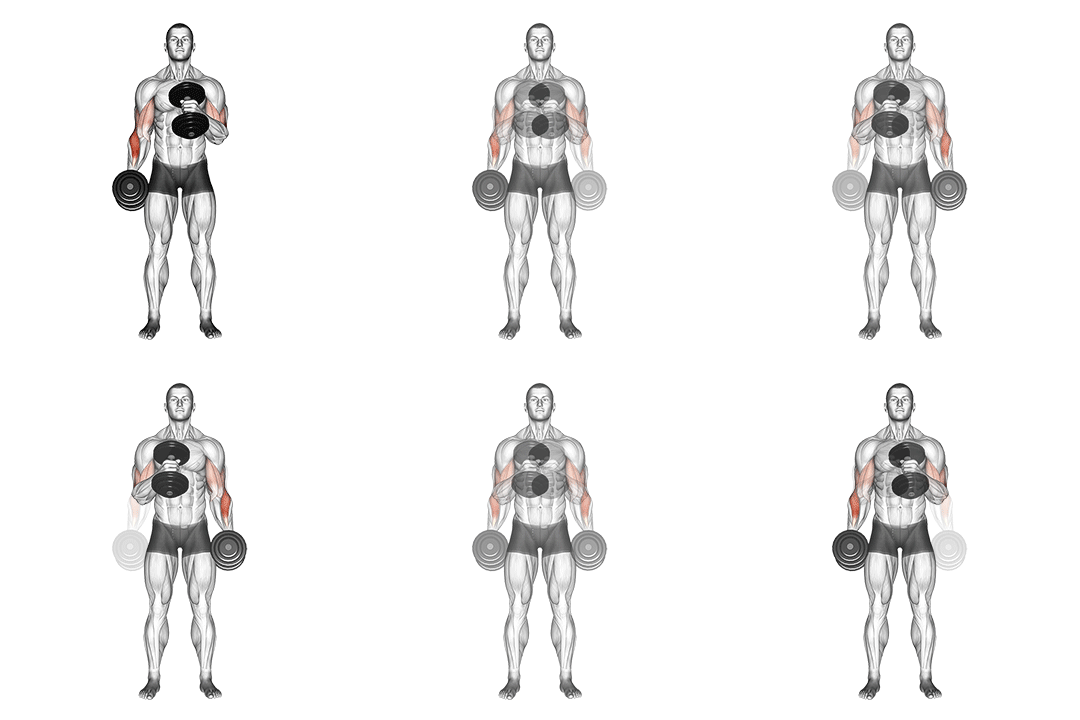
Curl one dumbbell at a time across your torso toward the opposite shoulder. The cross-body hammer curl lets you give one arm your full attention and keeps the dumbbell close to your body.
Seated Hammer Curl
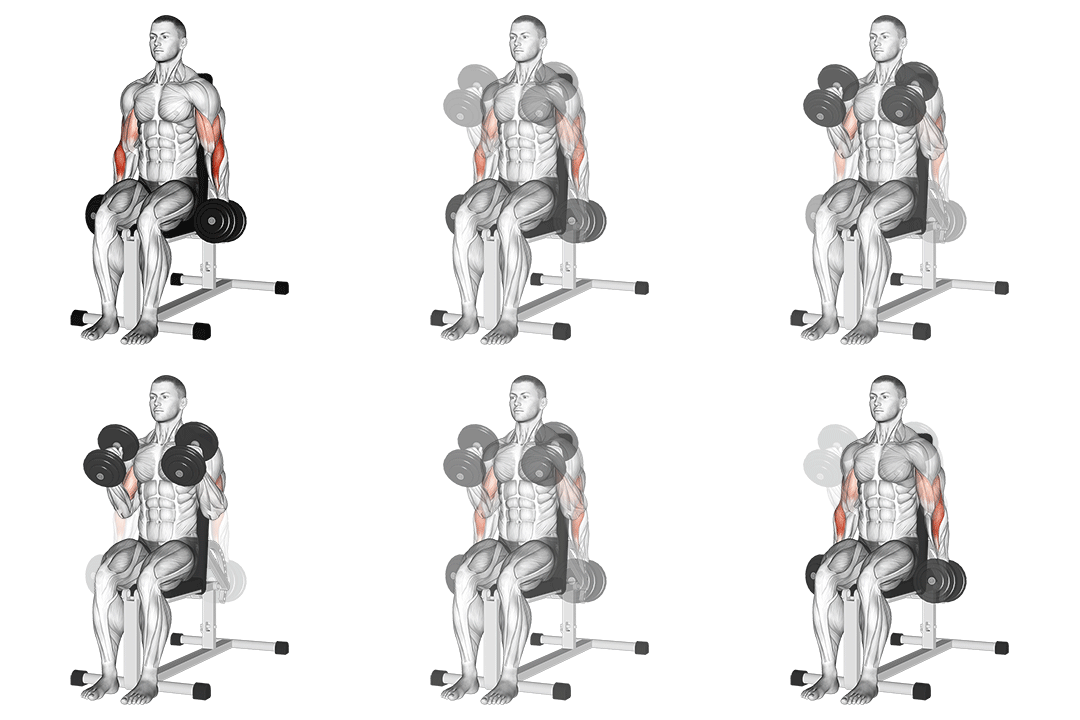
Sitting takes the legs and hips out of the lift, which makes it harder to cheat. Use the seated hammer curl if you catch yourself swinging the weight when you stand.
Preacher Hammer Curl
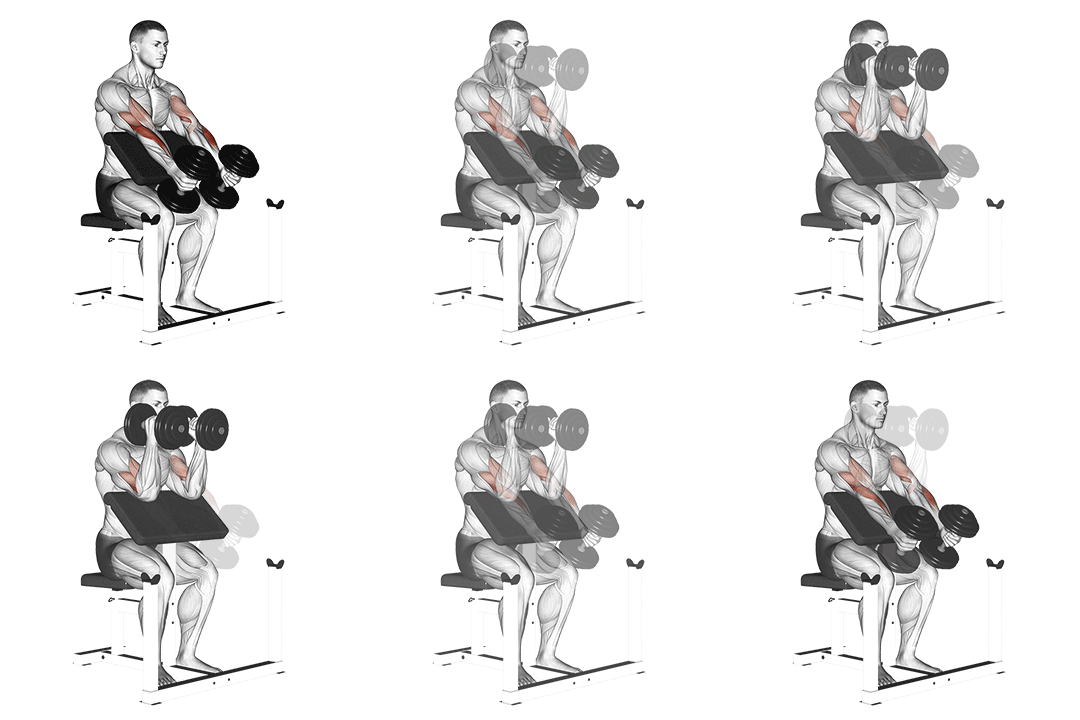
Your upper arms rest on an angled pad, so they cannot move, and the bottom of the curl gets harder. The dumbbell hammer preacher curl suits lifters who want strict isolation.
Cable Rope Hammer Curl
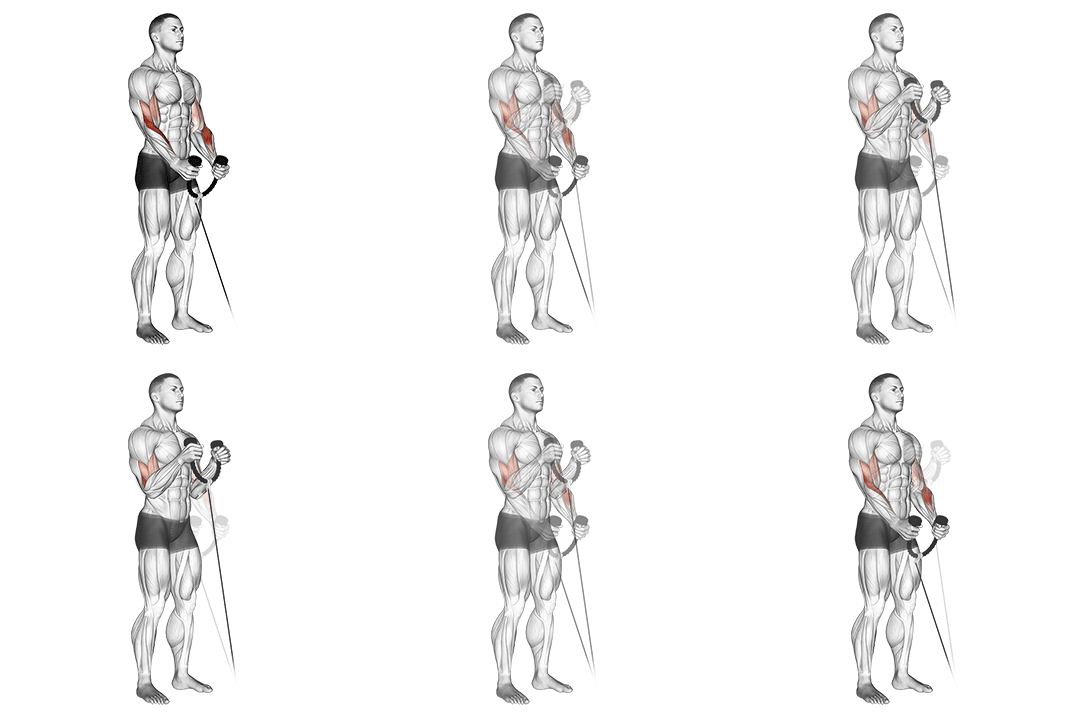
A dumbbell gets easier near the top of the curl, where the forearm is close to vertical. A low cable keeps pulling through the whole range, so the cable hammer curl with a rope holds tension on the muscles from start to finish.
Training with kettlebells only? Use the kettlebell hammer curl. No free weights at all? Our dumbbell hammer curl alternatives page lists swaps by equipment.
Hammer Curl Sets and Reps
| Goal | Sets | Reps | Rest |
|---|---|---|---|
| Strength | 3-4 | 6-8 | 2-3 min |
| Hypertrophy | 3-4 | 8-12 | 1-2 min |
| Endurance | 2-3 | 12-15 | 30-60 sec |
Muscle growth can be achieved across a wide range of loads (Schoenfeld et al., 2021), so pick the rep range that lets you stay strict. For most lifters that is 8 to 12 reps. Very heavy hammer curls tend to turn into swings. Finish most sets with 1 to 2 reps left in reserve.
Start with a weight you can curl 12 times without your elbows leaving your sides, and move up when every set reaches the top of the range. For targets by bodyweight and training level, see our hammer curl strength standards.
Hammer curls count toward your weekly biceps volume, and muscle growth rises with the number of weekly sets per muscle (Schoenfeld et al., 2017). If hammer curls are your only curl, use the table. If you also do palms-up curls, 2 to 3 sets once or twice a week is enough.
Do them after your back exercises, since rows and pull-ups have already warmed up the elbow flexors, or on arm day after your palms-up curls. On a dumbbell-only day they fit into an upper body dumbbell workout the same way.
Hammer Curl FAQs
Do hammer curls make your arms bigger?
Yes, when you train them hard and add weight or reps over time. They work all three elbow flexors. The brachialis in particular lies under the biceps, so growth there adds thickness you can see from the front.
Do hammer curls work the forearms?
Yes. The brachioradialis makes up much of the upper forearm and is a prime mover in this lift, and the finger and wrist flexors work to hold the dumbbell. For complete forearm training, add a palms-down movement such as the barbell reverse curl.
Should you curl both arms together or one at a time?
Both work. Curling both arms together is quicker and keeps the load balanced on your torso. Alternating lets you concentrate on one side and gives each arm a short rest between reps, which helps when your grip is the limiting factor.
How often should you do hammer curls?
Once or twice a week is enough for most lifters. Count hammer curls alongside your other curls when you add up your weekly sets for the elbow flexors.
Why do I feel hammer curls in my shoulders?
Your elbows are probably moving forward as you curl. The front of the shoulder already works harder with a neutral grip than with a palms-up grip (Coratella et al., 2023), and letting the upper arm lift adds to it. Lower the weight and keep your elbows under your shoulders.
References:
Coratella, G. et al. (2023). Biceps brachii and brachioradialis excitation in biceps curl exercise: Different handgrips, different synergy. Sports, 11(3), 64. PubMed
Schoenfeld, B.J. et al. (2021). Loading recommendations for muscle strength, hypertrophy, and local endurance: A re-examination of the repetition continuum. Sports, 9(2), 32. PubMed
Schoenfeld, B.J. et al. (2017). Dose-response relationship between weekly resistance training volume and increases in muscle mass: A systematic review and meta-analysis. Journal of Sports Sciences, 35(11), 1073-1082. PubMed
Interested in measuring your progress? Check out our strength standards for Bench Press, Squat, Deadlift, and more exercises.