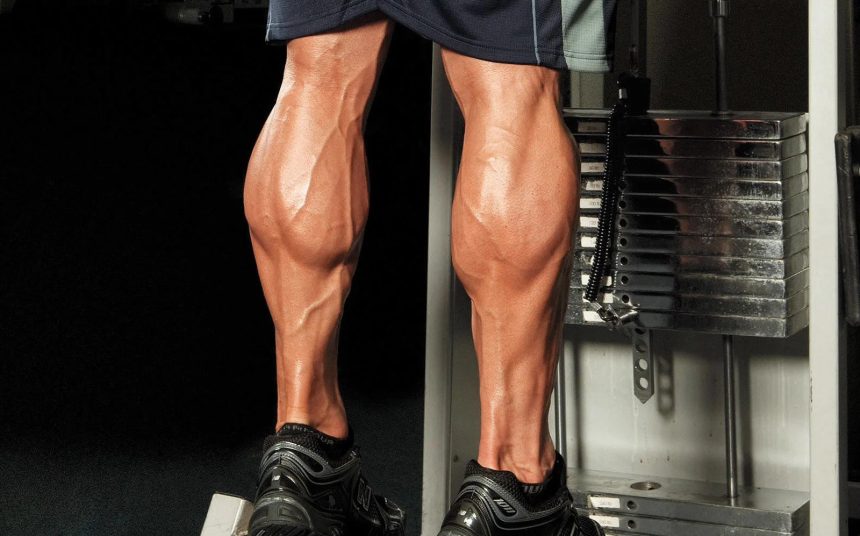
If your calves won’t grow, look at which calf raise you do most.
In a 2023 study, researchers had 14 untrained adults train one leg with standing calf raises and the other with seated calf raises for 12 weeks. The standing leg grew more: the gastrocnemius, the big calf muscle you see from behind, grew 9 to 12% on the standing side and barely at all on the seated side, while the soleus grew about the same on both legs (1). This 30-minute workout puts standing raises first and gives seated raises a smaller job.
30-Minute Calf Workout: Overview
Your calf is two main muscles. The gastrocnemius crosses both your knee and your ankle, so it works hardest when your knee is straight. The soleus sits underneath it and works whether your knee is straight or bent. That’s why seated raises, with your knee at 90 degrees, mostly train the soleus.
The authors concluded that training the gastrocnemius at a long muscle length, which a straight knee gives you, promotes growth. The two-second pause at the bottom of every rep below is our rule, not theirs: it stops you bouncing out of the stretch.
Do this workout twice a week, either at the end of a leg day or on its own. Warm up with 5 minutes of easy cardio and a set of 20 bodyweight calf raises.
| 30-Minute Calf Workout | ||||
| # | Exercise | Sets | Reps | Recovery |
| 1 | Standing calf raise | 4 | 8-12 | 90 seconds |
| 2 | Single-leg dumbbell calf raise | 2 | 10-12 per leg | 30 seconds |
| 3a | Seated calf raise | 3 | 12-15 | 60 seconds |
| 3b | Tibialis raise | 15-20 | ||
| 4 | Bodyweight calf raise burnout | 1 | AMRAP | N/A |
Exercises 3a and 3b are a superset. Do a set of seated calf raises and then, without resting, a set of tibialis raises. Rest for 60 seconds, then repeat the pair twice more.
That’s 9 hard sets for your calves, plus the burnout. A review on time-efficient training recommends at least 4 weekly sets per muscle group (2). The superset pairs opposing muscles, and a 2025 meta-analysis found that pairings like this let lifters complete more reps than straight sets in less time (3).
30-Minute Calf Workout: Exercise Instructions
Calves are easy to cheat with a bounce. Every rep in this workout starts from a dead stop in the stretched position: lower slowly, pause for two seconds at the bottom, then rise all the way up onto your toes.
1. Standing calf raise
The standing calf raise is the exercise that produced the growth in the 2023 study, so it gets the most sets and the heaviest load. Use a standing calf machine or a Smith machine with a plate or step under the balls of your feet.
How to do it:
- Stand on the platform with the balls of your feet on the edge and your heels hanging off. Set the shoulder pads so your legs are straight when you stand tall.
- Keep your knees straight but not locked.
- Lower your heels as far as you can, until you feel a deep stretch in your calves. Pause for two seconds.
- Push through the balls of your feet and rise as high as you can.
- Squeeze at the top for a second, then lower slowly and repeat.
2. Single-leg dumbbell calf raise
Training one leg at a time lets a single dumbbell load each calf hard, and it stops your stronger side from doing more of the work. Our one-leg dumbbell calf raise guide covers the movement in more detail.
How to do it:
- Hold a dumbbell in one hand and stand on a step with the ball of the same-side foot on the edge. Hold a rail or wall with your free hand for balance.
- Hook your other foot behind your working ankle.
- Lower your heel into a full stretch and pause for two seconds.
- Rise as high as you can onto the ball of your foot.
- Do all your reps on one leg, then switch. Rest for 30 seconds after both legs.
3a. Seated calf raise
With your knee bent, the seated calf raise takes most of the gastrocnemius out of the movement and puts the soleus to work. It’s the smaller job in this workout, so it gets moderate weight and higher reps.
How to do it:
- Sit in a seated calf raise machine with the pads on your lower thighs and the balls of your feet on the platform.
- Release the safety bar and lower your heels into a full stretch. Pause for two seconds.
- Push up onto your toes as high as you can.
- Lower slowly and repeat, then go straight to the tibialis raises.
3b. Tibialis raise
The tibialis raise trains the tibialis anterior, the muscle on the front of your shin that lifts your toes. It does the opposite job to your calves, so it pairs well with seated raises in a superset.
How to do it:
- Lean your back against a wall with your heels about a foot in front of it.
- Keep your legs straight and lift your toes as high as you can toward your shins.
- Lower them under control without letting them touch the floor, and repeat.
4. Bodyweight calf raise burnout
Finish with one set of bodyweight calf raises on a step, to failure. Take three seconds to lower on every rep. When you can’t rise any higher, hold the bottom stretch for 20 seconds.
More Calf Workouts:
- 15 Best Calf Exercises for Massive Lower Legs + Workouts
- The 11 Most Effective Calf Raise Exercises
- Why Your Calves Are Skinny and How to Fix Them
- Calf Workouts With Dumbbells
- Donkey Calf Raise
- Do Squats Work Your Calves?
30-Minute Calf Workout: Wrapping Up
Calves grow when you give them the same things as any other muscle: heavy sets, full range of motion and enough volume. The 2023 study adds one more rule: keep your knees straight for most of your sets.
Give this workout eight weeks, twice a week. Add weight to the standing calf raise whenever you hit 12 clean reps with the two-second pause on every set.
References
Fitness Volt is committed to providing our readers with science-based information. We use only credible and peer-reviewed sources to support the information we share in our articles.
- Kinoshita, M., Maeo, S., Kobayashi, Y., Eihara, Y., Ono, M., Sato, M., et al. (2023). Triceps surae muscle hypertrophy is greater after standing versus seated calf-raise training. Frontiers in Physiology, 14, 1272106. DOI: 10.3389/fphys.2023.1272106. PMID: 38156065.
- Iversen, V. M., Norum, M., Schoenfeld, B. J., & Fimland, M. S. (2021). No Time to Lift? Designing Time-Efficient Training Programs for Strength and Hypertrophy: A Narrative Review. Sports Medicine, 51, 2079-2095. DOI: 10.1007/s40279-021-01490-1. PMID: 34125411.
- Zhang, X., Weakley, J., Li, H., Li, Z., & García-Ramos, A. (2025). Superset Versus Traditional Resistance Training Prescriptions: A Systematic Review and Meta-analysis. Sports Medicine, 55, 953-975. DOI: 10.1007/s40279-025-02176-8. PMID: 39903375.