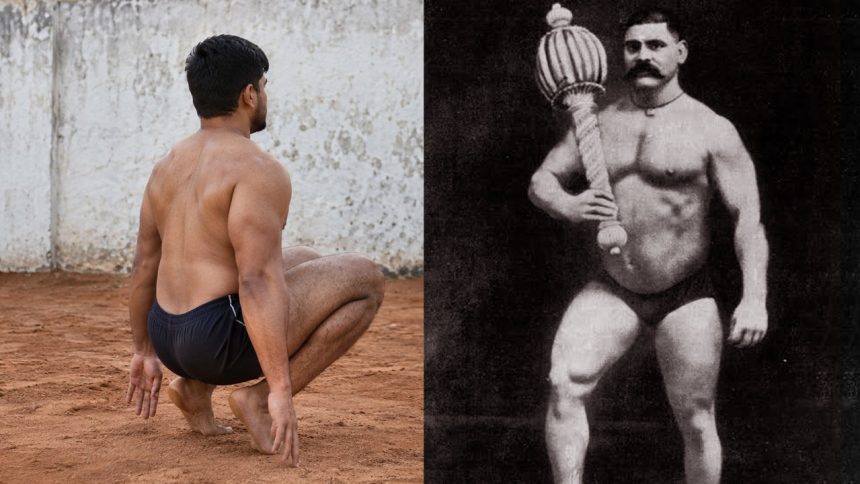
The Great Gama is remembered as the wrestler nobody beat, and he built his legs without a single machine. The centre of his training was the bethak, the deep bodyweight squat now known as the Hindu squat, which he did every day from the age of ten.
You don’t need his numbers. The squat takes no equipment and under 10 minutes. For a bigger one-rep max, heavy weights still win, but research on bodyweight and light-load training suggests hard sets like these can build muscle.
Who was the Great Gama?
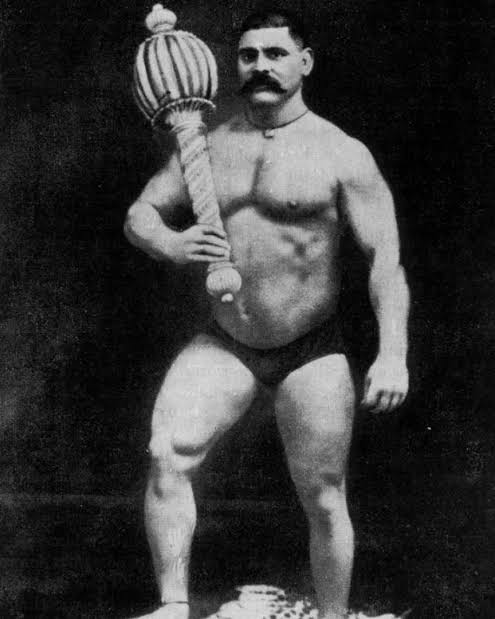
Gama Pehlwan was born on May 22, 1878, into a family of wrestlers in what was then British India. He stood 5 feet 8 inches and weighed about 196 pounds when he travelled to London in 1910, by one account too small to be entered in the heavyweight tournament he had come for. He challenged the field anyway.
Anthropologist Joseph Alter, who studied Indian wrestling for decades, describes what happened next. Gama wrestled the Polish wrestler Stanislaus Zbyszko for about three hours and had the upper hand when the bout was stopped for the day. Zbyszko did not come back the next day, and Gama was declared the winner. By Alter’s 1995 account, they met again in Patiala in January 1928, and Gama won in 42 seconds.
Google marked his 144th birthday in 2022 with a Doodle saying he “remained undefeated throughout his international matches.” That unbeaten record included draws: Alter describes three drawn bouts with his rival Rahim Sultaniwala.
The squat Gama did every day
The bethak was part of his training from childhood. Around 1888, the ruler of Jodhpur held a national exercise competition, and the main contest was who could do the most bethaks. More than 400 wrestlers entered. Gama was ten. After several hours, only 15 men were still squatting, and the ruler stopped the contest and named the boy the winner. Asked how many he had done, Gama said he could not remember, but probably several thousand. He spent the next week in bed.
His reported daily totals climbed from there:
| When | Reported Hindu squats (bethaks) a day | Also in the routine |
|---|---|---|
| Age 10 | 500 | 500 dands (Hindu push-ups) |
| About age 15 | 3,000 | 1,500 dands and a one-mile run wearing a 120-pound stone ring |
| 1908, age 30 | 5,000 | 3,000 dands and wrestling with 40 training partners |
| Age 50 | 6,000 | 4,000 dands |
These figures come from Gama’s Indian biographers, as collected by Alter in the journal Iron Game History. Nobody counted them independently, and Alter himself notes the hyperbole that surrounds Gama’s story. What the accounts agree on is the method: the squat was done every day, fast, in sets of 100. One description has him jumping back and forth as much as a foot as he squatted.
How to do the Hindu squat
The Hindu squat differs from a gym squat in two ways. Your heels lift off the floor as you go down, and your arms swing to keep a rhythm. You need a clear patch of floor with room to swing your arms.
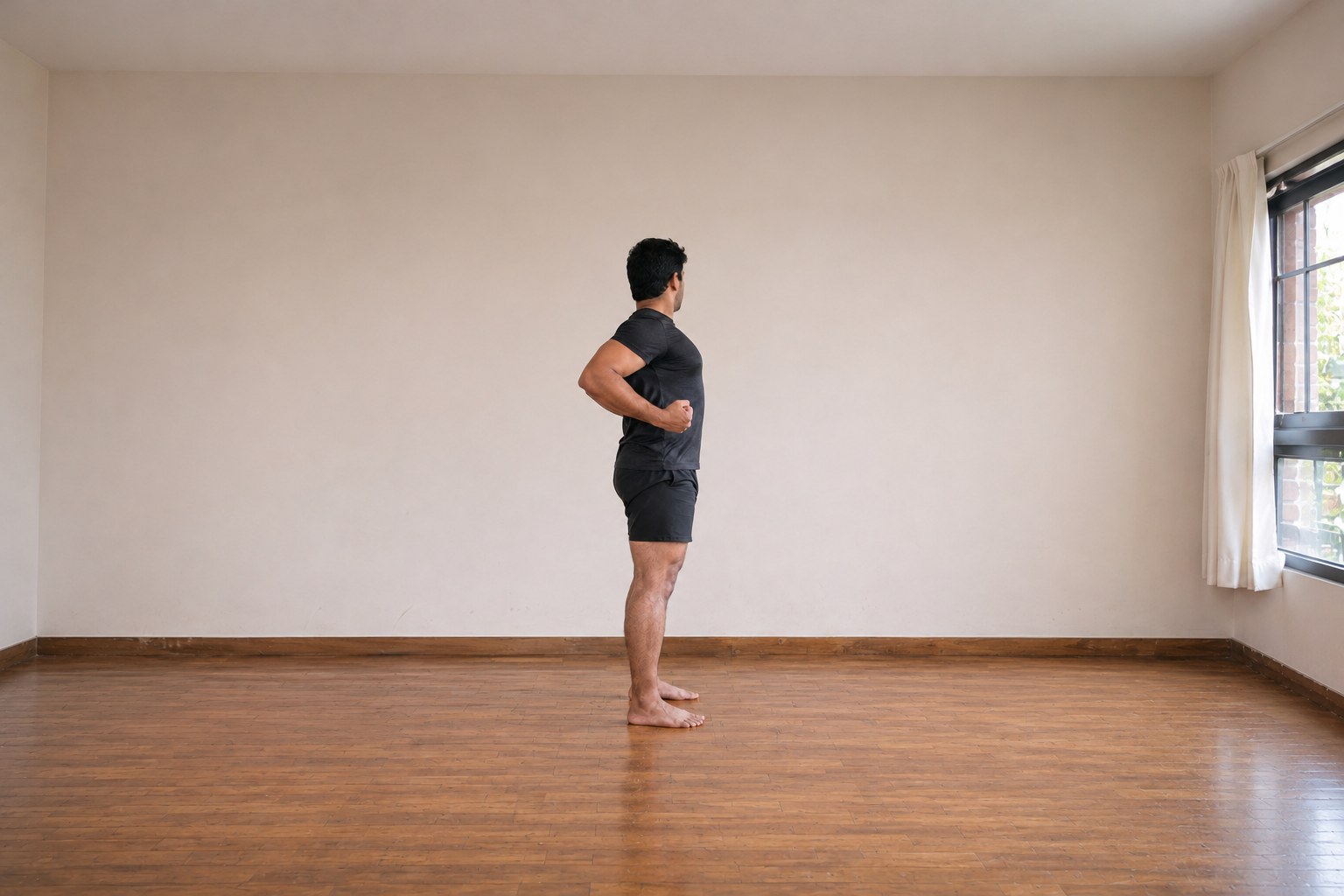
- Stand with your feet about shoulder width apart. Pull your elbows back so your hands sit in loose fists beside your lower ribs.
- Drop your hips straight down. As you sink, let your heels rise and your knees travel forward over your toes, and swing your arms down and behind you.
- At the bottom you are on the balls of your feet, hips close to your heels, chest up, with your hands reaching back toward your heels.
- Push through the balls of your feet to stand, swinging your arms forward and up to chest height.
- As your heels touch down, pull your elbows back to the start. That is one rep. Move straight into the next.
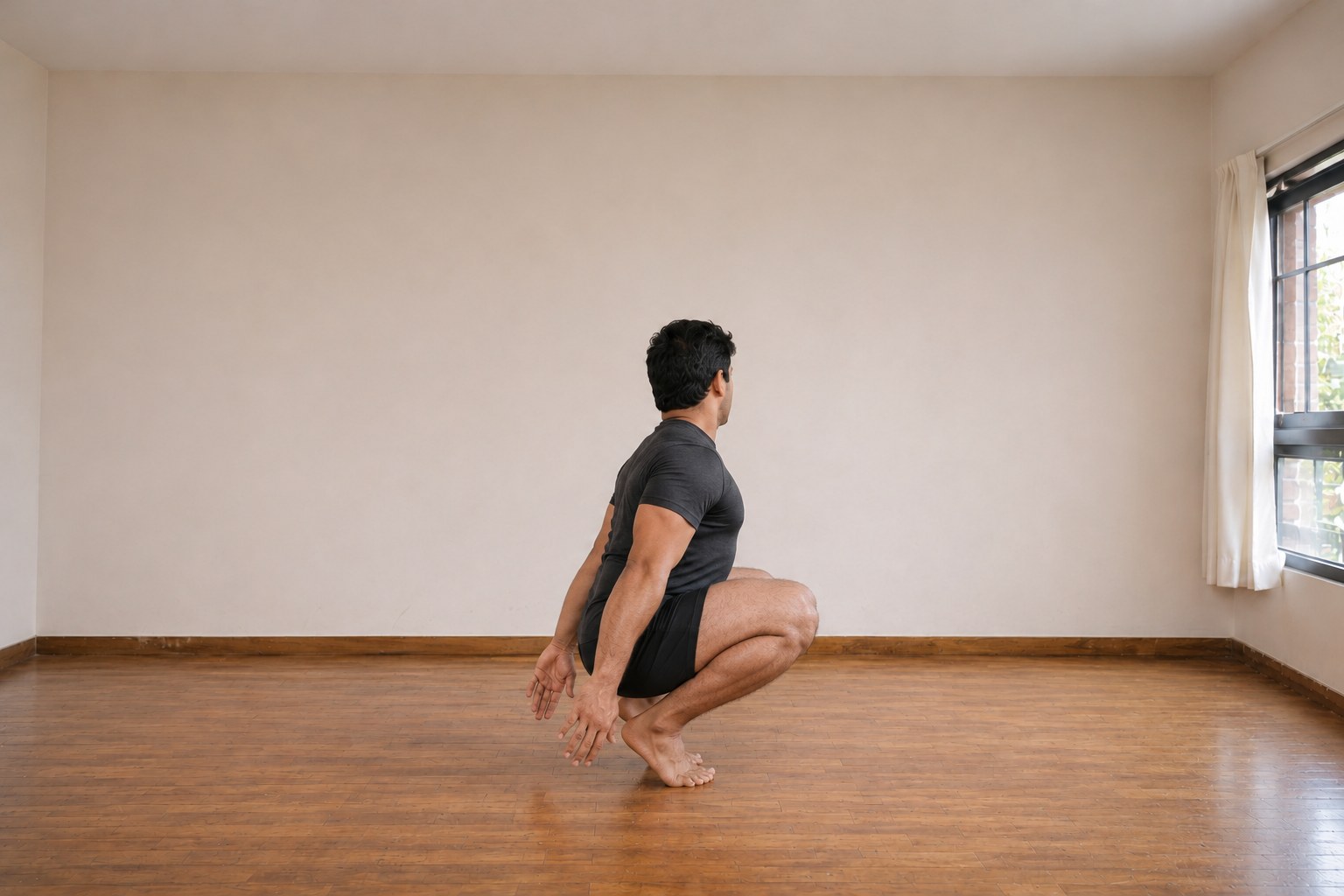
Keep a steady rhythm of about one rep every two seconds. If your balance goes, slow down or go only as deep as you can control. Our Hindu squat guide covers the common variations in more detail.
The quads do most of the work, because your knees bend fully and travel forward. Your glutes help you stand up, and your calves work on every rep because you rise onto the balls of your feet. Done for long sets, the move also leaves you breathing hard, so it trains your stamina along with your legs.
Can the Hindu squat replace the leg press?
No study has put the Hindu squat against the leg press. The evidence compares bodyweight leg training with heavy barbell squats, and light loads with heavy ones.
A 2023 trial put 13 sedentary young women on either a progressive bodyweight leg program or barbell back squats at 60 to 80 percent of their max, twice a week for six weeks. Both groups gained knee strength and added muscle thickness in the glutes and calves, and the study found no significant difference between them. The thigh measurements were less clear. It was a small study in beginners, so read it as a sign that bodyweight leg training works when you are new to it.
The wider research points the same way. A 2017 meta-analysis of 21 studies compared light loads with heavy loads. Muscle growth was similar with both. Maximal strength was different: the heavy-load groups gained more on one-rep-max tests.
If you train at home, the Hindu squat is a sound stand-in for muscle and stamina, with the caveat that these studies do not show it equals the leg press. If you train in a gym and want a heavier one-rep max, keep the heavy work and add one or two sets of Hindu squats after your main lifts. Our breakdown of the squat versus the leg press compares the two main gym leg builders.
There is one catch. Every study in that review took its sets to failure. Once 20 Hindu squats feel easy, a set of 20 ends a long way short of that. That is why the plan below keeps adding reps.
Who should modify or skip the Hindu squat
The raised heels and forward knees put more of the work on the quads and the knee joint. In one study of seven weight-trained men doing barbell squats, letting the knees travel past the toes raised the turning force at the knee by about 28 percent compared with holding them back. That study did not test Hindu squats, so it cannot say how large the effect is here. A review that drew on more than 160 papers was reassuring about deep squats in general: it found no added injury risk for healthy knees when the squat is learned properly and loaded gradually. Neither settles the question for this exact move, so stop if it causes knee pain.
- Pain at the front of the knee: skip the Hindu squat for now. Use flat-footed air squats to a depth that doesn’t hurt, or wall sits.
- Shaky balance: hold a door frame or the back of a chair with one hand until the heel lift feels steady.
- New to exercise: spend two weeks on air squats first, then start the plan at week 1.
- Pain during the plan: stop and drop back a week. Pain that stays or spreads is a reason to see a doctor or physical therapist.
The 4-week Hindu squat plan
Do this three days a week with a day off between sessions, for example Monday, Wednesday and Friday. Gama squatted daily, but he had built up to it since he was ten. Three days a week gives your knees and calves a rest day while the reps climb. Each session takes under 10 minutes. Rest 60 seconds between sets.
| Week | Sets and reps | Total reps per session |
|---|---|---|
| 1 | 3 sets of 10 | 30 |
| 2 | 3 sets of 15 | 45 |
| 3 | 4 sets of 15 | 60 |
| 4 | 4 sets of 20 | 80 |
The last few reps of each set should feel hard. If your first session felt easy, move to week 2 next time. If you can’t finish a week’s reps with good form, repeat that week before you move on.
After week 4, test yourself with one unbroken set and write the number down. Then pick a path. To chase Gama’s numbers, do that one set three days a week and add five reps each week. A single set of 50 is a strong first goal, and 100 in one set is the standard his accounts describe. To keep sessions short, use the changes below.
How to make it harder without adding reps
These changes make each set hard again in fewer reps:
- Lower slowly: take three seconds to go down and stand up at normal speed.
- Pause at the bottom: hold for two seconds on the balls of your feet before you stand.
- Add a half rep: go down, come halfway up, go back down, then stand. That counts as one.
- Add load: wear a backpack with a few books in it. Start with about 10 pounds.
Change one thing at a time and drop your reps by about a third when you do.
Common questions
Can I do Hindu squats every day like Gama?
Not at the start. Gama had trained daily since childhood. Run the three-day plan first. Once week 4 feels comfortable and your knees are pain-free, add a fourth day and see how you recover before adding more.
Are Hindu squats bad for your knees?
Research on deep squats in general has not found a higher injury risk for healthy knees, but no study has tested the Hindu squat itself. Forward knee travel raised the load on the knee in one barbell-squat study, so build up slowly and skip the move if the front of your knee already hurts.
Should I do Hindu squats barefoot or in shoes?
Either works. Bare feet or flat, thin-soled shoes make it easier to balance on the balls of your feet than thick, soft running shoes.
How fast should I do them?
Start at about one rep every two seconds. Accounts of Gama say he did his faster than most wrestlers, in sets of 100. Speed up only when your form holds.
The bottom line
The Hindu squat was the centre of Gama’s daily training and needs only floor space. Take sets close to failure and research suggests it can build leg muscle. For a heavier one-rep max, keep lifting heavy. Start with three sets of 10 this week.
Sources
- Alter, J. S. (1995). Gama the world champion: Wrestling and physical culture in colonial India. Iron Game History, 4(2), 3-9.
- Alter, J. S. (1992). The Wrestler’s Body: Identity and Ideology in North India. University of California Press.
- Google. (2022, May 22). Gama Pehlwan’s 144th birthday. Google Doodles. Accessed November 16, 2026.
- Wei, W., Zhu, J., Ren, S., Jan, Y. K., Zhang, W., Su, R., & He, L. (2023). Effects of progressive body-weight versus barbell back squat training on strength, hypertrophy and body fat among sedentary young women. Scientific Reports, 13(1), 13505. DOI: 10.1038/s41598-023-40319-x. PMID: 37598268.
- Schoenfeld, B. J., Grgic, J., Ogborn, D., & Krieger, J. W. (2017). Strength and hypertrophy adaptations between low- vs. high-load resistance training: a systematic review and meta-analysis. Journal of Strength and Conditioning Research, 31(12), 3508-3523. DOI: 10.1519/JSC.0000000000002200. PMID: 28834797.
- Fry, A. C., Smith, J. C., & Schilling, B. K. (2003). Effect of knee position on hip and knee torques during the barbell squat. Journal of Strength and Conditioning Research, 17(4), 629-633. PMID: 14636100.
- Hartmann, H., Wirth, K., & Klusemann, M. (2013). Analysis of the load on the knee joint and vertebral column with changes in squatting depth and weight load. Sports Medicine, 43(10), 993-1008. DOI: 10.1007/s40279-013-0073-6. PMID: 23821469.