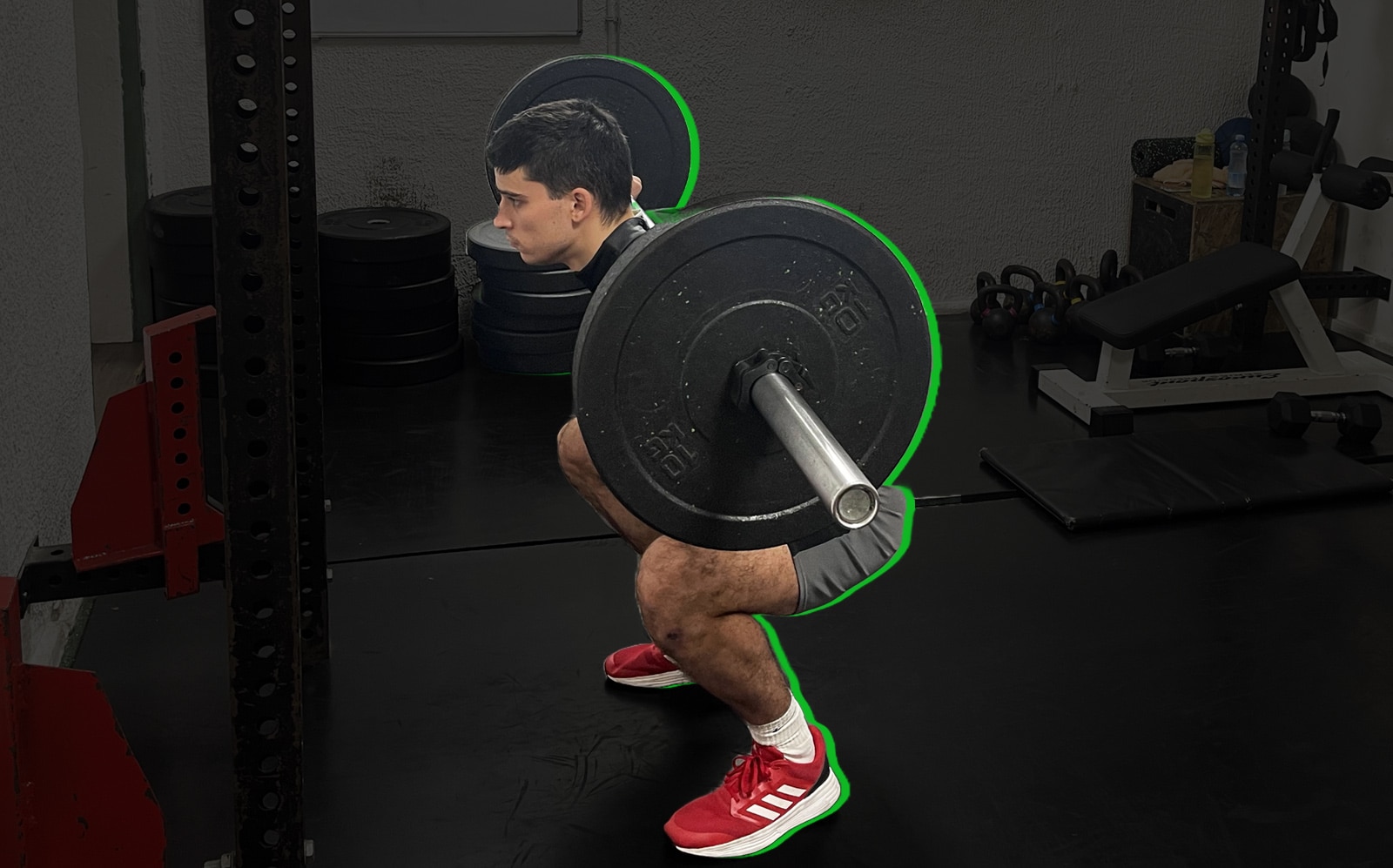
Learn the Definition of Tempo Squats, How to Correctly Perform and Program Them, Their Most Notable Benefits, and Who They Are Best Suited For.
While playing basketball professionally and preparing for the season ahead, I used to implement tempo squats to prepare my musculoskeletal system for the numerous challenges I was about to face.
What do I mean by that?
Well, varying the tempo of your exercises, not just squats, is useful for many reasons. These include better mind-muscle connection, teaching your body how to absorb the force properly, and varying time under tension (TUT).
However, incorporating slow eccentric exercises was something that helped me immensely in increasing my muscle hypertrophy, one of the primary goals of every athlete in development during the offseason.
In fact, one of the studies titled “The Influence of Movement Tempo During Resistance Training on Muscular Strength and Hypertrophy Responses” suggests that slower eccentrics (lowering phase during squats) increases muscle hypertrophy, while faster concentric phase (moving the bar towards the ceiling in this case) is much better for strength and power development. (1)
I regularly implement tempo squats with my clients for numerous reasons. Some of them include better control of muscle hypertrophy, but the most important is correcting bad form and technique. I can better spot which phase of the lift mistakes occur and make sure my clients correct them before getting injured.
How to Perform Tempo Squats
Below, I would take the example of the 2-0-2 tempo, but essentially, all things stay the same; you just add one second to both the eccentric and concentric portions of the lift to get the 3-0-3 or whichever tempo you desire.
Step One — Assume the Starting Position
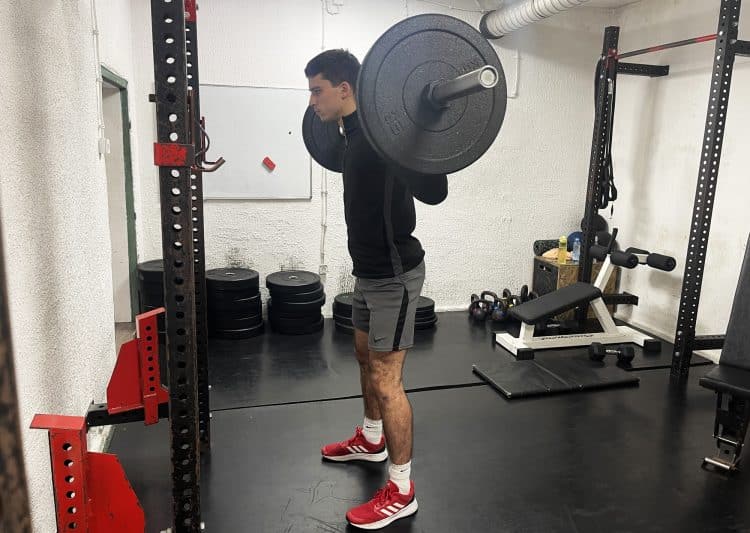
Load the barbell with appropriate weight plates. Place the loaded barbell on your back and take a step back to have enough space to perform the exercise. Assume a shoulder-width stance with your feet, point your toes slightly outward, and ensure your back is strong and your eyes are looking straight ahead of you.
Pro Tip: Slightly flex your knees and contract your core and glute muscles to become more stable and eliminate any possibilities of potential injuries.
Step Two — Perform 2-Second Eccentric
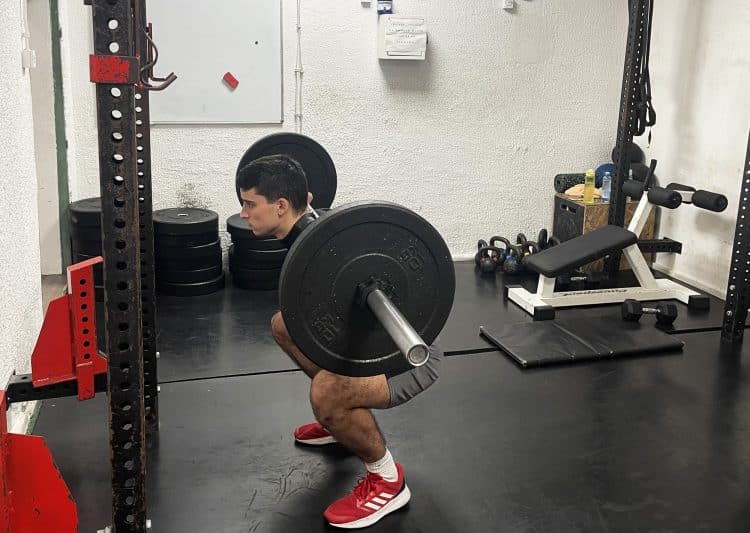
Slowly lower your body towards the floor by initiating triple flexion – flex/bend your hips, knees, and ankles simultaneously. Lower over the course of two seconds.
Pro Tip: Incorporate abdominal breathing so you match the tempo of inhaling with the tempo of the eccentric phase. This will help you perform the exercise with better technique and less chance of injury.
Step Three — Transition From Eccentric to Concentric Phase
When you reach the bottom position, immediately transition to the following step. However, depending on the tempo prescribed, this phase may involve a static hold.
Pro Tip: Actively engage your core and explosively push through your heels, ensuring a seamless and powerful switch while maintaining your form. This rapid shift not only builds strength but also improves your reactive muscle capabilities.
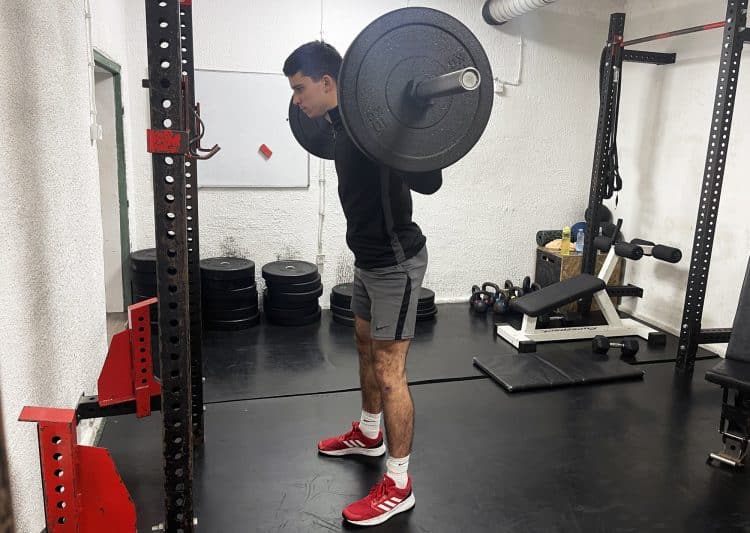
Step Four — Perform 2-Second Concentric
Initiate triple extension to return to the starting standing position; extend your ankles, knees, and hips simultaneously. Take two seconds to come back up.
Pro Tip: Imagine and visualize firing all the muscle fibers in your legs to drive the bar with ease while still focusing on the 2-second tempo.
Watch Vanja Vukas demonstrate the temp squat exercise:
What Are Tempo Squats?
The tempo squat is a modification of the original squat exercise, which allows you to change the amount of time you spend under each of the muscle action or movement phases of the lift.
The most popular tempo squats are 2-0-2 and 3-0-3.
What Is the Definition of Tempo?
In the context of performing exercises, the tempo is the time you dedicate to each phase of the movement. Essentially, there are three muscle actions or movement phases.
Those include:
- Eccentric phase: The working muscle lengthens.
- Isometric phase: When the working muscles generate force without changing their length.
- Concentric phase: The working muscles shorten.
The prime mover is simply the muscle responsible for generating the majority of the force in the movement. You can also think of it as the muscles you want to target with your chosen exercise. Sometimes, the prime mover can be a combination of several muscles.
In the context of squats, think in terms of glutes, quads, and hamstrings; even though some experts may define hams more as a synergistic muscle, the point stays the same.
How to Read Tempo?
To read tempo correctly, you must first know each part of its written form. Essentially, in the fitness space, people represent tempo in either 3 or 4 numbers:
- X-X-X: in this example, the first X defines the time it takes for the eccentric phase, the second one describes the same for the isometric phase, and the third one represents the time it takes for the concentric phase.
- X-X-X-X: Everything is like in the first example, but the fourth X represents the time between two reps.
Consider a tempo of 2-1-2.
This simply means that you will:
- Perform the eccentric phase for 2 seconds.
- Perform the isometric phase for 1 second.
- Perform the concentric phase for 2 seconds.
Also, the isometric phase is always the static portion of the lift between the eccentric and concentric phases.
In the case of squats, that would represent the lowest/bottom squat position, and you would be supposed to hold it for X number of seconds.
How to Program Tempo Squats? (Sets, Reps, Load, and Frequency)
If you are a beginner, start with 3-4 sets of 6-8 reps with around 60-70% of your 1RM. Also, start with the tempo 2-0-2 and, after two to three weeks, proceed with the 3-0-3 tempo. The rest of the intervals between the sets should be at least 2 minutes.
Don’t perform this tempo squat workout more than once a week. You can potentially combine a regular leg workout with this tempo variation, but make sure not to overtrain.
Overtraining syndrome is when you fail to recover from the previous workout sessions, not allowing your muscles to supercompensate (read refill/restock) glycogen (“stored muscle carb/sugar”). (2)
What Are the Benefits of Tempo Squats?
The benefits of tempo squats include better muscle hypertrophy, injury reduction, improved mind-muscle connection, better force absorption during plyometrics, and mastery of exercise form and technique.
Let’s cover each one briefly.
Better Muscle Hypertrophy
Performing a longer eccentric phase, as suggested by the study in my introduction, will increase time under tension (TUT) and cause more muscle tears. This will produce greater muscle protein synthesis to rebuild those damaged fibers, resulting in the enlargement of muscle cells (myofibril).
Injury Reduction (Prevention Sounds Too Optimistic)
Prolonging the tempo of your eccentric phase will ultimately result in greater injury reduction. This is because the eccentric phase is always going against gravity. It teaches you how to absorb the force against gravity properly, which is essential for reducing injuries.
Improved Mind-Muscle Connection
Slow eccentrics and fast concentrics are the best for improving your mind-muscle connection. Slower eccentrics and more time under tension (TUT) will allow you to develop better mind-muscle connection simply because you will “feel” the tension in your muscles more than usual.
On the contrary, going as fast as possible during the concentric phase will fire up those fast-twitch muscle fibers that are “sleeping” and waiting for the right moment to activate.
Better Force Absorption During Plyometrics
Slow eccentrics teach your body how to absorb the force of landing properly and are prerequisites for starting plyometric training.
Performing lower body exercises such as squats, Bulgarian split squats, single-leg Romanian deadlifts, and calf raises with controlled eccentrics will teach your body how to absorb substantially more force. This translates nicely during the landing phase of different plyometric exercises. Think in terms of box jumps, drop jumps, hurdle jumps, and similar.
Mastering Exercise Form and Technique
Changing the tempo of your exercise will help you master the form and technique correctly.
Slower eccentrics will improve your mind-muscle connection, which results in technique mastery and better movement stereotype formation. Movement stereotype formation is developing a consistent and efficient way of performing a specific movement or action through repetition and practice.
In addition, fast concentrics will teach your body how to explosively perform the last portion of the exercise, mastering the final aspect of the movement.
Who Should Use the Tempo Squat in Their Training?
Powerlifters, athletes, and Olympic lifters should use tempo squats in their training regime.You can easily reduce the chance of injuries, which is immensely important in professional sports.Also, improving your mind-muscle connection will help you execute biomechanically similar movements with ease and greater precision.
Where Can I Learn More About Tempo Workouts?
If you want to learn more about tempo workouts, read the book by Ben Peterson, a physiologist, and Cal Dietz, a strength and conditioning specialist.The name of the book is “Triphasic Training: A Systematic Approach to Elite Speed and Explosive Strength Performance,” and you can order it from their official website or through Amazon.
This book is invaluable and will teach you everything you need to know about tempo training and how to program your workouts for outstanding athletic performance.If you are not an athlete, there is still a substantial amount of value packed in the book, and you will be able to implement their philosophies in your regular workout sessions.
FAQs
1. What is a tempo squat hold?
A tempo squat hold is a squat phase where you hold the bottom position of the squat for a predetermined amount of time. This is also called an isometric squat. Isometrics can help increase static and dynamic strength while minimizing joint wear and tear.
2. What does the ‘X’ signify in tempo exercise prescriptions?
In tempo prescriptions, an ‘X’ indicates that the specified phase of the exercise is performed explosively or as fast as possible. This approach focuses on developing power and speed by emphasizing rapid muscle contraction.
3. What is a 2-2-2 tempo?
2-2-2 tempo is when you perform the eccentric phase for 2 seconds, the isometric phase for 2 seconds, and the concentric phase for 2 seconds.
4. What is a 3-0-X-1 tempo squat?
A 3-0-X-1 tempo squat is a tempo squat variation where you:
- Perform the eccentric for 3 seconds
- Don’t pause at the bottom squat position
- Perform the concentric as explosively as possible
- Pause 1-second between reps
Wrapping Up
Tempo squats are an invaluable squat modification used for numerous reasons. These include increasing muscle hypertrophy and strength, better form and technique mastery, and injury reduction.
The most popular tempo squat variations are 2-0-2 and 3-0-3, with more emphasis on eccentric and concentrics, excluding any time devoted to the isometric phase of the lift.
In the comments below, let me know your thoughts on tempo squats and how you implement them in your workout sessions.
References:
- Wilk M, Zajac A, Tufano JJ. The Influence of Movement Tempo During Resistance Training on Muscular Strength and Hypertrophy Responses: A Review. Sports Med. 2021;51(8):1629-1650. doi:10.1007/s40279-021-01465-2
- Kreher JB, Schwartz JB. Overtraining syndrome: a practical guide. Sports Health. 2012;4(2):128-138. doi:10.1177/1941738111434406
Relevant Articles:
Interested in measuring your progress? Check out our strength standards for Sled Leg Press, Half Squat, Single Leg Squat, and more exercises.