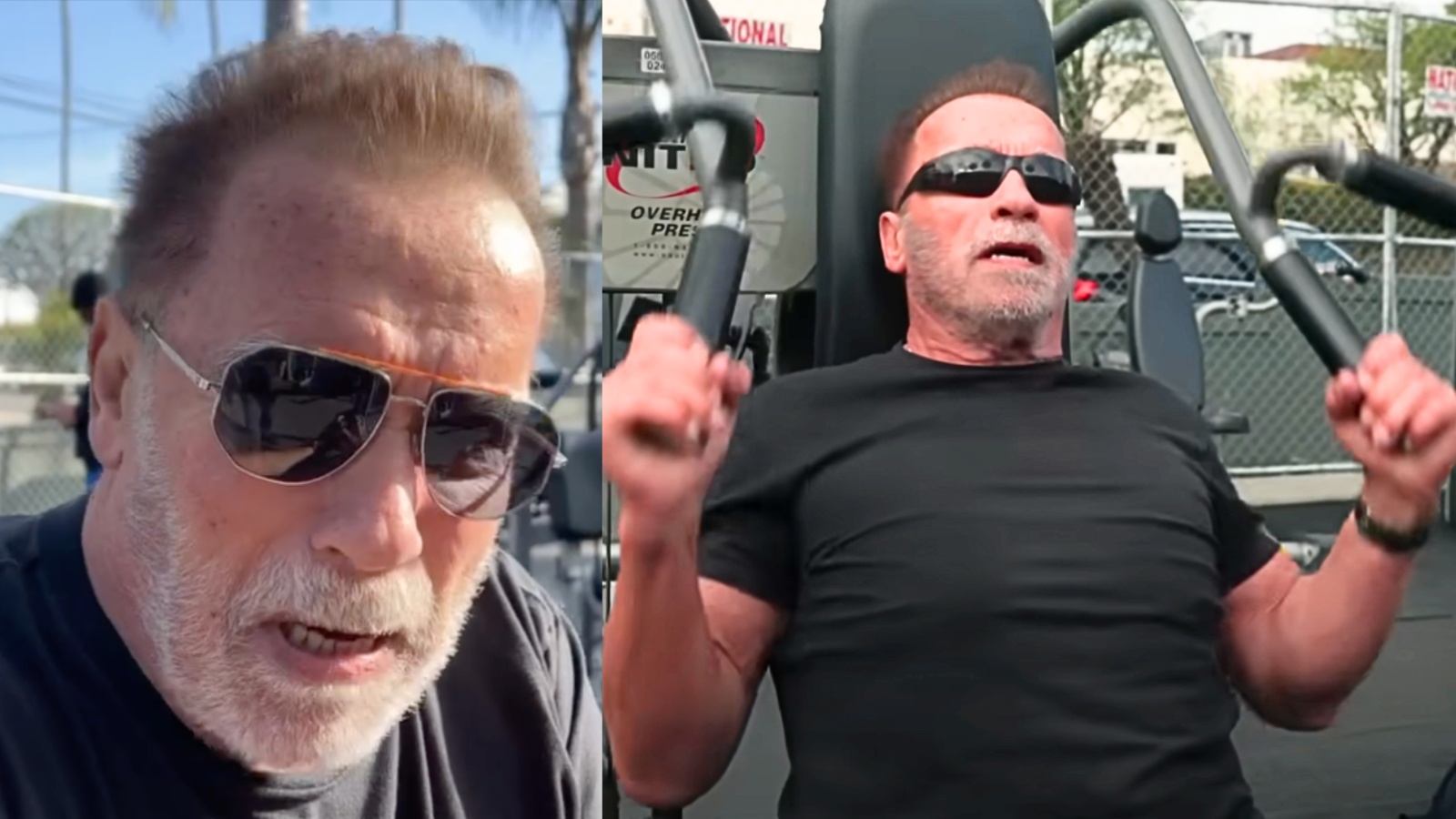
Could pushing for additional reps make a huge difference? According to Arnold Schwarzenegger, it might not. In his latest Arnold’s Pump Club newsletter, released on July 15, 2025, Schwarzenegger revealed that you don’t need to perform extra reps to experience a boost in muscle growth, strength, and metabolic health.
Seven-time Mr. Olympia Arnold Schwarzenegger still hits the gym with intensity, and while he doesn’t lift as heavy as he once did, he still finds new, innovative ways to test himself under iron. An active body is a rested mind, and Schwarzenegger lives by that.
Although he recently had a pacemaker installed, longevity and health remain his biggest drivers in life. Landing on an optimal rep scheme can be challenging, as it depends on individual strength, experience, and energy levels. This has led Schwarzenegger to examine whether more reps will ultimately net you additional gains.
Arnold Schwarzenegger Says You Don’t Need More Reps for Results: ‘Pushing Your Sets to Failure Is What Matters Most’
In the newsletter, Schwarzenegger tackled whether adding more reps to your set could accelerate gym progress. He revealed that performing 10 or 20 reps will still yield similar boosts in muscle growth, strength, and metabolic health.
“Do More Reps Lead To Better Results?
Ever wondered if cranking out 20 reps instead of 10 will supercharge your fitness? A new study puts this gym debate to the test — and the results might surprise you.
No matter if you do 10 or 20 reps per set, you’ll get similar boosts in muscle growth, strength, and metabolic health — assuming you’re pushing yourself to the limit.”
First, scientists examined three groups: one trained with a 10-rep maximum, one with a 20-rep maximum, and another group that didn’t train at all. Researchers found that muscle thickness increased significantly in both training groups.
“Researchers split participants into three groups: one trained with a 10-repetition maximum, another with a 20-repetition maximum, and a control group that didn’t train. Both training groups performed two lower-body workouts per week for six weeks, completing each set to concentric failure — meaning they couldn’t perform another rep with good form.”
“Muscle thickness increased significantly in both training groups, with no meaningful difference between those performing 10 and 20 repetitions. Strength improved across all exercises in both training groups.”
What matters most, beyond rep schemes, is pushing to failure.
“Whether you prefer heavier weights for fewer reps or moderate weights for more reps, pushing your sets to failure is what matters most.
To continue seeing results and prevent plateaus, you need to progress your workouts, allowing you to improve and challenge your muscles.”
Aside from rep ranges, Schwarzenegger emphasized that proper form is essential for progress.
“Instead of asking which style is better, appreciate that there are benefits to both. Heavier loads will make it easier to maximize intensity with less overall fatigue. At the same time, some people feel more confident with lighter loads, which might allow them to push harder.”
“Either way, good form is a necessity, and so is a full range of motion — the stretch and the flex, as Arnold would say — to make the most of every rep.”
If you thought intentionally slow, controlled reps were the key to muscle growth, think again. Schwarzenegger tackled the discussion recently and explained that slower reps didn’t lead to as much muscle growth because they don’t create the mechanical tension needed to maximize hypertrophy.
Schwarzenegger continues to influence his fan base decades after his retirement. Ultimately, he believes chasing failure is more important for muscle growth than simply performing additional reps.