Weight loss and fat burning are often portrayed as complicated and time-consuming. According to all too many fitness and nutrition experts, you need to follow a specialist training program combined with a super-restrictive diet to lean out and get in shape.
I’ve been a personal trainer for more than 35 years and, while I recognize strict diets and complex workouts can be effective, I also know that a simple approach is often better—much better.
That’s because the more complicated a program is, the easier it is to find excuses not to do it. This isn’t laziness or a lack of commitment; it’s just human nature to look for easier solutions to difficult problems.
The bottom line is that, provided you consume fewer kilocalories than you expend, your body has no choice but to burn fat for fuel. This is called a negative energy balance and is the unbreakable rule of effective fat loss (1). Provided you eat less and move more, you WILL burn fat and get lean. It’s the law of thermodynamics in action.
So, instead of trying to leverage too many methods and principles into my exercise and nutrition prescriptions, I focus on getting the best results from the least amount of time, effort, and resources.
This simplicity leads to greater consistency, and consistency is the foundation of success.
One of my most effective weight loss programs is arguably the simplest of all—the kettlebell swing and ruck hybrid. However, don’t let this fool you into thinking that simple means easy; this workout is brutal!
So, are you ready to burn fat faster than ever before? Do you enjoy a challenge? Then lace up your sneakers, grab your kettlebell, and let’s get to work!
Swing and Ruck Workout Overview
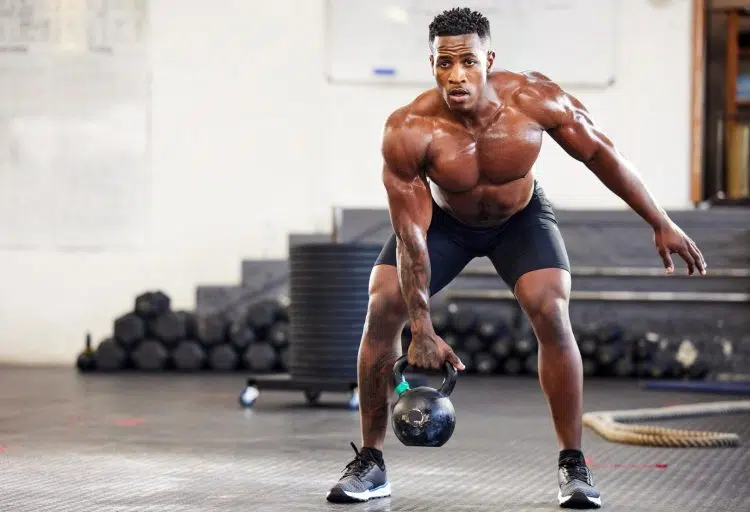
This workout comprises two proven fat loss exercises—kettlebell swings and rucking. While strictly speaking, rucking refers to walking while wearing a loaded backpack or weighted vest, in this instance, I’m using it to describe carrying a heavy kettlebell.
To do the workout, simply perform 20-30 kettlebell swings and then, carrying your kettlebell, walk 100-200 yards. From there, do another set of swings and then walk again. Continue until you have completed one mile. This should take somewhere from 20 to 30 minutes, depending on how fast you walk and how often you need to stop for a rest.
Despite the simplistic nature of this workout, how you perform it will have a huge impact on how effective it is. So, before you head out and do it for the first time, let’s take a more detailed look at the exercises you’ll be doing.
Kettlebell Swings
Kettlebell swings are an explosive exercise that hits your entire posterior chain, which is the collective name for your glutes, hamstrings, and lower back. In addition, kettlebell swings also work your upper back, core, shoulders, and forearms. As such, it burns calories like a furnace.
A set of high-rep kettlebell swings will leave you huffing and puffing like you’ve just finished a set of suicide sprints. But, unlike sprints, swings build muscle as they torch fat.
Your form is critical during swings, and poor performance could lead to serious injury, so make sure you follow these step-by-step instructions to make every rep as safe as possible:
- Hold your kettlebell in front of your hips using an overhand grip.
- Stand with your feet about shoulder-width apart, toes turned slightly outward.
- Brace your core and pull your shoulders down and back.
- Bend your knees slightly, hinge forward from your hips, push your butt back, and lower the kettlebell down between your knees. Do NOT round your lower back.
- Drive your hips forward as if you were doing a standing long jump. Use this momentum to swing the kettlebell forward and up to shoulder level. Keep your arms straight.
- Using your abs and lats, swing the kettlebell back down and hinge at your hips again.
- Transition immediately into another rep.
Pro Tips:
- Men should use a 12-16kg (26-35lbs) kettlebell while women should use an 8-12kg (18-26lbs) kettlebell.
- Swing the kettlebell higher, i.e., above head height if preferred.
- Clench your glutes at the top of each rep.
Kettlebell Rucking
This isn’t strictly speaking a rucking workout as you won’t be wearing a backpack or weighted vest. Rather, it’s more of a weighted carry, which is a little different but no less effective.
In between sets of swings, you simply pick up your kettlebell and carry it 100 to 200 yards until you’re ready to do more swings.
Walking with a weight increases your energy expenditure by a further 10-20% compared to unweighted walking. It also provides a greater challenge for your arms and core. It’ll probably be a toss-up which you find more demanding—the swings or the weighted carries—but doing both in the same workout will kick your butt!
It’s up to you how you carry your load, but I suggest rotating methods to a) spread the fatigue around your body and b) make the workout more varied.
Your options include:
Single-Arm Farmer’s Walk
- Stand side-on to your kettlebell with your feet about hip-width apart.
- Squat down and grab the handle with your nearest hand.
- Brace your core and pull your shoulders down and back.
- Without rounding your lower back or leaning sideways, stand up straight.
- With the weight by your side, walk for the required distance.
- Switch hands set by set.
Single-Arm Waiter’s Walk
- Swing or clean and press your kettlebell overhead to arm’s length.
- Keeping your torso perfectly upright and your arm straight, walk for the required distance.
- Lower the kettlebell carefully to the floor and switch sides set by set.
Goblet Walk
- Stand with your kettlebell between your feet.
- Squat down and grip the vertical handles.
- Curl the weight up to your chest and then stand up.
- Hold the kettlebell close to your body and then walk for the required distance.
Of course, you are free to carry your kettlebell however you want, and switch positions as often as necessary. However, while you can put it down whenever you need a rest, you MUST carry the weight for the entire distance.
Why Do This Workout?
Not sure if the swing and ruck hybrid is worth your time and energy? Consider the following advantages and benefits and then decide!
Huge Energy Expenditure
Cardio workouts generally burn between 400-600 kilocalories per hour. In contrast, the high-intensity nature of the swing and ruck hybrid means that you can achieve a similar energy expenditure in less than half the time.
In addition, this workout will also trigger a significant EPOC (excess post-exercise oxygen consumption) or afterburn effect. This is where your metabolism remains elevated for several hours after you’ve finished training. The higher the EPOC effect, the more fat you’ll burn. Low-intensity cardio does not have such a big effect on EPOC.
Related: Activity-Specific Calorie Calculators
A Full-Body Workout
Between them, swings and weighted carries work just about every muscle in your upper and lower body. From your calves to your forearms via everything in between, this is the epitome of a full-body workout.
Training all these muscles together is what makes this program such an effective kilocalorie burner. In addition, this full-body training effect means you’ll build real-world functional fitness and strength.
Low-Impact Fitness and Fat Loss
While jogging, running, sprinting, and jumping are effective fitness builders and fat burners, there is a downside—they’re also high-impact. High-impact training can cause foot, ankle, knee, hip, and lower back problems, especially for overweight or muscular people.
Kettlebell swings and walking, even with weight, are low-impact activities that, done with good form, are much easier on your joints than jogging and running.

Build Mental Toughness And Determination
This swing and ruck hybrid will challenge your mind as much as your muscles. Like most workouts, it starts off fairly easy, but, as fatigue levels start to increase, you’ll have to dig deep to finish it.
Mental toughness is an often-overlooked personality trait, but it can help make other aspects of your life seem much easier. As we used to say in the Marines, train hard to fight easy—challenging workouts prepare you for everything else that life throws at you.
Very Scalable
If walking a mile with a heavy kettlebell sounds a little daunting, you can easily scale this workout to make it more accessible. Your options include:
- Use a lighter kettlebell
- Do fewer swings per set
- Reduce the distance from one mile to 0.75, 0.5, or even 0.25 of a mile
Providing the workout challenges you, the precise weights and distances don’t really matter. That said, make sure you increase the distance and weight as you get fitter and stronger to ensure your conditioning continues to improve.
Frequently Asked Questions
Do you have a question about this swing and ruck hybrid workout? No problem, because I’ve got the answers. Need more info? Please drop me a line in the comment section below, and I’ll get back to you ASAP!
1. How can I do this workout if I don’t have a kettlebell?
No kettlebell? No problem! You can use a single dumbbell instead. Dumbbell swings are just as effective as the better-known kettlebell swing. Alternatively, you can put a medicine ball in a strong bag and swing/carry that instead. Be creative—there are plenty of things you can use instead of a kettlebell.
2. Can I do a different exercise?
Not a fan of swings? I hear you! Instead, try thrusters, high-pulls, or even bodyweight burpees or air squats. Alternating between a high-intensity exercise and brisk walking—even without equipment—is a great way to burn fat and lose weight. Just apply the principles of this workout to your chosen exercises.
3. How fast should I walk during the weighted carries?
While there is no official speed you need to maintain for the rucking portion of this workout, you should endeavor to walk as fast as you can while maintaining good form and controlling the weight. In fact, the slower you walk, the longer this workout will take and the harder it will feel. My advice? Pick up the pace and get it over with faster!
4. Can I do this workout on a treadmill?
There is nothing wrong with walking on a treadmill—it’s a convenient way to exercise. However, I don’t recommend you do this swing and ruck hybrid on one as it could make it less safe. You might trip and get dragged by the belt, resulting in a nasty friction burn. You could also hit your head on the control consol or handrail. Dropping your kettlebell could damage the machine. Keep this workout where it belongs—outside.
5. How often should I do this workout?
This workout is pretty demanding, so I suggest doing it no more than 2-3 times a week. This will allow enough time for rest and recovery. Feel free to do conventional workouts on the days in between. For example:
- Monday – swing and ruck hybrid
- Tuesday – full-body strength training
- Wednesday – swing and ruck hybrid
- Thursday – rest/stretch
- Friday – full-body strength training
- Saturday – swing and ruck hybrid
- Sunday – rest/stretch
Closing Thoughts
The swing and ruck hybrid proves that fitness doesn’t have to be complicated to deliver serious results. With just one kettlebell and one mile, you’ll torch fat, build strength, and toughen your mind in record time. The challenge is simple, but far from easy—and that’s exactly why it works.
Ready to put it to the test? Grab your kettlebell, hit the pavement, and let me know how your first session goes!
References:
1 – Strasser B, Spreitzer A, Haber P. Fat loss depends on energy deficit only, independently of the method for weight loss. Ann Nutr Metab. 2007;51(5):428-32. doi: 10.1159/000111162. Epub 2007 Nov 20. PMID: 18025815.