A weight sled is one of the simplest conditioning tools you can build. It has no motor, no app, no complicated setup, and no excuse factory. Load it, drag it, push it if the build allows, and let your legs, lungs, and upper back do the work.
The catch is surface and safety. A sled that works on turf may scrape concrete. A tire that drags well on asphalt may bounce on rough gravel. A homemade prowler that looks tough can still have sharp edges, loose plates, or a tow strap that fails under load. This guide keeps the build simple and gives you the decision rules before you waste a Saturday on the wrong version.
What is the easiest DIY weight sled?
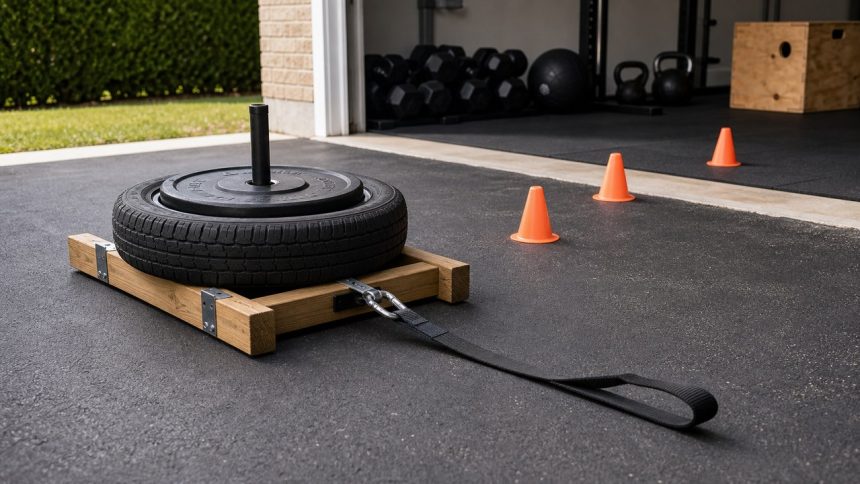
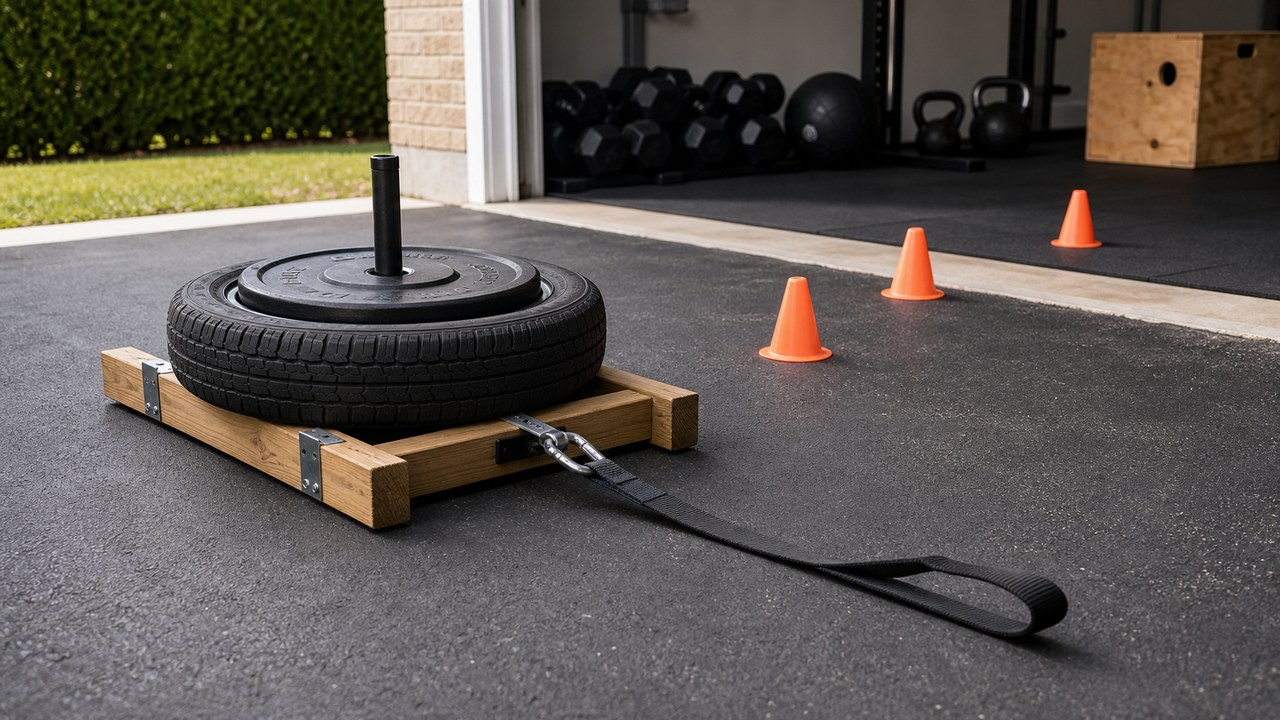
The easiest DIY weight sled is a tire sled with a tow strap, eye bolt, washer, and loading surface. It is cheap, quiet enough for driveways, and hard to break. For most home gyms, it is better than a complicated homemade prowler because pulling is safer and easier to build than pushing.
Start with pulling before pushing. Pulling with a harness, tow strap, or handles keeps the sled low and stable. Pushing requires upright posts, a smoother base, and better fabrication. If you only need conditioning, backward drags, forward drags, rows, and bear-crawl pulls are enough.
What materials do you need?
For a basic tire sled, you need an old tire, a 3/8-inch or 1/2-inch eye bolt, large washers, a lock nut, a tow strap or rope, and a way to secure plates or sandbags inside the tire. Use hardware that is rated for pulling force, not random garage leftovers.
| Part | Best choice | Skip this |
|---|---|---|
| Base | Car tire or low wooden platform | Cracked plastic bins |
| Connection | Eye bolt with washers and lock nut | Thin screws or bent hooks |
| Pull line | Tow strap, climbing-style webbing, or thick rope | Frayed rope or bungee cords |
| Load | Plates, sandbags, or concrete block wrapped safely | Loose bricks or sharp scrap |
| Handles | Sled handles or rope loops | Bare cable or chain in hands |
How do you build a tire sled?
Drill one hole through the tire tread or sidewall, install the eye bolt with large washers on both sides, tighten the lock nut, then clip the strap to the eye bolt. Place the load inside the tire so it cannot bounce out. Test with an empty tire for 20 yards before adding weight.
If the tire flips, the pull point is too high or the load is uneven. If the strap rubs against a sharp edge, move the attachment or add a sleeve. If the tire gouges your surface, stop using it there. A sled is supposed to condition you, not resurface the driveway.
Can you build a wooden sled instead?
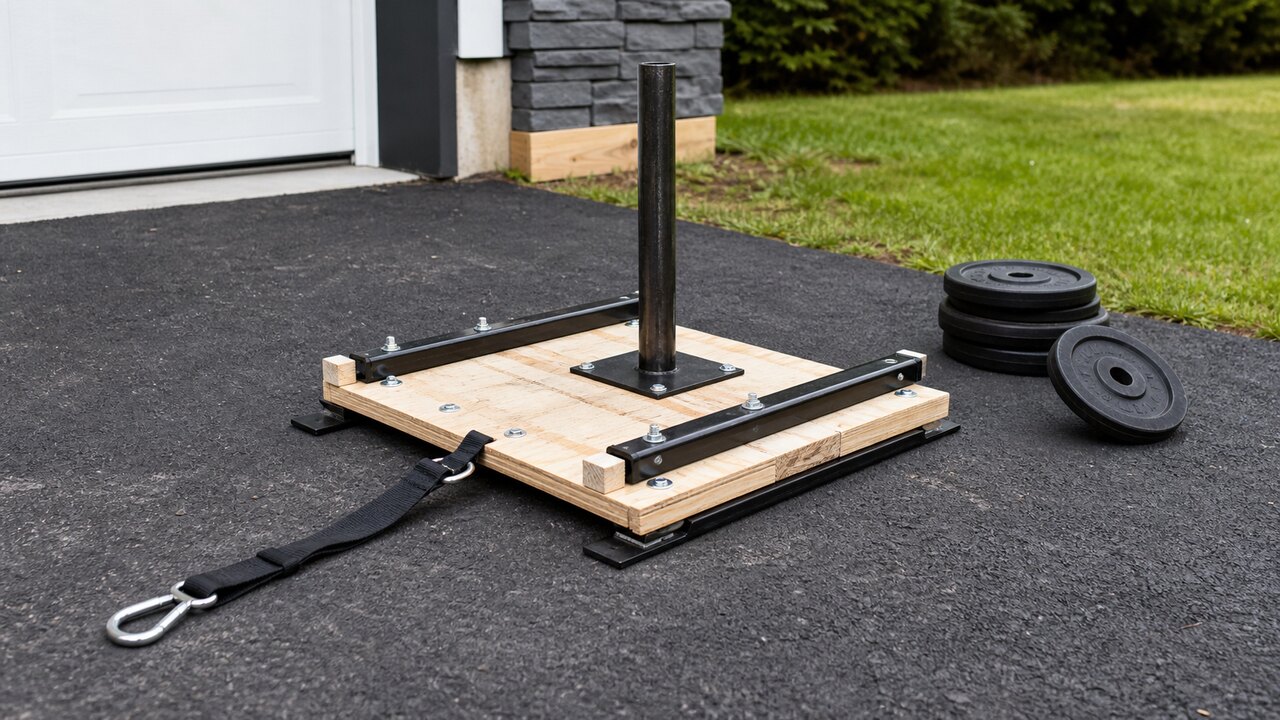
Yes, a low wooden sled works well on grass, turf, carpeted lanes, and some driveway surfaces. Use thick skids, rounded front edges, a central loading post or box, and a low pull point. The lower and wider the base, the less likely it is to tip.
Wood is easier to shape than metal, but it wears faster. Sand every edge, countersink screws, and inspect the bottom after each session. Skip plywood that splinters under load or thin boards that flex when you add plates.
How heavy should the sled be?
Start light. A good first session is 6 to 10 trips of 20 yards with a load you can move without sprinting or grinding. On rough surfaces, 45 pounds can feel heavy. On smooth turf, you may need much more. Surface friction matters as much as plate weight.
Use effort instead of ego: the sled should slow you down but not change your posture into a mess. For conditioning, aim for 20- to 40-yard trips. For strength-focused drags, use shorter trips and longer rests.
What exercises can you do with a DIY sled?
A DIY sled is best for forward drags, backward drags, lateral drags, sled rows, bear-crawl pulls, and low-impact finishers. It trains legs, glutes, calves, upper back, grip, and conditioning without eccentric soreness from lowering weights.
Try this 15-minute finisher: 20-yard forward drag, 20-yard backward drag, 10 sled rows, rest 60 seconds, repeat for 6 rounds. Keep the first round easy. The sled punishes overconfidence quickly.
Where should you use it?
Use the sled on turf, grass, smooth asphalt, rubber lanes, or a driveway you are allowed to mark. Avoid public roads, slick concrete, sharp gravel, crowded sidewalks, and any space where the strap can catch someone walking by.
If you train in a garage, pull from the driveway into the garage only if the transition is smooth. A tire catching on a lip can stop suddenly and yank your arms or hips. If you need indoor conditioning, battle ropes or a step platform may be easier. FitnessVolt already has DIY battle rope ideas and a DIY aerobic step guide for smaller spaces.
What mistakes should you avoid?
The biggest mistakes are using weak hardware, loading loose bricks, dragging on the wrong surface, and starting too heavy. A sled should feel rugged, but rugged is not the same as careless.
- Do not use bungee cords as the pull line.
- Do not drag near cars, pets, kids, or traffic.
- Do not let plates bounce out of the tire.
- Do not sprint before you know how the sled tracks.
- Do not push a DIY sled unless the uprights are built to handle force.
How does it fit into training?
Use sled work 1 to 3 times per week after lifting or on conditioning days. Keep hard sled sessions away from heavy squat or deadlift days if your legs need recovery. For most lifters, 10 to 20 minutes is plenty.
If you are building a full home setup, pair the sled with our home workout equipment guide and renter-friendly gym ideas to decide whether it belongs in your space.
Bottom line
The best DIY weight sled is simple, low, stable, and matched to your training surface. Build a tire sled first unless you truly need a push sled. Use rated hardware, secure the load, start light, and test the pull lane before adding intensity. Done right, it is one of the cheapest ways to make conditioning brutally effective at home.
Sources
- Centers for Disease Control and Prevention. (2024). Adult Activity: An Overview. CDC. Accessed May 30, 2026.
- Petrakos, G., Morin, J. B., & Egan, B. (2016). Resisted sled sprint training to improve sprint performance: A systematic review. Sports Medicine, 46(3), 381-400. doi:10.1007/s40279-015-0422-8. PMID: 26553497.