Most supplement claims collapse under the first good study. This one holds up better than most. A five-gram scoop that costs less than many pre-workouts has human data for strength, lean mass, body-composition changes during resistance training, and cognitive performance under sleep loss.
The powder is creatine monohydrate. Lifters know the name, yet many still use it like a pre-workout, swap to expensive forms, or expect it to burn fat by itself. The evidence points to a narrow and useful playbook: take enough to saturate muscle, train with progressive overload, and keep the health claims inside the lanes the research supports.
Evidence checked: two 2024 meta-analyses, the ISSN position stand, a 2025 randomized trial on hair-loss concerns, a 2026 sleep-deprivation trial, and FitnessVolt’s archive on creatine dosing, loading, water intake, and forms. We excluded brand sales pages and product ads.
What Is the 5-Gram Powder?
Creatine monohydrate works as a daily saturation supplement. Your muscles store creatine as phosphocreatine, which helps regenerate ATP during hard sets, sprints, jumps, and repeated high-effort work. The usual maintenance range is 3 to 5 grams per day, with larger athletes or high-volume phases sometimes using the upper end.
The mechanism matters because creatine works best when training creates the demand. A scoop cannot replace progressive overload, adequate protein, or sleep. It can help you repeat quality effort when your program already asks for hard work.
The International Society of Sports Nutrition position stand calls creatine monohydrate effective for increasing high-intensity exercise capacity and lean mass during training. The strongest case for the supplement is better training output repeated over weeks and months.
Why Is Monohydrate Still the First Choice?
Creatine monohydrate has the best evidence because researchers have tested it across hundreds of trials, position stands, and meta-analyses. Newer forms can dissolve well, taste better, or come in easier delivery formats, but convenience does not prove better strength, lean-mass, or safety outcomes.
Creatine hydrochloride, buffered creatine, ethyl ester, liquid creatine, gummies, and chews all compete for attention. None has replaced monohydrate as the evidence standard for lifters. If you want the simplest buying rule, choose a third-party-tested monohydrate and spend the savings on food or coaching.
FitnessVolt has broken down the practical differences in our guide to creatine monohydrate vs. HCL. HCL may suit someone who dislikes the texture of monohydrate, but the performance case still belongs to monohydrate.
Does Creatine Build More Muscle?
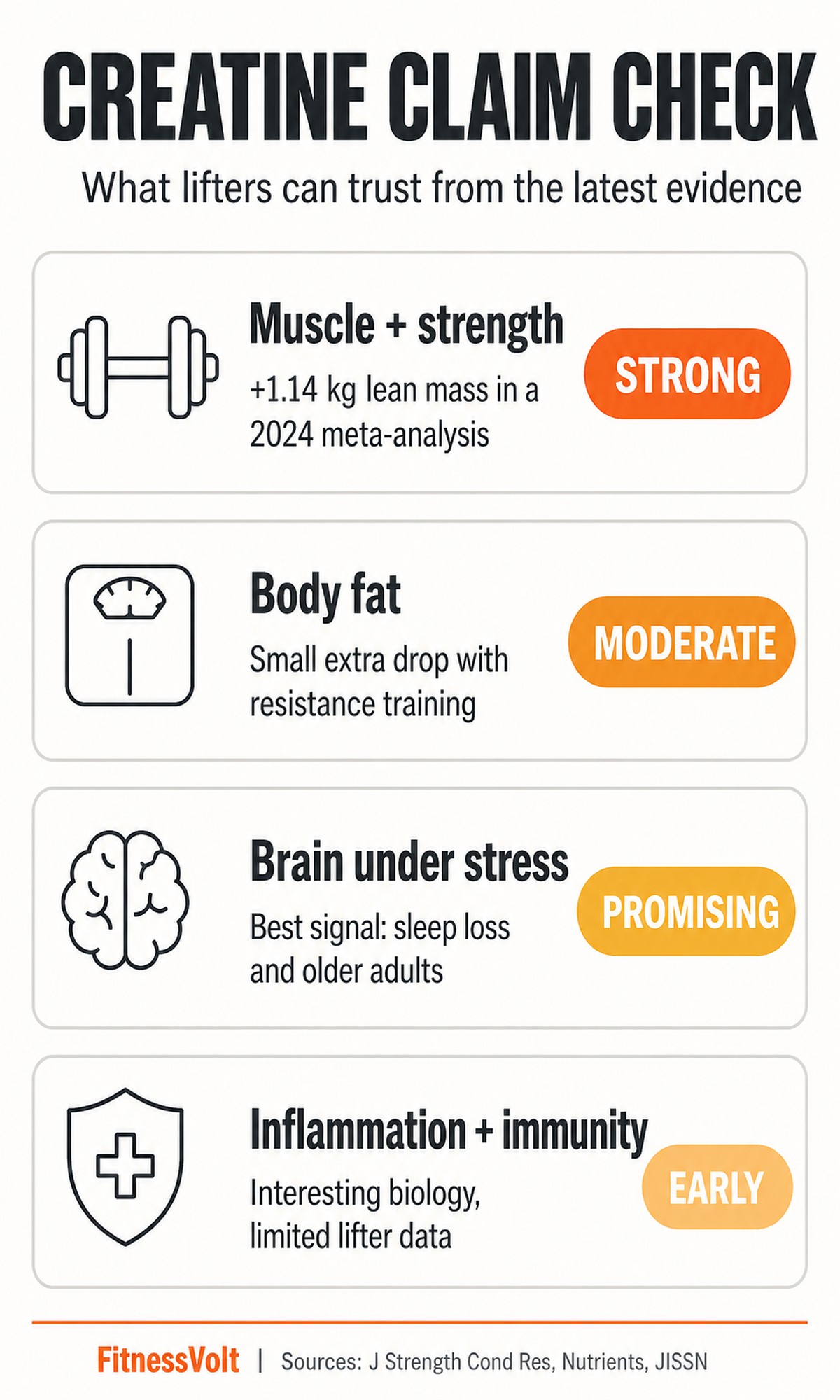
Creatine has strong support for lean-mass gains when lifters combine it with resistance training. Desai and colleagues published a 2024 systematic review and meta-analysis in the Journal of Strength and Conditioning Research showing about 1.14 kilograms more lean body mass with creatine plus lifting than lifting alone.
That number keeps expectations grounded. Creatine helps the average lifter gain a little more lean mass over time, not 10 pounds of muscle in a month. The payoff comes from repeated training exposure, stronger sessions, and enough food to support adaptation.
The same 2024 analysis reported a body-fat percentage difference of minus 0.88 percentage points and a fat-mass difference of about minus 0.73 kilograms favoring creatine. Those numbers make creatine useful for recomposition, but they do not turn it into a fat burner.
Does Creatine Increase Strength?
Creatine has strong support for strength gains in adults under 50 when paired with resistance training. A 2024 Nutrients meta-analysis reported weighted mean differences of 4.43 kilograms for upper-body strength and 11.35 kilograms for lower-body strength compared with placebo.
The strength effect fits the way lifters train. Creatine supports short, intense efforts such as heavy sets, sprint repeats, and explosive work. You should expect a gradual training benefit after muscle stores rise, not a caffeine-like hit in the first session.
If you want a body-size-based dose instead of guessing by scoop, use the FitnessVolt creatine calculator. For timing and usage details, our creatine usage guide covers the mistakes that waste a good supplement.
| Goal | Evidence strength | Best lifter move |
|---|---|---|
| More lean mass | Strong when combined with lifting | Use 3 to 5 grams daily and track progress over 8 to 12 weeks |
| More strength | Strong for resistance-trained outcomes | Pair it with progressive overload, not random hard sessions |
| Fat loss | Modest and indirect in lifting studies | Use it as a training aid while diet controls the deficit |
| Brain performance | Promising under stress, aging, and sleep loss | Do not copy high-dose study protocols without medical guidance |
| Inflammation | Mechanistic and early | Keep recovery focused on sleep, food, load management, and hydration |
Can Creatine Help With Fat Loss?
Creatine can improve body-composition outcomes during resistance training, but it does not burn fat in the way caffeine-heavy fat burners claim to. The best human evidence shows modest fat-mass differences when creatine supports lifting, not a direct fat-melting effect.
Use creatine during a cut because it can help you preserve training quality, strength, and lean mass while calories are lower. Keep protein high, keep steps consistent, and judge fat loss by waist, photos, gym numbers, and multi-week scale averages.
The scale may jump during the first week. Creatine can increase intracellular water in muscle as stores rise. Some lifters look fuller while body weight rises. A short-term weight increase does not mean you gained fat.
Does Creatine Help the Brain?
Creatine has a plausible brain-energy role, and the evidence looks strongest when the brain is under stress. A 2023 Nutrition Reviews meta-analysis found a small overall memory benefit in healthy people, with a stronger signal in older adults.
A 2026 randomized trial in Nutrients tested a single 0.2 grams per kilogram creatine dose during 21 hours of sleep deprivation. Participants showed less deterioration in several cognitive tasks, with improvement up to 12 percent in some outcomes. That dose is far above a normal 5-gram daily scoop for many people.
The brain data deserves attention, but it should not change the basic plan for most lifters. Start with the muscle dose. Treat high-dose cognitive protocols as research settings, especially if you have kidney disease, abnormal labs, or a complex medical history.
Should You Take Creatine With Salt or Electrolytes?
The creatine transporter SLC6A8 depends on sodium and chloride, so sodium belongs in the mechanism discussion. That does not mean every lifter should dump salt into a creatine drink. Most adults already get enough sodium through food.
Use creatine with water, a meal, or a shake you will not skip. Add electrolytes when sweat loss, heat, long sessions, or a low-sodium diet make them relevant. Skip extra salt if you have high blood pressure, kidney disease, heart failure, or a clinician-led sodium restriction.
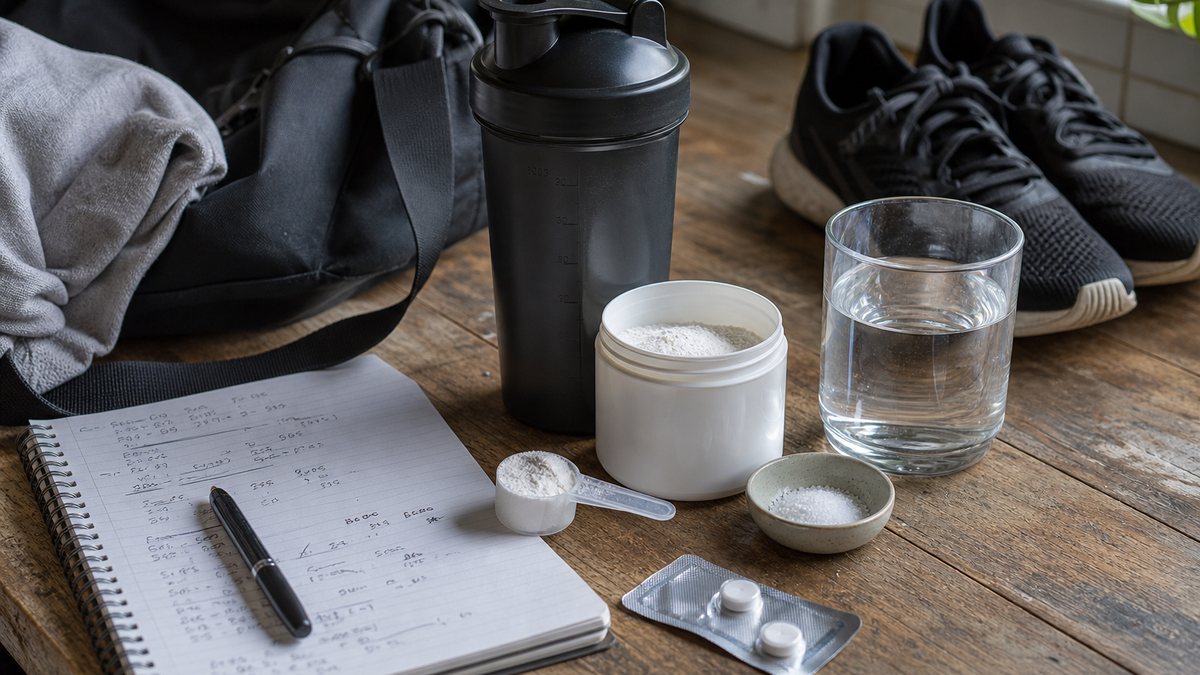
Hydration should stay practical. Creatine does not require a gallon-jug ritual, but you should take it with fluid and keep normal hydration habits consistent. Our guide to water intake while taking creatine gives a more useful baseline than internet gallon rules.
What About Hair Loss, Kidneys, and Cramps?
Common safety fears deserve separate treatment because bad supplement advice spreads faster than lab data. A 2025 randomized controlled trial using 5 grams per day for 12 weeks found no clear signal that creatine worsened androgen markers or hair-related outcomes in the studied group.
That trial does not prove creatine can never matter for a person already prone to hair loss. It does weaken the blanket claim that creatine causes baldness. FitnessVolt covers the full background in our guide to creatine and hair loss.
Kidney claims need precision. Creatine can raise blood creatinine because creatinine comes from creatine metabolism. That lab change can confuse screening tests, but it does not equal kidney damage in healthy users taking normal doses. Readers with kidney disease, abnormal kidney labs, or nephrology care should ask their clinician before supplementing.
Current sports-nutrition reviews do not support the claim that creatine causes dehydration or cramping in healthy athletes. Normal hydration, heat management, and sodium intake still matter because training conditions matter.
How Should Lifters Use It?
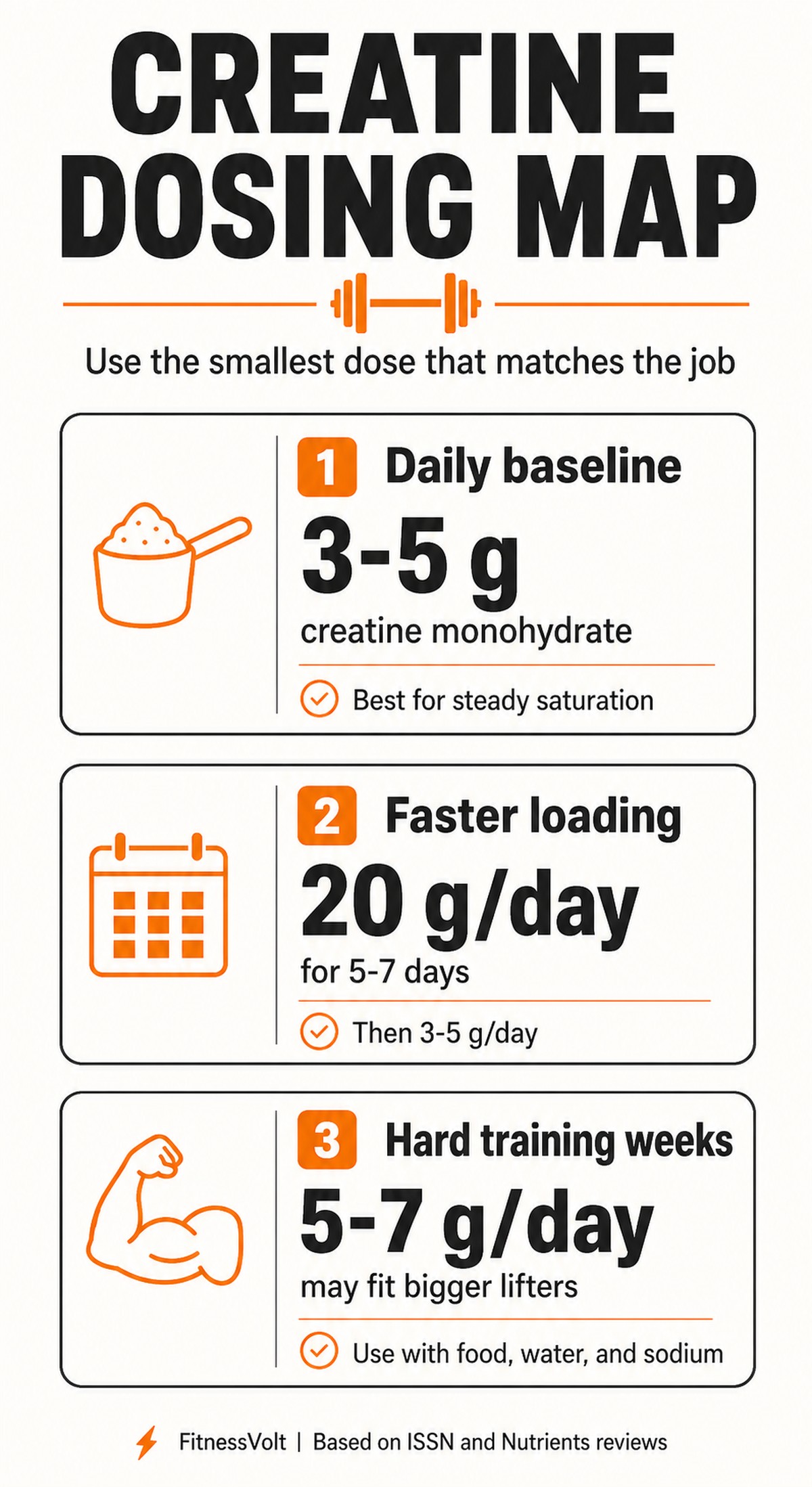
Most lifters should start with 3 to 5 grams of creatine monohydrate per day. Timing matters less than consistency. Take it with the meal, shake, or routine you repeat, then judge the result through training logs instead of day-one sensation.
| Situation | Dose | How to think about it |
|---|---|---|
| Most lifters | 3 to 5 grams daily | Start here. Take it daily and let muscle stores rise. |
| Larger athletes or high-volume blocks | 5 to 7 grams daily | Use the upper range when body size and training demand justify it. |
| Fast loading | 20 grams daily for 5 to 7 days, split into 4 doses | Fills stores faster, but stomach comfort can suffer. |
| Slow saturation | 3 to 5 grams daily from day one | Reaches the same general endpoint with less hassle. |
| Medical complexity | Clinician-guided | Kidney disease, abnormal labs, pregnancy, sodium restriction, or complex care changes the risk calculation. |
If you are choosing between a loading phase and a slower start, our guide to creatine loading vs. slow saturation covers the tradeoff. Loading works faster. Slow saturation is easier to tolerate.
Who Should Be Careful With Creatine?
Healthy adults have a strong safety record with normal creatine monohydrate dosing, but some readers need medical guidance first. Kidney disease, abnormal kidney labs, nephrology care, pregnancy, complex medication use, or a sodium-restricted plan all change the decision.
Pause before buying if the product label looks messy. Skip proprietary blends, stimulant-heavy mixtures, mystery “matrix” formulas, or products that hide the actual creatine dose. Third-party testing matters more than flavor hype.
Common Questions About the 5-Gram Powder
Is creatine a fat burner?
No. Creatine can support better body-composition outcomes during lifting, but diet still controls fat loss. The 2024 Desai meta-analysis found modest fat-mass differences when creatine was paired with resistance training.
Is 5 grams enough for most lifters?
Yes. Three to 5 grams per day covers most adult lifters. Bigger athletes or hard training blocks may justify 5 to 7 grams, while loading phases use higher short-term doses.
Do you need to take creatine before training?
No. Creatine works through saturation, so daily consistency matters more than pre-workout timing. Take it when you will remember it.
Does creatine cause hair loss?
Current evidence does not support a blanket hair-loss claim. A 2025 randomized trial using 5 grams per day for 12 weeks found no clear hair-loss signal in the studied group.
Should you take creatine with salt?
Use normal sodium and hydration habits unless sweat loss, heat, or diet makes electrolytes useful. Do not add extra salt if you have sodium restriction, high blood pressure, kidney disease, or heart failure.
Which form should lifters buy?
Creatine monohydrate remains the first choice. It has the strongest evidence, the lowest cost, and the clearest performance record for resistance training.
Bottom Line
A five-gram scoop of creatine monohydrate earns attention because the gym evidence is strong and the cost is low. The best-supported benefits are strength, lean mass, and repeated high-intensity performance during resistance training.
The fat-loss effect is modest and tied to training. The brain data is promising under stress and sleep loss. The inflammation and bone-health claims need tighter language until better human outcome data arrives.
Buy plain monohydrate, take 3 to 5 grams daily, train with intent, and measure results over months. That plan beats chasing new forms, oversized promises, or supplement hype.
Sources
- Desai, I., et al. (2024). The effect of creatine supplementation on resistance training-based changes to body composition: A systematic review and meta-analysis. Journal of Strength and Conditioning Research. DOI: 10.1519/JSC.0000000000004862. PMID: 39074168.
- Wang, C., et al. (2024). Effects of creatine supplementation and resistance training on muscle strength gains in adults under 50 years of age: A systematic review and meta-analysis. Nutrients. DOI: 10.3390/nu16213665. PMID: 39519498.
- Kreider, R. B., et al. (2017). International Society of Sports Nutrition position stand: Safety and efficacy of creatine supplementation in exercise, sport, and medicine. Journal of the International Society of Sports Nutrition. DOI: 10.1186/s12970-017-0173-z. PMID: 28615996.
- Antonio, J., et al. (2021). Common questions and misconceptions about creatine supplementation: What does the scientific evidence show?. Journal of the International Society of Sports Nutrition. DOI: 10.1186/s12970-021-00412-w. PMID: 33557850.
- Prokopidis, K., et al. (2023). Effects of creatine supplementation on memory in healthy individuals: A systematic review and meta-analysis of randomized controlled trials. Nutrition Reviews. DOI: 10.1093/nutrit/nuac064. PMID: 35984306.
- Forbes, S. C., et al. (2022). Effects of creatine supplementation on brain function and health. Nutrients. DOI: 10.3390/nu14050921. PMID: 35267907.
- Gordji-Nejad, A., et al. (2026). Single-dose creatine reduces sleep deprivation-induced deterioration in cognitive performance. Nutrients. DOI: 10.3390/nu18081192. PMID: 42075005.
- Chilibeck, P. D., et al. (2023). A 2-year randomized controlled trial on creatine supplementation during exercise for postmenopausal bone health. Medicine and Science in Sports and Exercise. DOI: 10.1249/MSS.0000000000003202. PMID: 37144634.
- Saito, T., et al. (2022). Creatine supplementation enhances immunological function of neutrophils by increasing cellular adenosine triphosphate. Bioscience of Microbiota, Food and Health. DOI: 10.12938/bmfh.2022-018. PMID: 36258765.
- Lak, S., et al. (2025). Does creatine cause hair loss? A 12-week randomized controlled trial. Journal of the International Society of Sports Nutrition. DOI: 10.1080/15502783.2025.2495229. PMID: 40265319.